

The Thematic Apperception Test (TAT) is a projective psychological assessment developed by Henry Murray.
- Thema: Refers to the underlying themes or patterns in the stories told by the person taking the test. These themes reflect the individual’s unconscious desires, conflicts, and concerns.
- Apperception: Apperception involves projecting one’s own feelings, thoughts, and experiences onto the images, thus revealing aspects of the individual’s inner world and unconscious mind.
According to Gordon Allport, individuals possess a number of traits—dynamic in nature and determine behaviour, divided into Cardinal, Central and Secondary traits.
- Cardinal Traits are highly generalized dispositions, indicating the goal around which a person’s entire life revolves; get associated with the name of the person-like- Gandhian Nonviolence. These are less pervasive in effect.
Individuals having similar attributes of traits are classified as a personality type.
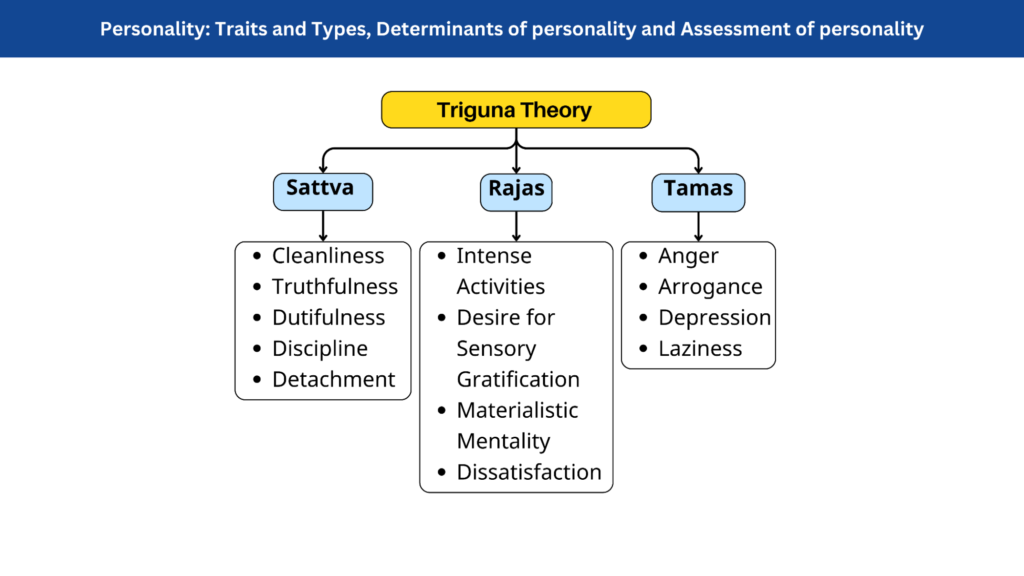
According to Trigunas theory, there can be three types of personality based on Trigun : Satva, Rajas, and Tamas.
- Satvik: These persons are dominated by Satva guna, such persons are truthful, neat, dutiful and disciplined.
- Rajsik: These persons are dominated by Rajas guna, such persons have tendencies like intense activity, desires for sensory gratification, and are of materialistic nature and envious of others.
- Tamsik: These persons are dominated by Tamas guna, such persons have attributes like anger, arrogance, depression, laziness, and feeling of helplessness.
According to Gordon Allport “Personality is the dynamic organization within the individual of those psychological systems that determine his unique adjustments to his environment.”
(In simpler terms, Allport’s definition suggests that personality is a dynamic and organized system within each person that shapes how they adapt and respond to the world around them.)
Carl Jung, in his widely recognised TYPE approach, classifies people into introverts and extraverts.
| Introverts are people who prefer to be alone, tend to avoid others, withdraw themselves in the face of emotional conflicts, and are shy. | Extraverts are sociable, outgoing, drawn to occupations that allow dealing directly with people, and react to stress by trying to lose themselves among people and social activity. |
Charak Samhita, a famous treatise on Ayurveda, classifies people on the basis of three humoural elements called tridosha – vata (space/air), pitta (fire/water), and kapha (water/earth). Each refers to a type of temperament, called prakriti (basic nature) of a person.The distribution of these elements determines a person’s overall, unique personality.
Although there are a large number of factors which influence the development of personality, such factors have been broadly grouped into three general categories and these are given below.
- Biological factors: consisted of body build, physical attractiveness, homeostasis, physical defects and health conditions.
- Psychological factors: consisted of intellectual factors, emotional factors including excessive love and affection, self disclosure, aspiration and achievement and goal setting behaviour
- Environmental factors: consisted of social acceptance, social deprivation, educational factors, family emotional climate, ordinal position of the individual in the family and size of the family.
Since these factors tend to determine the way personality develops they are also called as determinants of personality
The major self-reporting techniques of personality are – (only names asked)
- Minnesota Multiphasic Personality Inventory(MMPI) – Developed by Hathaway and McKinley for psychiatric diagnosis. Consists of 567 statements and the subject has to judge each statement as true or false. The test is divided into ten subscales.
- Eysenck Personality Questionnaire(EPQ) – Assesses two dimensions of personality (characterised by 32 personality traits) termed Introversion-Extraversion and Emotionalstable and emotionally unstable. A third dimension called Psychoticism vs Sociability was added and the ones who scored high on Psychoticism were egoistic and antisocial, and on the other hand, the ones who scored high on sociability were cooperative and friendly. This test is widely used.
- Sixteen Personality Factor Questionnaire(16 PF) – Developed by Raymond Cattell and his colleagues. The technique of factor analysis was used to discover and measure the fundamental personality traits. The test provides declarative statements, and the subject responds to a specific situation by choosing from a set of given alternatives it is used with high school students and for purposes like career counselling, occupational testing, etc.
- (Fairly structured measures, based on theory that require subjects to give verbal responses using some kind of rating scale.The method requires the subject to objectively report her/his own feelings with respect to various items. Responses are accepted at face value, scored in quantitative terms and interpreted on the basis of norms for the test.)
Projective techniques used to assess personality have several drawbacks, including:
- Subjectivity: Scoring is subjective, and interpretations of answers can vary between examiners.
- Lack of standardization: Projective techniques lack standardized scales and scoring.
- Time-consuming: Projective tests can take a long time to administer and score.
- Interpretation bias: Projective techniques can lead to interpretation bias.
- Environmental influence: Projective tests can be influenced by the environment or the examiner’s demeanor.
- Misinterpretation: Ambiguous images and responses can lead to misinterpretation by the therapist.
- Lack of validity and reliability: Projective tests that lack standard grading scales may lack validity and reliability.
- Harmful conclusions: Incorrect conclusions from projective examinations can be harmful to the examinee.
| Trait Approach | Type Approach |
| Defines personality based on specific psychological qualities | Classifies personality into a broad form of behavioural characteristics. |
| Focuses on identifying and measuring traits | Emphasises categorising individuals into groups |
| Traits are enduring characteristics | Types are predetermined categories with little variation |
| Example: Big Five model identifies traits | Example: Carl Jung’s extrovert and introvert type |
MINNESOTA MULTIPHASIC PERSONALITY INVENTORY
- Developed by HATHAWAY and McKINLEY
- Effective in identifying varieties of psychopathology
- Revised version is MMPI-2
- Consists of 567 statements. The subject has to judge each statement as ‘true’ or ‘false’.
- The test is divided into 10 sub scales which seek to diagnose hypochondriasis, depression, hysteria, psychopathic deviant, masculinity-femininity, paranoia, psychasthenia, schizophrenia, mania and social introversion.
- India version by Mallick and Joshi –Jodhpur Multiphasic Personality Inventory. (JMPI)
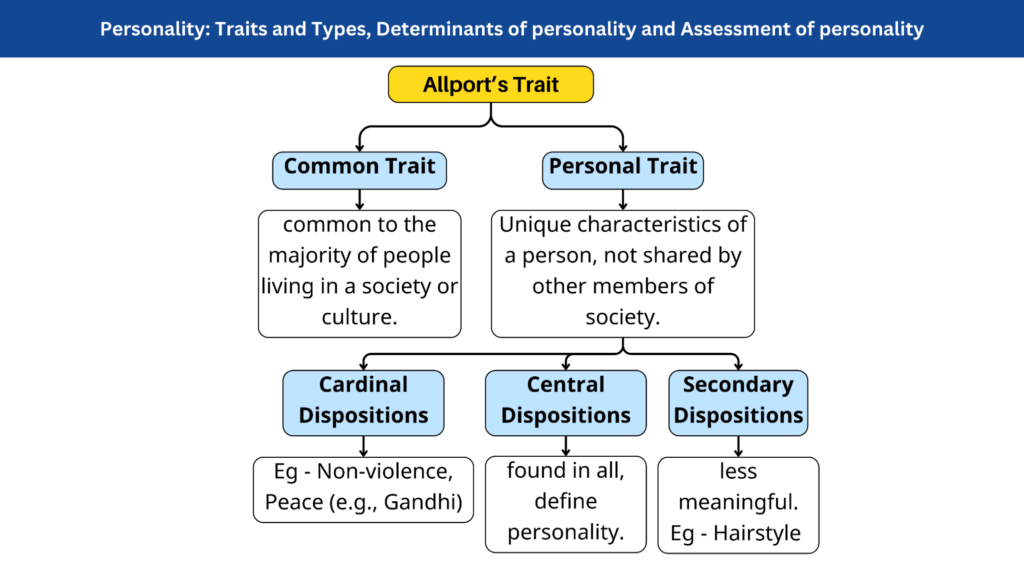
Allport categorized traits into two types: common and personal traits.
- Common Traits: These are traits most individuals share within a society or culture. For example, if many people in a culture show cooperativeness in different situations, cooperativeness is considered a common trait.
- Personal Traits: These traits are unique to an individual and are consistent across all situations. They are further divided into:
- Cardinal Dispositions: Dominant traits that entirely influence a person’s behavior (e.g., Gandhi’s commitment to non-violence).
- Central Dispositions: Traits that define personality, like honesty or punctuality.
- Secondary Dispositions: Traits that are less consistent and less significant, like hairstyle or dressing sense.
| Trait approach | Type approach |
| ❖ Macro view | ❖ Macro view |
| ❖ Consistent | ❖ Not Consistent |
| ❖ Focuses on individual traits and finer details of personality. | ❖ Focuses on broad categories and generalizations. |
| ❖ No stereotype(imply that all individuals within a type share the same characteristics, ignoring individual variation.) | ❖ Stereotype(recognize that people possess varying levels of multiple traits, allowing for uniqueness and complexity.) |
| ❖ Focus on a human trait | ❖ Different types of personalities |
| ❖ Can be visualised from a person’s mind | ❖ Can be visualised from a person’s behavior |
| ❖ Eg- Big 5 Factor Theory(e.g., openness, conscientiousness, extraversion, agreeableness, neuroticism) | ❖ Eg- Jung’s Typology – classified persons into 2 types- introverts and extroverts |
Spranger in his book “Types Of Man” described six types of man, taking into account their value orientation in life.
- Theoretical Type – They are seekers of truth. They try to understand and make sense of the world around them through reason and logic. They are interested in finding answers to questions like What is God?
- Economic Type – They are utilitarian. They view things from the point of view of practicality and their economic value. For eg;- If a Rose is given to them then they will think of how to make a profit out of it.
- Aesthetic Type – These people are lovers of nature and beauty. They lay emphasis on form and harmony and believe in making life attractive and charming. For eg;- If a Rose is given to them, they’ll praise its beauty and preserve it.
- Social type – Such people are gregarious, and like to mingle with people in social gatherings. They often enjoy good prestige in society. For eg;- They may greet a friend’s birthday by presenting him Rose.
- Political Type – These are persons who value power and influence. Their behavior is oriented toward gaining power and influence over others. For eg, a person of this type may make a garland of roses and garland a powerful politician to win his favor.
- Religious Type – This type of person emphasizes the unity of the cosmos. They have a spiritual bent of mind and believe in God. such a person may lay the rose on the feet of God.
- Rorschach Ink-blot Test
- Developed by Hermann Rorschach to study personality and emotions.
- It has 10 cards with ink-blot pictures.
- A person is asked what they see in each ink-blot.
- Their answers help to understand hidden thoughts, feelings, and personality traits.
- Thematic Apperception Test (TAT)
- Developed by Henry Murray and Christina Morgan.
- It has 30 black-and-white picture cards.
- A person is asked to write a story for each picture
- Guidlines – what is happening in the picture, what led to it, and how it will end.
- The stories show the person’s motives, needs (like achievement or power), and emotional state.
| Basis | TYPE | TRAIT |
| Perspective | Macro view | Micro View |
| Consistency | Not Consistent (Personality may change in different situations.) | Consistent (Traits are relatively stable over time.) |
| Focus | On different type of personalities (generalizations) | Focus on human trait (finer details) |
| Individual Uniqueness | Stereotype(assumes similar behavior in all people of a type, ignoring individual variation.) | Recognizes uniqueness(people possess varying levels of multiple traits, allowing for uniqueness and complexity.) |
| Visualization | Can be visualised from person’s behaviour | Can be visualised from person’s mind |
| Example | Jung’s Typology (Introvert/Extrovert), Sheldon’s Somatotypes | Cattell’s 16PF, Eysenck’s 3-factor model, Big Five (OCEAN) |
Basis of Difference | Projective Techniques | Non-Projective Techniques (Objective / Psychometric) |
Nature of Stimulus | Uses unstructured or ambiguous stimuli (e.g., inkblots, pictures).Uncover hidden, unconscious aspects of personality. | Uses structured and well-defined stimuli (e.g., questionnaires, rating scales).Provide quantitative and reliable measures of observable personality traits. |
Aim | To assess unconscious motives, conflicts, and emotions. | To measure specific personality traits or dimensions objectively. |
Awareness of Purpose | The subject is not aware of the test’s purpose; responses are spontaneous. | The subject is aware that their personality is being measured. |
Type of Response | Responses are open-ended, imaginative, and subjective. | Responses are fixed or limited, usually through multiple-choice or rating scale. |
Examples |
|
|
Scoring and Interpretation | Complex and subjective; requires expert judgment and training. | Objective and standardized; scoring is based on fixed norms. |
Usefulness | Helpful in clinical diagnosis and counseling. | Useful in research, selection, and vocational guidance. |
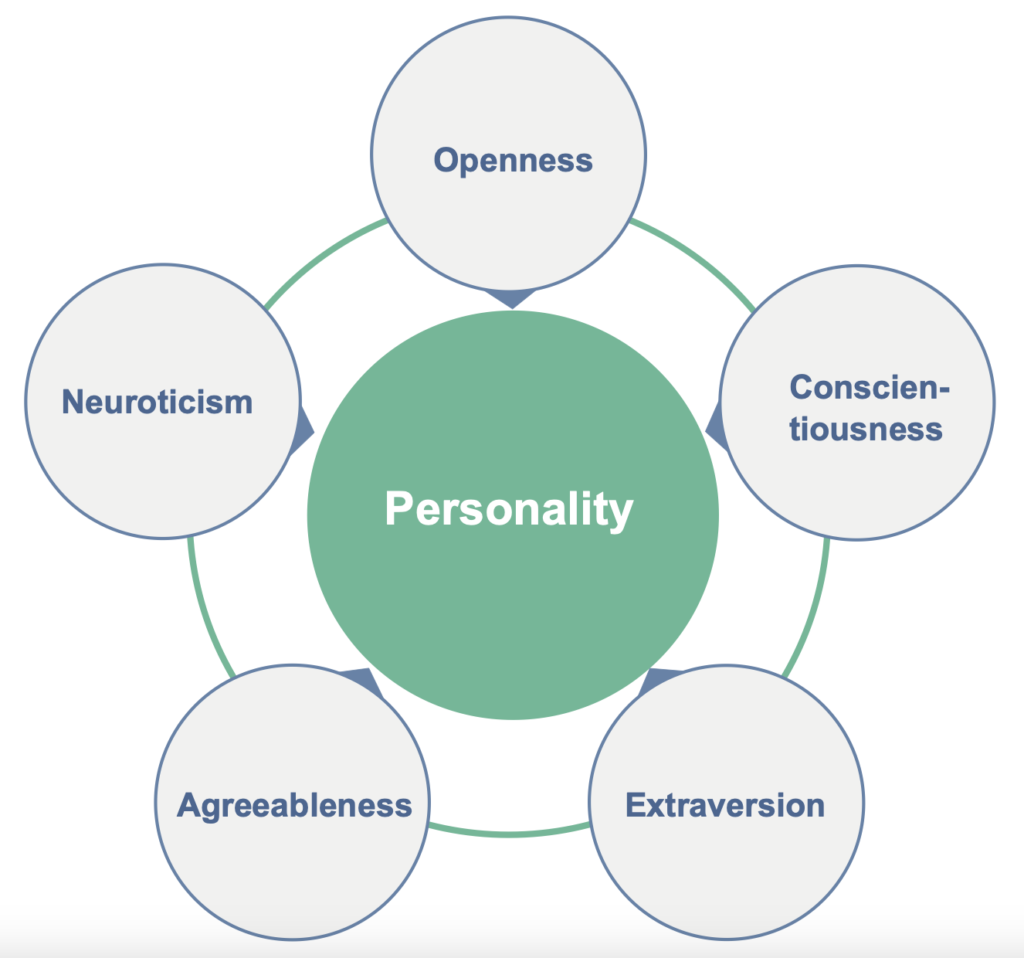
Paul Costa and Robert McCrae identified five broad personality traits through factor analysis. Psychologist Lewis Goldberg termed them the ‘Big Five’ factors of personality. These factors include:
- Openness to experience: High scorers are imaginative and curious, while low scorers tend to be rigid.
- Extraversion: Characterizes sociable and assertive individuals, with shy individuals at the opposite end.
- Agreeableness: Describes helpful and friendly individuals, contrasting with hostile and self-centered ones.
- Neuroticism: High scorers are emotionally unstable, while low scorers are well-adjusted.
- Conscientiousness: High scorers are responsible and hardworking, whereas low scorers tend to be impulsive.
These traits are assessed using various measures, such as self-report questionnaires.
Limitations:
- Oversimplification of personality to just 5 factors, overlooking domains like honesty, etc.
- Personality traits may not remain as stable over time as the model implies.
According to Gordon Allport, individuals possess a number of traits — dynamic in nature and determine behaviour.
Words people use to describe themselves and others provide a basis for understanding human personality.
Three categories
- Cardinal Traits: highly generalized disposition, indicates the goal around which a person’s entire life revolves; get associated with the name of the person-like- Gandhian Nonviolence. Less pervasive in effect.
- Central Traits: less pervasive in effect, but still quite generalized disposition. e.g., sincere; often used in writing a testimonial or job recommendation for a person.
- Secondary Traits; least generalised characteristics of a person, e.g., likes mangoes.
The way an individual reacts to a situation depends on his/her traits. People sharing the same traits might express them in different ways.
Characteristics of Projective Techniques of Personality Assessment
- The stimuli are relatively or fully unstructured and poorly defined.
- The person being assessed is usually not told about the purpose of assessment and the method of scoring and interpretation.
- The person is informed that there are no correct or incorrect responses.
- Each response is considered to reveal a significant aspect of personality.
- Scoring and interpretation are lengthy and sometimes subjective.
It is a method of personality assessment based on a questionnaire asking a person to report feelings or reactions in certain situations.
Merits | Demerits |
|
|
|
|
|
|
|
|
|
|
Projective techniques are based on Sigmund Freud’s psychoanalytic theory of personality, which focuses on the evaluation of the unconscious mind.
- Rorschach Ink-blot test : It contains 10 cards depicting ink-blot pictures shown in specific order. Person is asked to show what they see in the ink blot and where they see it, what it reminds them of.
- Rosenweig’s picture frustration test (PFT) : The test presents a series of situations in which one person frustrates another with the help of cartoon-like pictures. The subject is asked to tell what the other (frustrated) person will say or do.
- Thematic Apperception Test (TAT) : It is Developed by Morgan and Murray, consists of 30 cards on which black and white pictures are printed. The subject is asked to write a story based on the pictures printed on the given card.
- Other : Sentence Completion Test (SCT), Word Association Test (WAT).


