

Godavan (GIB) is the flagship species of the grassland, and the state bird of Rajasthan.GIBs are especially vulnerable because of their narrow frontal vision and large size.
- Their habitat consists of arid and semi-arid grasslands, often with scattered short shrubs, bushes, and low-intensity cropping. They tend to avoid irrigated areas.
- Historic Range: Indian subcontinent (india and pakistan),but their habitat has now shrunk to just 10 percent of its former extent.
- 6 states : Andhra Pradesh, Gujarat, Karnataka, Maharashtra, Madhya Pradesh, Rajasthan (earlier 11 states)
Protection status : Critically Endangered (IUCN) : less than 150 Great Indian Bustards remaining in the wild.
Conservation Measures:
Project Great Indian Bustard (Rajasthan) – 2013
- Protected Areas :
- Desert National Park in Rajasthan
- Kutch Bustard Sanctuary, Gujrat
- Great Indian Bustard Sanctuary or Jawaharlal nehru Bustard sanctuary , maharashtra
- Rollapadu Wildlife Sanctuary in Andhra Pradesh..
- It is kept under the species recovery programme under the Integrated development of Wildlife Habitats of MoEFCC.
- GIB Conservation Breeding project at Sam in Jaisalmer → 2019
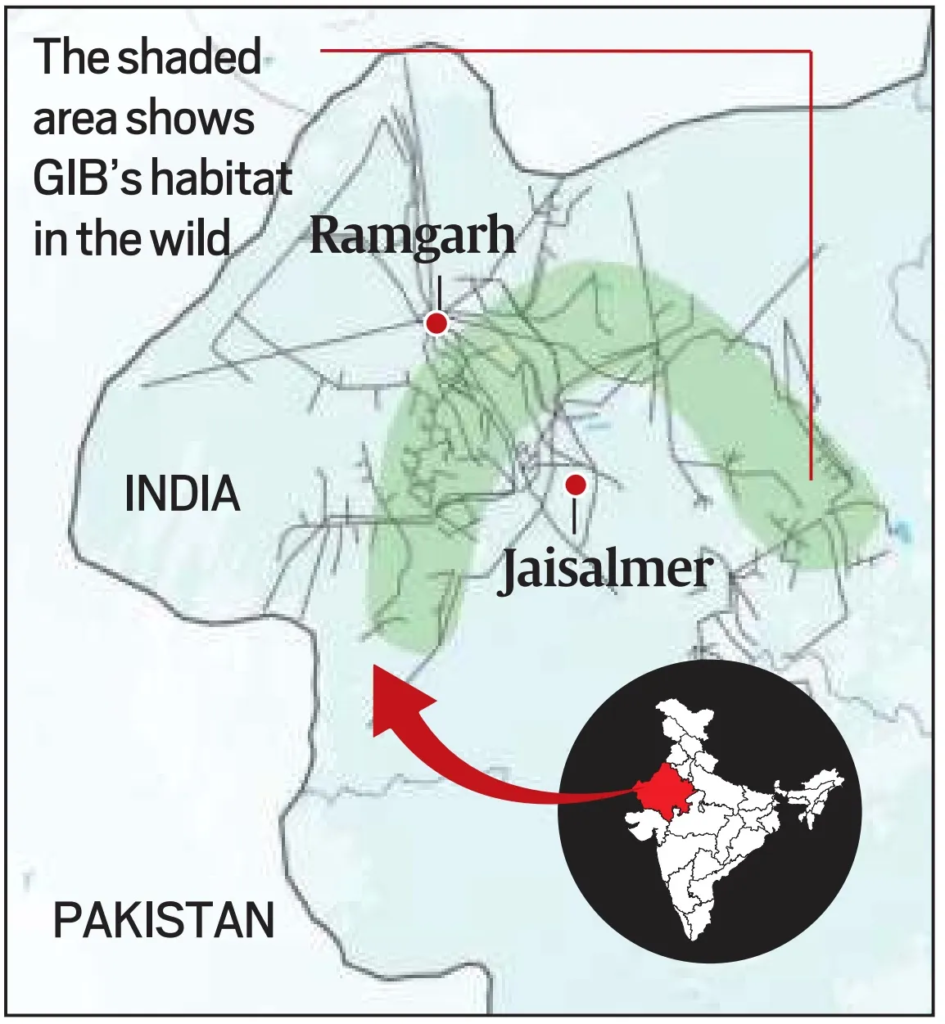
Western Rajasthan is characterized by arid and semi-arid conditions :
Flora:
- Dominated by Tropical Thorny Forests, characterized by trees like Khejari(Prosopis cineraria) , Rohida, Ber, and Thor, along with thorny bushes such as Akra, and Ker.
- Adapted to arid and semi-arid climates, these plants have long roots and thorny leaves, with grasses like sevan and dhaman also present.
Fauna:
- Notable species include the critically endangered Great Indian Bustard, Indian Vulture, Demoiselle Crane (Kurja), and various desert-adapted mammals like the Indian Gazelle and Desert Fox.
- Reptiles like the Indian Sand Boa, Spiny-tailed Lizard, and various snakes are also present, along with diverse insect and invertebrate species.
Despite its arid climate and sparse forest cover compared to other states, Rajasthan’s distinct physical and climatic conditions have led to diverse vegetation types thriving in different ecological niches. However, with only 9.60% forest cover compared to India’s 24.62%, the region faces significant challenges in maintaining its ecosystem balance.
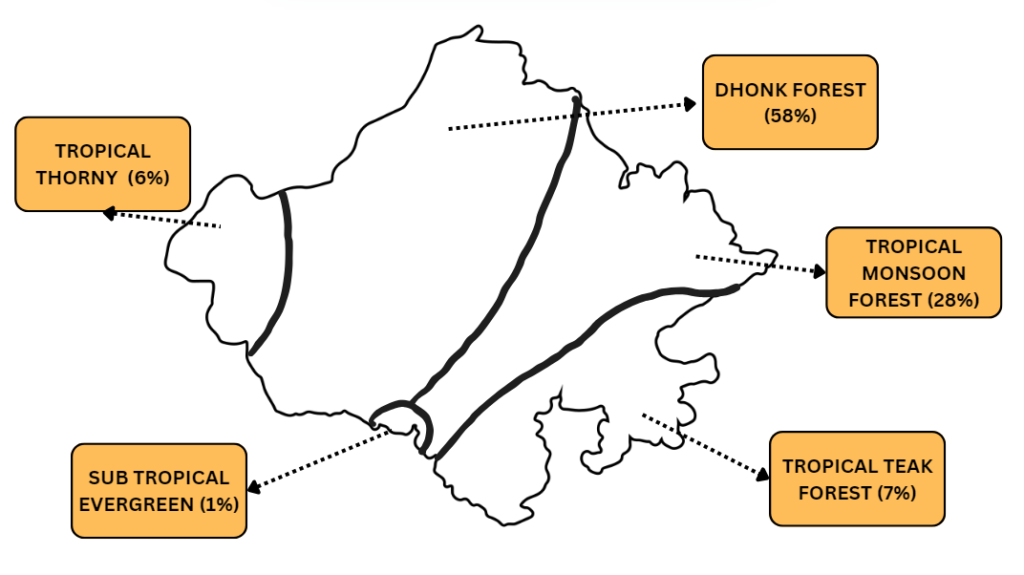
- Tropical thorny/Xerophyte forest-
- 6% of Rajasthan area.
- 0-30 cms rainfall.
- Arid desert area.
- Jaisalmer, barmer, Bikaner, jodhpur.
- Thorny bushes, cactus, aloe vera.
- Prevents desertification.
- Tropical dhonk forest
- 58% of rajasthan area.
- 30-60cms rainfall
- Semi arid areas
- Shekhwati, nagour, luni basin, sawai madhopur, karauli.
- Khejri, rohida, babool, ber, ker
- Fuel wood supply.
- Tropical dry deciduous/Monsoon
- 28% of rajasthan area.
- 50-80cms rainfall
- Alwar, bharatpur, karauli, dholpur, Jaipur, tonk, dausa, Udaipur, Chittorgarh, Bhilwara, rajsamand
- Sal, teak, mango, rosewood,sandalwood,
- Timber of economic importance is supplied
- Tropical teak forest
- 7% of rajasthan area.
- 75-110 cms rainfall
- Banswara, Dungarpur, pratapgarh, kota, Jhalawar
- Mahua, gular, tendu, palash
- Industrial use
- Sub- tropical evergreen forest
- 1% of rajasthan area
- About 150cms rainfall
- Mountabu, sirohi
- Jamun, bamboo, ambartari(dicleptera abuensis)
- Highest biodiversity
Deforestation, the widespread removal of trees for various human activities, exacerbates the challenges posed by desertification, particularly in Rajasthan where approximately 67% of the state’s land is already affected by desertification, leading to frequent drought-like conditions known colloquially as “Tijo Kuriyo Aatho Kaal.”
The impacts of deforestation:
- Aggravating Desertification: Deforestation intensifies the desertification process, compounding the already substantial desert areas in Rajasthan.
- Habitat Loss: Deforestation threatens the habitats of wildlife species like the Great Indian Bustard, contributing to biodiversity loss.
- Soil Erosion: The removal of forest cover accelerates soil erosion, diminishing the land’s fertility and stability.
- Disruption of Hydrological Cycle: Forests play a crucial role in regulating water cycles, and deforestation disrupts this balance, affecting rainfall patterns and groundwater recharge.
- Climate Change: Deforestation contributes to environmental heat, global warming, and increased greenhouse gas emissions.
- Alteration of Rainfall Patterns: Deforestation is linked to decreased rainfall and fewer rainy days, impacting agricultural productivity and water availability.
- Groundwater Depletion: Deforestation negatively affects groundwater conditions, further exacerbating water scarcity issues.
- Socioeconomic Impacts: Indigenous communities dependent on forests for their livelihoods are displaced, exacerbating social inequalities and marginalization.
Steps Taken to Address Deforestation:
- Rajasthan State Forest Policy-2023: Aimed at increasing vegetation cover to 20% to combat desertification and promote sustainable land use.
- Desert Development Program 1978 (DDP): Designed to address desertification through afforestation and land management initiatives.
- Desert Prone Area Development Program 1974 (DADP): Focuses on sustainable development practices in desert regions to mitigate desertification.
- Rukh Bhaila Program 1986: Aims to promote afforestation and tree planting activities.
- Hariyali Pariyojana 2003: An initiative to increase green cover and promote environmental conservation.
- Aravali Afforestation Program: Targets afforestation efforts in the Aravalli Range to prevent soil erosion and desertification.
- Integrated Water Land Development Program 1989 (IWDP): Aims to improve water management and land use practices to combat desertification.
Rajasthan’s ambitious growth target of 30% by 2030 hinges on urgent action to combat desertification and deforestation. These initiatives not only attract investments but also contribute to achieving Sustainable Development Goals (SDGs) 1, 2, 13 and 14.
With its varied topography, Rajasthan boasts a rich biodiversity and offers a diverse range of habitats for wildlife. Following Assam, Rajasthan holds the second rank in terms of wildlife. Historically, Rajasthan has been referred to as the ‘Hunter’s Paradise.’
Threats to biodiversity and wildlife include :
- Habitat loss and fragmentation: Agricultural expansion and infrastructure projects like DMIC, Expressway, and Pachpadra refinery have led to fragmentation of habitats.
- Since human settlements increased into the interior desert habitat, desert wolves were in direct conflict with the shepherds. Now they are restricted to a few places near the Luni riverbed in Jodhpur and the foothills of the Aravallis.
- Climate changes : IIT Bombay study shows that Rajasthan’s precipitation and IGNP water availability have risen in the last two decades, impacting xerophytic flora and fauna negatively.
- distribution of desert foxes is reducing. → desert fox shows avoidance of thick green woodlands as they are typically adapted to open dry grassland and desert environments.
- Development Projects
- Electricity projects are impeding the natural flying zone of the Great Indian Bustard.
‘Rajasthan’s Orans, habitats for endangered species like the Great Indian Bustard, face threats from green energy projects.
- Pollution: Increasing pollution like air, water, and soil pollution, along with greenhouse gas emissions, agricultural fertilizers, and plastic waste, pose severe threats to wildlife habitats and ecosystems. Contaminants, excessive light, and noise further endanger many species.
- Overexploitation of resources : Illegal sand mining and the disappearance of 31 hills in the Aravallis have raised concerns, posing a threat to biodiversity and wildlife
- Invasive species : The desert ecosystem faces severe invasion by invasive species like Prosopis juliflora, Lantana camara, Parthenium hysterophorus, Ageratum conyzoides, and Argemone Mexicana.
- Human-wildlife conflict in Rajasthan from January 2016 to December 2018: 338 interactions between humans and leopards reported, resulting in 56 leopard deaths
Conservation measures In rajasthan
Institutional and Policy Measures:
Community-Based Conservation Initiatives
| In Situ Conservation Measures:
Ex Situ Conservation Measures:
|
Other Conservation Efforts:
- Eco-Sensitive Zones (15): Including Band Baretha, Bassi, Keoladeo, Sitamata, Darra, Jamua Ramgarh, and others
- Biodiversity Heritage Sites: Aakalwood Fossil Park (Jaisalmer), Keora-Ki-Nal (Udaipur), Ram-Kunda (Udaipur), Nag-Pahar (Ajmer), Chhapoli-Mansa Mata (Jhunjhunu)
- Biological Parks (4+2 in process): Sajjangarh (Udaipur), Machiya (Jodhpur), Nahargarh, Abedha (Kota)
- Eco-Tourism Sites (9)
- Bird Reserves (2): Keoladeo and Sambhar



