

The basic minerals are not separated from the ores of non-metallic minerals by chemical process. These are used in their natural form only.
- Building stone
- Marble:
- Rajasthan has a monopoly in marble production.
- Different colored marble stones are found across the state: green in Udaipur, black in Bhaislana, pink in Jalore and Banswara, yellow in Jaisalmer, white in Makrana, and rainbow-colored marble in Pali.
- The state possesses a reserve of 1100 million tonnes of high-quality marble, with major production centers in Makrana, Rajsamand, Udaipur, and Kishangarh.
- Limestone : 10 % of india’s reserve ⇒ cement grade (Chittor , bundi), chemical grade (Jodhpur), steel grade(Jaisalmer)
- Sand stone: white- brown in jodhpur, white in karauli-daang region, kota stone in kota, Bundi etch
- Granite: jalore, pali, sirohi, udaipur etc
- Marble:
- Gypsum:
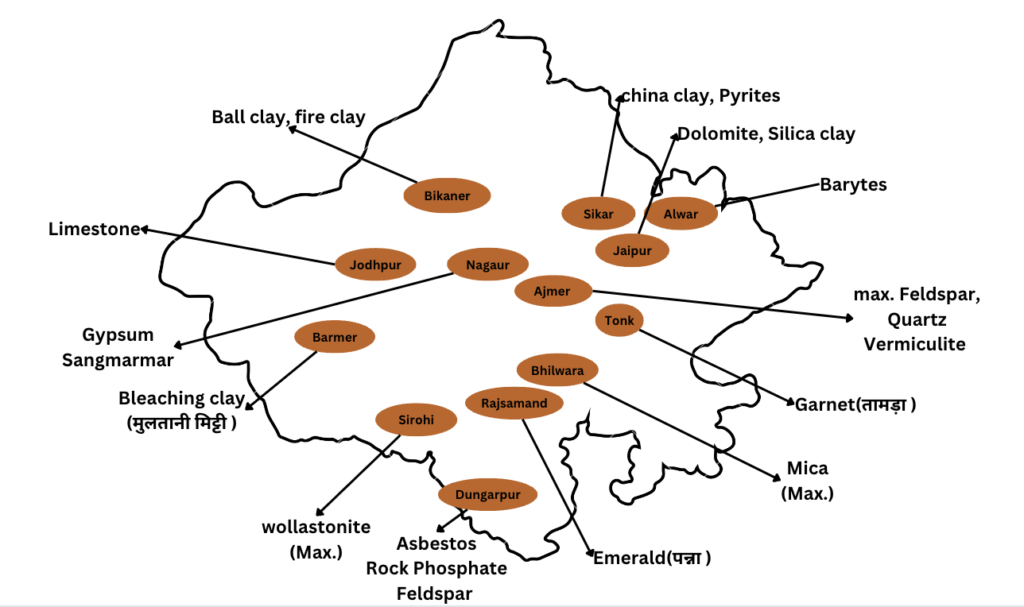
- Rajasthan holds the maximum quantity of gypsum in India, mined in four major areas: Nagaur Belt (Goth-Manglod, Bhadwasi, Mangol), Churu-Bikaner Belt (Jamsar, Lunkaransar, Taranagar), Jaisalmer-Barmer Belt (Mohangarh,
- Hamirwali), and Pali-Jodhpur Belt (Falsund, Manglod).
- Asbestos : Khairwada, rishabhdeo (Udaipur); deval, Piparda (Dunagrpur)
- Feldspar : 60 % of india. 96% of rajasthan in Markeda, Ajmer
- Fluorspar: mando ki pal (Dungarpur)
- Mica: three belt : 1) Jaipur – Tonk Belt (Barla, Mankhand, Banjari, Lakshmi); 2) Bhilwara- udaipur belt : Danta–Bhunas,3) other region : torawati (sikar), ajmer etc
- Rock Phosphate : udaipur (jhamar kotda, dafan kotda), Banswara (salopet), Jaisalmer (Birmania)
- Dolomite : Banswara(vitthal dev, tripura sundari), udaipur, rajsamand (haldighati, nathdwara)
- Silica sand : Bundi (barodia), jaipur, sawai madhopur, bharatpur, barmer
- Clay minerals : china clay, ball clay, fire clay (bikaner), Bleaching clay (barmer)
- Precious stone : emerald(rajsamand belt – kalaguman, tikki, gogunda ); Garnet (rajmahal- tonk, ajmer- sarwad)
- Other: calcite, bentonite, Pyrites (sikar), rock salt (deedwana, lunkasar, pachpadra lake), barytes, magnesite.
Rajasthan possesses significant potential for wind energy due to its favorable geographical location and topography. The state’s first private sector wind power project was established in 2001 at Bada Bagh in Jaisalmer, after which Rajasthan became the hub of wind energy.
Factors:
- High Wind Velocity: The velocity of wind in Rajasthan ranges from 20 to 40 km per hour.
- Vast Area of Wasteland: Western Rajasthan has a vast area of wasteland available, ideal for wind energy projects.
- Potential: The wind energy potential in the state is estimated to be about 127.7 GW at a 120-meter hub height and 284.2 GW at a 150-meter hub height.
- Components: A majority of the components required for wind projects are manufactured domestically.
- Minimal Obstructions: Large stretches of open land with minimal obstructions facilitate the smooth flow of wind, maximizing the efficiency of wind turbines.
Government Initiatives:
- The state’s Wind & Hybrid Energy Policy-2019 underscores the importance of promoting both wind and solar energy to maximize resources and mitigate risks associated with grid instability.
- The Rajasthan Renewable Energy Policy 2023 aims to achieve 15 GW dedicated to wind and hybrid energy.
Major Wind Power Plants:
- Amarsagar, Soda Bandhan, Aakal, Deogarh, Hansua, Mohangarh (Jaisalmer)
- Phalodi (Jodhpur) ; Harshnath (Sikar)
Rajasthan’s commitment to renewable energy has been recognized nationally, with the state receiving the first prize from the Ministry of New and Renewable Energy for achieving the highest wind capacity addition in the year 2022-23.
(Maximum wind power plants in Rajasthan are installed in Jaisalmer. For this reason Jaisalmer is called the city of feathers. Jaisalmer is producing 95% of Rajasthan’s wind energy. Most of the wind power plants have been installed by the private sector.)
extra-(राजस्थान में सर्वाधिक पवन ऊर्जा संयंत्र जैसलमेर में स्थापित हैं। इसी कारण से जैसलमेर को पंखों का शहर कहा जाता है। जैसलमेर राजस्थान की 95% पवन ऊर्जा का उत्पादन कर रहा है। अधिकांश पवन ऊर्जा संयंत्र निजी क्षेत्र द्वारा स्थापित किए गए हैं।)
Conventional sources of power generation, particularly thermal (coal and gas) and hydroelectric power plants, play crucial roles in meeting Rajasthan’s electricity demand.
Thermal Power Plants:
- Coal-based Power Plants: Rajasthan has several coal-based thermal power plants. Lignite coal found here has high sulphur and low carbon, so Rajasthan imports coal.
- Kota Super Thermal Power Plant: 1240 MW
- Suratgarh Thermal Power Station: 1500 MW
- Chhabra Thermal Power Plant : 2320 MW.
- Giral Lignite Power Plant: 250 MW (lignite-fired)
- Gas-based Power Plants: Some thermal power plants in Rajasthan also use natural gas as a fuel source. Eg. Ramgarh Gas Thermal Power Plant, Dholpur Gas thermal Power Plant, Anta Gas Power Plant etc
Hydroelectric Power Plants: Rajasthan has limited hydroelectric power generation due to its geographical features.
- State Govt: Jawai HEP (8 MW), Jhakam small hydel, Anas hydel etc
- Sharing : Bhakra Nangal HEP(Share 168.5), Vyas HEP, Mahi HEP (140 MW) , Chambal Hydel Power Plant (386 MW)
Nuclear Power: The Rajasthan Atomic Power Project (RAPP) is a nuclear power plant in Rawatbhata, Rajasthan, India, with 6 pressurized heavy water reactor (PHWR) units and a total installed capacity of 1,180 MW.
| Energy Type | Regions | Key Features & Projects |
| Solar Energy | Western RajasthanJaisalmer, Barmer, Jodhpur, Bikaner | High radiation, 325 solar days/year; Major parks: Bhadla, Nokh, Phalodi–Pokaran, Pugal supports green hydrogen production |
| Wind Energy | Thar Desert Belt(Jaisalmer, Barmer, Nagaur, Jodhpur | Wind speed 20–40 km/h; Open terrain; 5th in wind power in India; |
| Biomass Energy | Sri Ganganagar, Bharatpur Hanumangarh | Agricultural residue; First plant at Padampura (Ganganagar); 14 plants (128.45 MW by 2024) |
| Biofuel Energy | Southern Zones Udaipur, Banswara, Dungarpur, Pratapgarh | Jatropha and Ratanjot cultivation; Facilities at Kalrawas and Jhamarkotra |
| Nuclear Energy | Chittorgarh | Installed Capacity: 1,180 MW |
Rajasthan is a significant producer of crude oil in India. The State contributes about 20 per cent (6 million metric tonnes per annum) to total crude oil production (30 MMTPA) in India and is the second largest producer after Bombay High.
- The petroleum-producing area in the state covers approximately 150,000 square kilometers across 14 districts within four petroliferous basins. The Ministry of Petroleum & Natural Gas has classified the first three basins as Category-I, similar to Bombay High, Cambay Basin, and Assam, indicating significant potential for hydrocarbon exploration.
| Sr. No | Basin | Basin Coverage |
| 1 | Jaisalmer Basin | Jaisalmer – Mari Arch, Kishangarh Sub-Basin, Shahgarh Depression and Miajlar Sub Basin, District Jaisalmer and part of Jodhpur. |
| 2 | Barmer – Sanchore Basin | Districts Barmer and Jalore (partly). |
| 3 | Bikaner – Nagaur Basin | Districts Bikaner, Nagaur, Ganganagar, Hanumangarh and Churu (partly). |
| 4 | Vindhyan Basin | Districts Kota, Jhalawar, Baran, Bundi and Bhilwara (partly) etc. |
Rajasthan Refinery Project:
- HPCL Rajasthan Refinery Ltd. (HRRL) is a Joint Venture between Hindustan Petroleum Corporation Limited (HPCL) and Government of Rajasthan (GoR) with an equity participation of 74 per cent and 26 per cent respectively.
- 9 MMTPA Refinery cum Petrochemical Complex at Pachpadra, Barmer commenced on 16 January, 2018.
- The cost of the project is ₹43,129 crore and is funded on a debt equity ratio of 2:1.
- The refinery will produce products of BS-6 standard.
- First of its kind in India i.e. integrated with a Petrochemical complex.
- Current status : 60% work done, commercial production set to start by Dec. 2024.
Rajasthan M-Sand Policy 2024:- The policy aims to promote an eco-friendly alternative to river sand in light of Supreme Court restrictions on unregulated mining.
- Demand and Target:- – Rajasthan faces high sand demand, with a target to increase M-Sand production to 30 million tonnes by 2028–29.
- Objectives:- Key goals include reducing river sand dependence, promoting recycling of overburden and construction waste, and generating local employment.
- Raw Materials:- Materials like granite, sandstone, quartzite waste, mining overburden, and recycled construction debris are used for M-Sand.
- Policy Duration:- The policy remains effective till 31 March 2029 or until replaced.
- Incentives:- The policy offers financial and operational incentives to boost M-Sand unit establishment and usage in government projects.
- Waste Management:- The policy mandates a zero-discharge model, encourages reuse of treated water and slurry, and ensures eco-friendly disposal.
- Implementation:- A dedicated M-Sand Cell under DMG in Jaipur will oversee implementation, and the State Government will resolve any disputes.
