

Magnetic properties of ferromagnetic materials-
- Strongly attracted to magnetic fields.
- Contain unpaired electrons → magnetic moments align by exchange interaction.
- Form magnetic domains where atomic magnetic moments align.
- When magnetised, domains align → strong net magnetism.
- Retain magnetism after field removal → retentivity.
- Lose ferromagnetism above Curie temperature.
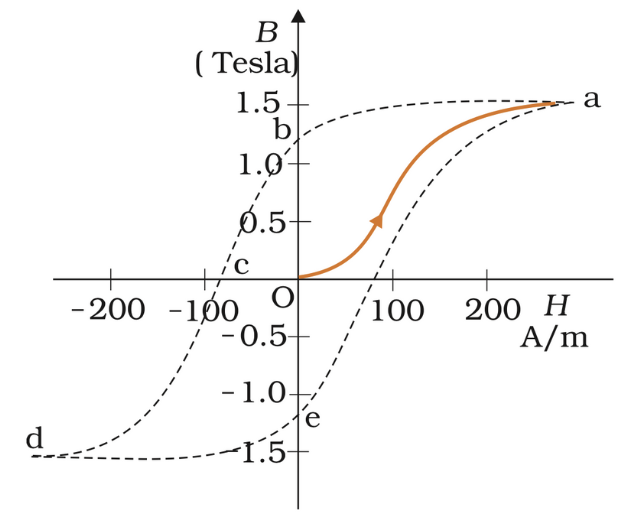
Hysteresis:
- Lag between magnetic flux density (B) and applied magnetic field strength (H) in ferromagnetic materials.
- When magnetised and external field is removed, some magnetism remains – called Retentivity.
- Coercivity: Reverse magnetic field required to fully demagnetise the material.
- Hysteresis Loop (B-H curve): Graph showing magnetisation and demagnetisation cycle.
- The area of hysteresis loop = energy lost per cycle as heat (hysteresis loss).
- Hysteresis is important for designing transformers, motors, and magnetic devices.
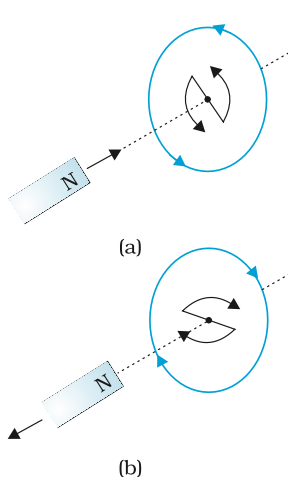
- Lenz’s Law states that the direction of the induced current (or electromotive force, EMF) in a conductor is such that it opposes the cause that produces it.
- Mathematical Formulation:
- It is expressed as: Induced EMF (e)=−dΦ\dt
- where Φ is the magnetic flux, and the negative sign represents Lenz’s law.
- Applications:Electric generators, Transformers, Induction heating, Magnetic braking in trains
The Earth’s Magnetism: arises due to electrical currents produced by convective motion of metallic fluids (consisting mostly of molten iron and nickel) in the outer core of the earth. This is known as the dynamo effect.
The dynamo effect works as follows:
- Electrically conducting fluids, such as molten metals like iron, nickel, or other materials with high electrical conductivity, are present in the outer core of a planet or star.
- The fluids undergo convective motion due to various factors such as heat from the planet’s core, rotation, and other internal processes.
- This convective motion causes the fluid to flow in complex patterns within the outer core.
- As the conducting fluid moves, it generates electric currents through a process known as electromagnetic induction. The electric currents, in turn, create a magnetic field through a process analogous to that of an electromagnet. This magnetic field reinforces the existing magnetic field, resulting in a self-sustaining feedback loop known as a dynamo.
A. Magnetic susceptibility (denoted χ, chi) is a measure of the extent to which a material can be magnetized in an applied magnetic field. It is the ratio of magnetization M (magnetic moment per unit volume) to the applied magnetizing field intensity H.
M = χH
Magnetic susceptibility indicates whether a material is attracted into or repelled out of a magnetic field.
Paramagnetic | Diamagnetic | Ferromagnetic |
0< χ < e small and positive | –1 < χ <0small and negative | χ >>1large and positive |
|
|
|
Aluminum, sodium, calcium, oxygen (at STP) and copper chloride | Bismuth, copper, lead, silicon, nitrogen (at STP), water and sodium chloride. | Hard ferromagnets → Alnico, an alloy of iron, aluminum, nickel, cobalt and coppersoft ferromagnetic materials → soft iron |
B. Superconductors are materials that show a transition to zero resistance (perfect conductivity) and perfect diamagnetism below a certain critical temperature.
- Perfect diamagnetism : Here the field lines are completely expelled! χ = –1 .A superconductor repels a magnet and (by Newton’s third law) is repelled by the magnet.
- The phenomenon of perfect diamagnetism in superconductors is called the Meissner effect (used Magnetic Levitation).
Type I : mercury and lead
Type -II : LaBaCuO, BaCuO
C. Permanent magnets are materials that retain their magnetism even after the removal of an external magnetic field. They are typically made of ferromagnetic materials.
- The hysteresis curve allows us to select suitable materials for permanent magnets.
- The material should have high retentivity, high coercivity, and high permeability.
- Steel, alnico, cobalt steel and ticonal.
Electromagnets: An electromagnet is a type of magnet in which the magnetic field is produced by an electric current. Electromagnets usually consist of wire wound into a coil.
- Core of electromagnets are made of ferromagnetic materials which have high permeability and low retentivity. The hysteresis curve of such materials must be narrow.
Ex. Soft iron
- Electromagnets are used in electric bells, loudspeakers and telephone diaphragms. Giant electromagnets are used in cranes to lift machinery
- The main advantage of an electromagnet over a permanent magnet is that the magnetic field can be quickly changed by controlling the amount of electric current in the winding. However, unlike a permanent magnet that needs no power, an electromagnet requires a continuous supply of current to maintain the magnetic field.
Process of Electromagnetic Induction-
- Electromagnetic induction is the process by which an electromotive force (EMF) is induced in a conductor when it experiences a changing magnetic field.
- Discovered by: Michael Faraday (1831).
- Faraday’s Laws:
- First Law: A changing magnetic flux induces EMF in a coil.
- Second Law: The induced EMF is directly proportional to the rate of change of magnetic flux.
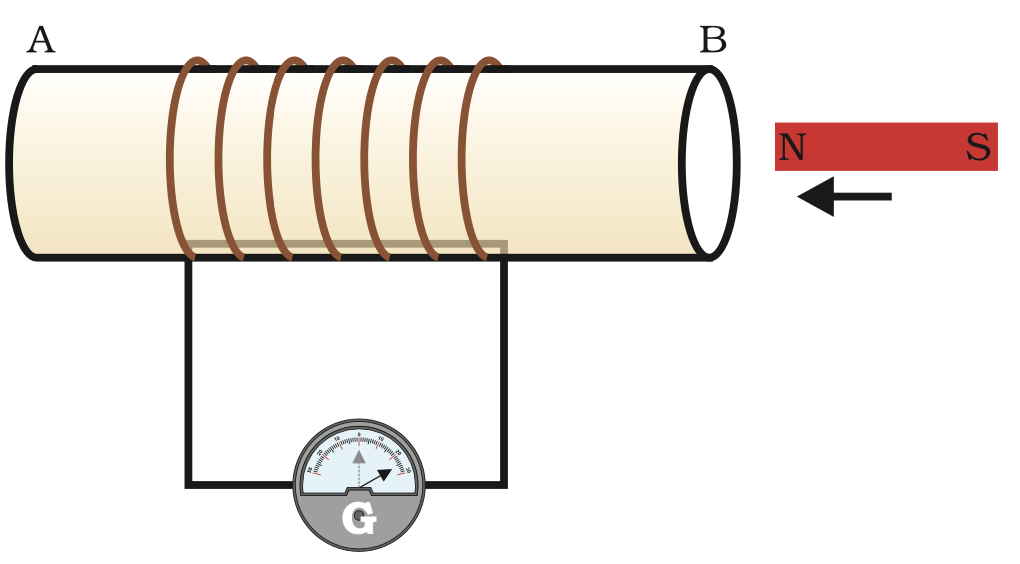
- Lenz’s Law: The direction of the induced current opposes the change in magnetic flux, ensuring conservation of energy.
- Mechanism:
- Moving a magnet relative to a coil or changing the magnetic field strength induces current.
- Faster movement or stronger magnets increase the induced EMF.
Applications of Electromagnetic Induction-
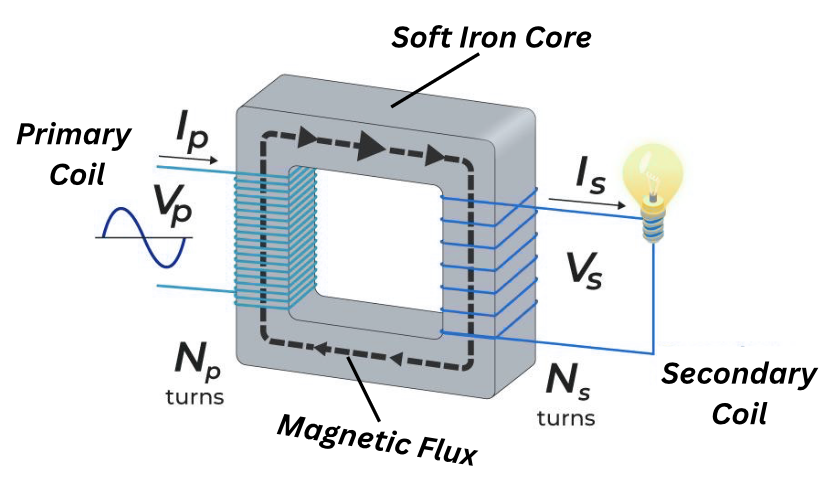
(A) Transformers
- Principle: Works on the principle of mutual induction.
- Function: Changes AC voltage—can step-up (increase) or step-down (decrease) voltage.
- Structure: Comprises a primary coil, secondary coil, and soft iron core.
- Applications:
- Power transmission at high voltages to reduce losses.
- Domestic appliances (chargers, stabilizers).
- Voltage regulation in electronic devices.
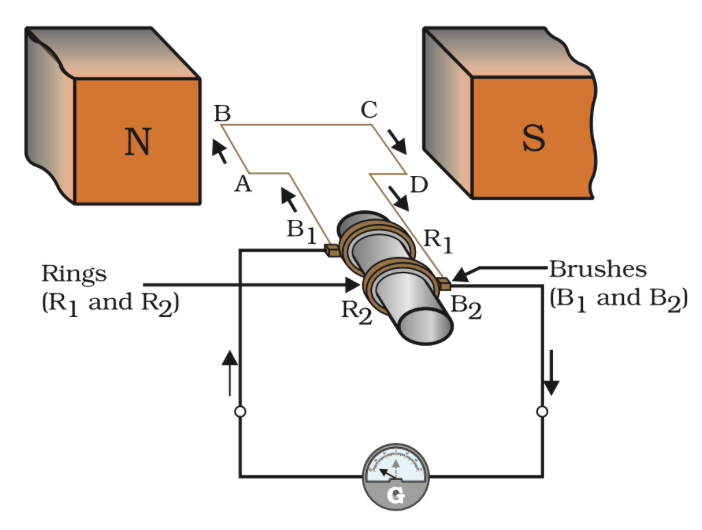
(B) Electric Generators
- Principle: Converts mechanical energy into electrical energy using electromagnetic induction.
- Function:A coil rotates in a magnetic field → magnetic flux changes → EMF induced.
- AC Generator: Uses slip rings; produces alternating current.
- DC Generator: Uses split rings; produces direct current.
- Applications:
- Power plants (thermal, hydro, nuclear).
- Dynamo in bicycles.
- Renewable energy generation (wind, hydro).



