

International trade and Balance of payments, Foreign aid and investment

Sol – 

  1. RCEP (Regional Comprehensive Partnership Agreement)
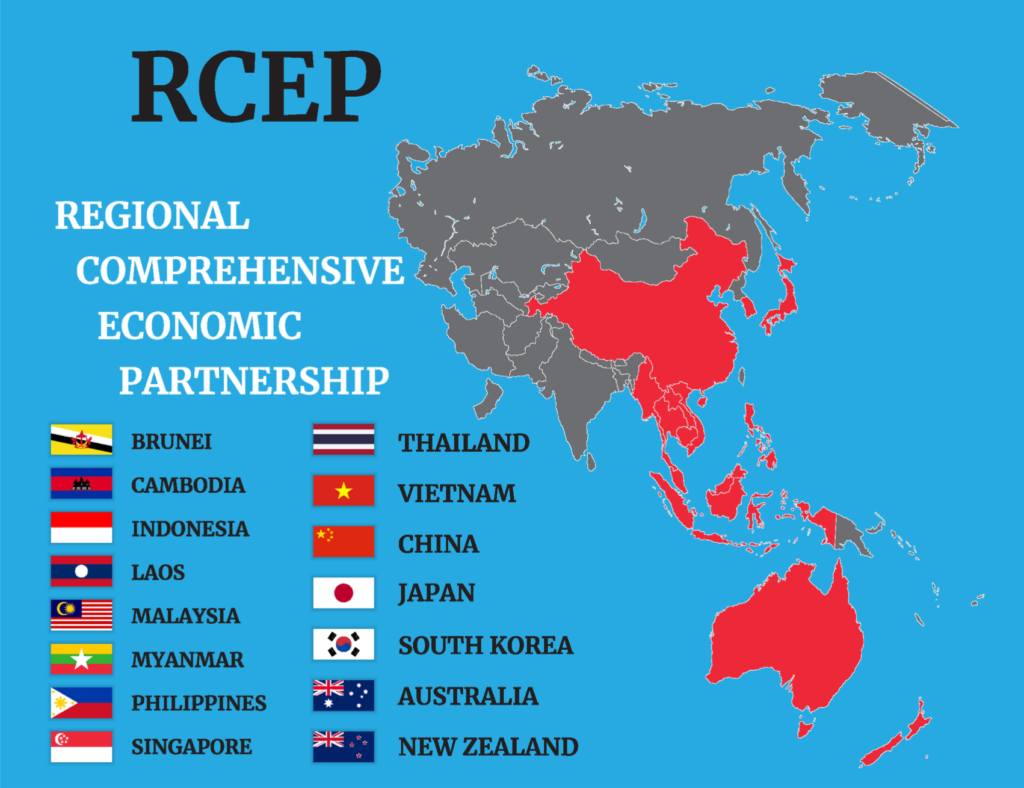
  • The Regional Comprehensive Economic Partnership (RCEP) is a free trade agreement (FTA)between 15 countries
    • 10 ASEAN Nations – Brunei, Cambodia, Indonesia, 
    • Laos, Malaysia, Myanmar, Philippines, Singapore, Thailand, and Vietnam
    • 5 Other countries – Australia, China, Japan, New Zealand, and South Korea 
    • RCEP member nations represent over 30% of the global Gross Domestic Product(GDP) and one-third of the world’s population
    • India did not join RCEP because
      • Fear of a dump from China
      • Fear of dairy products influx from New Zealand [Hurting Indian dairy owners] 
      • India wanted better mobility in the service sector 
  1. Pacific Alliance – 
  • The Pacific Alliance is a Latin American trade bloc, formed by Chile, Colombia, Mexico, and Peru, which all border the Pacific Ocean
  • Purpose – To ensure complete freedom in the movement of goods, services, capital, and people.
  • India enjoys observer status at the annual summit of the Pacific Alliance
  1. Most Favoured Nation
  • Most-Favoured-Nation requires WTO members to treat all trading partners equally.
    • If a country gives favorable treatment to one country regarding a particular issue, it must treat all Members equally with respect to the same issue
    • Ex – If WTO Member A agrees in negotiations with country B, which need not be a WTO Member, to reduce the tariff on product X to five percent, this same “tariff rate” must also apply to all other WTO Members as well. 
  1. Rules of Origin
  • Rules of Origin – Rules of origin are laws, regulations, and procedures that identify where an imported product originally came from. These guidelines used to determine the country where a product was made, which then dictates the tariff rates or trade benefits it receives.
    • ROOs are often specified in free trade agreements (FTAs)  
    • Important because many trade rules, regulations, and laws provide differential treatment to goods and products based on where they originate from. 
    • For example, tariffs may be reduced or increased depending on where a product comes from

The textile sector is the second-largest employment generator after agriculture employing around 45 million people. 

Current Status:

  • India is the sixth-largest exporter of textiles and apparel globally.
  • 80 percent of its capacity is spread across Micro, Small ,and Medium Enterprises (MSME) clusters
  • Key export destinations include the EU, USA,UK and UAE, which collectively account for over 50% of India’s textile exports.
  • However, India’s share in global textile trade (~4%) remains lower than China, Bangladesh, and Vietnam.
  • Decline in India’s exports to traditional markets like the EU and USA, have experienced a slowdown, influenced by global economic conditions and increased competition.

Opportunities:

  • Growing Global Demand for Man-Made Fibres (MMF):
    • Shift from cotton to man-made fibers offers potential to scale up and compete with major producers like Vietnam, China, and Taiwan
    • As India currently accounts for 9.2% of global MMF production, With the right investments and policy support, India can become a leading hub for MMF-based textiles
  • Market Diversification:
    • Because of Geopolitical shifts and disruptions in traditional supply chains, global retailers are seeking alternative sourcing destinations. 
    • This opens up new markets for India beyond the USA and EU, like Latin America, Africa, and Southeast Asia.
  • Sustainability Focus:
    • Increased emphasis on sustainable production, India’s focus on renewable energy, eco-friendly dyes, and sustainable textile processes will give advantage in the international market.
  • Policy Support and Infrastructure Boost:
    • Schemes such as PLI (Production-Linked Incentive) and PM MITRA (Mega Investment Textiles Parks) are creating an ecosystem favourable  to higher production capacity, innovation, and export competitiveness.
  • China+1 Strategy: Global shift away from China provides India a chance to attract more orders.
  • Expanding FTAs: Recent agreements with UAE, Australia, and negotiations with UK & EU could open new markets.
  • Technical Textiles:Emerging field with applications in healthcare, defence, and infrastructure.
  • Emerging Markets and E-commerce:Growth in e-commerce and direct-to-consumer (D2C) models offers new avenues for Indian textile exporters .

Challenges: 

  • Stiff Global Competition:
    • Intense competition from China, Bangladesh, and Vietnam due to lower labor costs, better infrastructure, and favorable trade agreements. 
    • These countries are able to offer products at more competitive prices, impacting India’s global market share.
  • Cumbersome Export Procedures:
    • Complex regulatory and documentation requirements, including multiple clearances, delay the export process and reduce ease of doing business for Indian textile exporters.
  • Pre-Shipment Inspection Certificate (PSIC):
    • Mandatory requirements like PSIC in certain textile categories cause delays in logistics and increase transaction time, reducing India’s competitiveness in time-sensitive markets.
  • High Tariff Barriers in Key Markets:
    • India faces high tariff rates in export destinations. 
    • For instance, Indian silk shawls attract an 11.3% duty in the US, whereas Korean silk products enter duty-free due to the Korea-USA Free Trade Agreement (FTA). 
    • The absence of comprehensive FTAs with major markets puts Indian exporters at a disadvantage.
  • Export Infrastructure Bottlenecks – Delays in ports, inefficient logistics hamper export competitiveness.
  • High Cost of Production – Power tariffs, logistics, and compliance costs remain high.
  • Fragmented Industry – Dominance of small-scale units leads to lack of scale and modernization.
  • Limited Innovation & Branding – Indian textiles lack global brand identity and R&D.

Policy Measures to Boost Competitiveness:

  • PLI Scheme for Textiles – Outlay of ₹10,683 crore to boost MMF and technical textile exports.
  • National Technical Textiles Mission (NTTM) – Allocated ₹1,480 crore to support research and development in high-value segments.
  • PM-MITRA Parks – Launched across seven sites to create integrated, world-class textile infrastructure and attract FDI.
  • RoSCTL Scheme – Continued support for rebate of state and central levies for garment exporters, extended in Budget FY25.
  • Comprehensive FTAs – Deals like UAE-India CEPA (2022) reduce tariff barriers. Ongoing negotiations with the EU and UK aim to further enhance market access.
  • Export Diversification Strategy – Focus on tapping non-traditional products (optical items, office equipment) and new regions, especially African countries.

Conclusion 

With government    support, growing demand for MMF and sustainable fabrics, and global supply chain changes, India can achieve a goal of $150 billion in textile exports by 2030 and become a major player in textile exports.

Sol –

Primary Concerns of India within the WTO and steps taken – 

  1. Agricultural Subsidies and Market Access
    • India is concerned about the high levels of agricultural subsidies provided by developed countries like USA, which distort global agricultural trade
    • 5 % (for developed countries) is high in absolute terms 
    • Steps taken – 
      • AoA (The Agreement on Agriculture)
      • Bali summit (2013) – Peace clause 
  2. Public Stockholding for Food Security
    • Constraints imposed by the WTO’s Agreement on Agriculture on these programs
  3. Fisheries subsidies
    • To curb harmful subsidies, which are seen as a key factor in the widespread depletion of the world’s fish stocks
    • India demands that WTO must keep in mind ‘polluter pay principle’ (PPP) and ‘common but differentiated responsibilities and respective capabilities’ (CBDR-RC).
  1. Intellectual Property Rights (IPR) and Access to Medicines
    • India is concerned about the impact of stringent IPR regimes on access to affordable medicines. It advocates for a balanced approach that considers public health needs.
    • Steps taken – 
      • Compulsory licensing (Berne Convention)
      • Ex – Nexavar, a drug for liver and kidney cancer
  2. Dispute Settlement Mechanism
    • Delays in the WTO’s dispute settlement mechanism – Trade rules are not enforced fairly
    • Demand to reform the Appellate Body to ensure timely resolution of disputes
  3. High cost of cross-border remittances
    • The remittance costs are about 6.18% globally which is well above the United Nations’ SDG target of 3 %
  4. IT and electronics rules
    • After India banned 59 mobile apps of China, they have claimed that India has violated World Trade Organization (WTO) rules
    • Japan and Taiwan filed a case against India in WTO over the import duties imposed on certain electronic goods 

Reforms necessary – 

  1. Reforming the Dispute Settlement Mechanism – Addressing the current impasse in the Appellate Body by appointing new members and ensuring its independence and impartiality
  2. Transparency and Inclusivity – Better voice to developing and least developed countries
  3. Strengthening Multilateralism – Reinforcing the multilateral trading system like RCEP
  4. Capacity Building – To support developing countries in meeting their WTO commitments and effectively participating in negotiations
  5. Flexibility in Agreements – To give level playing fields to developing and underdeveloped countries 
  6. Addressing New Trade Issues = Especially in IT and Service trade (digital trade, data flows, and e-commerce etc)
  7. Environmental Sustainability – Integrating environmental sustainability into the WTO framework to address global challenges such as climate change

Leave a Comment

Your email address will not be published. Required fields are marked *

error: Content is protected !!
Scroll to Top
Telegram WhatsApp Chat
