

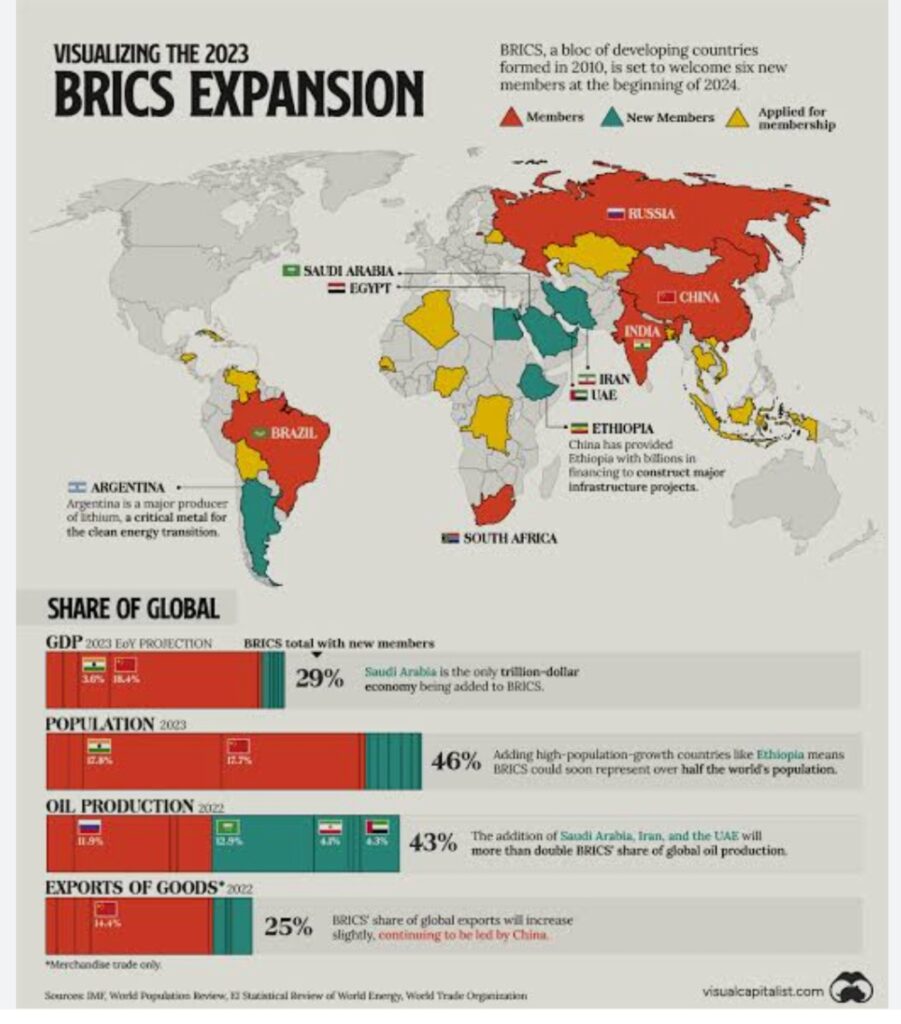
The 15th BRICS summit in Johannesburg announced the addition of six new members to the five-member grouping (Brazil, Russia, India, China, and South Africa). Among these, Egypt, Ethiopia, Iran, Saudi Arabia, and the United Arab Emirates have joined BRICS as full-time permanent members.
Significance–
- Increased global representation: represents almost half the world’s populations .
- Building institutions outside western control. Eg. NDB
- Shifting power dynamics: Will increase multipolarity.
- South-South cooperation: Will raise cooperation ,better engagement.
- Strategic: Will help to make a collective voice for the restructuring of global institutions by increasing cooperation in trade ,defense, Emerging Technical issues.
- De-Dollarisation possibilities: Through BRICS, India and China can push their own currencies as alternative currencies to the dollar.
- Opens up opportunities for accelerated regional economic cooperation in the Middle East particularly between Saudi Arabia and Iran.
- Opportunity of convergence: BRICS+ with three original members of the OPEC.
The addition of West Asian members to BRICS offers a positive geopolitical narrative, yet there’s a risk of the group becoming merely a talk shop like its predecessors. It’s also perceived as contributing to a new Cold War divide, amid China-India rifts and Middle East instability, hindering cooperation.
The 18th G20 Summit convened in New Delhi, India, on September 9th-10th, 2023, under the theme “Vasudhaiva Kutumbakam” (The world is one family), culminating in the adoption of the New Delhi Declaration.
Economic Initiatives:
- G20 2023 Financial Inclusion Action Plan (FIAP)
- One Future Alliance (OFA): Proposal to support Digital Public Infrastructure(DPI) in low and low-middle-income countries.
- Global Digital Public Infrastructure Repository (GDPIR): Plan to regulate crypto-assets.
- International Taxation: Reaffirmation of commitment to twin pillars: Profit allocation and nexus, and Global Minimum Taxation.
- Multilateral Development Banks (MDBs): Acknowledgment of the need for stronger MDBs to address global developmental demands.
- Global Value Chains (GVC): Adoption of G20 Generic Framework for Mapping GVCs.
- Start-up 20 Engagement Group: Establishment to foster innovation and entrepreneurship.
- Data for Development (D4D): Endorsement of G20 Principles on Harnessing Data for Development and launch of the Data for Development Capacity Building Initiative.
- MSMEs’ Access to Information: Jaipur Call for Action.
- Sustainable Blue Economy: Chennai High-Level Principles.
Non-Economic Initiatives: Showcasing India’s leadership
- India-Middle East-Europe Economic Corridor (IMEE-EC): A multinational rail and shipping project linking India with the Middle East and Europe has been announced.It will challenge China’s economic ambitions in the region. It aims to boost trade, deliver energy resources and improve digital connectivity.
- Russia-Ukraine War: India along with Brazil, Indonesia and South Africa, played a key role in avoiding a fracturing of the G20 over the Ukraine conflict.
- Green Development Pact:
- Encourage efforts to triple renewable energy capacity by 2030.
- Climate financing : The declaration emphasizes a substantial increase in climate financing, calling for a “quantum jump” from billions of dollars to trillions of dollars.
- It underscores the need for USD. 5.8-5.9 trillion in the pre-2030 period for developing countries and USD 4 trillion per year for clean energy technologies by 2030 to achieve net-zero emissions by 2050.
- Launch of initiatives like the Resource Efficiency Circular Economy Industry Coalition (RECEIC), Travel for LiFE etc.
- Global Biofuel Alliance: Joint effort by India, the United States, and Brazil to promote biofuels as a key component of the energy transition. It will help accelerate India’s existing biofuels programs such as PM-JIVANYojna, SATAT, and GOBARdhan scheme.
- Food Security and Nutrition: Key initiatives included supporting the Black Sea grain initiative, promoting millet research through MAHARISHI, and advocating for transparent agricultural trade. Strengthening systems like Agricultural Market Information System (AMIS) and GEOGLAM for better monitoring and early warning was also emphasized.
- Multilateral Institutions for the 21st Century:
- Agreement on UNGA 75/1 (UNSC reforms) for the first time.
- Admittance of the African Union (G20 now G21): it is a major step towards increasing the representation of developing countries in the forum. The AU’s membership in the G20 offers an opportunity to reshape global trade, finance, and investment and would provide a greater voice to the Global South within the G20.
- G20 Satellite Mission proposed by India for environment and climate observation
- Women Empowerment: Creation of a working group to prioritize gender equality and leadership.
- Terrorism: Strong condemnation and support for FATF’s efforts in asset recovery.
- Healthcare Resilience: emphasized integrating traditional medicine with modern practices and adopting a one-health approach.
- Cultural Showcase: Bharat Mandapam, a bronze statue of Lord Nataraja, the Konark Chakra, Thanjavur Paintings, Dhokra art, a brass statue of Lord Buddha, and a rich musical heritage spanning Hindustani, Folk, Carnatic, and Devotional music.
India’s G20 presidency successfully navigated challenges, emphasizing inclusivity, sustainable development, and climate action. The presidency revitalized multilateralism and amplified the voice of the Global South, marking a significant shift in the global narrative.
India’s simultaneous participation in the Quad and BRICS—representing opposing geopolitical poles—highlights its pursuit of multi-alignment. This enhances India’s global leverage but also presents complex strategic challenges.
Divergent Geopolitical Constructs:
- Quad (Established 2007; revived 2017):
- Members: US, Australia, Japan, India.
- Vision: Free, open, rules-based Indo-Pacific; counters China’s assertiveness.
- Represents 24% of the world population, 35% of global GDP, and 18% of trade.
- Key initiatives: IPMDA, Quad Vaccine Partnership, Critical Tech, QUIN, Malabar naval exercises.
- BRICS (Formed 2009, expanded 2024):
- Members: Brazil, Russia, India, China, South Africa + new entrants (e.g., Iran, Egypt, UAE).
- Focus: Reforming global financial institutions, multipolarity, and de-dollarization.
- Represents 42% of the global population, 30% of the global GDP (PPP), ~25% of the global oil output.
- Initiatives: New Development Bank (NDB), Contingent Reserve Arrangement (CRA), BRICS Pay.
How It Enhances India’s Strategic Autonomy:
- Strategic Hedging Across Blocs– Allows India to engage both the Global North (Quad) and the Global South (BRICS) without being bound by any single camp.
- Platform for Global South Leadership– Through BRICS, India champions equity in global governance and reforms in the UN, IMF, and World Bank.
- Access to Critical Technologies & Capital– Quad offers advanced tech cooperation (5G, AI, semiconductors); BRICS offers alternative finance via NDB (India has received $ 1B+ in loans).
- Diversified Security Partnerships– Quad enhances India’s maritime surveillance in IOR; BRICS provides alternate space for dialogue with China, Russia.
- Flexibility in Diplomacy– Dual platforms give India room to manoeuvre between US-led order and China-Russia-centric multilateralism.
How It Challenges India’s Strategic Autonomy:
- China Dilemma– China is adversarial at LAC and in IOR but remains a key BRICS player—creates internal tension in India’s positioning.
- Quad’s Hard Security Push vs BRICS’ Anti-West Tilt– India must navigate Quad’s increasing militarisation and BRICS’ growing anti-West rhetoric (e.g., de-dollarisation drive).
- Russia Factor– India’s BRICS partnership with Russia contrasts with the Quad’s silent endorsement of Western sanctions post-Ukraine war.
- Perception of Duality– Critics question India’s credibility: China accuses India of aligning with the US (Quad), while the US eyes India’s continued BRICS engagement with suspicion.
- Resource and Diplomatic Strain– Maintaining active roles in both forums requires significant diplomatic bandwidth, coordination, and resource mobilisation.
India’s dual engagement with the Quad and BRICS exemplifies its strategic autonomy and ambition to be a “balancing power” in global geopolitics. However, sustaining this approach demands a calibrated diplomacy that reconciles ideological divergences, manages strategic contradictions, and ensures alignment with India’s long-term national interests.
India’s foreign policy often grapples with balancing its relations between the developed North (e.g., Western nations) and the developing South (e.g., Global South countries).
Joining Developed North | Leading the developing South |
|
|
India has adopted a balanced approach with both the Global North and South, advocating for equitable global governance and UN reforms, while supporting multilateralism, just energy transitions, and development-based diplomacy.
The recent 18th G20 Summit in New Delhi, themed “Vasudhaiva Kutumbakam” (The world is one family), highlighted India’s role as a consensus builder and global unifier, bridging developed and developing countries.
Global South: Includes countries in Asia, Africa, and South America, characterized by lower levels of wealth, education, and healthcare. Notable exceptions include emerging economies like India and China.
Importance of the Global South in the Modern World
- Economic Influence
- Emerging Markets: The Global South includes some of the fastest-growing economies such as India, China, and Brazil.
- Trade Opportunities:Africa alone has a combined GDP of over $2.6 trillion and is a crucial trade partner for many Global North countries.
- Geopolitical Significance
- Multipolar World: The rise of the Global South contributes to a more balanced global power structure. Countries like China and India are becoming influential players in international politics.
- Regional Stability:
- Stability and development in Global South regions are essential for global peace and security.
- Many conflicts in these regions have global repercussions, such as migration crises and terrorism.
- Technological and Industrial Growth
- Innovation Hubs: Emerging centers of technology and manufacturing, e.g., India’s IT sector.
- Industrialization: China’s Belt and Road Initiative (BRI) involves over 60 countries and aims to improve infrastructure and trade routes across the Global South.
- Youth Demographics: Africa’s youth population is expected to double to 1 billion by 2050, driving innovation and change.
- Environmental Stewardship: Many Global South countries are at the forefront of addressing climate change due to their vulnerability to its impacts.
- The International Solar Alliance, initiated by India, promotes solar energy use in 121 countries, mostly from the Global South.
India’s Role in Becoming the Voice of the Global South
- Historical Association with Global South
- Non-Aligned Movement (NAM): India played a pivotal role in establishing NAM, advocating for the socio-economic and political priorities of the Global South.
- G-77 Establishment: India was instrumental in forming the G-77, a coalition of 134 developing nations at the UN, to present a unified voice on global issues.
- Contemporary Initiatives and Leadership
- Voice of Global South Summit: India conducts this summit to build solidarity among Global South countries, addressing common challenges and promoting cooperation.
- New Delhi Declaration: Under its G-20 presidency, India included issues like debt financing, climate justice, and gender equality, reflecting the concerns of the Global South.
- Expansion of G-20: India facilitated the inclusion of the African Union in the G-20, giving a stronger voice to Global South countries in global governance.
- COVID-19 Response
- Vaccine Maitri Initiative: Supplied vaccines to Global South countries.
- TRIPS Waiver Proposal: Proposed waiver of intellectual property rights for COVID-19 vaccines to increase global production and accessibility.
- Climate Leadership
- International Solar Alliance (ISA): Promotes solar energy in developing countries and enhances their sustainable energy transitions.
- Climate Negotiations: India advocates for climate justice and has been a key player in establishing the Loss and Damage Fund at COP28.
- Challenges and Roadblocks
- UNSC Membership: India’s campaign for a permanent seat faces opposition from some Global South countries.
- Neglect of NAM and G-77: India’s reduced engagement with these groups has caused communication breakdowns.
- China Factor: China’s extensive economic aid challenges India’s leadership in the Global South.
- Inconsistent Engagement: India has been inconsistent in maintaining regular summits with Africa and the Indo-Pacific regions.
- Perceived Interference: Accusations of India’s interference in domestic politics of Global South countries have caused mistrust.For Ex- ‘India Out Campaign’ in the Maldives.
- Project Implementation Delays: For Ex- delays in Kaladan Project, Asia Africa Growth Corridor, etc.
India’s potential to be the voice of the Global South lies in its ability to acknowledge the diversity within the region and tailor policies accordingly. By bridging the North-South divide and enhancing South-South cooperation through alliances like BRICS and G-77, India can strengthen its position on the global stage. Establishing a development bank and maintaining regular summits with African and Indo-Pacific nations further solidify India’s commitment to promoting sustainable development and fostering strong diplomatic ties within the Global South.



