

The sculpture depicts Lord Shiva in his cosmic dance, known as the “Ananda Tandava,” symbolizing the eternal rhythm of creation, preservation, and destruction. Notable features include :
- Shiva is balanced on his right leg and and suppressing the apasmara, the demon of ignorance
- His left leg is raised in a bhujangatrasita stance which represents tirobhava, that is kicking away the veil of maya (illusion)
- Four arms: Right hand in Abhaya hasta (gesture suggesting fearlessness), upper right holds damaru (musical instrument), left hand in dola hasta (connects with Abhaya hasta), upper left carries a flame.
- The matted and flowing locks of Shiva represent the flow of river Ganges
- The Nataraja is surrounded by a nimbus of glowing lights ( symbolising the vast unending cycles of time)
- Raja Ravi Varma (1848-1906), a celebrated Indian painter tried to create a style that was both modern and national.
- Introduced realism into Indian art : He mastered the Western art of oil painting and painted themes from Indian mythology eg Damayanti Talking to a Swan , Shakuntla Janm,, Women Holding Fruit
- Popularization of Indian Mythology : Indian Goddesses Lakshmi and Saraswati, Draupadi vastrharan, Ganga Bhism, Savitri
- Humanizing Indian Royalty: Portrait of Maharaja Sayajirao Gaekwad III
- Democratization of art : Ravi Varma embraced modern printing technology, particularly chromolithography, to mass-produce his paintings. This made art more affordable and accessible to a broader audience in India.
- Overall, Raja Ravi Varma played a pivotal role in bridging traditional Indian art with modern techniques, making art more inclusive and widely appreciated.
Historical Significance: One of the finest examples of Mauryan sculpture, built by Ashoka to commemorate Buddha’s first sermon (Dhammachakrapravartana) at Sarnath.
Components: Originally had five parts:
- Shaft (now broken)
- Lotus bell base
- Drum on the bell base with four animals moving clockwise
- Four majestic addorsed lions
- Crowning element (Dharamchakra), a large wheel (now broken and displayed in the site museum at Sarnath)
National Emblem: The capital without the wheel and lotus base is India’s National Emblem.
Lion Figures: Four lions seated back to back on a circular abacus, appearing as if holding their breath.
Polished Surface: Typical of the Mauryan Period.
Abacus Design: Features a 24-spoke chakra (wheel) in all directions, with a bull, horse, elephant, and lion between each chakra, finely carved.

Feature | Gandhara School | Mathura School |
Influence | Strongly influenced by Greco-Roman art | Purely indigenous Indian style with some Persian influence |
Material Used | Grey or bluish-grey schist stone | Red sandstone from Mathura region |
Buddha Representation | Buddha depicted with Hellenistic features—curly hair, muscular body, draped robe | Buddha shown with Indian features—broad shoulders, smiling face, and dhoti-like drapery |
Sculptural Style | Realistic, with intricate details and deep carving | More symbolic, bold lines, and less intricate detailing |
Patronage | Flourished under Kushana rulers, especially Kanishka | Also patronized by Kushanas, but originated earlier under Sungas |
Key Examples | Standing and seated Buddhas from Takshashila and Peshawar 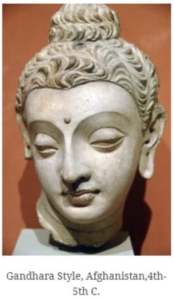 | Buddha statues from Mathura, yaksha and yakshi figures 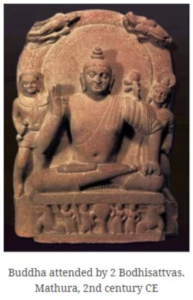 |
- Foundation of Mughal Painting : Humayun laid the foundation for Mughal painting while staying in Persia.
- He brought two painters, Mir Sayyid Ali and Abdal Samad, to India, who later became prominent during Akbar’s reign.
- Akbar invited many painters from across the country, with notable artists like Baswan, Miskina, and Daswant.
- Themes and Works
- Illustrations of Persian versions of the Mahabharata and Ramayana were produced in miniature form. Many Indian fables were also turned into miniature paintings in the Art Studio established by Akbar.
- Historical works, such as the Akbar Nama, and Hamznama were significant themes in Mughal paintings.
- Indian colors like peacock blue and Indian red began to be used in these paintings.
- Symbolic Paintings:
- Paintings in the Badshah Nama, such as the motif of the lion and the lamb (or goat) peacefully nestling next to each other symbolised justice and harmony.
- Divine Light : Jahangir was often depicted with halos and against dark backgrounds to symbolize divine light and authority.
- Jahangir was depicted shooting the figure of poverty in a painting by Abu’l Hasan, symbolizing the elimination of poverty.
- The painting included a chain of justice descending from heaven, illustrating divine justice.
- Climax during Jahangir’s Reign:
- Jahangir employed numerous painters, including Abul Hasan, Bishan Das, Madhu, Anant, Manohar, Govardhan, and Ustad Mansur.
- Progress was also made in portrait painting and paintings of animals.
- Later, European painting influences could be seen in Mughal art.
- Depiction of Buddhist Stories-Views of Lord Buddha’s life and Jataka stories, which presents a rich visual story of his teachings and previous births.eg.-Picture of Buddha’s birth and attainment of knowledge on the walls of cave1.
- Mastery of Expression-Displaying emotions efficiently in the depiction of animals and birds.eg.-In Cave 17, the expression of the eyes of the Bodhisattva and the facial expressions, which showed their divine and heartbroken form.
- Cultural and Social Reflection-Painting is a glimpse of the dress, jewelry and social customs, which presents the cultural practices of ancient India as a historical document.eg.-Very beautiful description of her jewelry and clothes in the portrait of Queen Padmavati in Cave 17.
- Symbolism and Themes-Painting includes symbolic forms such as illustration of Bodhisattva and divine beings, which reflect the spirituality of Buddhism.eg.-The symbol of the Dharmachakra with the depiction of Bodhisattva Avalokiteshvara in Cave 16.
- Use of Color-Use of natural minerals and vegetable colors in paintings.The lines were drawn from red ocher, which provided a specific visual identity.
- Artistic Evolution-Earlier pictures had sharp lines and limited colors, while later paintings show flexible lines, different skin colors and more detailed features.eg.-Raw and simple images in cave 1, while in cave 16 and 17 detailed and sophisticated pictures.
- Influence on Later Art-Architecture, sculpture and painting in Ajanta’s unique combination influenced the latter Buddhist art, such as wall painting in other places such as Ellora and Bagh.
India’s art and culture have evolved over thousands of years, shaped by its diverse geography, history, and interactions with various civilizations. The richness of Indian culture lies in its ability to absorb and adapt to external influences while preserving its core indigenous identity.
| Aspect | Indigenous Elements | External Influences | Examples |
| Architecture | Rock-cut caves (Ajanta, Ellora), temple styles – Nagara, Dravida, Vesara | Indo-Islamic styles (domes, arches, minarets); Colonial architecture (Gothic, Baroque, Neo-Classical) | Taj Mahal (Indo-Islamic); Sun Temple Konark (Nagara); Victoria Memorial, Rashtrapati Bhavan (Colonial fusion) |
| Sculpture | Mauryan and Gupta sculptures – idealized forms, symbolic representation of deities | Gandhara art with Greek influence – realistic human features, robes, curly hair | Sarnath Buddha, Yaksha-Yakshi statues, Gandhara Buddha with Greek robes and curly hair |
| Painting | Madhubani, Warli, Pattachitra, Ajanta murals, Jain manuscript art | Persian miniatures, Company paintings with European techniques (perspective, realism) | Mughal miniature of Akbar Nama, Rajput paintings, British Company paintings, Kalighat paintings |
| Performing Arts | Classical dance forms – Bharatanatyam, Odissi, Kathakali, rooted in temple rituals and scriptures | Kathak adapted Persian court aesthetics – costume, ghungroos, themes from Persian poetry | Kathak in Mughal courts, Fusion music concerts, Sufi-Kathak collaborations |
| Music | Carnatic and Hindustani traditions, devotional Bhajans, Vedic chants | Introduction of tabla, sarod, and ghazal traditions from Central Asia and Persia | Tansen’s ragas, Bhakti-Sufi musical compositions, Qawwalis, Veena and Tanpura use |
| Language & Literature | Sanskrit epics (Ramayana, Mahabharata), Tamil Sangam poetry, , Pali Buddhist texts | Urdu from Persian-Arabic-Hindi mix; English education and writing during British rule | Baburnama (Persian), Works of Tagore, Raja Rao, R.K. Narayan in English |
| Religion & Philosophy | Indigenous faiths – Hinduism, Buddhism, Jainism, Sikhism | Arrival of Islam, Christianity, Judaism, Zoroastrianism enriched spiritual and cultural life | Mosques in Indian style, Churches beside temples, Interfaith festivals like Urs |
| Clothing & Textiles | Handloom weaving, traditional outfits – sarees, dhotis, turbans, natural dyes and block printing | Chikankari, zardozi from Persia; Western tailoring, industrial fabrics from Europe | Sherwani (Indian kurta + Persian tailoring), British-era uniforms with Indian motifs |
| Festivals & Cuisine | Local harvest and religious festivals – Holi, Diwali, Pongal, native vegetarian cuisines | Eid, Christmas, Nowruz, Mughlai cuisine, spices and baking from foreign lands | Indian households celebrating Diwali with sweets and Eid with Biryani; Christmas cake trend |
| Education & Science | Gurukul system, Ayurveda, Vastu Shastra, early mathematics and astronomy | Influence of Greek astronomy, Unani medicine, Western education and sciences | Modern universities blending Indian philosophy with Western disciplines (e.g., Nalanda + IIT system) |
Indian art and culture stand as a living example of unity in diversity, where external influences were not imposed but adapted into local traditions. This fusion created a rich, layered, and resilient cultural identity. The ability of Indian civilization to absorb the new while preserving the old has made it one of the most enduring cultures in the world.



