
- The cooling of water in an earthen pot is an example of heat transfer by evaporation and the latent heat principle.
- Evaporation:
- The water escaping through pores comes in contact with air and evaporates.
- Evaporation is an endothermic process—it absorbs heat from the water inside.
- Cooling Effect:
- As heat is lost during evaporation, the remaining water’s temperature decreases, leading to cooling.In hot and dry conditions, the rate of evaporation increases, making the cooling effect more pronounced.
- Thermodynamic Principle:
- The cooling effect follows the principle of latent heat of vaporization—heat is absorbed to convert liquid water into vapour, lowering the water temperature.
The anomalous expansion of water refers to the unusual behavior where water, instead of contracting, expands upon cooling below 4°C.
- From 0°C to 4°C:
- Water’s density increases as temperature rises; it contracts when heated.
- At 4°C, water reaches maximum density.
- Below 4°C:
- Water expands when cooled from 4°C to 0°C.
- Significance:
- In lakes and ponds during winter, water at 4°C sinks to the bottom, while colder water rises and freezes on the surface.
- The ice layer insulates the water below, helping aquatic life survive in harsh conditions.
IR is generally understood to include wavelengths from around 750 nm to 1000 μm(frequencies of 400 THz to 300 GHz).
Heat waves : When infrared waves are absorbed by molecules, such as water molecules present in most materials, their thermal motion increases, leading to an increase in temperature. This heating effect is why infrared waves are associated with heat.
In maintaining Earth’s warmth : infrared waves play a crucial role through the greenhouse effect.
- Shorter Wavelength Radiation: The Sun emits shorter wavelength radiation, primarily in the form of visible light and ultraviolet (UV) radiation. These wavelengths easily pass through the Earth’s atmosphere and reach the surface.
- Absorption by Earth: When this shorter wavelength radiation reaches the Earth’s surface, it is absorbed and re-emitted as longer wavelength infrared radiation.
- Greenhouse Gas Absorption: Greenhouse gases in the atmosphere, such as carbon dioxide (CO2), methane (CH4), and water vapor (H2O), absorb this infrared radiation.
- Re-Emission: After absorbing the infrared radiation, greenhouse gases re-emit it in all directions, including back towards the Earth’s surface.
- Trapping Heat: This re-emitted radiation effectively traps heat within the Earth’s atmosphere, contributing to the warming of the planet.
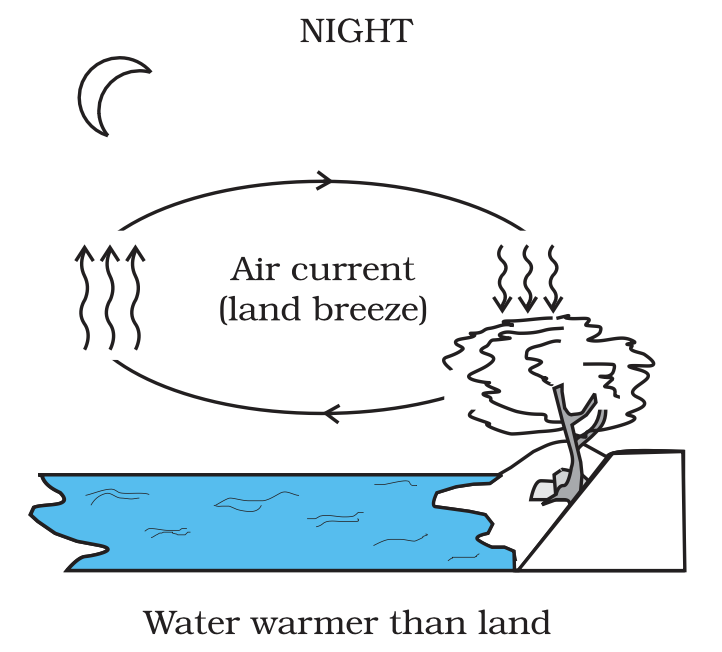
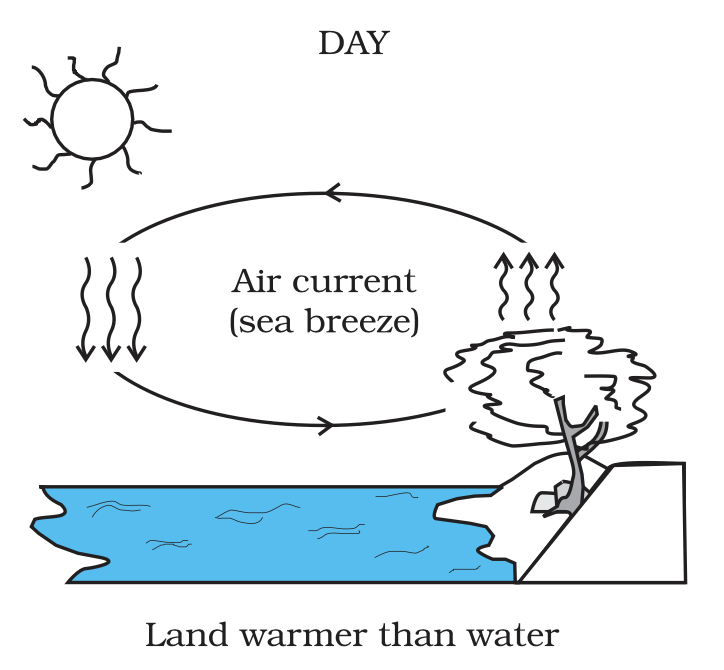
This is a convection process driven by temperature differences and heat transfer.
Sea Breeze :
- During the day, land heats up faster than water due to lower specific heat.
- Warm air over land rises (convection), creating a low-pressure area.
- Cooler air over the sea moves in to replace it, forming a sea breeze.
Land Breeze :
- At night, land cools faster than water.
- Now, air over water is warmer, rises, and creates a low-pressure zone over the sea.
- Cooler, denser air from land moves toward the sea, forming a land breeze.