

Social responsibility refers to the extent to which the actions of social actors, including public authorities, align with mutual expectations, prevailing legal standards, social norms, collective interests, and ensuring trust at all levels of society. It implies the obligation to perform duties that serve the public interest. This responsibility is essential for maintaining societal integrity, ensuring social justice, and fostering the development of social relations.
Perspectives of public authorities’ social responsibilit
| Perspectives | Internal | External |
| Examples | Social dialogue, innovation, labour protection, wage stability, labour stability, appropriate working conditions, social insurance, gender equality | Cooperation with local communities, promotion of small and medium business, reduction of corruption, socially responsible investment, development of civil society, reduction of company operation risks, environmental protection |
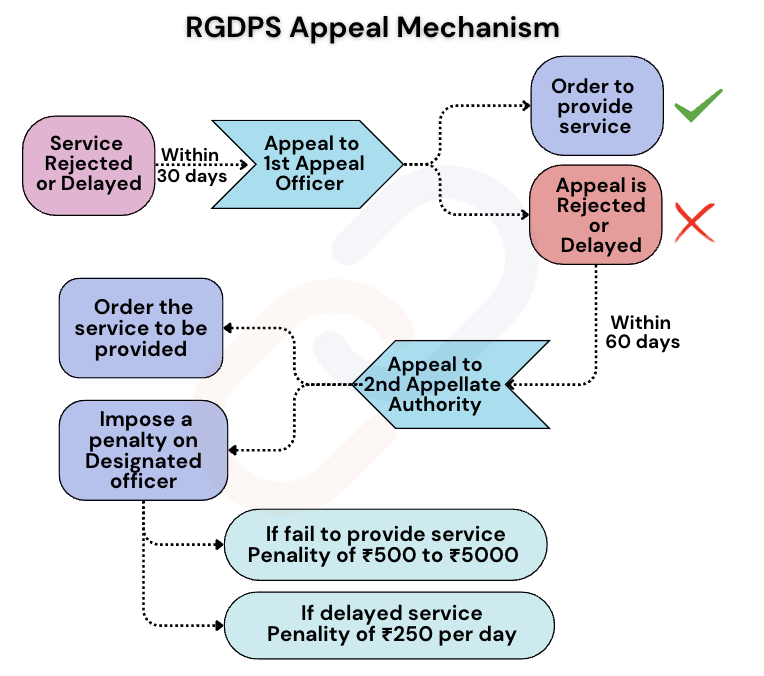
The RGDPS Act, 2011 ensures timely delivery of 308 services from 28 departments in Rajasthan.
- First Appeal: If the application is rejected or delayed by the designated officer, an appeal can be made to the First Appeal Officer within 30 days. The officer may order the service to be provided or reject the appeal.
- Second Appeal: After the first appeal decision, an appeal can be made to the Second Appellate Authority within 60 days. The authority may order the service to be provided or impose a penalty on the designated officer.
- Direct Appeal: If the designated officer fails to comply, a direct appeal can be made to the First Appeal Officer or Second Appellate Authority.
- Powers of Appeal Officers: Appeal officers have powers similar to a civil court, such as issuing summons and inspecting documents.
- Penalty (By Second Appellate Authority):
- On Designated Officer: ₹500 to ₹5,000 for failure to provide service and ₹250 per day for delays (maximum ₹5,000).
- On First Appeal Officer: ₹500 to ₹5,000 for delays in decision-making.
- Compensation: Part of the penalty may be awarded to the appellant (up to the penalty amount).
The Rajasthan government implemented the Right to Hearing Act on 1 August 2012, with the aim of providing a time-bound hearing and disposal of complaints.
- Public Hearing Officer (PHO) : The PHO is tasked with disposing of complaints within 15 days. If a complaint is rejected, reasons must be provided in writing. Additionally, decisions on complaints must be communicated within 7 days.
- First Appellate Authority : Individuals who haven’t been heard or are dissatisfied with the PHO’s decision can appeal to the first appellate authority within 30 days. Appeals filed after 30 days may be considered with valid reasons. The first appellate authority is expected to decide on appeals within 21 days.
- Second Appellate Authority : A second appeal can be made to the second appellate authority within thirty days from the decision of the first appellate authority. Appeals filed later may be considered with sufficient cause.
- The second appellate authority has the power to order the PHO or the first appellate authority to provide a hearing or dispose of the appeal within specified time limits, or reject the appeal.
- The second appellate authority may impose a penalty on the PHO ranging from five hundred rupees to five thousand rupees.
The Rajasthan government implemented the Right to Hearing Act on 1 August 2012 to ensure time-bound hearings and the disposal of complaints.
Utility of the Right to Hearing Act | Limited Effectiveness |
|
|
Measures Needed to Fulfill the Goal of Right to Hearing:
- Appellate Officers: Appoint Sub Divisional Officer, Assistant Director of Public Services, District Collector, and Divisional Commissioner as second appeal officers instead of departmental officers.
- Regular monitoring of online and offline cases.
- Help Centers: Establish at the village/ward level for grievance assistance.
- Increase penalties: Raise the penalty range to ₹2,000–₹20,000 from the current ₹500–₹5,000.
- Adopt the Rajasthan Transparency and Social Accountability Bill (RTSAB) early.
- Publicity: Use newspapers, TV, radio, and hoardings for awareness.


