

Ans: Management possesses many characteristics of a profession, such as a systematic body of knowledge, professional associations, and a service motive. However, because entry into management is not restricted and membership in professional bodies is voluntary, management cannot be regarded as a complete or full-fledged profession.
Management is a Profession | Management is not a full Profession |
|
|
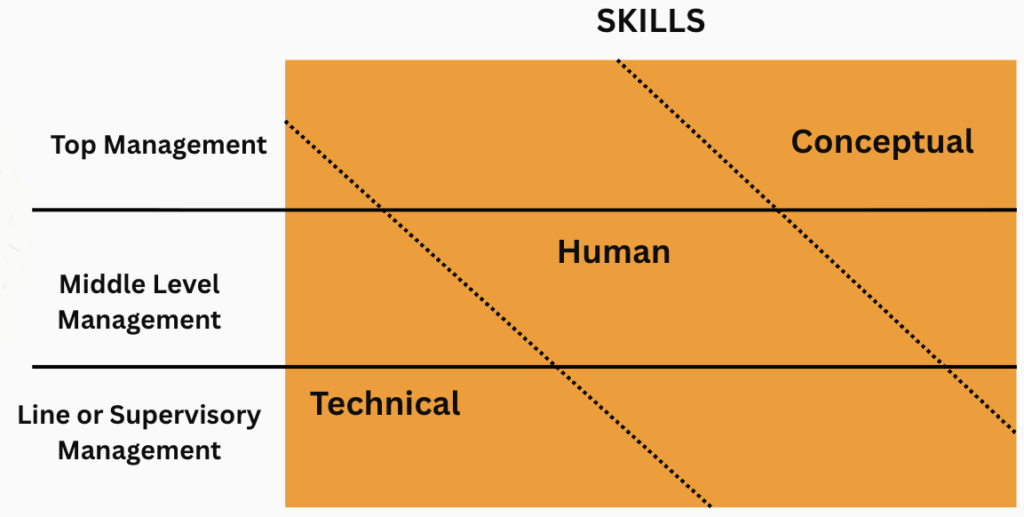
According to Robert Katz (1974), managers require three essential skills: Technical Skills, Human Skills, and Conceptual Skills. All three skills are important for effective management, but the relative importance of each skill varies according to the manager’s position in the organizational hierarchy.
- Technical Skills refer to the ability to use specialized knowledge, methods, and tools to perform specific tasks. These skills are most important for lower-level or first-line managers, as they are directly involved in day-to-day operations and supervise operational employees. As managers move to higher levels, the need for technical skills decreases
- Human Skills involve the ability to work effectively with people, understand their feelings, build trust, and encourage teamwork. These skills are important at all levels of management because every manager must interact with employees, colleagues, and superiors. Human skills help create a positive work environment and ensure cooperation.
- Conceptual Skills refer to the ability to understand the organization as a whole and recognize how different parts are interconnected. These skills are most important for top-level managers, who make strategic decisions and must consider the long-term impact of their actions on the entire organization.
Management is considered a multi-disciplinary field because it draws knowledge, concepts, and principles from various other established disciplines rather than being a completely independent body of knowledge.
“Management has a structured body of knowledge consisting of theories and principles developed over time. It also draws knowledge from other disciplines such as Economics, Sociology, Psychology, and Mathematics.“
Reasons:
- Economics → Provides concepts like resource allocation, cost-benefit analysis, profit maximization, and market behaviour.
- Sociology → Helps in understanding group behaviour, organizational culture, and social relationships.
- Psychology → Contributes to motivation theories, perception, leadership, and individual behaviour.
- Mathematics & Statistics → Supports decision-making models, quantitative techniques, operations research, and financial analysis.
Management integrates these diverse fields to solve complex organizational problems. While it has developed its own principles (like those of Taylor and Fayol), it is not a pure or independent discipline like Physics or Chemistry. It is an applied and integrative discipline that borrows heavily from the social sciences and other areas.



