

Crisis of Conscience – A Crisis of conscience is a strong form of ethical dilemma in which the moral agent needs to fight with inner beliefs and external circumstances. This creates a deeper inner tension or conflict and hence a great deal of mental pain.
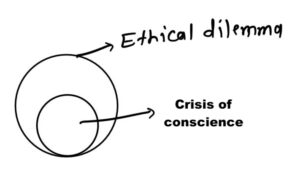
Example –
- J. Robert Oppenheimer after Hiroshima bombing
- Dinesh Thakur Ranbaxy case [Job and life threat on one hand and public safety on the other hand]
- Healthcare Workers during the COVID-19 Pandemic
How to solve –
- Strong emotional intelligence – Self-awareness, Social awareness and management
- Inner development (Meditation/spirituality)
- External knowledge – (Like Geeta helped Oppenheimer), laws, rules, etc
Conflict of Interest – The Situation when decisions taken in a public capacity have some vested interest in the private sphere of life
Example –
- Chanda Kochhar (Misused her position as CEO of ICICI bank for personal benefits)
- Insider trading (इनसाइडर ट्रेडिंग) (Rajat Gupta case)
- Cricket selector (His/her son came for trial)
How to solve –
- Clear rules and regulation
- Transparency in system
- Proper Audit mechanism
- Value development programs
Definition – Situation when there is conflict between two or more moral principles and moral agent need to pick one at the cost of other. Moral agents need to optimize the benefit
Dilemma | Example | Remedy |
Principle Vs preservation (सिद्धांत बनाम संरक्षण/रक्षा) | IES satyendra dubey exposed corruption in highway development – Was killed | Nehruvian Approach – National interest must be at the top |
Professional life Vs personal life (व्यावसायिक जीवन बनाम निजी जीवन) | IPS officer 24*7 Duty – Less time to family members | Utilitarian Approach – The Greatest Good for the Greatest Number |
Profit vs Social responsibility (लाभ बनाम सामाजिक जिम्मेदारी) Social ethics vs Economic ethics (सामाजिक नैतिकता बनाम आर्थिक नैतिकता) | An IAS officer heading DISCOM – Dilemma to bring it out of loss vs govt’s commitment to give free electricity | Common Goods Approach – What is good for society is good for an individual. Hence decisions should be beneficial for all members of society. |
Preferential treatment vs non-discrimination (विशेषाधिकार बनाम गैर-भेदभाव) | Ex – Jharkhand tribal girl death from hunger due to denial of PDS (Biometric didn’t work) – Such a case demand preferential treatment | Rights Approach – Every human being has right to live with dignity |
Punishment vs Reward (दण्ड बनाम पारितोषिक) | Offering flowers to those violating traffic rules = Change of heart | Justice/Fairness approach – All equals should be treated equally. |
End vs Means (साध्य बनाम साधन) | End – To make a bridge for better traffic management Means – Need to break a temple = Religious sentiments might get hurt | Gandhian Approach – Both end and means should be auspicious for long-lasting impact |
Autonomy vs Accountability (स्वायत्तता बनाम जवाबदेही) | Autonomy – To take CL (Casual Leave), PL (privilege leave) and other leaves Accountability – Of Incharge of office to get the work done on time Ex – Shri Satish Dhawan gave autonomy to APJ Abdul kalam for Rohini Satellite launch but when the launch failed, he made himself accountable for the failure | Virtue Based Approach – The act done by a virtuous person is right. Hence the decision maker should focus on character development first and then autonomy should be provided |
Rules vs Discretion (नियम बनाम स्वविवेक) | Rules – Don’t provide PDS to anyone without proper documents Discretion – Someone dying from hunger must be provided relief |
|
Loyalty vs Honesty (वफादारी बनाम ईमानदारी) | Loyalty – Towards govt in power Honesty – Expose wrongdoing if required | Legal Approach – The action must follow the legal principles and hence must withstand the court’s trial |
Automation vs Employment (ऑटोमेशन बनाम रोजगार) | Ex – Govt to promote AI, ML, Robotics and other cutting edge technology, on the other hand 69% jobs are at threat due to automation |
|
National interest vs Humanity (राष्ट्रहित बनाम मानवता) | Officer investigating Ajmal Kasab |
|
Development vs sustainability (विकास बनाम संधारणीयता/निरंतरता) | Mumbai Metro Rail Corporation Ltd (MMRCL) to cut trees in Aarey forest Mumbai SC allowed to cut 177 trees [Penalty above than that] |
|
Letter of law vs Spirit of law (कानून बनाम कानून की भावना) | A traffic police challan a car carrying critical patient for overspeeding | Virtue Based Approach – The act done by a virtuous person is always right. Hence in such a case, intentions matter. |
Speed vs accuracy (गति बनाम सटीकता) |
| Utilitarian Approach – The Greatest Good for the Greatest Number [i.e try to maximize the outcome] |
National security vs Privacy (राष्ट्रीय सुरक्षा बनाम गोपनीयता) | Taking someone’s fingerprint or Narco test | Nehruvian Approach – National interest must be at top |
Equality vs Equity (समानता बनाम न्याय संगतता) | Reservation in administrative jobs | Justice/Fairness approach – All equals should be treated equally. Favoritism should not be promoted |
Senior’s order vs public good (वरिष्ठ का आदेश बनाम जनता की भलाई) | When the superior’s direction is against public good. Ex – A Junior can’t or shouldn’t rebel against his/her senior (Otherwise work culture gets spoiled) but also he/she shouldn’t get succumbed to wrong advice | Legal Approach – The action must follow the legal principles and hence must withstand the court’s trial |
Secrecy vs Transparency (गोपनीयता बनाम पारदर्शिता) | Someone demanding information of national importance in RTI (RTI act section 8) | Nehruvian Approach – National interest must be at top |
Centralization vs Decentralization (केंद्रीकरण बनाम विकेंद्रीकरण) |
| Buddha’s Madhyam marg or Aristotle’s golden mean approach |
Justice vs mercy (न्याय बनाम दया/रहम) | Ex – Nirbhaya rape case. One of the culprits was a juvenile. Got only 3 year sentence (Juvenile Justice Act) Release of A.G. Perarivalan, a convict in the former Prime Minister Rajiv Gandhi assassination case seeing his satisfactory conduct in jail. | Rights Approach Every human being has the right to live with dignity |



