
- Seismic waves are vibrations or oscillations that travel through the Earth’s interior and across its surface. They can be caused by earthquakes, volcanic activity, or human-induced events.
- There are two types of seismic waves –
- Body waves are generated due to the release of energy at the focus and move in all directions.
- Surface waves : The body waves interact with the surface rocks and generate new set of waves called surface waves.
- Body waves can be further sub-categorized into : P waves (Primary waves) and S waves (Secondary waves)
Property | P-Waves | S-Waves |
Type of Wave | Longitudinal / Compressional waves | Transverse / Shear waves |
Motion | Move in a push-pull motion | Move in a side-to-side motion |
Speed, Frequency and impact | Faster speed, relatively high frequency, least destructive among the earthquake waves. | Slower, high frequency and possess slightly higher destructive power compared to P-waves. |
Transmission |
|
|
Appearance on Seismograph | Travel from the earthquake focus to the earth’s surface, and are first to reach | Arrive at the surface with some time lag. |
Shadow Zone | 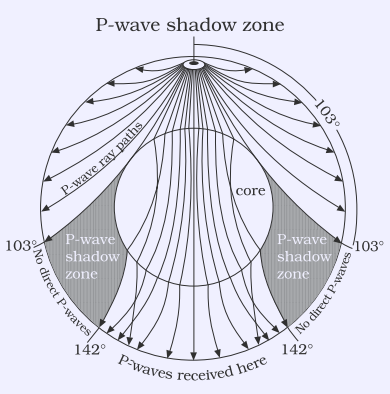 The shadow zone of P-waves appears as a band around the earth between 105° and 145° away from the epicentre. | 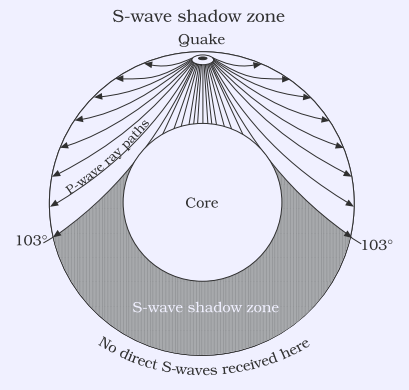 The entire zone beyond 105° does not receive S-waves. The shadow zone of S-wave is much larger than that of the P-waves. |
India has in recent years witnessed devastating earthquakes in Maharashtra in 1993, Gujarat in 2001, Kashmir in 2005 and other disasters like Tsunami in 2004 among others.
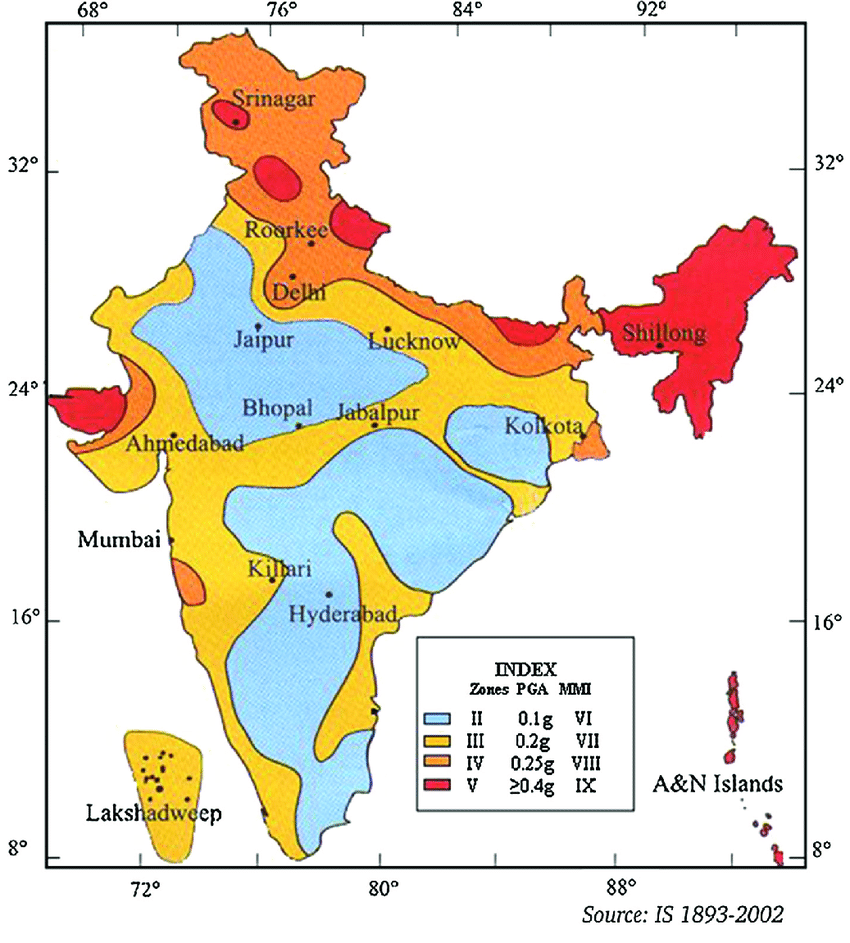
The Bureau of Indian Standards with the help of Indian Meteorological Department has grouped the country into four seismic zones, based on modified Mercalli scale. Zone V is known to experience the highest level of seismicity, while Zone II has the lowest.
- Zone V (very severe intensity zone): This includes parts of Jammu and Kashmir (Kashmir valley); the western region of Himachal Pradesh; the eastern part of Uttarakhand, Kutch in Gujarat; a portion of Northern Bihar; all northeastern states of India and the Andaman & Nicobar Islands.
- Zone IV (severe intensity zone): This zone includes Ladakh; remaining parts of Jammu & Kashmir, Himachal Pradesh, and Uttarakhand; some parts of Haryana, parts of Punjab; Delhi; Sikkim; the northern part of Uttar Pradesh; small portions of Bihar and West Bengal; parts of Gujarat and small portions of Maharashtra near the west coast and a small part of western Rajasthan.
- Zone III (moderate intensity zone): This zone encompasses Kerala; Goa; Lakshadweep islands; parts of Uttar Pradesh and Haryana; remaining parts of Gujarat and Punjab; parts of West Bengal, western Rajasthan, Madhya Pradesh; the remaining part of Bihar; northern parts of Jharkhand and Chhattisgarh; parts of Maharashtra, Odisha, Andhra Pradesh, Telangana, Tamil Nadu, and Karnataka.
- Zone II (low intensity zone): This zone includes the remaining parts of Rajasthan, Uttar Pradesh, Gujarat, Haryana, Madhya Pradesh, Maharashtra, Odisha, Andhra Pradesh, Telangana, Karnataka, and Tamil Nadu.
It is estimated that about 11% of the country falls in zone V, approximately 18% in zone IV, around 30% in zone III, and the remaining in zone II. This means that nearly 59% of India’s landmass is prone to earthquakes of varying intensities.
Extra :
- The National Centre for Seismology (NCS) under the Ministry of Earth Sciences is the nodal agency for monitoring earthquakes in and around India.
- Information on earthquakes reported by NCS is disseminated to central and state disaster authorities promptly for mitigation measures.
- The National Disaster Management Authority (NDMA) conducts regular awareness campaigns through various media to sensitize the public about earthquake prevention and preparedness.