

| Aspect | Himalayan Drainage System | Peninsular Drainage System |
| Origin | Himalayan mountains covered with glaciers | Peninsular Plateau and central highland |
| Rivers | Rivers are perennial, snow-fed, and carry more water. | Rivers are mostly rain-fed and have seasonal flow patterns. |
| Characteristics | V-shaped valleys, deep gorges, and meandering | Straight courses, little scope for the formation of meanders. |
| River Patterns | Dendritic (tree-like) pattern due to young geological age. | More matured pattern with radial and rectangular patterns. |
| Depositional Features | Form extensive floodplains and deltas (e.g., Ganga-Brahmaputra). | Form smaller deltas and estuaries (e.g., Godavari, Krishna). |
| Erosion | Intense erosion due to steep slopes and young age. | Less erosion compared to the Himalayan rivers. |
| Hydroelectric Potential | High potential due to steep gradients and high water flow. | Moderate potential due to seasonal flow and less gradient. |
| Examples | Ganga, Brahmaputra, Yamuna, Indus. | Godavari, Krishna, Kaveri, Mahanadi. |
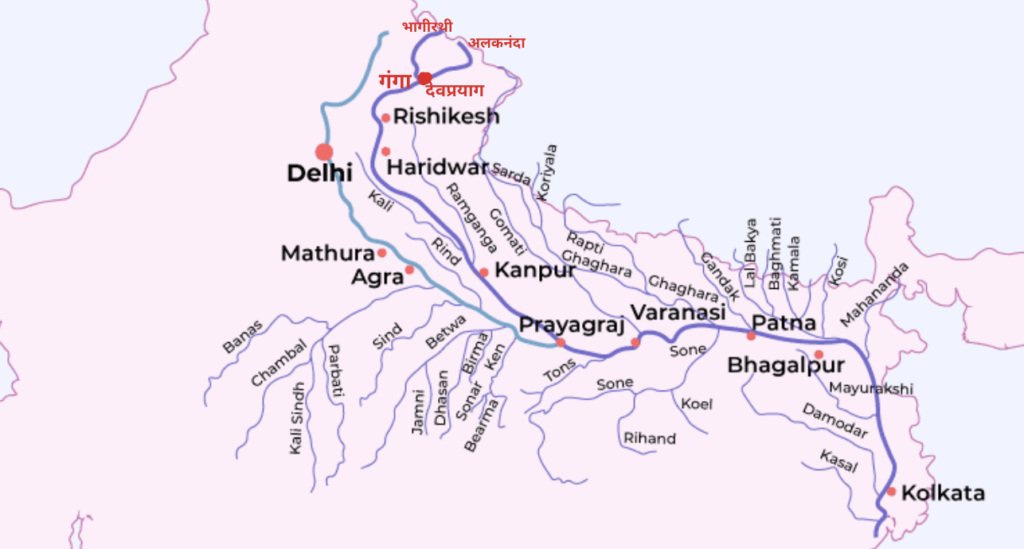
- Bhagirathi River originates from the Gangotri Glacier near Gomukh in the Kumaon Himalayas, meets the Alaknanda at Devprayag, flows under the name of River Ganga.
- River Ganga enters the plains near Haridwar.
- Flows through Uttarakhand, Uttar Pradesh, Bihar and West Bengal.
- Important cities like Kanpur, Prayagraj etc. are situated on its banks.
- Tributaries –
- Left bank- Ramganga, Gomti, Ghagra, Gandak, Kosi, Mahananda.
- Right bank- Yamuna and Son.
- Ganga River is an international river, flows in Bangladesh as Padma
- Padma and Brahmaputra form the Sunderban Delta, the world’s largest delta.
- Extra: Namami Gange
The Interlinking of Rivers (ILR) project in India, part of the National Perspective Plan (NPP), aims to move water from areas with surplus water to regions facing shortages. This ambitious project plans to connect 30 rivers, with 14 links in the Himalayan region and 16 in the Peninsular region.
- Prospects of River Interlinking in India
- Improved Water Availability: River interlinking can improve water availability in drought-prone regions by creating a network of interconnected rivers and reservoirs. This can help in the storage and distribution of water for agricultural, industrial, and domestic use.
- Increased Hydropower Generation: By creating a network of interconnected rivers and reservoirs, river interlinking can help generate hydropower, increasing the country’s capacity to meet the rising demand for electricity.
- Flood Control: River interlinking can help manage excess water during the monsoon season by storing water in reservoirs, reducing flood damage and protecting human lives and properties.
- Employment Generation: The construction and maintenance of the river interlinking project can generate significant employment opportunities in both skilled and unskilled sectors, including industries such as construction, engineering, and transportation.
- Improved Environmental Management: The project can improve environmental management by addressing changes in biodiversity and water quality. With proper environmental safeguards, it can help conserve water resources and restore degraded ecosystems.
- Improved Inter-State Relations: Promotes cooperation among states, resolving water-sharing disputes and ensuring equitable water distribution.
Challenges of the River Interlinking Project in India | Way forward |
Environmental Challenges:
| Climate Change Adaptation
|
Social Challenges:
| Environmental Protection
|
Legal Challenges:
| Institutional Framework for Dispute Resolution
|
Financial Challenges:
| Water Sharing Mechanism
|
Political Challenges:
| Agricultural Reform
|



