

The District Collector in his capacity as the district magistrate (i.e. executive magistrate) is ultimately responsible for the maintenance of law and order in the district. The District Collector in his capacity as the district magistrate performs the following functions.
- To control and supervise the subordinate magistracy.
- To issue orders when there is threat to public peace and order under section 144 of the Criminal Procedure Code.
- To release prisoners on parole.
- To inspect the jails.
- To submit an annual criminal report to the government.
- To control and direct the action of district police.
- To prosecute offenders under the Factories Act and Trademark Act.
- To recommend schemes for the development of forests.
- To call the armed forces to aid and assist the civil administration to deal with any abnormal situation in the district.
- To grant, suspend or cancel many kinds of licenses like arms, hotel, explosives, Petroleum and others.
- To order disposal of unclaimed property.
- Maintaining control over smuggling, narcotics trade, and terrorist activities.
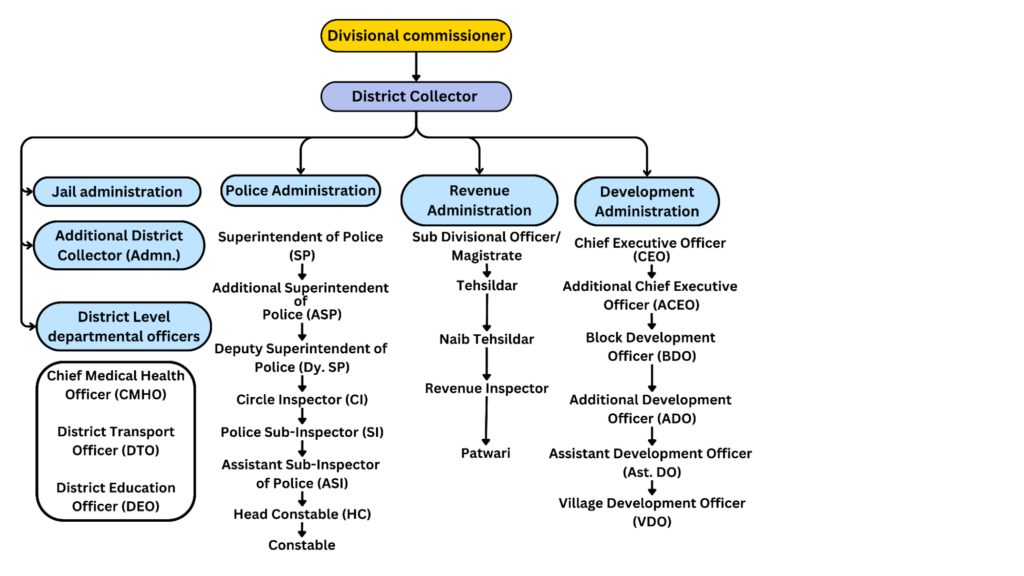
(Yha ,answer 10 marker ke hisab se hai)
After independence, divisions were created as an intermediate administrative level between the state and districts for better coordination. Each division has 3–4 districts, led by a Divisional Commissioner.
Evolution in Rajasthan
- 1947: Divisional Commissioner posts established in major divisions.
- 1962: Posts abolished; duties shifted to Collectors and Revenue Board.
- 1987: Posts reinstated due to increased workload and coordination needs.
Role of Divisional Commissioner in Bridging State and District Administration in Rajasthan
- Link between State and District: Acts as a vital administrative link connecting state government policies with district-level execution.
- Coordination: Ensures coordination among various district departments and between districts and state-level authorities.
- Supervision: Supervises district administration to ensure that state policies and programs are properly implemented.
- Problem Reporting: Conveys district problems, challenges, and feedback to the state government for timely redressal.
- Guidance and Monitoring: Provides administrative guidance and monitors the work of district collectors and officers.
- Facilitating Decentralization: Helps in decentralizing administrative powers by bringing state authority closer to district administration.
- Panchayati Raj Linkage: Coordinates between Panchayati Raj Institutions at district level and the state government for rural development.
- Conflict Resolution: Resolves inter-departmental conflicts at the district level to ensure smooth governance.
- Inspection and Review: Conducts inspections and periodic reviews of district offices and schemes to maintain administrative efficiency.
- Enhancing Accessibility: Makes state administration more accessible to the people at the grassroots by being physically closer than the state capital.
Thus, The Divisional Commissioner plays a vital role in linking the state and district administration in Rajasthan by coordinating development activities, supervising district officials, and ensuring better governance. However, critics say the role is limited to passing information like a post office without real decision-making power. To improve governance, the post needs more authority and clearer responsibilities for effective supervision and timely decisions.
Sub-Divisional Officers serve as vital links between district and tehsil administration. While their authority in developmental matters is constrained, they primarily function as regulatory officers. Their responsibilities include:
- Judicial Duties : Sub-Divisional Officers (SDOs) serve as a crucial link in revenue court hierarchy, akin to first-class judges in land revenue matters. While Tehsildars also handle revenue cases, SDOs possess appellate authority in such cases.
- Regulatory Functions: The Tehsil office oversees regulatory functions within the district.
- Revenue related work like land revenue, land records, land maps, land reform, consolidation, acquisition and distribution of additional land, management of government land, records and statistics related to crops etc.
- Distribution of essential commodities like sugar, cloth, and rationing of food grains falls under its purview.
- Implementation of state government laws such as licensing, explosive substance control, and prevention of adulteration and hoarding.
- conducting inspections, raids, and addressing complaints to combat corruption.
- As a Magistrate (SDM): Depending on the needs of the area, these officers may be designated as second-class or first-class magistrates.
- Functions as Executive Magistrate: powers given under CrpC → issuing search warrants, Security for good behavior from suspected persons, Dispersal of unlawful assembly by use of Police (Sec. 129), Power to issue order in urgent cases of nuisance or apprehended danger (Sect. 144)
- Other functions: Providing bail in case of breach of peace, Inspecting the jails and police stations of the subdivision.
- Inspection-Related Activities:
- They are granted disciplinary powers concerning Patwaris and revenue inspectors (Girdawars).
- According to Rajasthan land revenue rules, he personally oversees 1/5 of the records of Sadar Kanungo in each tehsil annually.
- He addresses difficulties encountered during recovery.
- He must inspect each tehsil twice a year, checking the Girdawari of 45 villages in 24 Patwar circles.
- This necessitates spending at least 80 days and 60 nights outside the headquarters annually.
- Election-Related Activities
- Electoral Registration Officer : responsible for tasks such as entering voter names and removing them in the event of death or migration.
- The SDO works as Assistant Returning Officer (ARO)/Returning Officer (RO) in the Lok Sabha, state assembly, Panchayati Raj, and urban body elections.
- Appointing booth-level officers(BLO), implementing the model code of conduct(MCC), and conducting voter awareness programs in the sub-division.
- Other works
- Issuing various certificates in the sub-division, such as caste certificates and EWS certificates.
- Addressing public complaints at the sub-division level.
- Conducting work related to census, animal census, and BPL census in the sub-division.
- Serving as a protocol officer for welcoming dignitaries at the sub-division level
It is commonly perceived that the S.D.O. has no major duties apart from revenue matters. Their duties often include communicating directives from the District Collector to the Tehsil and forwarding reports from the Tehsil to the District Collector. This role has led to them being referred to as the “Eye and Ear” of the District Collector.



