

Feature | Ramjet | Scramjet |
Air Compression | Relies on missile’s high-speed motion | Relies on missile’s extremely high-speed motion |
Combustion | Subsonic (air is slowed inside engine) | Supersonic (air remains supersonic during combustion) |
Speed Range | Efficient at supersonic speeds (Mach 3–6) | Efficient at hypersonic speeds (Mach 6 to 12) |
Efficiency | High at supersonic speeds | High at hypersonic speeds |
Booster Requirement | Requires a booster to reach supersonic speeds | Requires a booster to reach hypersonic speeds |
Examples | BrahMos missile (supersonic cruise) 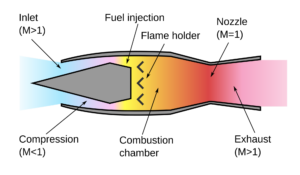 | Under development (e.g., BrahMos-II, HSTDV) 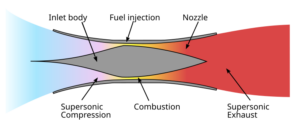 |
- Project Kusha: Jointly developed by the Defence Research and Development Organisation (DRDO) with Israel Aerospace Industries.
- Objective: Development of India’s very own Long-Range Surface-to-Air Missiles (LR-SAM) by 2028-29
- Capabilities: Seeks to establish a formidable 3 layered defense system to detect and destroy incoming stealth fighters, aircraft, drones, cruise missiles and precision-guided munitions.
- Components: With its long-range surveillance and fire control radars would have different types of interceptor missiles designed to hit hostile targets at 150 km, 250 km, and 350 km ranges.
- Expected Impact: Rival the effectiveness of Russia’s S-400 and Israel’s Iron Dome systems.
Mission Divyastra is the inaugural flight test of the domestically developed Agni-5 nuclear missile with a 5,000-km range, featuring MIRV technology. The Divyastra test means India has managed to ace the technology for miniature warheads.
- Launched by DRDO’s from Dr APJ Abdul Kalam Island off the Odisha coast.
- Objective: The test emphasized firing multiple warheads to strike widely separated targets simultaneously.
- MIRV (Multiple Independently-targetable Re-entry Vehicle ) technology enables the missile to deliver multiple warheads to various or the same locations in a single launch, potentially including decoys to mislead enemy ballistic missile defences.
Extra:
- India has joined a select group of countries who have the MIRV technology → US, UK, France, China, Russia and India are among the elite group.
- This Agni, capable of carrying nuclear warheads, is aimed mainly at thwarting the challenge from China.
- ‘Mission Divyastra‘ project was led by a woman scientist Sheena Rani.
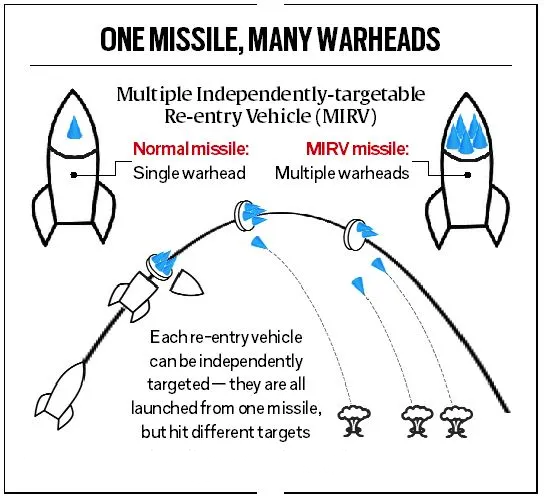
Mission Divyastra is India’s successful test of the Agni-5 missile equipped with Multiple Independently Targetable Reentry Vehicles (MIRVs)—a significant leap in nuclear delivery capability.
Strategic Implications of Mission Divyastra for India’s Nuclear Deterrence
- Missile Defence Penetration: The MIRV-equipped Agni-5 can carry multiple warheads on different trajectories, making it difficult for enemy missile defence systems to track and intercept.
- Credible Nuclear Deterrence: Significantly strengthens India’s second-strike capability against nuclear threats from China and Pakistan, in line with India’s No First Use (NFU) doctrine.
- Regional Stability: Counters China’s growing MIRV arsenal and Pakistan’s MIRV-capable Ababeel missile, thereby maintaining strategic balance in South Asia.
- Technological Superiority: Joins elite MIRV nations (US, Russia, China, etc.).
- Counterforce Potential: Improves India’s ability to neutralize strategic targets in case of retaliation, complicating the adversary’s defense planning.
- Boost to Strategic Autonomy: Demonstrates India’s self-reliance in sophisticated missile technology, aligning with its long-term defense modernization goals.
- The S-400 Triumf, also known as the SA-21 Growler by NATO, is a highly advanced surface-to-air missile defense system developed by Russia’s Almaz Central Design Bureau.
- It is designed to engage a variety of aerial targets, including aircraft, unmanned aerial vehicles (UAVs), and ballistic missiles, at long ranges and high altitudes.
- Creates Layered defence net : Each system has four different types of missiles for up to 40 km, 120 km, 250 km and maximum range of 400 km and up to 30 km altitude.
- India has contracted five S-400 Triumf regiments from Russia under a $5.43 billion deal signed in October 2018.
- Woking : S-400 detects an aerial threat approaching the air defence bubble (the area it has to protect), calculates the trajectory of the threat, and fires missiles to counter it. It has long-range surveillance radars that send information to the command vehicle. On identifying the target, the command vehicle orders a missile launch.
| Feature | Cruise Missile | Ballistic Missile |
| Meaning | Cruise missiles are self-propelled, guided weapons that can be launched from various platforms, including aircraft, ships, or ground-based launchers. | Ballistic missiles are unguided rockets that follow a high, parabolic trajectory when launched, ascending into space and then descending rapidly toward their target. |
| Propulsion | Typically powered by jet engines or rocket motors. | Uses rocket propulsion for initial launch and then follows a ballistic trajectory. |
| Guidance | Utilizes onboard navigation systems for guidance. | Typically guided by pre-programmed instructions and/or external tracking systems. |
| Trajectory | Flies at low altitudes following a curved path. | Follows a high-altitude trajectory, reaching the peak altitude before descending rapidly. |
| Speed | Generally subsonic or supersonic. | Can be hypersonic or supersonic during various phases of flight. |
| Maneuverability | Highly maneuverable, capable of changing direction and altitude. | Limited maneuverability compared to cruise missiles. |
| Range | Range varies, often hundreds to thousands of kilometers. | Typically longer range compared to cruise missiles, potentially reaching intercontinental distances. |
| Time of Flight | Longer time of flight due to lower speeds and terrain-following flight. | Generally shorter time of flight due to higher speeds and ballistic trajectory. |
| Example | BrahMos, Nirbhay. | Prithvi I, Prithvi II, Agni I, Agni II and Dhanush missiles.. |
The Integrated Guided Missile Development Programme (IGMDP) was initiated under the leadership of APJ Abdul Kalam at DRDL, Hyderabad, in 1983 to bolster the Indian missile program. DRDO announced the successful completion of IGMDP in 2008.
Objectives of India’s IGMDP were:
- Self-Reliance: To achieve self-sufficiency in the development and production of various missile systems to reduce dependency on foreign suppliers.
- Strategic Deterrence: To enhance India’s strategic capabilities by developing a robust and indigenous missile arsenal for deterrence against potential threats.
- National Security: After the 1962 war with China and the 1965 & 1971 wars with Pakistan, India realized the importance of self-reliance in vital military equipment to safeguard national security.
Components of IGMDP:
- Prithvi: Short-range surface-to-surface ballistic missile designed for tactical battlefield use.
- Prithvi-I: Range – 150 km, Prithvi II: Range – 350 km, Prithvi III: Range – 750 km; Dhanush is the naval variant of the Prithvi III missile
- Agni: Medium to intercontinental range ballistic missiles.
- Agni-1 to Agni-3 were developed under IGMDP. Ranging from Agni-1 (700 km) to Agni-III (3,500 km), these missiles are pivotal to India’s nuclear deterrence strategy
- Akash: Medium-range surface-to-air missile system designed for air defense against aerial threats.
- An intercept range of 30 km. Akash flies at supersonic speed, reaching around Mach 2.5. It can reach an altitude of 18 km.
- Trishul: Short-range, quick-reaction surface-to-air missile system
- It has a range of 12 km and is used as anti-sea skimmer from ships against low-flying attacks.
- Nag: Third-generation fire-and-forget anti-tank guided missile.
- NAMICA (Nag Missile carrier), HELINA (Helicopter version)
Strategic Significance:
- Overcoming Technological Challenges: IGMDP enabled India to achieve self-reliance in critical missile technology despite restrictions imposed by the MTCR.
- Nuclear Deterrence: Agni missiles support India’s nuclear deterrence strategy based on a no-first-use policy.
- Strategic Deterrence: Prithvi and Agni missiles provide deterrence against potential threats from China and Pakistan.
- Technological Spin-offs: IGMDP led to the development of crucial technologies like phase shifters, magnesium alloys, and carbon fibers.
- International Standing: IGMDP elevated India’s reputation as a technologically advanced defense player globally.
- National Security: IGMDP’s missile defense system enhances India’s national security by countering aerial and missile threats effectively.
- Make in India: IGMDP’s success contributes to India’s Make in India initiative, paving the way for future missile exports.
DRDO has played a pivotal role in advancing India’s defence capabilities. DRDO’s recent achievements underscore India’s growing autonomy in defence production, reducing dependence on foreign imports.
DRDO’s Recent Achievements
- Advancements in Missile Systems
- Agni-5 with MIRV (Mission Divyastra) & Agni-Prime → Boosting India’s strategic deterrence.
- BrahMos Missile: A joint Indo-Russian development; India has taken over full design and production to ensure strategic autonomy.
- Rudram-1 & 2 → India’s first anti-radiation missile to target enemy radar systems.
- Solid Fuel Ducted Ramjet Technology → Enables the missile to intercept aerial threats at very long range at supersonic speeds.
- Advancements in Air Defence Systems
- Akash-NG Missile, Very Short-Range Air Defence System (VSHORADS), Vertical Launch Short Range Surface to Air Missile (VL-SRSAM) → Enhancing air defence capabilities.
- Indigenous Defence Systems
- High-speed Expendable Aerial Target (HEAT) – ABHYAS, Man Portable Anti-tank Guided Missile Weapon System (MPATGM), Supersonic Missile-Assisted Release of Torpedo (SMART), Varunastra Torpedo.
- Pinaka MBRL, Dhanush Artillery Gun, Indigenous Light Tank – Zorawar → Boosting artillery strength.
- Defence Technologies & Equipment
- ABHED (Advanced Ballistics for High Energy Defeat) → Light Weight Bullet Proof Jackets.
- Medium Range-Microwave Obscurant Chaff Rocket: This system reduces radar detection, enhancing stealth capabilities of naval platforms.
- Life Support Systems:
- Integrated Life Support System (ILSS) technology for pilot of LCA Tejas.
- ‘HANS’ (High Altitude parachute with Navigation & advanced Sub-assemblies) → Military combat parachute system.
- Crew Module Parachute System for Gaganyaan Programme.
Contribution to Atmanirbhar Bharat :
- Indigenous R&D → DRDO is reducing India’s dependency on foreign defence imports through extensive research and development.
- Self-Reliance in Defence → Focus on self-reliant design, development, and manufacturing, in line with the “Make in India” initiative.
- Private Sector Collaboration → Encouraging the private sector to contribute to defence production, fostering a robust indigenous defence industry.
- Technology Transfer: Facilitating the transfer of technology to industries, enhancing domestic production and export potential.
Through its cutting-edge innovations, DRDO has significantly contributed to strengthening India’s defence capabilities and realizing the vision of Atmanirbhar Bharat, ensuring strategic autonomy and enhanced national security.



