

‘Virtual digital asset’ refers to any information, code, number, or token (not being Indian currency or foreign currency) generated through cryptographic means or otherwise and can be called by whatever name. Eg. Crypto currencies like Bitcoin, NFTs etc
- Virtual digital assets are intangible and exist only in the digital realm but can be transferred, stored, or traded electronically,
- These are typically decentralized and operate independently of central authorities, making them appealing to many users.
- Specifically include a non-fungible token, i.e., NFT, or any other token of similar nature, by whatever name is called.
- Transactions come under the purview of the Prevention of Money Laundering Act (PMLA).
Extra : VDAs was introduced in the Finance Bill 2022 to provide for taxation and withholding of tax pertaining to VDAs. Effective from 1 April 2022 onwards, any income from transfer of VDAs is taxable at the rate of 30% (plus surcharge and cess).
| Aspect | Proof of Work (PoW) | Proof of Stake (PoS) |
| Participants | Called miners, open to everyone on the network. | Called forgers, chosen based on the number of coins they hold. |
| Mechanism | Miners solve complex mathematical problems to validate transactions. | Validators are chosen based on the amount of stake. |
| Rewards | Earn block rewards + transaction fees. | Earn transaction fees and sometimes staking rewards. |
| Energy Consumption | High — requires significant computational power. | Low — energy-efficient, minimal computing needed. |
| Used By | Bitcoin, Litecoin. | Ethereum (after merge), Cardano, Binance Coin. |
Blockchain is a distributed ledger technology that allows secure, transparent, and tamper-proof transactions. Here, information is stored as “blocks’’ that are coupled together forming “chains”.
Principles of Blockchain Technology:
- Decentralized: Records are stored across a peer-to-peer network rather than a central authority.
- Transparent : Participants can view and verify all transactions on the blockchain.
- Immutable: Once data is recorded on a blockchain, it cannot be altered or deleted, providing tamper-proof records.
- Cryptographically secured: Encryption mechanisms like digital signatures secure identities and prevent fraud.
- Distributed consensus: New data can be added to a blockchain only through agreement between the various nodes of the network, a mechanism known as distributed consensus.
- Automated through smart contracts: Terms are automatically executed when conditions are met.
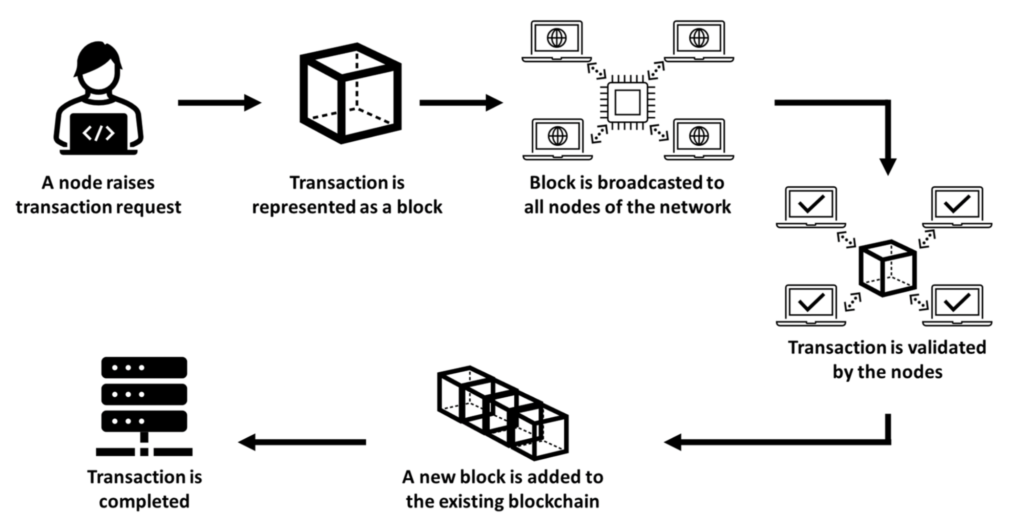
Applications:
- Supply Chain Management: Blockchain’s transparency and immutability make it ideal for tracking goods throughout the supply chain.
- can be used to prevent the sale of spurious drugs in the country
- Agriculture: it can reduce contamination and food fraud
- Identity Management :Critical citizen information like land records, census data, birth and death records, business licenses, criminal records, intellectual property registry, electoral rolls could all be maintained as blockchain-powered, tamper-proof public ledgers.
- Healthcare Records: Patients have control over their medical records, and healthcare providers can access verified, immutable patient data in real-time.
- Voting Systems:Blockchain-based voting systems ensure transparency and integrity in elections by recording votes on a tamper-proof ledger. Decentralization prevents single points of failure or manipulation, enhancing trust in the electoral process.
- Smart Contracts: These are self-executing contracts with the terms of the agreement directly written into code. They automate and enforce contract execution, reducing the need for intermediaries.
- Cross-Border Payments: It enables fast and low-cost cross-border transactions by eliminating intermediaries and providing a transparent and secure ledger for financial transactions.
- Digital Asset Management: Blockchain-based platforms enable the tokenization and trading of digital assets such as real estate, artwork, and securities.
- Intellectual Property Management: Blockchain can be used to manage intellectual property rights by securely recording ownership and usage rights, reducing disputes and infringement cases.
- Fighting corruption:Registering government transactions on the blockchain establishes a trusted transaction history, simplifying auditing and enhancing transparency in public procurement.
- Cut red-tapism: Blockchain ensures seamless data sharing between government agencies, eliminating duplication and contradictions, and streamlining processes for users.
- E-Governance: Estonia utilizes blockchain infrastructure to authenticate and manage all public e-governance services.
(Taking cues from Estonia, India has the opportunity to harness blockchain infrastructure to authenticate and streamline public e-governance services. Currently, data navigation across various systems and dependence on private databases result in increased complexity and costs as the network expands, leading to inefficiencies.)
A blockchain is a decentralized, distributed ledger that records all transactions across multiple computers. It promises transparency, efficiency, and security across various sectors.
Blockchain Beyond Cryptocurrency: Opportunities
- Supply Chain Management: Ensures product authenticity and traceability from source to consumer (e.g., Walmart using blockchain for food safety).
- Healthcare: Enables real-time access to medical history and verification of pharmaceuticals. Reduces counterfeit drugs and ensures data privacy.
- Agriculture: Tracks produce from farm to table, ensures fair and fast payments to farmers and reduces exploitation of farmers.
- Governance: Used for secure and tamper-proof storage of land records, birth/death registries, and licenses. Immutable transaction history helps detect and prevent fraud in public procurement and welfare schemes.
- Education: Verifies academic credentials and prevents forgery.
- Financial Services (Beyond Crypto): Facilitates cross-border payments and smart contracts.
- Environmental Sustainability: Tracks eco-friendly and organic supply chains, ensuring verified sustainability claims.
- Philanthropy & Aid: Transparent distribution of charitable funds, reducing misuse and increasing donor confidence.
Challenges in Implementation
- Scalability Issues: Current blockchain networks struggle with high-speed processing and large-scale adoption.
- Regulatory Uncertainty: Lack of clear legal frameworks hinders adoption
- Technical Complexity: Understanding and deploying blockchain solutions require specialized skills and training.
- Integration with Existing Systems: Difficult to merge blockchain with traditional databases and IT infrastructure.
- Security Risks: Vulnerabilities such as smart contract bugs and hacking remain concerns.
- Data Privacy Concerns: Immutability conflicts with evolving data protection laws and balancing transparency with confidentiality.
- High Energy Consumption: Especially with Proof-of-Work mechanisms (though newer systems like Proof-of-Stake offer efficiency).
While blockchain holds immense potential in diverse sectors, its successful adoption demands overcoming technological, regulatory, and infrastructural challenges. A balanced policy approach can unlock its full value for India’s digital future.



