

Sol –
Chromosomal disorders are genetic conditions caused by abnormalities in the number or structure of chromosomes. These disorders often result from errors during cell division, leading to an incorrect distribution of genetic material.
Autosomal Aberrations | Sex Chromosomal Aberrations |
Autosomal aberrations involve abnormalities in the number or structure of autosomes, which are non-sex chromosomes (chromosomes 1 to 22 in humans). | Sex chromosomal aberrations involve abnormalities in the number or structure of sex chromosomes (X and Y chromosomes) |
|
|
Sol –
CAR-T cell therapy, also known as Chimeric Antigen Receptor T-cell therapy, is a type of immunotherapy that uses a
patient’s own immune system to fight cancer.
- It involves extracting T cells, genetically modifying them to target cancer antigens, multiplying them, and reinfusing the engineered CAR T cells back into the patient’s body to provoke a potent immune response against cancer cells.
- { T cell collection →T cell engineering→T cell expansion→Infusion into the patient→CAR T cells multiply and kill cancer cells.}
- CAR-T cell therapies, often referred to as ‘living drugs’.
- CAR T-cell therapy has been approved for leukaemias (cancers arising from the cells that produce white blood cells) and lymphomas (arising from the lymphatic system).
- NexCAR19: India’s first indigenously-developed CAR-T cell therapy → has received Central Drugs Standard Control Organisation (CDSCO)approval
- NexCAR19 is India’s first Made-in-India CAR-T therapy.
- Mechanism: Targets cancer cells that carry the CD19 protein. CD19 acts as a flag on cancer cells, enabling CAR-T cells to recognize and eliminate these cells.
- Patient Eligibility:
- Intended for people with B-cell lymphomas who have not responded to standard treatments like chemotherapy.
- Approved for patients aged 15 years and older.
- Efficacy : Causes minimal damage to neurons and the central nervous system, minimizing neurotoxicity.
- Significance : India becomes one of the first developing countries with an indigenous CAR-T and gene therapy platform.
- (Developed through an academia-industry partnership →Created by Prof. Rahul Purwar and his team at the BSBE Department, IIT Bombay, in association with Tata Memorial Centre and ImmunoACT.)
Sol –
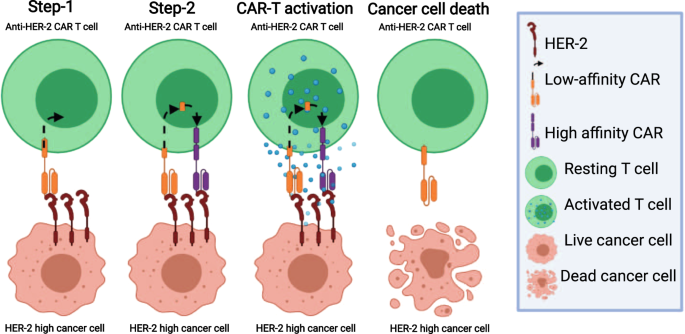
CAR (Chimeric Antigen Receptor) T-cell therapy is a groundbreaking immunotherapy that reprograms a patient’s immune cells to hunt and destroy cancer.
Mechanism of CAR-T Cell Therapy:
- T-Cell Extraction-T-cells are collected from the patient’s blood through a process called leukapheresis.
- Genetic Modification- The T-cells are engineered in a lab to express Chimeric Antigen Receptors (CARs), which help them identify specific antigens on cancer cells (e.g., CD19 in leukemia and lymphoma).
- Expansion and Activation- The modified CAR-T Cells are multiplied in large numbers to ensure a strong immune response when reintroduced into the body.
- Infusion into the Patient- The CAR-T Cells are infused back into the patient’s bloodstream, where they seek out and bind to cancer cells expressing the target antigen.
- Cancer Cell Destruction-Once CAR-T cells recognize the cancer cells, they release cytotoxic molecules like perforin and granzymes, leading to cancer cell apoptosis (cell death).
CAR-T Cell Therapy is a revolutionary approach that enhances the immune system’s ability to fight cancer.
Sol –
- Dhara Mustard Hybrid-11 (DMH-11) – indigenously developed transgenic mustard.
- It is Genetically modified variant of Herbicide Tolerant (HT) mustard
- A cross between Indian mustard variety ‘Varuna’ and East European ‘Early Heera-2’ mustard.
- Contains two alien genes (‘barnase’ and ‘barstar’) isolated from a soil bacterium called Bacillus amyloliquefaciens that enable breeding of high-yielding commercial mustard hybrids.
- Approximately 28% more yield than the national check and 37 % more than the zonal checks.
Recently The Genetic Engineering Appraisal Committee (GEAC) has approved the environmental release of genetically modified (GM) crops, such as mustard. The Government of India informed the Supreme Court that GM crops will make quality edible oil more affordable for the common man and reduce foreign dependency
Sol –
Biotechnology primarily focuses on the large-scale manufacturing of biopharmaceuticals and biological products through the utilization of genetically modified microorganisms, fungi, plants, and animals.
Application in Agriculture
- Tissue Culture: Cultivating whole plants from small plant parts in a controlled environment. Micropropagation is used to regenerate disease-free plantlets of bananas from tissues of healthy banana plants.
- Somatic Hybridization: Fusing protoplasts of different plant varieties to create hybrid plants. Used for producing new plant hybrids with desired characteristics.
- Genetically Modified Crops: with desirable traits such as pest resistance, disease resistance, drought tolerance, and increased nutritional value.
- Bt Cotton: Engineered with genes like cryIAc and cryIIAb from Bacillus thuringiensis, producing insecticidal proteins that target specific pests.
- Golden Rice: Genetically modified to produce beta-carotene, a precursor of vitamin A, addressing vitamin A deficiency in populations relying heavily on rice as a staple food.
- GM-Mustard:GEAC has approved the environmental release of Dhara Mustard Hybrid-11 (DMH-11).
- ‘Protato’: A genetically modified potato variety enriched with proteins, awaiting final approval for consumption.
- Pest Resistant Plants: RNA interference (RNAi) is used to silence nematode-specific genes in host plants, preventing infestation.
Sol –
Biotechnology primarily focuses on the large-scale manufacturing of biopharmaceuticals and biological products through the utilization of genetically modified microorganisms, fungi, plants, and animals.Biotechnology encompasses a diverse array of disciplines, including Medical Biotechnology (Red), Industrial Biotechnology (White), Environmental Biotechnology (Green), Marine Biotechnology (Blue), Animal Biotechnology, Plant Biotechnology and Informatics (Gold Biotechnology).
Application in Agriculture
- Tissue Culture: Cultivating whole plants from small plant parts in a controlled environment. Micropropagation is used to regenerate disease-free plantlets of bananas from tissues of healthy banana plants.
- Somatic Hybridization: Fusing protoplasts of different plant varieties to create hybrid plants. Used for producing new plant hybrids with desired characteristics.
- Genetically Modified Crops: with desirable traits such as pest resistance, disease resistance, drought tolerance, and increased nutritional value.
- Bt Cotton: Engineered with genes like cryIAc and cryIIAb from Bacillus thuringiensis, producing insecticidal proteins that target specific pests.
- Golden Rice: Genetically modified to produce beta-carotene, a precursor of vitamin A, addressing vitamin A deficiency in populations relying heavily on rice as a staple food.
- GM-Mustard:GEAC has approved the environmental release of Dhara Mustard Hybrid-11 (DMH-11).
- ‘Protato’: A genetically modified potato variety enriched with proteins, awaiting final approval for consumption.
- Pest Resistant Plants: RNA interference (RNAi) is used to silence nematode-specific genes in host plants, preventing infestation.
Application in Medicine: The recombinant DNA technological processes have made immense impact in the area of healthcare by enabling mass production of safe and more effective therapeutic drugs.
- Pharmaceutical Drug Development: Biotechnology facilitates the creation of biologic drugs
- monoclonal antibodies like Herceptin used in cancer therapy.
- Genetically engineered insulin production simplified insulin synthesis using bacteria like E. coli, ensuring efficient and abundant supply. This method eliminated reliance on insulin extracted from animals, reducing allergic reactions and ensuring purity.
- CAR T-cell therapy is used to treat certain blood cancers
- Gene Therapy: Corrects genetic defects by introducing normal genes into cells to compensate for non-functional ones. It was first applied in 1990 to treat adenosine deaminase deficiency in a child.
- Luxturna: a gene therapy for treating inherited retinal diseases.
- emerging therapies like CRISPR-based gene editing for correcting genetic defects.
- Stem cell therapy, also known as regenerative medicine, promotes the repair response of diseased, dysfunctional or injured tissue using stem cells or their derivatives.
- Molecular Diagnosis: Recombinant DNA technology, Polymerase Chain Reaction (PCR) and Enzyme Linked Immuno-sorbent Assay (ELISA) are some of the techniques that serve the purpose of early diagnosis.
- PCR enables detection of low pathogen concentrations, aiding in HIV and cancer diagnosis.
- ELISA detects pathogen presence through antigen-antibody interactions, aiding in infection diagnosis.
- Rt -PCR tests for infectious diseases like COVID-19
- Vaccines:
- mRNA-based COVID-19 vaccines developed by Pfizer-BioNTech and Moderna.
- traditional vaccines like the hepatitis B vaccine produced using recombinant DNA technology.
- Assisted reproductive technology
- Mitochondrial Replacement Therapy (MRT) is employed to replace a mother’s faulty mitochondrial DNA with healthy mitochondria from a donor woman during the in vitro fertilization (IVF) process, resulting in a “three-parent” baby.



