

Agricultural productivity is the amount of agricultural products produced from a given set of inputs. In India, it’s measured by the yield per unit of land (Kg/ha).
Key Trends
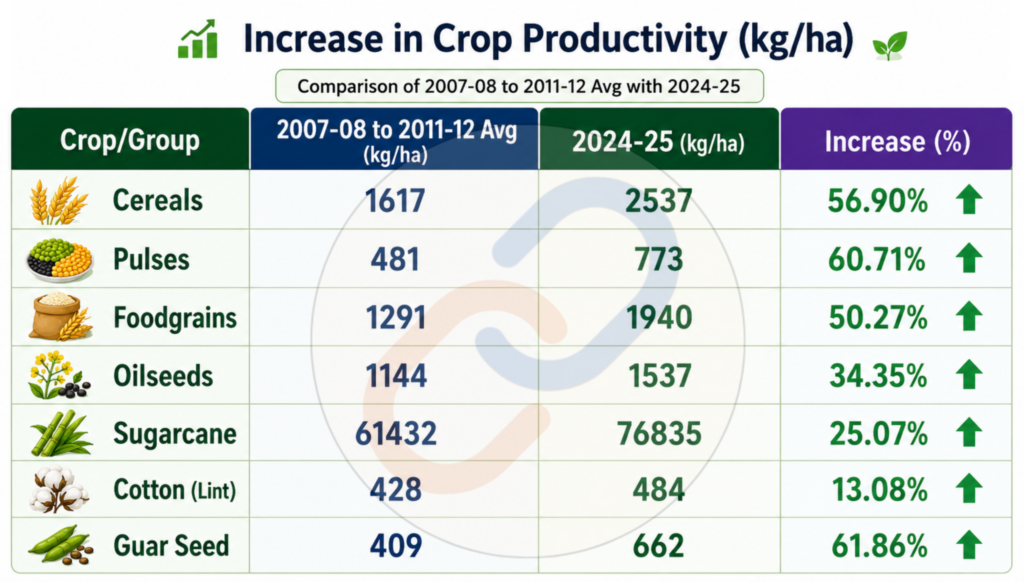
1. Long-Term Productivity Gains (2007-08 to 2011-12 Average vs Recent Years):
2. Advance Estimates 2025-26 (Production in lakh tonnes):
- Total Foodgrains: 283.98 (-8.28%)
- Kharif: 89.55 (-21.61%)
- Rabi: 194.43 (-0.49%)
- Cereals: 236.85 (-11.56%)
- Pulses: 47.13 (+12.75%)
- Oilseeds: 100.46 (+7.18%)
National Standing (2023-24): Rajasthan ranks 1st in Rapeseed & Mustard (43.43%), Bajra (41.34%), Total Oilseeds (23.61%), and Guar (88.80%).
Horticulture: Area under fruits increased by ~35% and production by ~52.7% in recent years. Vegetables and spices have also shown steady growth.
Overall Assessment: Long-term productivity has improved significantly (especially in pulses and cereals), but short-term production remains volatile due to rainfall dependency.
Policy Interventions Undertaken to Improve Productivity
The Rajasthan Government, along with Central schemes, has implemented a multi-pronged strategy:
- Seed Improvement: Mukhyamantri Beej Swavalamban Yojana — promotes farmer-led certified seed production with 50% subsidy.
- Soil Health Management: Soil Health Cards and Goverdhan Jaivik Urvarak Yojana (50% subsidy on organic manure units).
- Irrigation Efficiency: Expansion of micro-irrigation under “Per Drop More Crop” and solar pumps.
- Horticulture Development: MIDH with Centres of Excellence for onion, kinnow, mango, etc.
The Rajasthan Agricultural Competitiveness Project (RACP) is a World Bank-funded initiative launched by the Government of Rajasthan to sustainably enhance agricultural productivity and farmers’ incomes in selected regions through climate-resilient practices, efficient water management, and stronger market linkages.
Implementing Agency: Rajasthan Agricultural Competitiveness Project Management and Implementation Society (RACPMIS), under the Agriculture Department
Objectives
- Sustainably increase agricultural productivity and farmers’ incomes in selected regions of the state.
- Promote climate-resilient agriculture suited to Rajasthan’s arid and semi-arid conditions.
- Improve water use efficiency and management, addressing the state’s core structural constraint.
- Strengthen market linkages and agri-value chains to improve farmers’ price realization.
Key Components
- Watershed development and water harvesting: Building community-level water conservation infrastructure to stabilize irrigation availability.
- On-farm water management and irrigation infrastructure: Improving water-use efficiency at the field level through micro-irrigation and related technologies.
- Agriculture and horticulture diversification: Encouraging farmers to move beyond traditional cropping into higher-value horticulture and diversified farming systems.
- Livestock development and animal health services: Strengthening the allied livestock sector, which provides income stability alongside crop farming.
- Support to agri-business and market access: Building post-harvest and market infrastructure to connect farmers with buyers and reduce intermediary losses.
- Strengthening of Farmer Groups and FPOs: Building collective bargaining power and input/output aggregation capacity among smallholder farmers.
Rajasthan’s agricultural transformation increasingly rests on two pillars beyond traditional farming — physical infrastructure (irrigation, storage, marketing) and technology-driven interventions (drones, digital platforms, soil diagnostics) — both central to converting the sector’s natural constraints into managed, productivity-enhancing systems.
Role of Infrastructure Development
- Irrigation infrastructure: Budget 2026-27 allocated over ₹11,300 crore for irrigation facility works across the state, directly addressing the structural water-dependency constraint on productivity.
- Storage and warehousing: Rajasthan State Warehousing Corporation (RSWC) operates 97 warehouses across 36 districts with 17.25 lakh MT capacity (December 2025); average utilization stood at 48% (8.25 lakh MT), with highest-in-India rebates for SC/ST farmers (70%) and FPOs (60%) reducing post-harvest storage costs.
- Cooperative storage network: 8,912 warehouses have been constructed under cooperative institution schemes, supporting both agricultural produce storage and PDS foodgrain distribution.
- New agri-mandis and market infrastructure: New agricultural markets sanctioned in Banswara, Dausa, and Sriganganagar, plus a vegetable mandi in Sawai Madhopur, improving farmers’ market access and price realization.
- Custom Hiring Centres: 500 Custom Hiring Centres (₹96 crore) enable small and marginal farmers to access mechanized equipment without individual ownership costs.
- Cold chain and processing infrastructure: Godowns of 250 MT and 500 MT capacity under construction (₹20 crore), alongside Centres of Excellence for Onion & Vegetables (Alwar), Kinnow (Sriganganagar), and Mango (Banswara) strengthening crop-specific value chains.
Role of Technological Interventions
- Namo Drone Didi Yojana: Promotes women-led drone services with 3% interest subvention for procurement of 1,070 agricultural drones, enabling precise nano-urea and pesticide application.
- Agri Stack PMU: Provides data-driven consultancy, precision input management, crop planning support, and market intelligence to farmers — a digital backbone for evidence-based farming decisions.
- Soil health diagnostics: 4.79 lakh soil samples collected and 4.15 lakh soil health cards issued (2025-26 up to December), enabling balanced fertilizer application.
- Agri Clinics: Established at district headquarters (20 set up in 2024-25, 13 more underway in 2025-26) to provide expert soil testing, crop advisory, and pest/disease treatment services.
- Mukhyamantri Beej Swavalamban Yojana: Technology-enabled farmer-led seed production, with 1.12 lakh quintals distributed and 31.50 lakh free seed minikits to popularize improved varieties.
- Solar-powered farm technology: 50,000 solar pumps (₹1,500 crore) and subsidies for power tillers, disc ploughs, cultivators, and 500 solar crop dryers, reducing energy costs while improving productivity.
Measures for Further Improvement
- Expand irrigation coverage: Accelerate completion of major projects (ERCP-PKC Link, Narmada Canal) alongside micro-irrigation scale-up to reduce rainfall dependency.
- Increase warehouse utilization: With utilization at only 48% against installed capacity, targeted awareness campaigns and farmer aggregation (via FPOs) could improve capacity use.
- Deepen Agri Stack integration: Extend digital advisory services to all districts with vernacular, mobile-first interfaces for wider farmer adoption.
- Scale up drone and precision agriculture: Expand Namo Drone Didi coverage beyond current numbers to reach a larger share of women-led SHGs.
- Strengthen cold chain infrastructure: Prioritize cold storage expansion for horticulture crops (fruits, vegetables) where post-harvest losses are typically highest.
- Integrate climate-resilient technology: Expand Centres of Excellence and natural farming clusters (currently 2,000, covering 2.50 lakh farmers) to more districts.
Infrastructure and technology together are shifting Rajasthan’s agriculture from a purely rainfall-dependent, fragmented system toward a more resilient, data-informed, and market-connected sector — a transition central to achieving the ANNADATA pillar of Viksit Rajasthan@2047, provided utilization gaps in existing infrastructure are closed alongside continued technological expansion.



