

Indian National Movement 1939 – 1947 is an important topic in Modern Indian History that covers the final phase of India’s freedom struggle against British rule. This period includes major events such as the Quit India Movement, INA activities, partition of India, and the achievement of independence in 1947.
Major Events of Indian National Movement (1939–1947)
Second World War & Nationalist Response
- Sept 1, 1939: Germany invades Poland; WWII begins.
- Sept 3, 1939: Britain declares war on Germany.
- British Government of India declares India a belligerent without consulting Indians.
Congress’ Initial Offer to Viceroy
- Congress decided to support the war effort conditionally:
- Post-war: A Constituent Assembly should frame a free India’s political structure.
- Immediate: Some form of responsible central government must be created.
- Viceroy Linlithgow rejected the offer.
British Statement (Jan 1940) –
- Promised Dominion Status after war — unacceptable to Congress.
- Ramgarh Session (March 1940) — President: Maulana Azad
- All agreed a battle must be waged — disagreed only on timing and form.
- Left decisions on timing to Gandhi.
- Gandhi still willing to offer moral, non-violent support to Allies.
- Subhas Bose demanded direct action taking advantage of Britain’s weakness.
August Resolution (8 August 1940) –
- Lord Linlithgow, proposed dominion status after ww2 and expand governor general’s council with more Indians.
- Congress and league both rejected this .
Individual Satyagraha (1940–41) –
- British Attitude
- Declared no constitutional progress until Congress reached agreement with Muslim leaders.
- Passed many ordinances restricting:
- Freedom of speech
- Freedom of press
- Right to form associations
- Congress Turns to Gandhi Again
- Late 1940: Congress requests Gandhi to lead.
- Gandhi prepares for a future mass movement, begins with limited individual satyagraha.
- Nature of Protest
- Satyagrahi demands freedom of speech through an anti-war declaration.
- Delhi Chalo Movement.
- Leaders & Impact
- Vinoba Bhave: first satyagrahi.
- Jawaharlal Nehru: second satyagrahi.
- By May 1941: 25,000 arrested for individual civil disobedience.
- Changes in Executive Council (July 1941) –
- Viceroy’s Executive Council expanded: Indians
- Key departments — Defence, Home, Finance—remained with the British.
- National Defence Council created with only advisory powers.
Pakistan Resolution (Lahore, March 1940) —
Muslim League
- Demanded grouping of Muslim-majority contiguous areas (NW + East) into:
- “Independent states”
- Constituent units to be autonomous and sovereign.
- Demanded safeguards for Muslims where they were in minority.
- Demand for a Constituent Assembly formally conceded.
- Dominion status was explicitly offered.
Launch of the Quit India Movement 1942 –
- Congress Working Committee of the Indian National Congress met at Wardha on July 14, 1942.
- Congress decided to launch a mass civil disobedience.
- All India Congress Committee met at Gowalia Tank, Bombay, on 8 August 1942 .
- Passed the famous Quit India Resolution. sloganed ‘Do or Die’ .
Wardha CWC Meeting — Internal Debates
Gandhi’s View
- Sympathetic to Britain because he hated fascism.
- Suggested unconditional support, but no embarrassment to Britain during war.
Socialists’ View (Bose, JP, Narendra Dev)
- No sympathy for either side — both were imperialist.
- Felt it was the right moment for civil disobedience to force independence.
Nehru’s View
- Morally opposed fascism, but Britain/France still imperialist.
- No cooperation unless India was free first.
- No immediate civil disobedience.
Resolution:
- Condemned Fascist aggression.
- India cannot join a war for “democracy” while itself denied democracy.
- British must clarify war aims and future of Indian democracy.
QUIT INDIA MOVEMENT
Why Congress Started a Struggle in 1942 –
- Failure of the Cripps Mission showed Britain would not grant real constitutional advance.
- Any further silence by nationalists would mean accepting British authority in deciding India’s future.
- Severe popular discontent due to rising prices, shortages of rice and salt.
- Hardships due to commandeering of boats in Bengal and Orissa.
- Fear of British scorched-earth policy in Assam, Bengal, and Orissa.
- British defeats in South-East Asia made a Japanese attack on India seem imminent.
- Collapse of British prestige after Japan’s victories; mass withdrawal of deposits from banks occurred.
- Racist British evacuation from Burma (SE Asia):
Quit India Resolution (8 August 1942, Bombay)
- Congress Working Committee first passed a resolution at Wardha (July 14, 1942).
- Quit India proposal was presented in the All India Congress Committee meeting in Bombay on August 7, 1942.
- Ratified at the Gowalia Tank Maidan (August 8, 1942) = now the “August Kranti Maidan.”
- Gandhiji said about this movement that,
“India’s soil will create a movement that will be bigger than the Congress.”
- Proposed by Jawaharlal Nehru; seconded by Sardar Patel.
- Main decisions:
- Demand immediate British withdrawal.
- Launch of a mass civil disobedience movement.
- Gandhi was appointed leader of the movement.
- Gandhi’s famous call: “Do or Die.”
- Gandhi’s Instructions to Various Groups
- Govt servants → Don’t resign; declare allegiance to Congress.
- Soldiers → Stay in army; don’t fire on Indians.
- Students → Leave studies if confident.
- Peasants →
- If zamindars anti-govt → pay mutually agreed rent.
- If pro-govt → withhold rent.
- Princes → Support people; accept their sovereignty.
- People in princely states → Support rulers only if anti-British.
- Gandhiji and Sarojini Naidu were placed under house arrest at Aaga Khan Palace in Pune, while other leaders were detained at Ahmednagar Fort.
- Rajendra Prasad was arrested and kept in detention in Patna.
- Spread of the Movement –
- All top leaders (Gandhi, Nehru, Patel, Azad, etc.) arrested pre-dawn on 9 August 1942.
- Aruna Asaf Ali hoisted the Indian flag at the Bombay session on August 9.
- Strongest in Eastern UP, Bihar, Midnapore, Maharashtra, Karnataka.
- Led by Socialists, Forward Bloc members, Gandhians, revolutionaries.
- Major underground leaders:
- Jayaprakash Narayan, Rammanohar Lohia, Aruna Asaf Ali, Usha Mehta, Biju Patnaik, Achyut Patwardhan, Sucheta Kripalani, R.P. Goenka, Chhotubhai Puranik.
- Usha Mehta set up the famous Underground Radio (Congress Radio).
- Sumati Morarji regularly provided Achyut Patwardhan with a new car, keeping him safe from arrest.
- Jayaprakash Narayan ran away from Hazaribagh jail on 9 November 1942 and made ‘Azad Dasta’.
- Three members of the Viceroy’s executive (MS Annie, NR Sarkar, HP Modi) resigned.
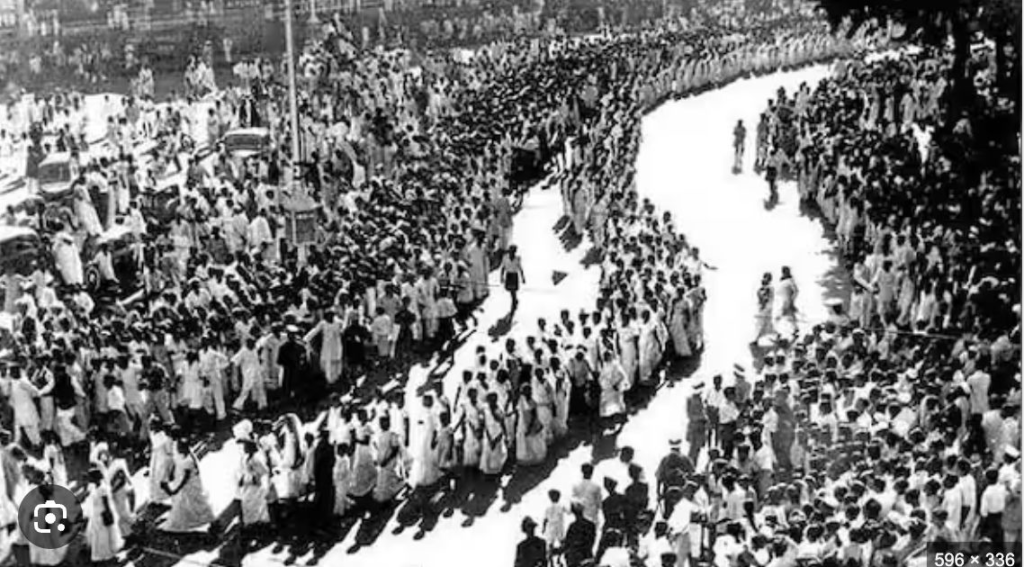
Parallel Governments
- Ballia (UP) – Aug 1942, led by Chittu Pandey; freed some Congress leaders.
- Tamluk (Midnapore, Bengal) – 1942–44, known as Jatiya Sarkar, Vidyut Vahinis.
- Satara (Maharashtra) – 1943–45; Prati Sarkar under Y.B. Chavan & Nana Patil.
- Ran people’s courts, libraries, prohibition campaigns, organised “Gandhi marriages.”
Activities in different states
|
Region |
Activities |
|
Bihar |
|
|
Uttar Pradesh (UP) |
|
|
Bengal |
|
|
Western India |
|
|
South India |
|
Participation of Various Social Groups
- Youth & students , Women – active role (Aruna Asaf Ali, Sucheta Kripalani, Usha Mehta)
- Workers Peasants – no anti-zamindar violence. Lower-level government employees & police often passed information to activists.
- Many Muslims sheltered underground leaders; no communal riots.
- Communists opposed movement after USSR entered Allied side (called war a “People’s War”).
- Muslim League opposed — feared Hindu dominance if British left.
- Hindu Mahasabha boycotted.
- Princely states gave muted response
Gandhi’s Fast (Feb 1943) –
- On 10 February 1943, Gandhiji started a fast in jail, as the government was pressurizing him to condemn violent activities. Gandhiji blamed the British government for the violence.
- The demand for Gandhiji’s release increased, and on 6 May 1944 he was released on the basis of illness.
March 23, 1943 Pakistan Day was observed.
- FAMINE OF 1943 — Occurred during World War II; worsened hardships created by the war.
- Fundamental causes:
- Food diverted to feed the large Allied army.
- Rice imports stopped due to Japanese occupation of Burma & SE Asia.
- Gross mismanagement & profiteering; rationing started late and only in big cities.
- Fundamental causes:
British Response to Quit India Movement 1942
- The British responded to the Quit India Movement with swift repression, arresting key Congress leaders
- Detaining over 100,000 people, and declaring the Congress unlawful.
- Violent clashes led to significant casualties, with deaths ranging from 1,028 to over 10,000.
Nature of the Quit India Movement (1942) –
- Different from Earlier Gandhian Movements
- Non-Cooperation Movement (1920–22) and Civil Disobedience Movement (1930–34):
- Were conceived as peaceful mass struggles
- Social base expanded gradually
- Strict emphasis on non-violence and discipline
- Quit India Movement (1942):
- Began as a massive uprising from the very beginning
- Aim was to force the British to quit India immediately
- No phased or gradual approach
- Ends Justifying Means
- British attitude during World War II and support to Jinnah’s communal politics deeply frustrated Gandhi
- Failure of negotiations (Cripps Mission) hardened Indian public opinion
- In Harijan (March 1942):
- Gandhi wrote that every Indian must consider himself free
- Individuals should act independently to achieve freedom
- Thus:
- Greater emphasis on ends (freedom) rather than means (non-violent methods)
- Clear Goal and Objectives –
- Complete withdrawal of British rule from India
- Four main features:
- Acceptance of violence against the colonial state
- Participation of anyone believing in complete independence, not just trained satyagrahis
- Students were expected to play a major leadership role after arrests
- Call for total defiance of government authority
- Underground Activities –
- Extensive underground resistance developed due to repression
- Purpose of underground activities:
- Maintain popular morale
- Establish a line of command
- Provide guidance to activists
- Distribute arms and ammunition
- Activities included:
- Secret meetings
- Sabotage of communication lines
- Circulation of illegal pamphlets
- Underground radio broadcasts
- Overall Character –
- Most radical, spontaneous, and mass-based movement of the freedom struggle
- Reflected:
- Deep popular anger
- Determination for immediate independence
- Though suppressed brutally, it:
- Made British rule morally and politically untenable
- Marked the final mass upsurge before independence
National movements, Congress activities, British policy 1945-47 –
- Two basic strands shaped the national upsurge in the last 2 years of British rule.
- Negotiations between British Govt, Congress, Muslim League; accompanied by growing communal violence → ended in freedom + partition.
- Militant, localised mass actions by workers, peasants & princely states’ people.
- Major militant actions/events:
- INA Release Movement
- Royal Indian Navy (RIN) Revolt
- Tebhaga Movement
- Worli Revolt
- Punjab Kisan Morchas
- Travancore people’s struggle (Punnapra–Vayalar)
- Telangana Peasant Revolt
- Major militant actions/events:
- July 1945:
- Labour Party came to power in Britain. Labour government sympathetic to Indian demands
- Clement Attlee became PM.
- Pethick-Lawrence became Secretary of State for India.
- Britain no longer a major power; USA & USSR favoured Indian freedom.
- British economy destroyed; Britain owed £1.2 billion to India.
- Labour Party came to power in Britain. Labour government sympathetic to Indian demands
- August 1945: Elections to central & provincial assemblies announced.
- CONGRESS ELECTION CAMPAIGN (1945–46) & INA TRIALS Elections held in winter 1945–46.
- INA Trials
- First major trial (Nov 1945) held at Red Fort, Delhi. Accused trio represented Hindu-Muslim-Sikh unity:
- Prem Kumar Sehgal (Hindu)
- Shah Nawaz Khan (Muslim)
- Gurbaksh Singh Dhillon (Sikh)
- Trials led to massive anti-British sentiment nationwide.
- Bhulabhai Desai led the team of defence lawyers in the Azad Hind Fauj (INA) trial at the Red Fort with the team of other lawyers –
- Tej Bahadur Sapru
- Kailash Nath Katju
- Jawaharlal Nehru
- Asaf Ali
- First major trial (Nov 1945) held at Red Fort, Delhi. Accused trio represented Hindu-Muslim-Sikh unity:
- Royal Indian Navy Revolt – Feb 18, 1946 → RIN Revolt (Bombay)
- Reasons:
- Racial discrimination (equal pay demand)
- Bad food
- Abuse by officers
- Arrest for writing “Quit India”
- INA trials
- Use of Indian troops in Indonesia
- Royal Indian Air Force strikes: Bombay, Poona, Calcutta, Jessore, Ambala.
- Patel & Jinnah intervened → ratings surrendered on Feb 23 after assurance of no victimisation.
- Impact of Royal Indian Navy Revolt –
- Armed forces revolt had huge psychological impact on people. RIN revolt seen as symbolising the end of British rule.
- Reasons:
- ELECTION RESULTS (1945–46)
- Congress performance
- Won 91% of non-Muslim votes.
- Won 57/102 Central Assembly seats.
- Majority in most provinces except Bengal, Sindh, Punjab.
- Won NWFP & Assam — both claimed by League for Pakistan.
- Muslim League performance
- Won 86.6% of Muslim votes.
- Won all 30 reserved Muslim seats in Central Assembly.
- Majority in Bengal & Sindh.
- Clearly emerged as sole representative of Muslims.
- Punjab
- Coalition of Unionist–Congress–Akali under Khizar Hayat Khan formed govt.
- Congress performance
- Communal Holocaust and Interim Government (1946–1947)
- From 16 August 1946, India witnessed unprecedented communal riots, causing several thousand deaths.
- Worst-hit areas: Calcutta, Bombay, Noakhali, Bihar, Garhmukteshwar.
- Interim Government (Sept 2, 1946 – Aug 15, 1947)
- Headed by Jawaharlal Nehru, dominated by Congress.
- Congress opposed compulsory groupings.
- Initially, Interim Government resembled the old Viceroy executive.
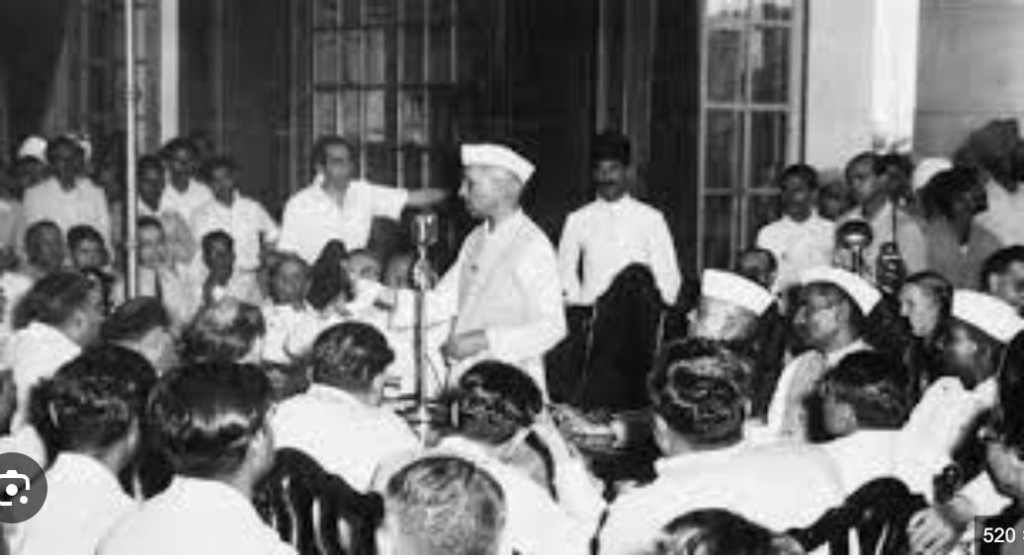
- Muslim League joined on 26 Oct 1946 .
- Congress: Nehru, Patel, Baldev Singh, John Mathai, Rajagopalachari, C.H. Bhabha, Rajendra Prasad, Jagjivan Ram, Asaf Ali, Jogendra Nath Mandal (later allied)
- Muslim League: Liaquat Ali Khan, Ibrahim Ismail Chundrigar, Abdur Rab Nishtar, Ghazanfar Ali Khan, Jogendra Nath Mandal.
- League’s Obstructionist Tactics
- Refused to attend Constituent Assembly (Dec 9, 1946).
- Finance minister Liaquat Ali Khan obstructed other ministries.
- League’s main goal: secure Pakistan, not cooperation.
- Feb 1947: Congress ministers demanded resignation of League members; League demanded Constituent Assembly dissolution, causing a political crisis.
The Bombay Plan –
- Known as “A brief memorandum presenting the outline of India’s economic development plan”.
- It was signed by eight industrialists –
- J.R.D. Tata, Ghanshyam Das Birla, Ardeshir Dalal, Lala Shri Ram, Kasturbhai Lalbhai, Darabshaw Shroff, Sir Purushottam Das Thakurdas and John Mathai.
- Aimed to double income in 15 years .
- Heavy govt investment and control over the development of heavy and basic industries.
Independence and Partition
Background –
- Communal riots and the failure of Congress–League coalition made partition appear unavoidable by early 1947.
- Jawaharlal Nehru (10 March 1947):
- Cabinet Mission Plan was the best solution if implemented.
- Only alternative was partition of Punjab and Bengal.
- Congress President Kripalani (April 1947):
- Conveyed to the Viceroy that Congress would accept Pakistan only if Bengal and Punjab were fairly partitioned.
Mountbatten Plan (3 June 1947)
- Accepted the freedom-with-partition formula.
- Suggested by V.P. Menon:
- Immediate transfer of power.
- Grant of dominion status with right of secession.
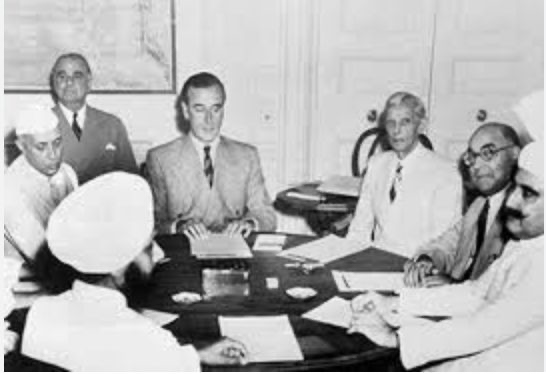
- Bengal and Punjab assemblies voted for partition.
- East Bengal and West Punjab → Pakistan.
- West Bengal and East Punjab → India.
- Referendums:
- Sylhet → Pakistan
- NWFP → Pakistan (Congress boycotted).
- Baluchistan and Sindh joined Pakistan.
Indian Independence Act, 1947
- Passed on 5 July 1947.
- Royal assent on 18 July 1947.
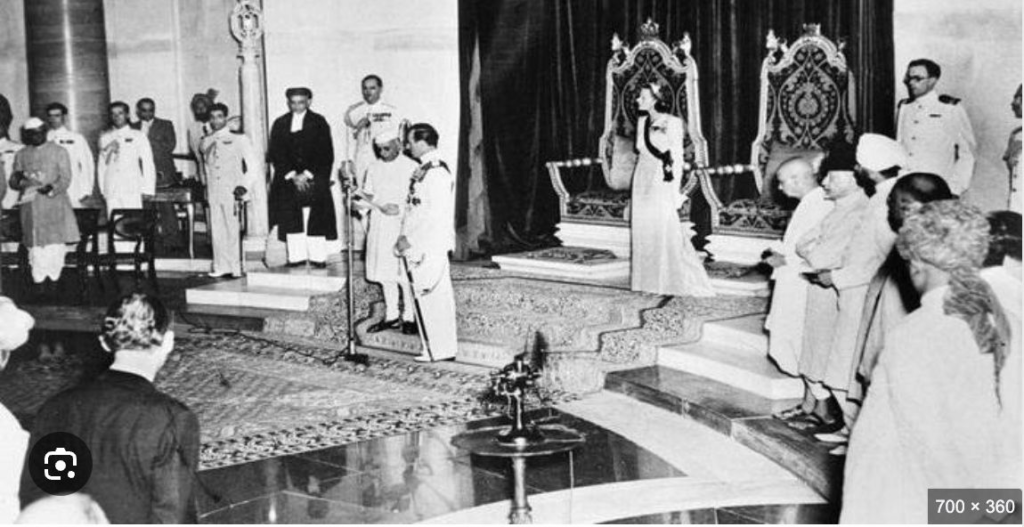
- Implemented on 15 August 1947.
Key Provisions
- Creation of two independent dominions: India and Pakistan.
- Constituent Assemblies to function as legislatures.
- Till new constitutions:
- Government to run under Government of India Act, 1935.
- Pakistan became independent on 14 August 1947.
- M.A. Jinnah → First Governor General of Pakistan.
- Mountbatten continued as Governor General of India.
- Problems of Early Withdrawal –
- No transitional institutions to handle partition.
- Mountbatten’s plan to be common Governor General failed (Jinnah refused).
- Radcliffe Award delayed:
- Ready by 12 August 1947.
- Announced after 15 August.
- British avoided responsibility for riots.
- Failure to prevent Punjab massacres.
Radcliffe’s Boundary Award & Communal Riots –
Decision on Partition of Punjab and Bengal
- Legislative assemblies of Punjab and Bengal met in two sections:
- Muslim-majority districts
- Non-Muslim districts
- By simple majority, both provinces voted for partition.
- Large religious minorities existed on both sides of the Radcliffe Line.
Challenges Before the Boundary Commission –
- Appointed in haste by the British government
- Chairman: Sir Cyril Radcliffe
- Composition:
- 2 Muslim + 2 non-Muslim judges for each commission
- Radcliffe:
- Had no prior experience of India
- Used outdated maps and census data
- Given only 6 weeks to draw boundaries
- Criteria for Drawing Boundaries
- Religious demography was the primary factor
- Other factors considered:
- Rivers as natural boundaries
- Administrative convenience
- Economic viability
- Rail and road connectivity
- Canal and irrigation systems
- Other factors considered:
- Sikh Problem –
- Sikhs were demographically scattered in Punjab
- Demanded inclusion of all Sikh holy shrines in East Punjab (India)
- 1941 Census data was faulty.
Announcement of the Award
Delayed Publication
- Boundary Commission report ready by 12 August 1947
- Lord Mountbatten delayed its publication till after 15 August
- Objective:
- To avoid British responsibility for communal riots and violence
- British Exit Strategy
Communal Riots & Violence
Spread of Riots
- Communal violence began in August 1946
- Intensified after announcement of partition and independence
- Worst affected regions:
- Areas along the Radcliffe Line, especially Punjab
- Regional Variation in Violence
- Punjab
- Most violent region.
- A war of extermination on both sides of the border
- Bengal
- Comparatively less violence
- Due to Gandhi’s presence and fasts
- Delhi
- Riots erupted with massacre of Muslims
- Revenge violence linked to events in Punjab
- Gandhian fasts had only temporary effect
- Bihar & United Provinces
- October 1946 (pre-partition):
- Muslims killed in Bihar
- Violence allegedly instigated by landlords to divert agrarian unrest
- October 1946 (pre-partition):
- Garhmukteswar (UP):
- Hindu pilgrims killed thousands of Muslims
- Punjab
- Why Were Casualties So High?
- Administrative Failure
- Governor-General anticipated riots and formed:
- Boundary Force of 50,000 men
- Nehru refused British military intervention
- Boundary Force itself:
- Governor-General anticipated riots and formed:
- Administrative Failure
- Divided along communal lines
- Breakdown of Authority
- European officers were preparing to leave India
Division of Resources
Division of Civil Government –
- A Partition Council was set up:
- Presided over by the Governor-General
- Included two representatives each from India and Pakistan
- A Steering Committee assisted the council:
- Members:
- H.M. Patel (India)
- Muhammad Ali (Pakistan)
- Members:
- All civil servants were given the option to choose:
- Whether to serve India or Pakistan
- Around 1,60,000 government employees opted for transfer across borders.
Division of Finances –
- Division of cash balances and public debt created serious tensions between India and Pakistan after Partition.
- Pakistan’s demand:
- Claimed one-fourth (25%) share of the total cash balances of undivided India.
- India’s position:
- Argued that only a small portion of cash balances represented actual working cash.
- The larger portion was maintained as an anti-inflationary reserve, not meant for routine expenditure.
- According to Ramachandra Guha (India After Gandhi):
- India withheld Pakistan’s share of the ‘sterling balance’.
- Sterling balance was the amount owed by Britain to India, jointly belonging to both dominions.
- This debt arose due to Indian financial contributions to the Second World War.
- Amount involved:
- Approximately Rs 550 million was due to Pakistan.
- Reason for India withholding the amount:
- Indian government was angered by Pakistan’s attempt to seize Kashmir by force.
- Hence, India was unwilling to release the payment immediately.
- Gandhi’s response:
- Considered India’s action unnecessarily spiteful and unethical.
- Undertook a fast to protest the withholding of Pakistan’s share.
- Condition of Gandhi’s fast:
- Ending the fast was made conditional upon the transfer of money to Pakistan.
- Outcome:
- Gandhi succeeded in pressurising the Congress leadership.
- India agreed to release more cash resources to Pakistan.
- Aftermath / Historical interpretation:
- According to some scholars, Gandhi’s insistence on paying Pakistan became one of the factors behind his assassination by a Hindu fanatic.
A Joint Defence Council was set up –
- Headed by Lord Auchinleck
- Position: Supreme Commander
- Responsibilities:
- Division of:
- Armed forces
- Plants
- Machinery
- Equipment
- Stores
- Division of:
- Decision:
- Muslim-majority units → Pakistan
- Non-Muslim units → India
- Due to serious disagreements:
- Post of Supreme Commander abolished.
- British troops:
- Began leaving India on August 17, 1947
- Withdrawal completed by February 1948.
Assassination of Mahatma Gandhi –
- Date: January 30, 1948
- Place: Birla House (New Delhi)
- Event:
- Gandhi was shot during evening prayer meeting
- Assassin:
- Nathuram Godse
- Jawaharlal Nehru (AIR address):
- “The light has gone out of our lives…”
- Sardar Patel:
- Urged people not to seek revenge
- Emphasised non-violence and self-reflection
- Trial of Godse
- Godse:
- Tried and sentenced to death
- Claimed motive:
- Gandhi’s “pro-Muslim” stance
- Especially his last fast for Pakistan’s dues
Why partition was necessary?
Gradual Concessions to the Muslim League
- Acceptance of partition was the final stage of step-by-step concessions to the League’s demand for a separate Muslim state:
- Cripps Mission (1942):
- Accepted autonomy of Muslim-majority provinces.
- Gandhi–Jinnah Talks (1944):
- Gandhi accepted the right of self-determination of Muslim-majority provinces.
- Cabinet Mission Plan (1946):
- Congress accepted possibility of a separate constituent assembly for Muslim-majority provinces.
- Later accepted compulsory grouping (December 1946).
- March 1947 CWC Resolution:
- Stated Punjab (and implicitly Bengal) must be partitioned if India was divided.
- 3 June Plan (1947):
- Congress formally accepted partition.
- Statements Reflecting Congress Leaders’ Thinking –
- Jawaharlal Nehru:
- Daily killings in Punjab made partition appear the only escape.
- Sardar Patel:
- Feared India would break into multiple Pakistans if partition was not accepted.
- Believed partition prevented administrative collapse.
- Maulana Azad:
- Partition accepted only by political organisations, not by the people.
- Many accepted it out of anger, resentment, or despair, not conviction.
- Jawaharlal Nehru:
British Role: Interpretations –
- Wali Khan:
- Britain created Pakistan due to international strategic compulsions, not Muslim welfare.
- R.J. Moore:
- Gradual devolution of power in a desperate society was inherently divisive.
- Britain was neither pro-Hindu nor pro-Muslim; imperial interests dominated.
Jinnah’s Assertion –
- M.A. Jinnah:
- Claimed sole credit for the creation of Pakistan.
Gandhi urged Congressmen –
- To accept partition politically
- But not in their hearts
Institutional Response in India
- Indian government set up:
- An Emergency Cabinet Committee to handle the Delhi crisis.
- A Ministry of Relief and Rehabilitation to manage refugee issues.
- Concept of ‘evacuee property’:
- Meant to protect property of those who migrated to Pakistan for possible return.
- Became meaningless in practice, as refugees occupied vacant Muslim houses.
- Later made the return of refugees impossible.
Delhi Pact on Minorities (Nehru–Liaquat Pact)
- Background
- Signed to:
- Address refugee problems.
- Restore communal peace, especially in Bengal.
- Key Features
- Signed on 8 April 1950.
- Signatories:
- Jawaharlal Nehru (India)
- Liaquat Ali Khan (Pakistan)
- Also known as Nehru–Liaquat Pact.
- Provisions
- Appointment of minority community ministers:
- At central and provincial levels in both countries.
- Appointment of minority community ministers:
- Establishment of:
- Minority Commissions
- Commissions of Inquiry to:
- Investigate causes of communal riots.
- Recommend preventive measures.
- Inclusion of minority representatives in:
- Cabinets of East Pakistan and West Bengal.
- Deployment of:
- Two central ministers (one from each country) in affected regions.
- Creation of an agency to:
- Recover and rehabilitate abducted women (widely criticised).
- Failure of the Pact –
- Attempt to encourage refugee return failed.
- Governments failed to:
- Restore confidence among refugees.
- Refugee properties declared ‘enemy property’.
- India later amended the Enemy Property Act (1968) in 2016.
- Criticism
- Criticised by Hindu nationalists:
- Syama Prasad Mukherjee
- K.C. Neogy
- Mukherjee:
- Resigned from Nehru’s cabinet.
- Believed refugee problem required:
- Population transfer
- Territorial acquisition from Pakistan.
- Criticised by Hindu nationalists:
Communists and Independence
Communist Party of India (CPI) Stand
- In December 1947, CPI termed independence as ‘fake’.
- Slogan: “Ye azadi jhooti hai”.
- Adopted at Second Party Congress (Calcutta).
- Declared Indian state as main enemy of the people.
- Goal:
- Overthrow government through general revolution.
- Followed B.T. Ranadive line.
- Proposed:
- A People’s Democratic Republic
- Rule of workers, peasants, and oppressed middle classes.
Why Communists Rejected Independence
- Belief in class struggle and armed revolt against Congress-led bourgeois state.
- Inspired by communist victories in Asia:



