

Health

Sol – 

SDG goal 3 calls upon states to ensure healthy lives and promote well-being for all at all ages. In line with this, India has implemented various initiatives aimed at ensuring quality and affordable healthcare accessible to all its citizens.

Major schemes – 

Scheme

Scheme

Scheme

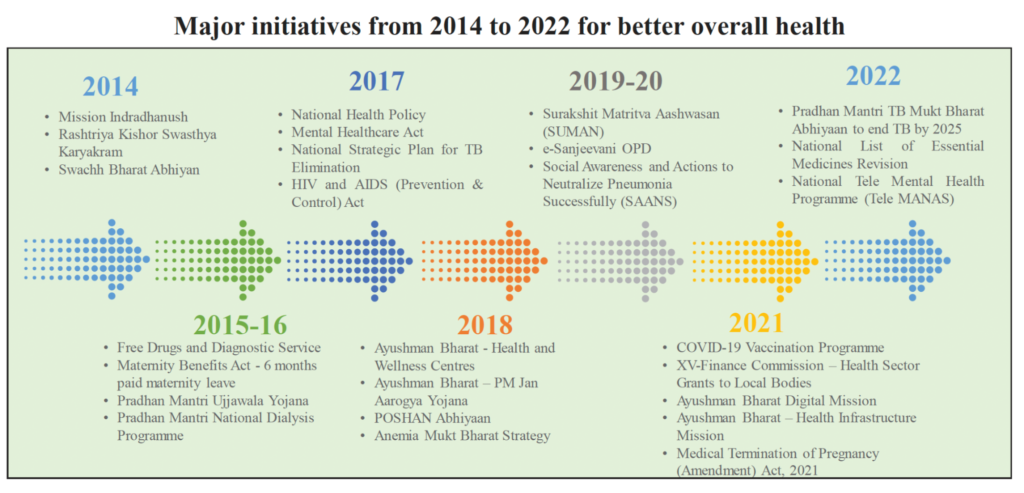
Ayushman Bharat – Pradhan Mantri Jan Arogya Yojana (PM-JAY),

  • World’s largest health assurance scheme.
  • ₹5 lakh per family per year for secondary and tertiary care.
  • Now extended to all citizens aged 70 years and above (Budget 2024–25).
  • Janani Suraksha Yojana – To reduce maternal and neonatal mortality by promoting institutional delivery among poor pregnant women
  • Pradhan Mantri Matru Vandana Yojana – partial wage compensation to women for wage loss during childbirth and childcare
  • Surakshit Matritva Aashwasan (SUMAN) – For Zero preventable maternal and newborn deaths
  • e-Sanjeevani OPD – National Telemedicine Service of India is a step towards digital health equity to achieve Universal Health Coverage (UHC)
  • eSanjeevani Telemedicine Platform:
    • Over 31 crore consultations.
    • Facilitates doctor-to-patient and doctor-to-doctor services, especially in rural areas.
  • Social Awareness and Actions to Neutralize Pneumonia Successfully (SAANS) – Launched in November 2019 to reduce childhood pneumonia deaths
  • Ayushman Arogya Mandirs:
    • Over 1.75 lakh Health and Wellness Centres.
    • Offer free diagnostics, medicines, maternal and child health services, and NCD screenings.
  • Maternity Benefits Act – 6 months paid maternity leave
  • Pradhan Mantri Ujjwala Yojana – To improve the health of women and children by providing them with clean cooking fuel, LPG, instead of smoky fuels or firewood
  • Pradhan Mantri National Dialysis Programme – Strengthening of District Hospitals by providing affordable dialysis services
  • Ayushman BharatHealth and Wellness Centres – Name changed to ‘Ayushman Arogya Mandir’ with the tagline ‘Arogyam Parmam Dhanam’
    • The creation of 1.5 Lakh Health & Wellness Centres
  • Jan Aushadhi Scheme: Promotes low-cost generic medicines through 14,000+ Jan Aushadhi Kendras.
  • POSHAN Abhiyaan – To reduce stunting, undernutrition, anemia (among young children, women, and adolescent girls), and low birth weight by 2%, 2%, 3%, and 2% per annum, respectively.
  • Anemia Mukt Bharat Strategy – To reduce anaemia among six beneficiary age groups – children (6-59 months), children (5-9 years), adolescents (10-19 years), pregnant and lactating women, and women of reproductive age (15-49 years)
  • COVID-19 Vaccination Programme – To include all persons aged 12 years and above, and for the precautionary dose for all persons aged 18 years and above
  • Ayushman Bharat Digital Mission – The backbone necessary to support the integrated digital health infrastructure of the country
  • Ayushman Bharat – Health Infrastructure Mission –
    • Launched in 2021 to strengthen critical health infrastructure.
    • Focus on all levels, viz., primary, secondary, and tertiary, and on preparing health systems to respond effectively to the current and future pandemics/disasters.
  • Medical Termination of Pregnancy (Amendment) Act, 2021 – 
  • National Health Policy 2017 
  • Mental Healthcare Act 2017 
  • National Strategic Plan for TB Elimination 2017
  • HIV and AIDS (Prevention & Control) Act 2017 
  • Mission Indradhanush 2014 
  • Rashtriya Kishor Swasthya Karyakram 2014 
  • Swachh Bharat Abhiyan 2014 
  • Pradhan Mantri TB Mukt Bharat Abhiyaan 2022 to end TB by 2025 
  • National Tele Mental Health Programme (Tele MANAS)
  • National Deworming Day
  • Universal Immunisation Programme (UIP):
    • Immunisation against 11 diseases
    • Achieved 93.5% immunisation coverage in FY24.

Improvements in overall health – 

  • Total fertility rate (children per woman) decreased from 2.2 (NFHS-4) to 2.0 (NFHS-5)
  • Health Insurance Coverage increased from 28.7% (NFHS-4) to 41.0% (NFHS-5)
  • Institutional births increased from 78.9% (NFHS-4) to 88.6% (NFHS-5)
  • Infant mortality rate decreased from 40.7% (NFHS-4) to 35.2%  (NFHS-5)
  • Children under 5 years who are stunted (height-for-age) decreased from 38.4% (NFHS-4) to 35.5%  (NFHS-5)
  • Children under 5 years who are wasted (weight-for-height) decreased from 21.0% (NFHS-4) to 19.3%  (NFHS-5)
  • Government Health Expenditure (GHE) has risen to 48% of Total Health Expenditure, reducing dependence on out-of-pocket payments.
  • Out-of-Pocket Expenditure (OOPE) dropped from 62.6% in FY15 to 39.4% in FY22, reflecting financial protection for citizens.
  • AI and tech integration (e.g., silicosis screening in Rajasthan, drone-based medicine delivery in NE India) enhanced last-mile care.

In conclusion, prioritizing quality healthcare is paramount for leveraging India’s demographic dividend and advancing the nation’s progress during the next 25 years of Amrit Kaal.


Leave a Comment

Your email address will not be published. Required fields are marked *

error: Content is protected !!
Scroll to Top
Telegram WhatsApp Chat