

Agriculture Productivity and Progress & Major policy initiatives in agriculture

Sol –

Millets are small cereal grains that are very nutritious. Some examples are – Kodo, Kutki, Foxtail, pearl millet, finger millet, Sorghum, etc 

Increasing importance at the national and international level – 

  1. The United Nations General Assembly declared 2023 the International Year of Millets (IYM)
  2. The government of India notified Millets as Nutri-cereals in April 2018
  3. Millet-based dishes served for lunch and dinner at G20 events 
  4. Millet Menu in Parliament – Bajre ki raab (soup), ragi dosa, Jowar Upma etc 
  5. Included in the National Food Security Mission (NFSM), to provide nutritional support
  6. A sub-mission on Nutri-cereals has been implemented since 2018-19 in 212 districts of 14 States
  7. The Indian Institute of Millets Research has incubated 250 start-ups under the Rashtriya Krishi Vikas Yojana
  8. Globally, India is the largest producer of millet, accounting for about 41% of the world’s production
  9. India accounts for more than 80 % of the millet produced in Asia
  10. PM inaugurates the Global Millets (Shree Anna) Conference

Justified because – 

  • High Nutritional value – 
    • Millets contain 7-12% protein and 15-20% dietary fiber
    • Very good sources of micronutrients, such as vitamins and minerals such as calcium, iron, zinc, potassium, and magnesium
  • Climate-resilient, and align with several UN Sustainable Development Goals (SDGs) –
    • Requires less water and agricultural inputs than other staple crops
  • Potential to generate livelihood, increase farmers’ income, and ensure food & nutritional security all over the world
    • India has more than 500 start-ups working in the millet value chains
  • Health benefits – 
    • They are low in Glycemic Index (GI) and, as such, do not cause huge spikes in blood sugar
    • Millets are gluten-free and can be consumed by patients suffering from celiac disease
    • They help in rendering health benefits like reduction in blood sugar level (diabetes), blood pressure, thyroid, cardiovascular and celiac diseases
  • Higher average yield – The global average yield is 1229 kg/ha, whereas India has a higher average yield of 1239 kg/ha

Additional info – The state of Rajasthan has the highest area under millets cultivation (29.05%) followed by Maharashtra (20.67%), Karnataka (13.46%), Uttar Pradesh (8.06%), Madhya Pradesh (6.11%), Gujarat (3.94%), and Tamil Nadu (3.74%).
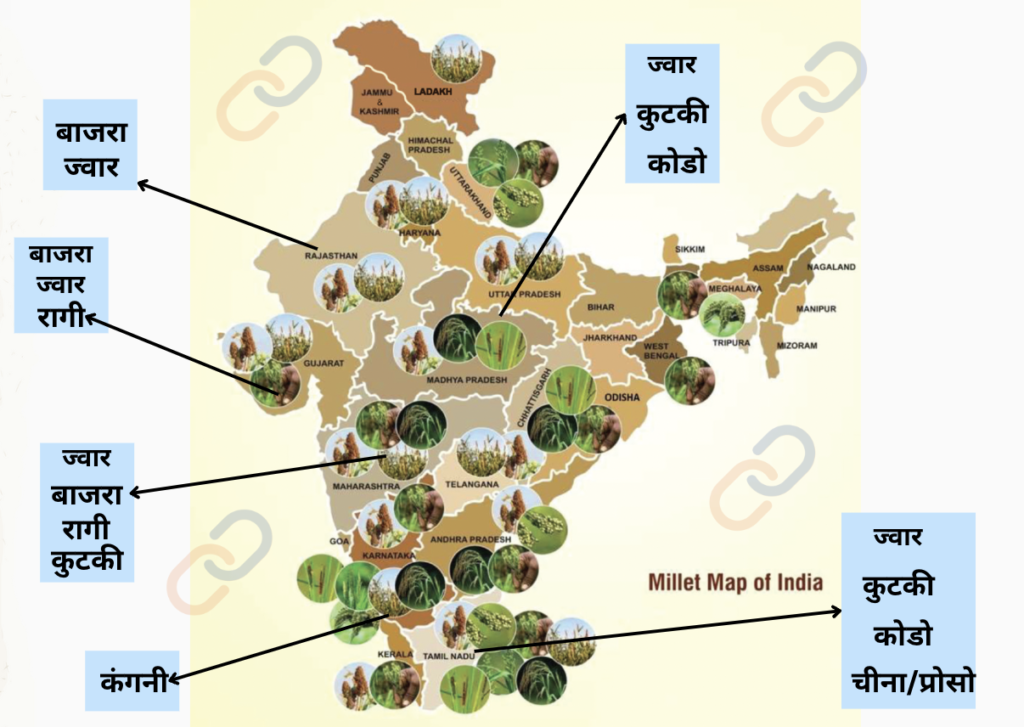
Sol – 

India’s agriculture plays a crucial role in ensuring national food security, maintaining affordable food prices for a significant low-income population, and providing employment for almost 55% of the country’s workforce. However, the sector faces various challenges that adversely impact its development and threaten the livelihoods of farmers.

Factors

Challanges

Reforms taken

Land

  • The average size of household ownership holdings declined (1.08 hectares) in 2015-16 
  • Disguised unemployment – 47 percent of the population is dependent on agriculture for their livelihood 
  • 86% of farmers are small and marginalized – Poor economy of scale, poor bargaining power, low productivity, etc 
  • Degrading land – Salinization, Water Logging, soil erosion, Overuse of fertilizers, etc
  1. Women – More than 75 percent of rural female workers are employed in the agricultural sector, SHGs
  2. Small and marginal farmers – Cooperative farming, Contract farming, Insurance
  3. Farmer produce organizations 
  4. Subhash Palekar – Zero Budget Natural Farming (ZBNF)

Input

  • Already minimal resources in agriculture
  • Treadmill effect 
  • Low replacement rate of seeds (<20%) 
  • Middlemen Costly HYV seeds, 
  • Poor R&D 
  • Black marketing of fertilizers
  1. Farmers’ produce organization and cooperatives to distribute seeds 
  2. SATHI (SEED TRACEABILITY, AUTHENTICATION AND HOLISTIC INVENTORY) PORTAL
  3. Neam coated urea
  4. Protection of Plant Varieties and Farmers’ Rights Act, 2001

Fund

  • 52% of agri households are indebted (NABARD) 
  • Avg farmer income is less avg Indian 
  • KCC benefits only big farmers
  1. Kisan Credit Card Scheme (KCC)
    • GoI extended the KCC facility to fisheries and animal husbandry farmers in 2018- 19.
  2. Agri Infrastructure Fund (AIF) 
  3. MSP 
  4. Modified Interest Subvention Scheme (MISS)
    • to provide short-term credit to farmers at subsidised interest rates.
    • Under this scheme, a short-term agricultural loan of up to ₹3 lakh is available at 7 per cent per annum
    • to farmers engaged in Agriculture and other Allied activities, including animal husbandry,
  5. PSL norms

Water use

  • Monsoon-dependent agriculture – Vulnerable to climate change 
  • Water-guzzling crops – Rice, Sugarcane, etc. 
  • Outdated techniques – Flood irrigation, Regional imbalance
  1. PM Krishi Sinchai Yojana 
    • Per drop more crop
    • Har Khet Ko Pani
    • Accelerated Irrigation Benefit Programme (AIBP)
    • Watershed Development

Mechanization

  • Only 40-45% mechanization in India (USA – 95%),
  • lack of multi-crop thresher 
  • Lack of hand-operated machines 
  • Gender bias in machines
  1. Custom hiring centers (CHCs)
  2. R&D – hand-operated and general neutral machines,
    • Multi-crop thresher 

Market 

  • Dominance of middlemen, 
  • Distress selling, 
  • Information asymmetry, 
  • Cartelization of traders
  1. Model APMC Act, 
  2. e-NAM [Pan-India Agri Market], 
  3. Bhavantar Bhugtaan Yojana [Price deficiency payment scheme], 
  4. Mechanisms like e-NWR to avoid distress selling 

Poor Logistic

  • Poor infra-cold storage, Road network, Grading and sorting facility, etc 
  • 92500 crore post-harvest losses
  1. Write all food processing-related schemes, like the PM Kisan Sampada scheme

Other

  • Monocropping 
  • Faulty government policies – 
    • Green Revolution – Regional imbalance 
    • Indiscriminate use of Urea 
    • Free electricity – Wastage of water Suicide (NCRB report – More than 11000 farmers committed
  • suicide in 2022)
  1. Use of MSP to promote crop diversification 
  2. M S Swaminathan Committee and Shanta Kumar Committee for overall agri and food reform 

Leave a Comment

Your email address will not be published. Required fields are marked *

error: Content is protected !!
Scroll to Top
Telegram WhatsApp Chat
