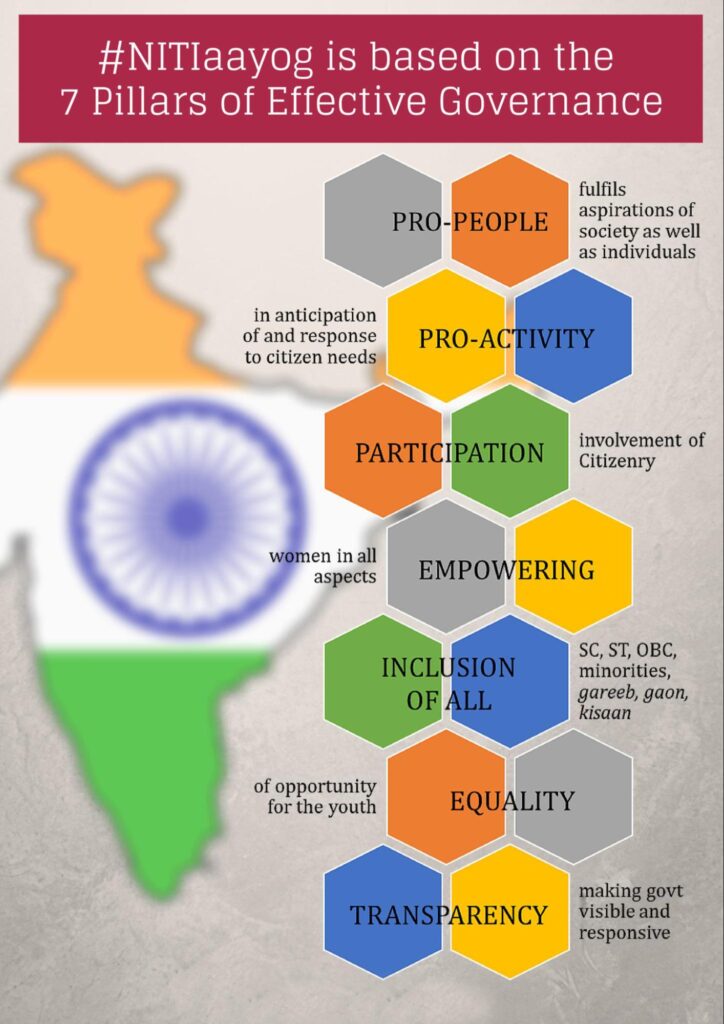
Established in 2015, NITI Aayog replaced the Planning Commission to better reflect the needs of a market-driven, cooperative federal economy, shifting from centralized planning to a dynamic policy think tank model.
Key Contributions & Transformations:
- Bottom-Up & Cooperative Federalism- Involves States in policy formulation via the Governing Council, promoting state-specific development strategies. Encourages state-specific planning based on local needs.
- Policy Think Tank- Provides expert inputs, real-time data, and policy research across sectors (e.g., health, education, AI, climate change). Example: Reports on gig economy, digital health, SDGs, etc.
- Flexible Planning Model- Replaced rigid 5-year plans with 3-Year Action Agenda, 7-Year Strategy, and 15-Year Vision, ensuring adaptability.
- Competitive Federalism- Encourages States/UTs to improve governance through performance-based rankings like the SDG Index and Health Index. e.g., Aspirational Districts Programme, SDG India Index
- Outcome-Oriented Governance- Focuses on impact assessment and measurable outcomes over fund allocation.
- Support to Aspirational Districts- Targets backward regions with real-time monitoring, data-driven planning, and sectoral convergence for inclusive development.
- Driving Innovation & Start-ups- Initiatives like Atal Innovation Mission (AIM) promote entrepreneurship, start-ups, and school-level innovation.
- Global Collaboration & SDG Localization- Aligns national policies with Sustainable Development Goals (SDGs) and facilitates international cooperation in policy best practices.
The transition from the Planning Commission to NITI Aayog in 2015 marked a move from centralized economic control to a more collaborative, federal, and dynamic policy-making institution. It aligns India’s development planning with 21st-century challenges and aspirations.
Limitations of the Planning Commission:
- Top-Down Approach- Centralised policies often ignored state-level diversity and ground realities.
- Outdated Structure- Five-Year Plans became rigid and disconnected from evolving global and domestic economic dynamics.
- Weak Federal Participation- States had limited input, leading to dissatisfaction and a lack of ownership in national priorities.
- Slow Policy Response- Bureaucratic delays in plan formulation and implementation made it unfit for real-time governance.
- Resource Allocation Over Policy Innovation- Focused more on financial distribution than on outcome-based, evidence-backed reforms.
Establishment & Structure of NITI Aayog:
- Formed in 2015 to replace the Planning Commission with a modern policy think tank.
- Chaired by the PM, with CMs, LGs, and experts forming the Governing Council.
- Structure encourages cooperative and competitive federalism, innovation, and real-time policy feedback.
Key Functional Differences:
| Parameter | Planning Commission | NITI Aayog |
| Approach | Centralised top-down | Bottom-up, cooperative federalism |
| Role | Resource allocator | Policy advisor and knowledge partner |
| Planning Tool | Five-Year Plans | Strategy @75, Vision Documents |
| State Participation | Limited | Active, through Governing Council |
| Fiscal Powers | Had budgetary control | No financial control |
Impact on India’s Development Policy:
- Greater State Empowerment-
- Active state role in vision-building through SDG localization and the Aspirational Districts Programme.
- Performance-based ranking promotes competitive federalism.
- Evidence-Based and Tech-Driven Policymaking-
- Use of real-time dashboards (e.g., NITI Health Index, Education Index).
- Promotes data-driven decision-making and localized interventions.
- Innovation & Future-Readiness-
- Leads in frontier policy areas like AI, EVs, and the digital economy.
- Launched Atal Innovation Mission and India@100 roadmap.
- Enhanced Centre-State Synergy-
- Governing Council Meetings are used for aligning national goals.
- Supports state capacity building through technical and policy handholding.
- New Models of Development-
- Introduced ‘Sunrise Sectors’ focus, like circular economy, gig economy, and blockchain.
- Launched State Institution for Transformation (SITs) to replicate NITI’s model at the state level.
- Private Sector & Civil Society Engagement-
- Collaborative models such as public-private partnerships in education, health, and infrastructure.
- Involves NGOs and think tanks for inclusive governance.
- Better Monitoring & Evaluation-
- Shift from input-based to outcome-based monitoring through regular reports and rankings.
- Created the Development Monitoring & Evaluation Office (DMEO) for impact audits.
- Focus on Self-Reliance (Atmanirbhar Bharat)-
- Supports indigenous innovation and Make in India through tailored policy guidance.
- Provided critical inputs during the COVID-19 economic recovery plans.
Challenges and Criticisms:
- Lacks fiscal powers; cannot enforce implementation.
- Overlap with existing ministries sometimes causes friction.
- Still evolving institutional identity and authority.
The shift from the Planning Commission to NITI Aayog reflects India’s maturing democratic and economic structure. While it has transformed developmental planning through decentralisation, innovation, and real-time data usage, empowering it with functional autonomy and execution authority can significantly amplify its impact.