

Socio-Political Impacts of Social Media in India
Positive Impacts:
- Political Mobilization: Social media platforms like Twitter and Facebook have been used for political campaigns and voter engagement (e.g., Modi’s 2014 campaign).
- Public Discourse: Enables direct communication between government and citizens, promoting transparency and accountability.
- Social Movements: Social media empowers marginalized communities and facilitates movements like #MeToo and #FarmersProtest, advocating for justice and equality.
- Increased Awareness: Raises awareness on social issues such as climate change, women’s rights, and health via viral campaigns.
- Civic Engagement: Facilitates online petitions, surveys, and campaigns for societal causes (e.g., Nirbhaya Case).
Negative Impacts:
- Political Manipulation: Social media is used to spread fake news, propaganda, and influence elections, undermining democratic processes.
- Polarization: Algorithms create echo chambers, deepening political and societal divides (e.g., political debates on Facebook).
- Censorship Issues: Excessive content moderation affects free speech.
- Spread of Misinformation and Radicalization: False information on social media misguides public opinion, harming democratic integrity.
- Cultural Shifts: Platforms like TikTok influence youth culture, shaping fashion, trends, and behaviors, sometimes contributing to the spread of unrealistic beauty standards.
- Cyber Exclusion: Certain communities face exclusion due to limited access to technology, exacerbating digital inequality.
Social media in India enhances political engagement and social movements but also contributes to polarization, misinformation, and manipulation. Effective regulation is key to maximizing its benefits while minimizing harm.
IT Rules 2021 describes OTT platforms as online curated content platforms (OCCPs). Online curated content is audio-visual content such as films, web-series, podcasts, etc., made available to viewers on demand, including but not limited to subscription by OTT platforms.
- Popular video-on-demand services in India include Disney+ Hotstar, Amazon Prime Video, Sony LIV, etc.
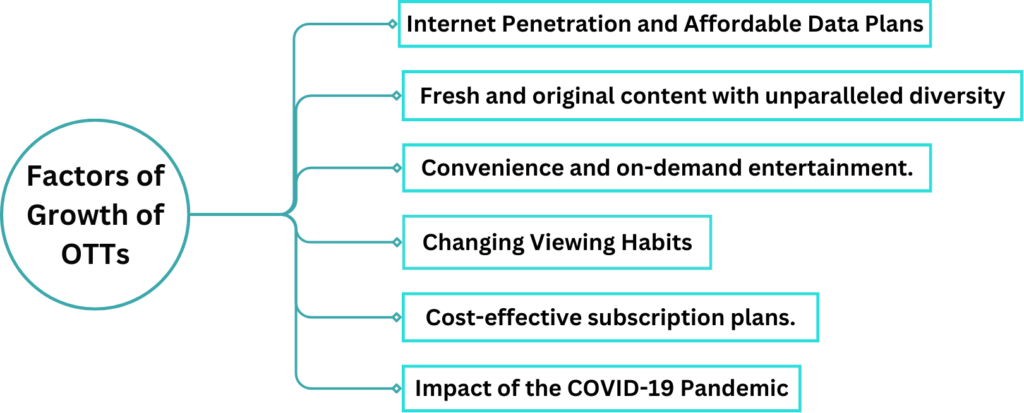
Rise of OTT platforms :
Ormax Report : India has 481 million OTT users (i.e. penetration of 34%.) and 102 million paid subscriptions.
Regulatory challenges:
- Rapid Growth : User penetration is projected to be 45.8% in 2024 and is expected to increase to 54.5% by 2029.
- market dominance and unfair competition : Netflix, Amazon Prime Video, and Disney+ Hotstar are the top three OTT players in India, with around 60-70% market share.
- Safeguarding user data and ensuring compliance with data protection regulations
- ‘Extended Release’ by OTTs shows disparity with the film industry (regulated by CBFC).
- Protection of Vulnerable Sections: The Supreme Court in 2018 and the Ad hoc committee of the Rajya Sabha in 2020 highlighted the alarming issue of child pornography on digital media.
- Demands from CIvil society : to monitor sexually explicit and any other content that promoted “false narratives”, “love jihad” and inaccurately depicted India’s history.
Addressing the regulatory challenges:
- 2020 : Govt brought OTT platforms under ambit of Ministry of Information and Broadcasting
- Ministry of I&B takes Action against Obscene Content on OTT Platforms : 18 OTT Platforms Blocked recently.
- Recently, TDSAT ruled that OTTs fall outside the jurisdiction of TRAI and are governed by the Information Technology Rules, 2021, under MeitY.
- Information Technology (Intermediary Guidelines and Digital Media Ethics Code) Rules, 2021 : establish a soft-touch self-regulatory architecture with a Code of Ethics and three-tier grievance redressal mechanism for OTT platforms.
- The Ministry of Information and Broadcasting (MIB) released the draft Broadcasting Services (Regulation) Bill, 2023 : in favor of unified regulation for “broadcasting, OTT, Digital Media, DTH, IPTV”.
Over-the-top (OTT) platforms are digital services that deliver content (audio, video, text) directly to consumers via the internet, bypassing traditional broadcast or cable TV distribution methods. The Code of Ethics of the IT Rules 2021 describes OTT platforms as online curated content platforms (OCCPs). Examples: Netflix, Amazon Prime Video, Disney+ Hotstar (video streaming), Spotify (music streaming), and Twitch (gaming and live streaming).
Socio-Economic Implications of OTT Platforms in India
- Socio-Cultural Impact
- Democratization of Content: Enables access to diverse content across languages and regions, e.g. Suzhal (Tamil), or Stage (Haryanvi). Empowers independent creators and regional storytellers.
- Affordable Entertainment: Offers cost-effective alternatives to multiplexes and cable TV.
- Content Diversity: Platforms promote cross-cultural exposure (e.g., K-dramas or Spanish series e.g., Money Heist) and support regional content (e.g., Telugu, Tamil films on Amazon Prime).
- Global Reach: Indian content gains global visibility, boosting soft power. Shows like Sacred Games and Mirzapur have garnered international acclaim.
- Changing Consumption Patterns: Shift from scheduled TV to on-demand viewing and binge-watching. Solo viewing reduces shared family entertainment.
- Youth Engagement and Trends: Shapes youth opinion and consumer behavior. Raises concerns about screen addiction and mental health.
- Economic Impact
- Industry Growth: India’s OTT market is projected to hit $12.5 billion by 2030, growing at 28.6% CAGR (FICCI-EY Report).
- Employment: OTT growth has generated jobs in scripting, dubbing, production, tech, and marketing.
- Encourages media startups and digital content firms.
- Boost to Digital Economy: Encourages investment in data infrastructure.
- Traditional Disruption: Decline of cable TV and shift in ad revenue models.
OTT platforms are redefining India’s media landscape by fostering inclusivity, economic growth, and creative freedom. However, a balanced regulatory framework is needed to address cultural sensitivities and content governance.
Social media refers to online platforms and technologies that enable users to create, share, and exchange information, ideas, and content in virtual communities and networks. Examples : Facebook, Twitter, Instagram, LinkedIn, YouTube, and Snapchat.
Role in democratizing information:
- Counters the hegemony of traditional media by providing a platform for individuals to share their thoughts, ideas, and opinions freely.
- Social media platforms are more accessible, inclusive and facilitate communication among diverse groups of people.
- empowered individuals to participate in public discourse, express dissenting views, and hold governments and institutions accountable. Eg role of social media during Arab Spring
- Provides a platform for marginalised communities to express their perspectives, concerns, and experiences : Me too movement
- Encouragement of digital literacy, including among older generations.
- Facilitation of direct communication channels, such as Twitter, utilized by government officials, bureaucrats
However, this democratization of information also poses challenges to internal security and social cohesion.
Challenges to internal security | Challenges to Social Cohesion |
|
|
In summary, while social media has democratized information and empowered individuals, its unchecked proliferation and misuse pose significant challenges to internal security and social cohesion. Addressing these challenges requires a multi-faceted approach that involves enhancing digital literacy, regulating social media platforms, and promoting responsible online behavior.



