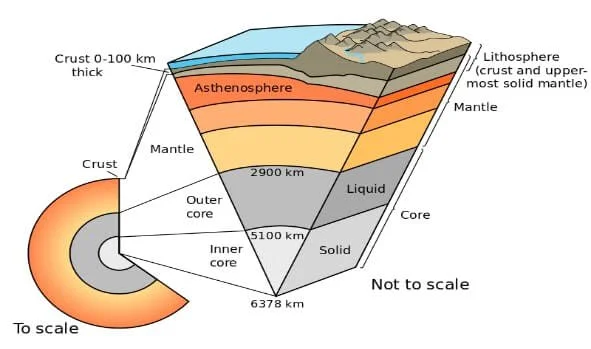
Seismic waves travel at different speeds through Earth’s layers, reflecting and refracting to reveal
its structure.
- Curved wave paths of S and P waves indicate density variations.
- P-waves (compressional waves) can travel through both the outer and inner core, but they are significantly slowed and refracted, indicating the liquid outer core and solid inner core.
- S-waves disappear beyond 2900 km depth, indicating a liquid outer core.
This helps recognize three Earth layers: crust, mantle, and core.
- Crust: It is the outermost solid part of the earth. Oceanic crust is thinner (about 5kms) as compared to the continental crust (about 30kms). Major constituent elements of crust are Silica (Si) and Aluminium (Al) and thus, it is often termed as SIAL. The mean density of the materials in the crust is 3g/cm3.
- Mantle: Extends from the crust to a depth of 2900 km. the mantle includes the asthenosphere, where magma originates for volcanic eruptions. The major constituent elements of the mantle are Silicon and Magnesium and hence it is also termed as SIMA.
- Core: Extending from 2900 km to the Earth’s center at 6371 km depth, the core is the Earth’s deepest layer.It is composed mainly of iron (Fe) and nickel (Ni) and hence it is also called as NIFE. It has a density of about 11 g/cm³ and is divided into two parts:
- The outer core, which is in a liquid state between 2900 and 5150 km depth.
- The inner core, denser and extending from 5150 to 6371 km depth.
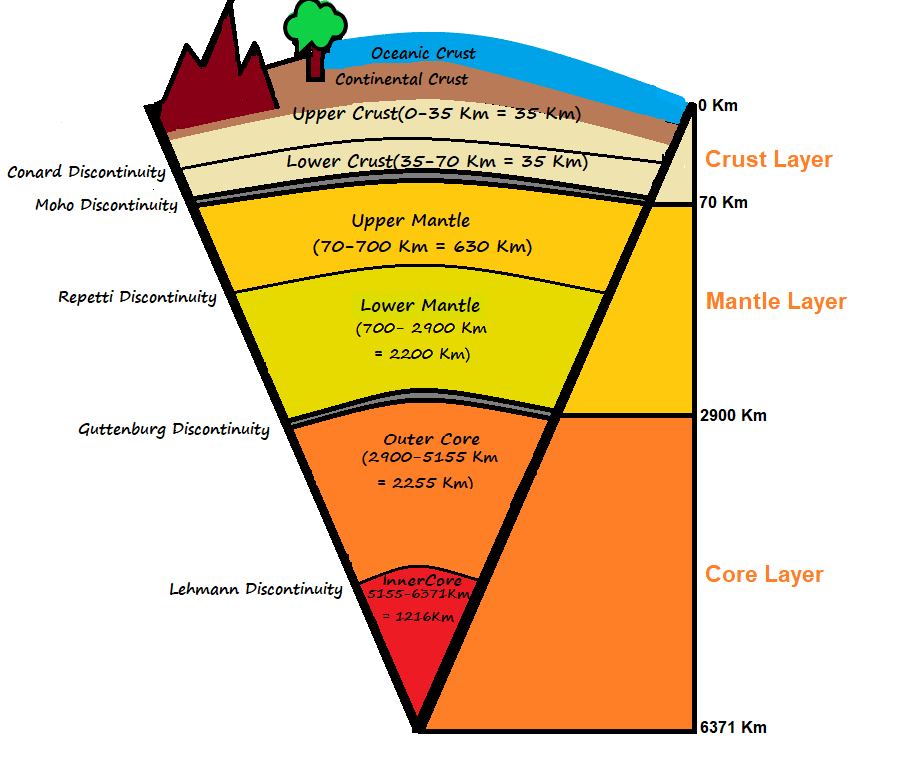
The transition zones that separate various layers of the Earth’s interior (crust, mantle and core) from each other are popularly known as Discontinuities.
The various discontinuities of the earth are as follows. (any two)
- Conrad Discontinuity: The Conrad Discontinuity separates the upper and lower crust.
- Mohorovicic Discontinuity: This is the transition zone between the crust and the mantle.
- Repetti Discontinuity: This separates the upper mantle from the lower mantle.
- Gutenberg Discontinuity: This is the transition zone between the lower mantle and the outer core.
- Lehmann Discontinuity: This is the layer separating the outer core from the inner core.
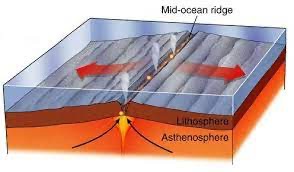
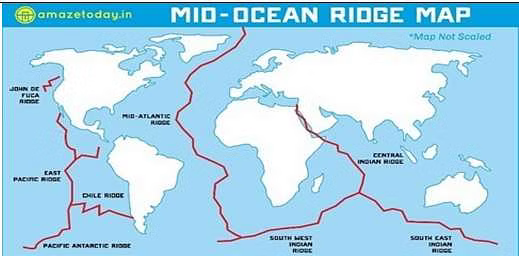
A mid-oceanic ridge is composed of two chains of mountains separated by a large depression. Magma comes out due to the divergence of plates inside the oceans. As a result of the freezing of this magma, submerged ridges are formed. These ridges are generally in the middle of the ocean, hence they are also called mid-ocean ridges. This process of formation of ridges continues continuously, which is responsible for the formation of oceanic crust (ocean bed spreading).
The best example of this is the Mid-Atlantic Ridge, which extends from the Western Isles in the Atlantic Ocean to Bouvet Island in the south.
| Aspect | Sial (Upper Layer) | Sima (Intermediate Layer) |
| Full Form | Si (Silica) + Al (Aluminium) | Si (Silica) + Ma (Magnesium) |
| Location | Outermost layer (Continental crust) | Beneath the Sial (Oceanic crust and upper mantle) |
| Depth | 50–300 km | 1000–2000 km |
| Average Density | 2.9 g/cm³ | 2.9 – 4.7 g/cm³ |
| Dominant Elements | Silica and Aluminium | Silica and Magnesium |
| Acidity/Alkalinity | Acidic in nature | Alkaline in nature |
| Major Rocks | Granite, Basaltic rocks, other continental rocks | Basalt, Gabbro (Mafic rocks) |
| Volcanic Activity | Does not produce lava directly | Source of lava during volcanic eruptions |
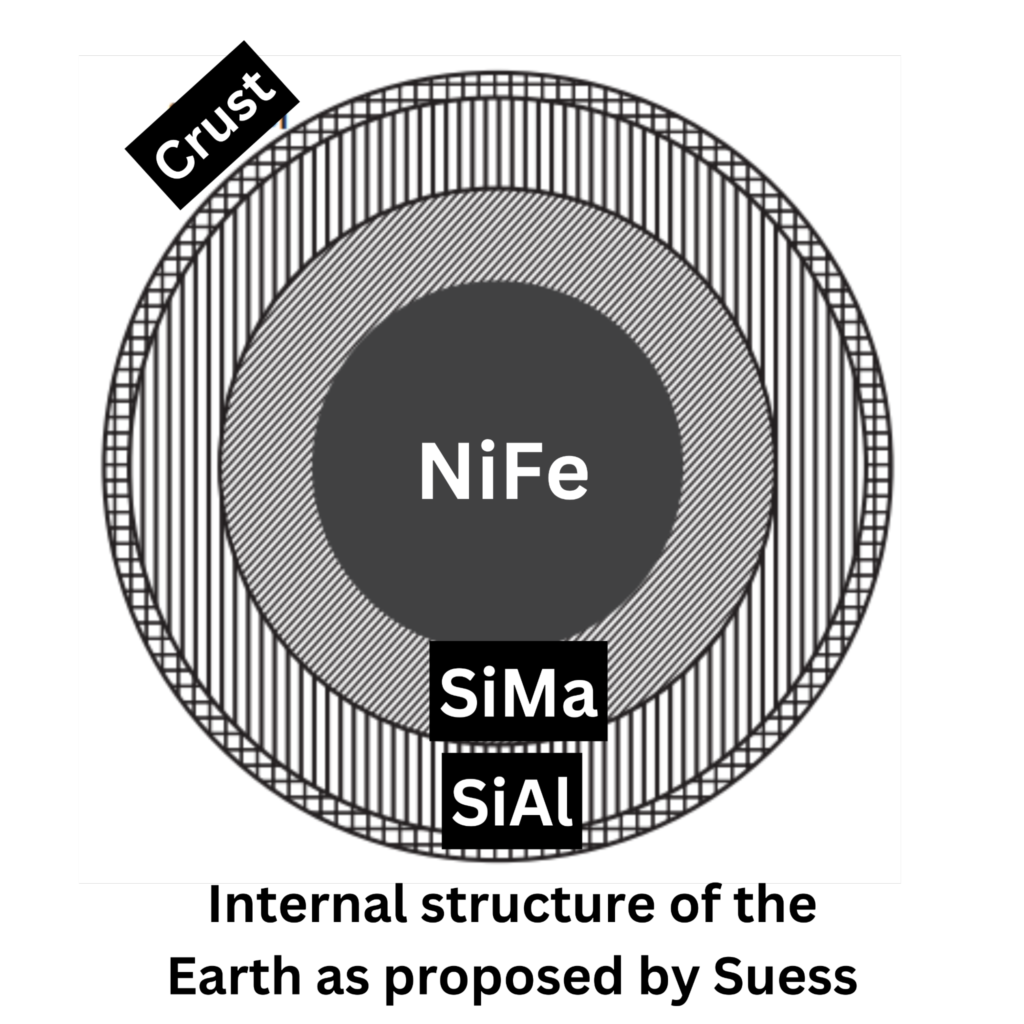
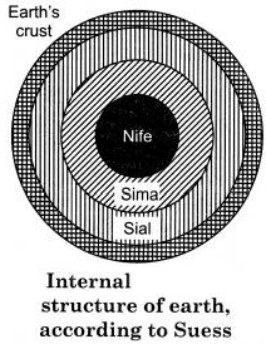
Suess has divided the crust internal state of the earth mainly on the basis of the chemical composition.
- Sial: Uppermost layer of the Earth.
- Silica and aluminum are obtained. Therefore this layer is called Sial (Si + al = Sial).
- Average density – 2.9 grams per cubic cm.
- Average depth – 50 – 300 km.
- Acid content is prominent.
- Contains rocky stones, basaltic rocks, granite rocks, etc.
- Sima: Intermediate layer
- Called the sima (Si + ma = Sima)- dominance of silica and magnesium.
- Density – 2.9 – 4.7 grams per cubic cm.
- Depth – 1000 – 2000 km.
- Basalt and Gebro rocks.
- Alkaline nature.
- Lava comes out of this layer during volcanic eruptions.
- Nife: Innermost and densest layer
- Density – 11 grams per cubic cm.
- Extends from the deepest end of the sima to the earth’s centre.
- Magnetic properties.
- Nickel and ferrum are present in its formation, so this layer is called (Ni + fe = Nife).