
Principles of Organisation: Hierarchy

Henri Fayol is regarded as the father of Classical theory.  Fayol’s Fourteen Principles of Management: 

  • 1) Division of work: Specialization boosts productivity.  
  • 2) Authority and responsibility: must match.   
  • 3) Discipline: Employees should obey orders under good leadership.  
  • 4) Unity of command: Each employee should receive orders from one superior to avoid confusion.   
  • 5) Unity of direction: one head and one plan for a group of activities having the same objectives.  
  • 6) Subordination of individual interest: Organizational goals take precedence over individual interests.    
  • 7) Fair remuneration: Monetary (Bonus etc) + Non Monetary (Compliment, credit etc).  
  • 8) Centralization or decentralization: Depends on business conditions and staff quality.   
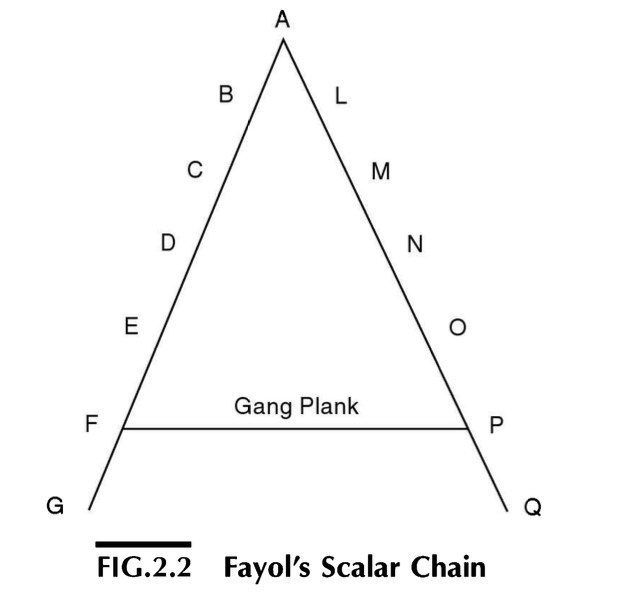
  • 9) Scalar chain: clear line of authority ensures unity of direction.
  • 10) Order: Material and social order are crucial for efficiency.   
  • 11) Equity: Fair treatment for all employees. 
  • 12) Stability of tenure: Employee stability is vital for success. 
  • 13) Initiative: Allowing personnel to show initiative. 
  • 14) Esprit De Corps: Fostering team spirit boosts morale.

These principles are flexible guidelines for managers, requiring adaptability to varying circumstances. The process of applying them would be more of an art than a science.

Formal Organisations Informal Organisations 
Logically planned and deliberately designed official structure.based on a network of personal relationships and group ties among employees
It has the legitimacy of official authority.It has the legitimacy of social sanction.
It is rational.It is irrational.
Its rules and regulations are promulgated by official authoritiesThe informal rules and norms are promulgated by small work groups.
It represents the views of classical administrative theorists.It represents the views of human relationists and the behaviourists.

LD White defined hierarchy as the universal application of the superior-subordinate relationship through multiple levels of responsibility, from top to bottom. 

  • It gives an organization a pyramidal shape of interconnected steps. Fayol referred to it as the ‘scalar chain‘, while Mooney called it the ‘scalar process’.
  • The hierarchy is based on: 1) Principle of ‘through proper channel’ , 2) Principle of ‘correspondence’ and 3) Principle of ‘unity of command’.

Advantages 

Disadvantages 

  1. It serves as an instrument of integration and coherence in the organisation.
  2. It acts as a channel of communication.
  3. It enables to fix responsibility at each level.
  4. It avoids short circuiting by ensuring strict adherence to procedure.
  5. It prevents congestion of work at the top level.
  6. It facilitates decentralisation of decision-making.
  7. It facilitates delegation of authority.
  8. It simplifies procedures for file movement.
  9. It helps in coordination by securing unity of purpose.
  10. It promotes discipline and order in the organisation.
  1. Causes delays due to red tape.
  2. Discourages initiative and drive, leading to indecisiveness and inefficiency.
  3. Hinders dynamic human relations, fostering rigidity.
  4. Makes the organization overextended, disconnecting top and lower levels.
  5. Creates superior-subordinate relationships due to hierarchical differences.

Leave a Comment

Your email address will not be published. Required fields are marked *

error: Content is protected !!
Scroll to Top
Telegram WhatsApp Chat