
ERG Theory, proposed by Clayton Alderfer, classifies human needs into three categories: Existence, Relatedness, and Growth. Two important features of this theory are Simultaneous Operation and Frustration-Regression.
- Simultaneous Operation: Unlike Maslow’s Hierarchy of Needs, ERG Theory suggests that different needs can be pursued simultaneously. An individual does not have to satisfy one level of need completely before moving to another. For example, an employee may seek job security (Existence Need), maintain good relationships with colleagues (Relatedness Need), and pursue career advancement (Growth Need) at the same time.
- Frustration-Regression: The Frustration-Regression dimension states that when a higher-level need remains unfulfilled, an individual may regress to a lower-level need that appears easier to satisfy. For example, if an employee is unable to achieve personal growth or promotion (Growth Need), he or she may focus more on social relationships and recognition from colleagues (Relatedness Need).
ERG Theory emphasizes the flexibility in need satisfaction. The concepts of Simultaneous Operation and Frustration-Regression make the theory more realistic and practical.
Herzberg’s Two-Factor Theory (also known as Motivation-Hygiene Theory), developed by Frederick Herzberg in the 1950s, is one of the most important content theories of motivation.
According to this theory, job satisfaction and job dissatisfaction are not opposites of each other. They are caused by two entirely different sets of factors.
1. Hygiene Factors (Maintenance Factors or Dissatisfiers)
- These are extrinsic factors related to the job context (work environment).
- Their presence does not motivate employees, but their absence causes dissatisfaction.
- They are necessary to prevent dissatisfaction but do not lead to positive motivation.
- Examples: Salary, company policy, supervision, working conditions, job security, interpersonal relations, status, etc.
2. Motivators (Satisfiers or Growth Factors)
- These are intrinsic factors related to the job content (nature of the work itself).
- Their presence leads to job satisfaction and motivation.
- Their absence does not necessarily cause dissatisfaction, but it fails to motivate.
- Examples: Achievement, recognition, responsibility, advancement, the work itself, personal growth, etc.
Key Difference between Hygiene Factors and Motivators:
| Basis | Hygiene Factors | Motivators |
| Nature | Extrinsic (Job Context) | Intrinsic (Job Content) |
| Effect | Prevent dissatisfaction | Create satisfaction & motivation |
| Absence | Causes dissatisfaction | Leads to no satisfaction (neutral) |
| Presence | No satisfaction (neutral) | Leads to satisfaction & motivation |
| Examples | Salary, working conditions, policy | Recognition, achievement, responsibility |
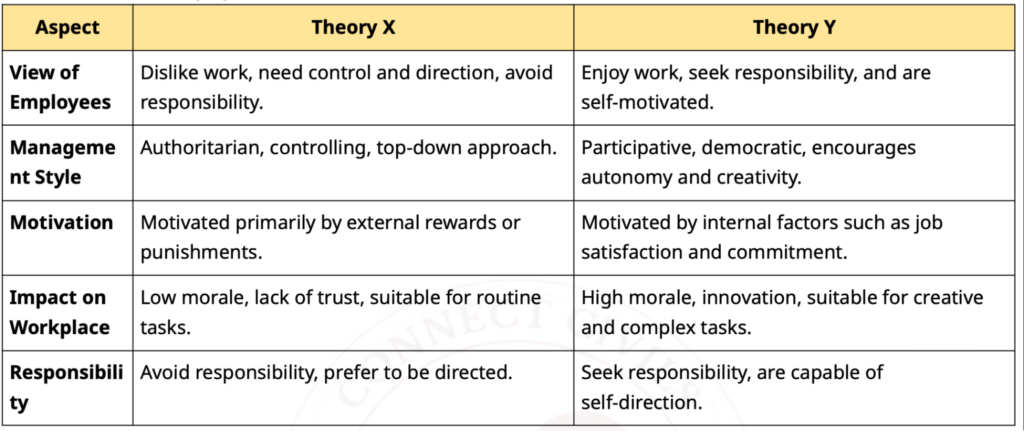
Douglas McGregor , an American social psychologist, proposed two contrasting theories of motivation in the workplace, known as Theory X and Theory Y . These theories describe two different views of individuals (employees) and their attitudes towards work.