

Rina | Relevance in administrative life |
Dev Rin (देव ऋण) |
|
Rishi Rin (ऋषि ऋण) |
|
Pitr Rin (पितृ ऋण) |
|
Nri Rin or manushya rin |
|
Bhut rin |
|
Concept of Rit is broader and advance because –
- Truth is only sense-generated knowledge. Rit can be extended beyond the senses
- Rit covers both physical (Cosmological) and social/moral order. Whereas, Dharma covers only moral order
- Rit covers both normative science and positive science [Physics laws like motion, gravit, etc]. Whereas, Dharma and Satya cover only normative science
- Rit is the precursor of Dharma and Satya
- Rit is beyond space and time [Universal] whereas Dharma and Satya change with time and space
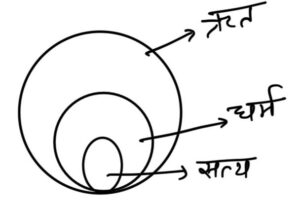
Root word for Rit is ‘Ru’ Which means movement. Hence Rit stands for an Organised movement. Rit means truth/right/righteousness or natural order which guides this universe
Ethical concern and challenges | Concept of rit |
Apathy and Lack of compassion | Rit advocates for order, harmony, and Lawfulness. It highlights the importance of maintaining harmony with each other and hence awakens social consciousness. |
Abuse of power and authority | According to Rit, there is a supreme power or guiding power that runs this universe in an order without Anarchy |
Egoistic attitude | The real doer is Vishnu and even others Gods have to follow the rules of Rit. Other gods are only instruments for this bigger cause |
Corruption | Going against Rit leads to Sin. |
Lack of innovation | Rit means natural order, which can be extended to an unknown
|
Armchair bureaucracy | Rit can’t be worshipped, It should only be followedHence Rit encourages action rather than mere preaching Rit rejects idleness and promotes activity |
Lack of integrityInsincerity (Violation of duty) | Rit is precursor to Dharma and karma |
Poor Efficiency | ऋतस्य बधिराणि कर्णानि ततर्द |
Karmavada (Doctrine of Karma) is the ethical principle that every action has consequences – “as you sow, so you reap.
| Ethical Principles of Karmavada | Application in Public Administration |
| Every action produces consequences | In administration, this promotes accountability and responsibility for decisions and policies.Ex – Prevention of corruption act 1988 (Corruption can be seen as Vikarma with inevitable consequences) |
| Moral Responsibility of Individuals – Karmavada emphasizes that individuals are responsible for their choices | In governance, this strengthens integrity, probity, and answerability among civil servants. |
| Nishkama Karma (Selfless Action) – ctions should be performed without attachment to personal gain. | Administrators guided by Nishkama Karma prioritize public welfare over personal interest. |
| Karmavada acts as an internal moral compass, reducing reliance solely on external controls. | Leaders guided by karmic ethics promote conscience-based governance and inspire ethical behavior among subordinates. |
| Fair and impartial system | Punishment or reward based on performance (Actions) promotes a sense of fairness and justice in the work culture. No one is above consequences – Politicians, bureaucrats, corporates. Ex – Article 14 [equality before the law and equal protection of the laws] |
However, sometime Karmavada is Misinterpreted and lead to the Justification of Social Inequalities. When interpreted as a principle of ethical accountability rather than deterministic fate, Karmavada offers a powerful moral foundation for public administration



