

Revolts of 1857 in India: In the subject of Modern History of India, the Revolt of 1857 is regarded as the first major and widespread uprising against British rule. It was driven by a combination of political, economic, military, and cultural grievances, involving soldiers, rulers, peasants, and common people, and marked the beginning of organized resistance to colonial domination.
The Revolt of 1857 in India
Revolts Before 1857
Revolts before 1857
- Major Causes –
- Oppressive land revenue settlements; eviction of peasants; encroachment on tribal lands.
- Exploitation by revenue collectors and moneylenders.
- Loss of tribal autonomy due to new administration.
- Migration of artisans to agriculture → pressure on land.
- Collapse of indigenous industries because of British policies.
Major Revolts Before 1857
Name of the revolt | Leader | Important Incident/Reason |
Sanyasi-Fakir Revolt (1763–1800) | Majnum Shah,Bhawani Pathak,Debi Chaudhurani. |
|
Velu Thampi’s Revolt, Travancore (1808–09) | ||
Paika Rebellion, Odisha (1817) | Bakshi Jagabandhu |
|
Savantvadi Revolts (1840s) |
| |
Chuar (Jungle Mahal) Uprisings (1766–1816) | Bhumij tribes,jagannath Singh, Durjan Singh |
|
Pagal Panthis | Tipu (son of Karam Shah). |
|
Faraizi Movement 1819 | Haji Shariatullah; Dudu Miyan. |
|
Kol Mutiny (1831–32) Chotanagpur. | Buddho Bhagat |
|
Wahabi Movement, Islamic revivalist movement | Syed Ahmed of Raebareli.Inspired by Abdul Wahab (Saudi Arabia) and Shah Waliullah (Delhi). |
|
Kuka Movement (Namdhari Movement) 1840 | Bhagat Jawahar Mal; led later by Baba Ram Singh. |
|
Narkelberia Uprising | Titu Mir |
|
Ho & Munda Uprising (1820–37) |
| |
Santhal Rebellion (Hul) (1855–56) | Sidhu & Kanhu Murmu |
|
Ramosi (Maharashtra hill tribes) 1822–1840s | Chittur Singh, Umaji Naik. |
|
Revolution of 1857
1.Economic Causes
- Heavy taxation and harsh revenue settlements impoverished peasants.
- Decline of handicrafts due to loss of royal patronage and competition from machine-made British goods.
2.Political Causes
- British expansion through ‘Effective Control’, ‘Subsidiary Alliance’, and ‘Doctrine of Lapse’.
- Denial of right of succession to Indian rulers, especially Hindu princes.
- Humiliation of the Mughal dynasty – titles and privileges withdrawn.
3.Socio-Religious Causes
- Racial discrimination by British officials.
- Suspicion of Christian missionary activities.
- Reform laws (e.g., Abolition of sati, Widow remarriage support) seen as interference in religion.
- Taxing of temple/mosque lands; Religious Disabilities Act (1850) altered Hindu inheritance laws.
4.Administrative Causes
- Rampant corruption in police, courts, and revenue departments.
- British rule appeared foreign and alien; “absentee sovereignty”.
5.Sepoy Discontent
- Restrictions affecting caste and religious practices.
- Fear of forcible conversion; rumours about chaplains.
- General Service Enlistment Act (1856) required overseas service – against religious beliefs.
- Lower pay and discrimination vis-a-vis British soldiers.
- Denial of foreign service allowance (bhatta).
- Native sepoys were mostly peasants – shared broader rural grievances.
- History of earlier military revolts (1764, 1806, 1825, etc.).
6.Greased Cartridge Issue
- Enfield rifle cartridges allegedly greased with cow and pig fat.
- Offensive to both Hindus and Muslims.
REVOLT STARTED
Date | Title | Description |
29th March 1857 | Mangal Pandey’s Revolt |
|
24th April 1857 | Meerut Revolt |
|
9th May 1857 | Imprisonment of Sepoys |
|
10th May 1857 | Revolt in Meerut |
|
May 1857 | March to Delhi |
|
Major Centres of Revolt and Leaders
- Delhi
- Bahadur Shah: nominal head.
- General Bakht Khan: real command; led Bareilly troops.
- Kanpur
- Nana Saheb proclaimed Peshwa; recognised Bahadur Shah as Emperor.
- Lucknow
- Led by Begum Hazrat Mahal; her son Birjis Qadir declared Nawab.
- Strong Hindu-Muslim unity in administration.
- Bareilly
- Led by Khan Bahadur; organised 40,000 soldiers and resisted strongly.
- Bihar
- Led by Kunwar Singh (aged ~70); joined revolt at Arrah.
- Faizabad
- Led by Maulvi Ahmadullah; a formidable fighter.
- Jhansi & Gwalior
- Rani Laxmibai led revolt after annexation under Doctrine of Lapse.
- Joined by Tantia Tope.
- Took Gwalior; Scindia sided with British.
- Baghpat
- Local hero Shah Mal united 84 villages; disrupted British communication.
- Ran local justice system.
- Gorakhpur
- Gajadhar Singh
- Farrukhabad
- Nawab Tafazzul Hussain
- Sultanpur
- Shaheed Hasan
- Sambalpur
- Surendra Sai
- Haryana
- Rao Tularam
- Mathura
- Devi Singh
- Meerut
- Kadam Singh
- Raipur
- Narayan Singh
- Mandsaur
- Shehzada Humayun (Ferozeshah).
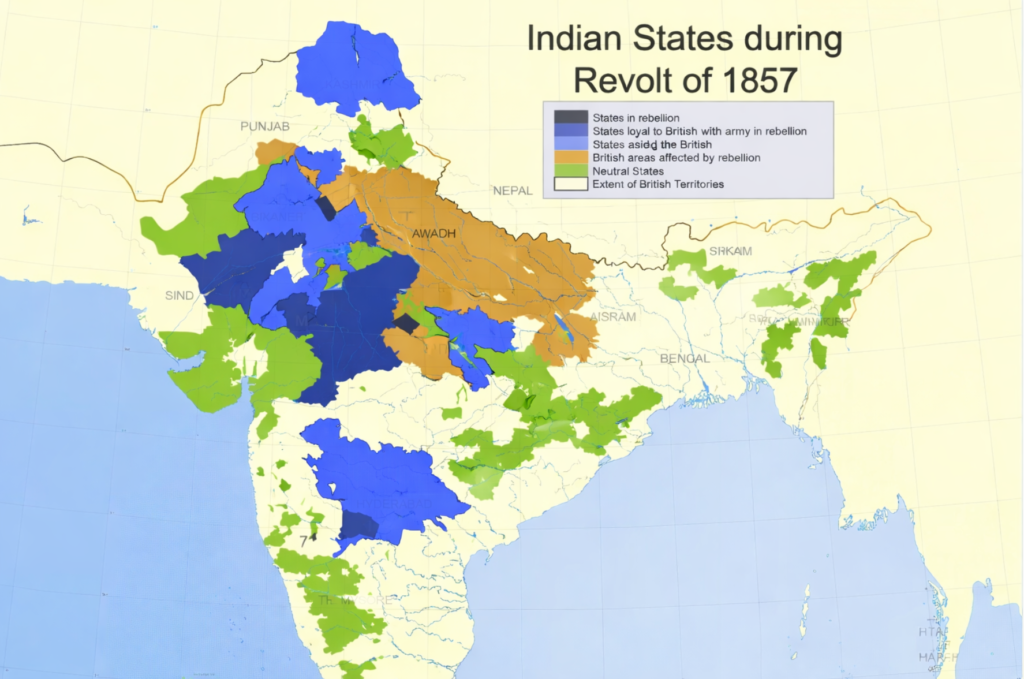
Reasons for the Failure of the Revolt-
- Limited geographical spread: South, East, and West India mostly unaffected.
- Lack of support from elites: Many rulers (Scindia, Holkar, Sindh, Patiala) sided with British.
- Merchants and moneylenders opposed revolt due to rebel attacks.
- Educated Indians viewed it as feudal and backward.
- Poor arms: Indians used swords/spears; British had modern rifles and telegraph.
- No central leadership: Rebel leaders unable to coordinate strategy.
- No unified ideology or concept of nationalism.
- Internal divisions among Indians.
Nature of the revolt
- R.C. Majumdar— “Neither first, national, nor a war of independence”,
- V.D. Savarkar (nationalist view): First war of Indian independence.
- Eric Stokes—“Elitist in character”
- Lawrence and Seeley—“Mere sepoy mutiny”
- T.R. Holmes—“A conflict between civilisation and barbarism”
- James Outram—“A Mohammedan conspiracy making capital of Hindu grievances”
- Percival Spear – Three phases of the revolt
- Sir John Siley: It was completely a unpatriotic and selfish soldier rebellion.
- Dr. S.N. Sen: In his book ‘Eighteen Fifty-Seven ‘, it is considered to start as a war for religion, which finally turned into a war of freedom.
- L.E.R. Reese: It is considered a war against Christianity by hardcore religious leaders.
- S.B. Chaudhary: The rebellion was the first joint effort of people from different classes to challenge foreign power.
Suppression of the Revolt
- British retook Delhi (Sept 20, 1857); Mughal princes killed by Lt. Hudson.
- Bahadur Shah exiled to Rangoon (died 1862).
- Kanpur retaken (Dec 1857); Nana Saheb fled to Nepal.
- Lucknow – Henry Lawrence, Henry Havelock, James Outram, Sir Colin Campbell
- Rani of Jhansi killed (1858); Tantia Tope captured and executed (1859). Sir Hugh Rose
- Benaras – Colonel James Neill
Consequences –
- Administrative Changes
- Government of India Act (1858): Company abolished; Crown took over.
- Secretary of State for India created; Viceroy replaced Governor-General.
- Queen’s Proclamation (Nov 1, 1858):
- End of annexation.
- Respect for princes’ rights.
- Religious freedom promised.
- Equality before law .
- Army Reorganisation
- Indian soldiers reduced; European soldiers increased. Higher posts reserved for Europeans.
- Divide and rule in army: caste, region, and community–based regiments.
- Preference to “Martial races” (Punjab, Nepal, NW frontier).
- Social & Political Impact
- Reformist policies slowed down; conservative attitude increased.
- Racial divide deepened; Indians seen as untrustworthy.
- ICS Act 1861 was created but examination rules favoured the British.
- Systematic economic exploitation intensified.
- White Mutiny
- European troops of Company protested transfer to the Crown and loss of batta.
- Significance of the Revolt
- Demonstrated that disunited and poorly armed Indians could not defeat the British militarily.
- Inspired later nationalist leaders; laid local traditions of resistance.
- Marked a turning point in the Indian freedom struggle.
- Barrackpore, Jalpaiguri , Dhaka were centres of the Sepoy Revolt in Bengal in 1857.
- British officer Lee Grand was defeated by Kunwar Singh in Bihar.
- Regarding Awadh in the Revolt of 1857 –
- In the battle of chinhat near lucknow , the british were defeated by the rebels .
- Henry lawrence died near lucknow residency in november 1857.
- Colin campbell was appointed commander in chief of the company’s army in India.
- Havelock, who led british army from Kanpur to Lucknow, died .
Tribal Revolts After 1857
Munda Revolt, 1890s (Singhbhum andRanchi districts of Chotanagpur region) | Birsa Munda |
|
Tana bhagat movement ( Oraon tribe Chotanagpur)(1914-1920) | Jatra Bhagat, Balram Bhagat |
|
Rampa revolt, (1916, 1922–24; Rampa region in Andhra Pradesh) | Alluri Sitarama Raju popularly known as ‘Manyam Veerudu’. |
|



