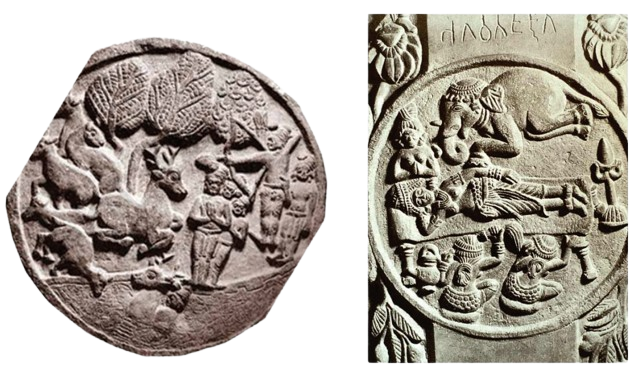

Post-Mauryan Period: In the subject of Ancient and Medieval India, the Post-Mauryan period (circa 2nd century BCE to 3rd century CE) marks the phase following the decline of the Mauryan Empire, characterized by political fragmentation and the rise of regional powers. Important dynasties such as the Shungas, Kanvas, Satavahanas, Indo-Greeks, Shakas, and Kushans emerged during this time, contributing to cultural exchange, trade expansion, and the spread of art and religion.
Post-Mauryan period
- After the assassination of the Mauryan emperor Brihadratha, Pushyamitra Shunga ended the Mauryan Empire in 185 BC.
- No major empire was established in the post-Mauryan period (from 200 BC to the rise of the Gupta Empire), but this period is historically important.
- At this time cultural relations were established with Central Asia, and foreign elements got mixed in Indian society. The Greeks adopted Indian religion and culture and got assimilated into Indian society.
- During this period India was divided into various regional and local dynasties.
Sources of information—
- Gargi Samhita, Mahabhashya of Patanjali, Divyavadana, Malavikagnimitra of Kalidas, Harshacharita of Banbhatta, and the historical book Rajatarangini of historian Kalhan.
- Ashvaghosha, who wrote Buddhacharita, Saudarananda Mahakavya, Sutralankara, and Sariputra Prakarana in Sanskrit.
- Nagarjuna, the originator of nihilism, relativism, and Madhyamik Sutra, is also a famous philosopher of this period who provides meaningful information.
- Apart from Maharishi Charak, the author of Charak Samhita; Chinese history books and travelogues of Chinese traveler Xuanzang (Hiuen Tsang), Tibetan historian Taranatha; Buddhist scholar Vasumitra; and Buddhist literature Tripitaka, “Milindapanha” also provides us with information about foreign invaders.
- The coins of the Kanishka period of Kaushambi, Sarnath, and Mathura also give correct indications. These coins are very important sources because the names of the rulers are inscribed on them.
- Accounts of writers such as Nearchus, Onesicritusand Aristobulus came with Alexander.
Objective and effect of Greek invasion
- Due to the early death of Alexander, the Greeks could not establish a permanent settlement in India.
- The Indian Greeks had a longer reign over the northwestern border regions as compared to Alexander’s invasion.
- The Greeks of Bactria ruled these regions for about two centuries, and hence this was the appropriate time for cultural exchange. Although the contribution of the Indian Greek rule is considered to be limited to the northwestern region, its Indian influence cannot be denied.
- In fact, the Greek characteristics got assimilated in India itself and merged into the mainstream.
- Currency (coins)—
- Before Greek influence, Indian silver-marked coins were technically inferior. They did not bear any name or date.
- The Indo-Greeks were the first rulers to mint gold coins bearing the king’s name, title, and date.
- These were superior due to superior manufacturing skills.
- Since the Greeks were receptive, they sometimes even used Indian monetary technology by adopting it.
- Fields of art and sculpture
- They introduced Hellenistic art to northwest India, which later developed into the Gandhara School of Art.
- The fusion of Indian and Greek art led to the development of the famous Gandhara style of art in the northwest.
- The Indo-Greek rule also left its mark in the fields of astronomy, literature, architecture, and religion.
- Also, the opening of new water and land routes led to the expansion of trade and commerce between India and Greece.
- Trade-Commerce-
- Items like Indian gems, ivory, spices, and fine clothes were in great demand in Greece, while the Indian market was also full of luxury goods and cosmetics coming from Greece.
- Around 166 BC, King Antiochus IV organized an exhibition all over Greece—in which Indian spices and ivory items were displayed.
- The names of at least 30 Indo-Greek rulers are known from a large number of contemporary coins. Coins of Menander have been found in Kabul in the north and Mathura near Delhi.
Note—The history of the Indo-Greeks is mainly written with the help of these coins. These coins have inscriptions in the Greek language; later Kharosthi and Brahmi scripts are also found. Sometimes there is difficulty in understanding this evidence because the names of some kings were the same. Therefore, it is not easy to differentiate the coins of one reign from the other.
- Coins throw light on the growing trade relations of this era.
Post-Mauryan Art
1. Political Situation
- After the decline of the Mauryan Empire, India became divided into several small kingdoms.
- Major dynasties in North India: Shunga, Kanva, Kushan, and Shaka.
- Major dynasties in southwestern India: Satavahana, Ikshvaku, Abhira, and Vakataka.
2. Religious Developments
- During this period, Brahmanical sects expanded significantly, including:
- Shaivism
- Vaishnavism
- Shaktism
- These sects developed distinct traditions of worship, temples, and sculpture.
3. Changes in Art and Architecture
- The Mauryan artistic tradition continued, including:
- Rock-cut cave architecture
- Expansion of stupas
- Development of sculpture and craftsmanship
- New dynasties introduced their regional characteristics, leading to greater diversity in art.
4. Impact of Foreign Contacts
- Foreign influences such as the Indo-Greeks, Shakas, and Kushans played an important role during this period.
- Their influence led to:
- The development of new art centers.
- A high level of advancement in sculpture.
- The emergence of distinct artistic styles such as the Gandhara and Mathura schools.
Architecture
1. Peak of Stupa Construction
- The post-Mauryan period was the golden age of stupa construction.
- Reasons
- Economic prosperity.
- Donations from guilds (Shreni Sanghas).
- Limited royal patronage.
2. Change in Building Materials
- The use of stone (prastara) increased in place of wood and brick.
- Stupas were built larger, more durable, and richly decorated.
3. Development during the Shunga Period
- The construction of Toranas (gateways) began during the Shunga period.
- Features of Toranas
- Beautiful carvings and engravings.
- Complex figures and decorative patterns.
- Visible Hellenistic (Greek) influence.
- Major Examples
- Bharhut Stupa (Madhya Pradesh)
- Toranas of the Sanchi Stupa
4. Stupa Construction in South India
- The Krishna Valley region became a major center of stupa construction.
- Patron Dynasties
- Ikshvakus
- Satavahanas
- Important Sites
- Amaravati
- Nagarjunakonda
- Jaggayyapeta
- Goli Ghantasala
- Bhattiprolu
- These stupas are known for their highly developed white marble sculptures and intricate carvings.
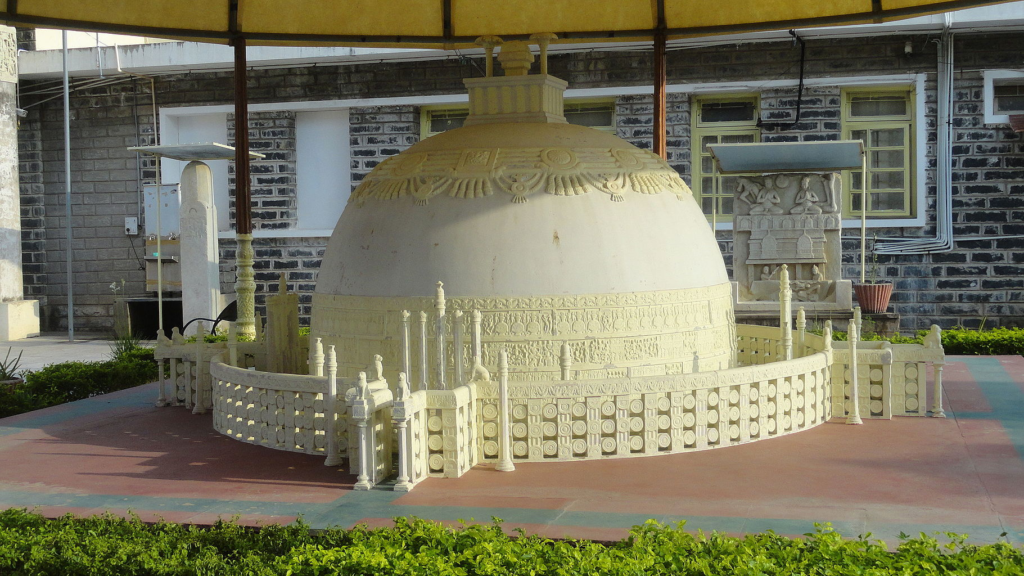
Amaravati Stupa: Architecture and Stages of Development
- Construction
- Built around 200 BCE by the Satavahana rulers at Amaravati (Andhra Pradesh).
- Location
- On the right bank of the Krishna River.
- Dimensions
- Height: 90–100 feet
- Structure
- Covered with marble slabs.
- Large dome, circumambulatory path (Pradakshina path), and toranas.
- The Vedika (railing) was carved with scenes related to Buddhism.
- Discovery
- Discovered in a ruined condition by Colonel Mackenzie in 1797 CE.
4 Stages of Development
- 200 BC–100 AD: Early construction; altars display imaginary animals, humans, and Buddha symbols.
- 100–150 AD: Sculpture becomes more natural; decorative sculptures and symbols become more realistic.
- 150–200 AD: Sculpture reaches its peak; Buddha’s life and Jataka tales are beautifully depicted.
- 200–250 AD: Elongated sculptures, deep human expression, ornamentation, and Jataka scenes predominate.
2. Sanchi Stupa No. 1: Physical and Aesthetic Features
- Location: Sanchi (50 km from Bhopal); UNESCO World Heritage Site.
- Prominent: Stupas 1, 2, and 3; Buddha relics in Stupa 1.
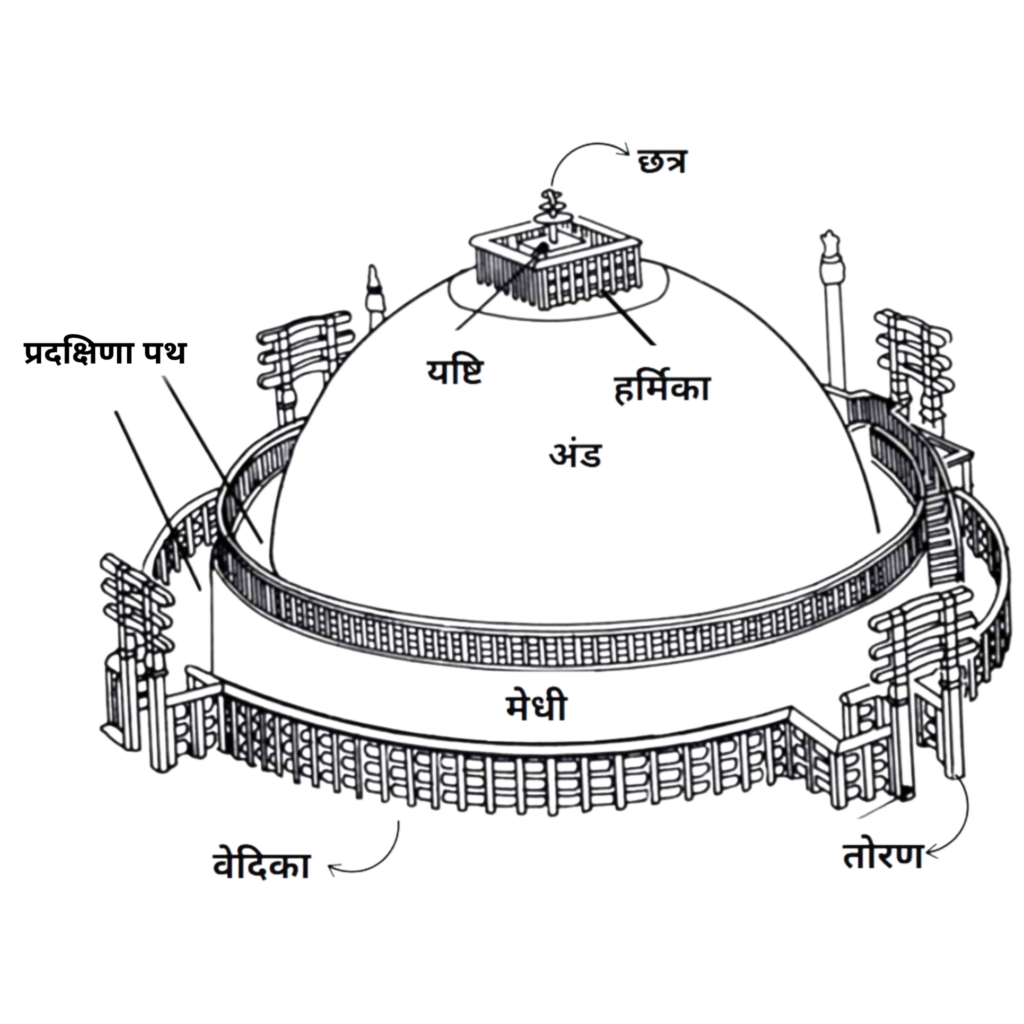
Physical Features
- Basic Structure: A small brick stupa built by Ashoka; later, stone, an altar, and arches were added.
- Dome: 54 feet high, 120 feet in diameter.
- Circumambulatory Path: Two—upper and lower.
- Torana: Four arches (1st century BCE). Triple ramparts, carved with lions, elephants, Dharmachakra, Yakshas, etc.
- Symbolic Buddha: Throne, footprints, umbrella, and stupa form.
- Load-bearing structure: Elephants/dwarves; Yakshinis for decoration.
Aesthetic Features
- The sculptures are relief-like and naturalistic, with no rigidity in the body.
- Gestures and postures are natural.
- Buddha was depicted in formless/symbolic form.
3. Rock-cut caves
- Construction continued into the post-Mauryan period.
- Two types:
- Viharas—dwelling halls for monks.
- Chaityas—prayer halls; apsidal hall (semi-circular end) rooms Barrel-vaulted roof.
- Features:
- Open courtyards and stone-and-gravel walls for protection from rain.
- Decoration with human and animal figures.
- Example:
- Chaitya Hall at Karle
- Ajanta: 29 caves (25 viharas + 4 chaityas)
4. Udayagiri and Khandagiri Caves (Odisha)
- Location: Near Bhubaneswar.
- Period: 1st–2nd century BCE, by the Kalinga king Kharavela.
- Nature: Both man-made and natural.
- Purpose: Possibly residences for Jain monks.
- Number:
- Udayagiri – 18 caves
- Khandagiri – 15 caves
- Major:
- Hathigumpha inscription (Brahmi script); mention of Kharavela’s military campaigns and the “Jain Namokar Mantra.”
- Ranigumpha: Two-story, beautiful sculptures.
Sculpture
- During this period, three independent schools of sculpture developed:
- Gandhara School
- Mathura School
- Amaravati SchoolArt Centers in North India (from 1st century CE)
- Major centers: Gandhara (Pakistan), Mathura, and Vengi/Amaravati (Andhra Pradesh).
- In Mathura and Gandhara, the symbolic representation of the Buddha was replaced by the human form.
Gandhara Style
Origin and Development
- Major patrons: Kanishka, Yavanas, Kushans.
- Area: Western Punjab near Peshawar, Afghanistan, on both sides of the Indus River.
- Influences: Greco-Roman, Bactrian, Parthian, and local Gandhara traditions.
- Centers: Taxila, Kapisha, Pushkalavati, Shahaji ki Dheri, and Begram.
- Period: 50 BCE – 500 CE, two phases—
- Early: Blue-gray sandstone
- Later: Clay, plaster
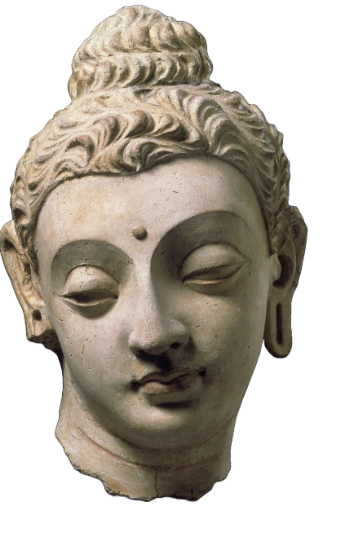
- Motivation: Buddha and Bodhisattva statues resembling the Greek god Apollo.
Main Features
- Style Greek, subject Indian (e.g., Maya Devi’s dream, birth of Buddha, marriage, Dharmachakra Pravartana, Jataka stories).
- Known as “Indo-Greek Art.”
- Curly hair, round face, and halo, influenced by foreign traditions.
- The turban and moustache show non-Indian influence.
- Sculptures project strongly from the front, with muscular and powerful bodies.
- Bodhisattva statues appear royal, wearing heavy ornaments and draped garments with folds.
- Important Bodhisattvas
- Padmapani—holding a lotus
- Manjushri—holding a book
- Maitreya – holding a flask
- Materials
- Black slate, limestone, and terracotta.
- Characteristics
- Fine anatomical details, physical beauty, and rich ornamentation.
- Examples
- Head of Buddha from Taxila
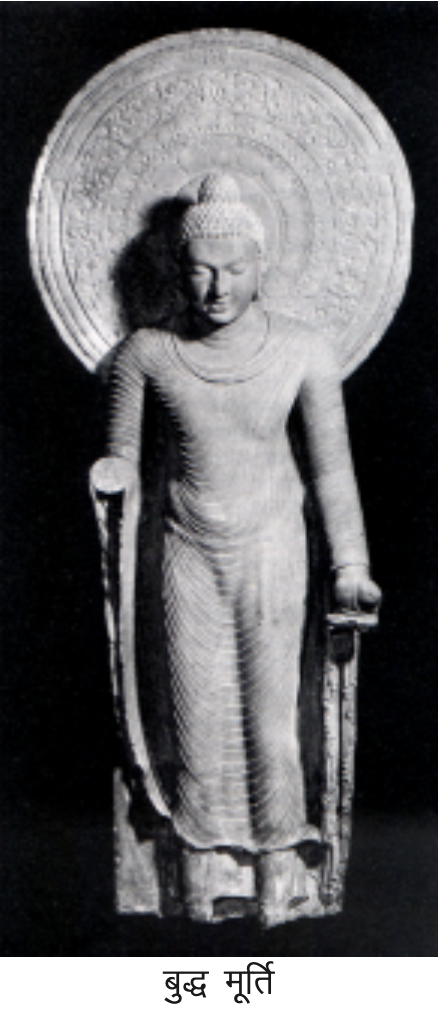
- A statue of a woman recovered from the Sapt Rishi Mound in Mathura.
Mathura Style
Development and Region
- Period: Kushan period (50–300 CE).
- Centers: Mathura, Sarnath, and Shravasti.
- Based on indigenous Indian tradition, with little or no foreign influence.
- Material: Red sandstone.
Importance
- The first human images of the Buddha were produced here.
- Earliest Hindu sculptures of Vishnu, Shiva, Durga, and Kartikeya.
- Early Jain images such as Kayotsarga, Padmasana, and meditation postures.
Buddhist Images
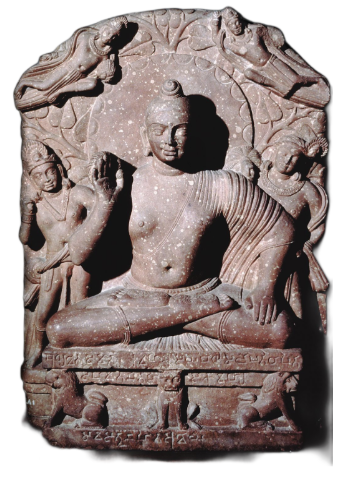
- Strong, well-built body, often seated in Padmasana.
- Right hand in Abhaya Mudra.
- Dharmachakra and Triratna symbols on palms and soles.
- Lion symbol below the throne or between the feet.
- Clothing clearly shown, with the left shoulder covered.
- Round face with a gentle smile; halo simple.
- Both standing and seated images were created.
Hindu Images
- Vishnu: with conch, discus, mace, and Abhaya gesture; forms such as Narasimha, Varaha, and Sheshashayi Vishnu.
- Shiva: linga forms (single-faced and five-faced), Ardhanarishvara, and Nandikeshvara.
- Characterized by softness and a divine facial expression.
Jain Images
- Standing images: Digambara, Kayotsarga posture, with Shrivatsa mark.
- Seated images: meditation posture.
- Important figures: Rishabhanatha, Parshvanatha, and Mahavira.
Other Sculptures
- Yaksha and Yakshini figures (e.g., cosmetic-applying Yakshini, bathing Yakshini).
- Headless statue of Kanishka wearing a cloak and heavy boots with geometric folds.
Stages of Development
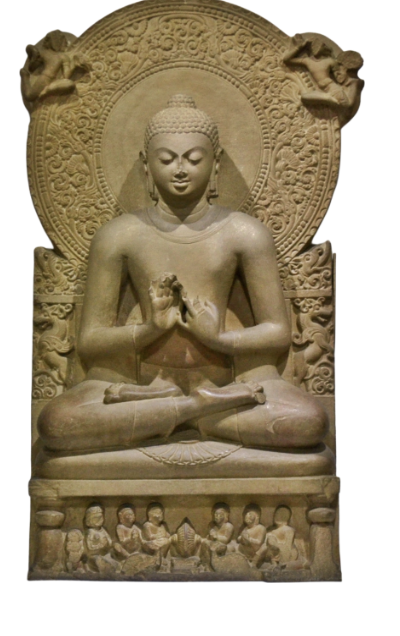
- 2nd–4th century CE: Greater roundness and muscular form; example—Katra mound Buddha.
- 5th–6th century CE: Development of transparent garment depiction.
Examples
- Seated Buddha in Padmasana
- Seated Buddha from Sarnath
Amaravati School
Development and Region
- Patrons: Satavahanas and Ikshvakus.
- Centers: Amaravati, Nagarjunakonda, and Ghantasala in the Krishna–Godavari valley.
- Similar thematic variety to Mathura, but with extensive use of marble.
- Subjects: Scenes from the life of Buddha, Maya Devi’s dream, royal court scenes, dance, and everyday life.
Main Features
- Dynamic movement and complex compositions.
- Flexible lines and lively figures.
- Extensive use of the Tribhangi (three-bent) posture.
- Female Figures: Natural, graceful, tribhangi posture, upper body often bare.
- Male Figures: Tall and slender, often wearing turbans or head cloths.
- Sculptural Style
- High relief and three-dimensional effect.
- Angular bodies and overlapping figures.
- Detailed depiction of ornaments, garments, and decorations, combining devotion with ornamentation.
Bharhut Sculpture
Shunga Period Background
- Shunga period: 188 BCE – 30 BCE.
- Founded by Pushyamitra Shunga, who killed the last Mauryan ruler, Brihadratha.
- Major art centers: Sanchi, Bharhut, Bodh Gaya, and Mathura.
- Bharhut (Satna, Madhya Pradesh) was a major center of Shunga sculpture.
Main Features
Structural Features
- The railings, gateways, and pillars of the stupa are massive and sturdy.
- Sculptures also appear heavy and solid.
Themes
- Yaksha, Yakshini, Naga, and scenes related to Buddhism.
- About 40 sculptures based on Jataka stories.
- Six sculptures depict historical events from the life of the Buddha.
Artistic Characteristics
Figurative Style
- Elongated figures.
- Low relief carving, but strong linear outlines.
- Bodies appear rigid and stiff, with limbs close to the body.
Narrative Style
- Creates the illusion of three dimensions using tilted perspective.
- Narratives are clear and focused on main characters.
- Additional figures added according to the progression of time in complex scenes.
- Sometimes multiple events are depicted in a single panel.
- Effective storytelling through visual imagery.
- Example
- Dream of Queen Maya (foretelling the birth of Siddhartha Gautama).