

Tughlaq Dynasty: In the subject of Ancient and Medieval India, the Tughlaq Dynasty (1320–1414 CE) was an important phase of the Delhi Sultanate, known for ambitious policies and administrative experiments. Rulers like Muhammad bin Tughlaq and Firoz Shah Tughlaq introduced significant reforms in taxation, irrigation, and governance, though some measures faced practical challenges and resistance.
Tughlaq Dynasty (1320–1412 AD)
Introduction:
- Origin: According to Ibn Battuta, the Tughlaqs belonged to the Qaraunah/Karana branch of the Turks—a mixed Turk-Mongol tribe.
- Name: “Tughlaq” was not the name of a race/caste but the personal name of Ghyasuddin.
- Duration: The Tughlaq dynasty ruled the Delhi Sultanate for the longest period (93 years).
Ghyasuddin Tughlaq (Ghazi Malik) (1320–1325 AD)
- Ghyasuddin Tughlaq, whose real name was Ghazi Malik, was the founder of the dynasty. He was known as “Malik-ul-Ghazi” due to his repeated victories over the Mongols.
- He established the city of Tughlaqabad in Delhi and made it his capital.
- Major Military Campaigns:
- Warangal Campaign (1321-23 AD): Jauna Khan Muhammad bin Tughlaq defeated King Prataparudra Deva. Warangal was renamed Sultanpur and annexed into the Delhi Sultanate.
- Bengal Conquest (1324 AD): Ghyasuddin conquered Bengal and Mithila, extending the Turkish Empire to North Bihar.
- Jajnagar (Odisha) Campaign (1324 AD): Jauna Khan defeated Bhanudeva II of Odisha and acquired immense wealth.
- Administration and Reforms:
- He promoted the construction of canals and roads, repaired bridges, and improved the postal system.
- He emphasized increasing agricultural production to boost revenue and ordered only limited increases in land tax.
- Amir Khusrow noted his wisdom, stating he “hid the turbans of hundreds of scholars behind his crown.”
- Conflict with Nizamuddin Auliya: While returning from Bengal to punish the Sufi saint, Auliya famously said, “Hunuz Dilli Durast” (Delhi is still far away).
- Death: Ghyasuddin died when a wooden palace, built by his son Jauna Khan at Afghanpur, collapsed. The architect was Ahmad, son of Ayaz. Historians like Ibn Battuta and Barani consider this a conspiracy by Jauna Khan.
Architecture
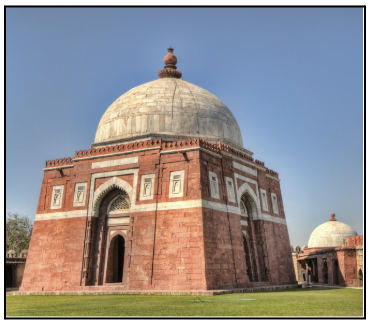
- It was constructed during the reign of Nasiruddin Mahmud Shah (the last ruler of the Tughlaq dynasty).
- This tomb is dedicated to the Sufi saint Sheikh Kabir-ud-din Auliya, who was a disciple of the famous Sufi saint Sheikh Roshan Chirag-e-Delhi.
- Popular Name: “Lal Gumbad” (Red Dome).
- This tomb is called “Lal Gumbad” because it is primarily built using Red Sandstone.
Muhammad bin Tughlaq (1325–1351 AD)
Personality:
- Known in history as the “Wise Fool” or a “mixture of opposites.”
- Original name: Jauna Khan; Title: Ulugh Khan.
- Ibn Battuta, a traveler from Morocco, visited his court, was appointed as the Qazi of Delhi, and later sent as an ambassador to China.Five Major Projects (according to Barani):
Transfer of Capital (1326-27):
- He moved the capital from Delhi to Devagiri (renamed Daulatabad) to have a central administrative point for his vast empire.
- Due to southern rebellions, the plan failed, and the capital returned to Delhi in 1335.
- Introduction of Token Currency:
- Due to a global silver shortage, he issued copper and bronze coins at par with silver coins.
- Widespread counterfeiting led to the failure of this scheme, and the Sultan had to exchange fake coins for genuine gold/silver from the treasury.
- Khurasan Expedition:
- He raised a massive army of 370,000 soldiers and paid them a year’s salary in advance to conquer Khurasan (Central Asia).
- The plan was aborted as the political situation there stabilized.
- Qarachil Expedition:
- A campaign against a hill ruler in the Kumaon/Kangra region.
- While the ruler accepted suzerainty, the Sultan suffered heavy losses in men and resources.
- Tax Increase in Doab:
- To recover treasury losses, he increased taxes in the fertile Doab region. Unfortunately, a severe famine struck that year.
- Harsh tax collection led to peasant uprisings and the abandonment of farming.
Other Contributions and Facts:
- Agriculture: Established the Diwan-e-Kohi (Agriculture Department) headed by an Amir-e-Kohi. He created a land assessment register and a famine code.
- Plague: During a “Black Death” outbreak in Delhi, he lived in Swargadwari (near Kanauj) for some years.
- Literature: Ibn Battuta wrote the famous book Safarnama (Rehla) during his reign.
- Social/Religious: He was the first Sultan to participate in the festival of Holi and patronized the Jain scholar Rajasekhara.
- Fragmentation: His harsh policies led to the birth of the Vijayanagara (Hindu) and Bahmani (Muslim) kingdoms in the South. Bengal also became independent.
- Death: He died in 1351 AD while suppressing a rebellion in Sindh.
- Evaluation: Badauni famously remarked on his death: “The Sultan was freed from his people, and the people from their Sultan.”
Architecture
Satpalah
- Constructed by Muhammad bin Tughlaq, it is a two-storied bridge featuring seven arches, built to channel water into an artificial lake.
Firoz Shah Tughlaq (1351-88 A.D.)
- After the death of Muhammad bin Tughlaq, his cousin Firoz Shah Tughlaq became the sultan. His coronation took place in Thatta (Sindh).
- He imposed the Jizya tax on Brahmins as well.
- With the objective of gaining the support and praise of the Ulema, Firoz looted Puri and the Jagannath Temple located there; the idol of the temple was thrown into the sea. Under compulsion, the King of Jajnagar accepted the Sultan’s suzerainty. He agreed to provide some elephants annually as tribute. After Jajnagar, the Sultan returned to Delhi after defeating the Hindu king of Birbhum and several feudal lords, forcing them to accept his suzerainty.
- From a military perspective, Firoz Shah proved to be a complete failure. He promoted nepotism (hereditary succession) in the army and granted land to soldiers in lieu of salary. During his reign, corruption had spread throughout the army.
- Firoz Shah Tughlaq abolished all other taxes except for Kharaj (land revenue), Khums (booty from war), Jizya (tax on non-Muslims), and Zakat (tax on Muslim income spent only on Muslims).
- A shurb (irrigation tax) was imposed on farmers.
- Due to his economic and administrative reforms, Firoz Shah is called the “Akbar of the Sultanate period” (as stated by Henry Elliot and Elphinstone).
- Firoz Shah Tughlaq founded the cities of Hissar, Firozabad, Fatehabad, and Jaunpur and established the city of Firoz Shah Kotla in Delhi.
- Firoz Shah Tughlaq repaired the fourth story of the Qutub Minar and constructed the fifth story.
- Firoz Shah established the department Diwan-e-Bandagan for slaves.
- He established Diwan-e-Khairat (Charity Department) for the financial assistance of women and children.
- He established a charitable hospital named Darul-Shifa.
- Firoz Shah Tughlaq established a marriage bureau, public works department, and employment bureau.
- Firoz Shah introduced two new coins: Adha (half a Jital) and Bikh (1/4 of a Jital). Firoz Shah also introduced the Shashgani (6 Jital) coin.
- The famous historian Barani was his courtier; he wrote the famous books Tarikh-e-Firozshahi and Fatwa-e-Jahandari.
Architecture / Masonry
- Firoz Shah Tughlaq was a great patron of architecture.
- He established the Public Works Department (PWD).
- Construction Works: Firoz Shah constructed 5 canals, among which the Ulughkhani Canal and Rajabaha Canal are prominent.
- Yamuna–Delhi → Hissar (Ulughkhani canal, 150 miles)
- Sutlej → Ghaggar (Rajabaha canal, 96 miles)
- Sirmour → Hansi
- Ghaggar → Firozabad
- Yamuna → Firozabad
- 50 towns, 20 palaces, 30 hospitals, 40 mosques
- 100 educational institutions, 100 bathhouses, 5 tombs
- 150 bridges and construction of numerous canals
- City Establishment: Firozabad, Fatehabad, Hissar, Jaunpur.
He also reconstructed old cities.
Kotla Firoz Shah:
- Construction of the Kotla Firoz Shah Fort in Delhi.
- Spread over an area twice that of Shahjahanabad.
- Built an 8-pillared building for the general public and 1 mosque for the Ulema.
- The Topra Ashokan Pillar was installed in front of the Jama Masjid located inside the fort.
- A second Ashokan pillar was brought from Meerut and installed in front of Kushk-e-Shikar (Hunting Palace).
- Remains of a two-story building have been found within the fort, which was used as a school (Madrasa).
- Tomb of Firoz Shah:
- Located in Hauz Khas (Delhi).
- This tomb is built on a square in plan.
- Khirki Mosque:
- Built over basements.
- Construction: During the period of Firoz Shah Tughlaq.
- Location: Jahanpanah (Delhi).
- Square plan.
- Numerous beautiful windows (latticework)—hence the name “Khirki Mosque.”
- Kali Mosque:
- Construction: During the period of Firoz Shah Tughlaq (FST).
- Location: Delhi.
- Two-story structure.
- Use of semi-circular arches.
- The courtyard of the mosque is divided into four parts.
- Begumpuri Mosque:
- Construction: During the period of Firoz Shah Tughlaq.
- Location: Jahanpanah.
- Kala Mosque:
- Construction: During the FST period.
- Location: Shahjahanabad.
- Built over basements.
Successors and the Decline of the Tughlaq Dynasty
Ghiyasuddin II
- After the death of Firoz Shah in 1388 AD, Tughlaq Shah became the ruler in the name of Ghiyasuddin II.
- He was an inexperienced and materialistic ruler.
- He did not take any concrete steps to strengthen the Sultanate.
- Firoz Tughlaq had strengthened the Sultanate’s administration to a great extent, but during Ghiyasuddin’s time, the administration collapsed. Ultimately, enraged by his conduct, the Maliks and Amirs deposed him.
abu bakr
- After Ghiyasuddin II, Abu Bakr became the Sultan of Delhi in 1389 AD. He was the son of Zafar Khan.
- During his reign, Shahzada Muhammad, who had served as Firoz’s lieutenant, tried to gain power over the sultanate.
- On April 24, 1389 AD, he declared himself sultan in Samana.
- After this, there was a struggle for power between Muhammad and Abu Bakr.
- After this struggle, Abu Bakr had to leave the throne in 1390 AD
- Muhammad also died in 1394 AD.
Mahmud
- After the death of Firoz Shah in 1388, there was a competition among the sultans. Ghiyasuddin II, Abu Bakr, Nasiruddin, Alauddin, and Nusrat Shah became rulers till 1398, respectively.
- Between 1398 and ’99, Timur attacked the areas of North India.
- Meanwhile, the Delhi Sultanate started disintegrating—Malwa and Khandesh separated.
- After Timur’s invasion, Gujarat also separated from the Delhi Sultanate. Timur conquered the areas of Uchch and Dipalpur in 1396-97.
- Sultan Mahmud returned to Delhi in 1405 and ruled till 1412. The rule of the Tughlaq dynasty of about 94 years came to an end when a chieftain named Daulat Khan took over Delhi.
- After the death of Mahmud Shah in 1412 AD, the Tughlaq dynasty ended, and Khizr Khan established a new dynasty in 1414 AD, which was called the Sayyid dynasty.
Timur’s invasion of India
Taimur Lang
- Timur was a fanatic Turkish Muslim born in Uzbekistan.
- Timur founded the Timuri dynasty.
- Timur, like Genghis Khan, wanted to trample the entire world with his power, and like Alexander, wanted to conquer the world.
- Timur was one of the greatest ruthless and bloodthirsty invaders of the world.
- Timur captured the throne of Samarkand after the death of the Mongol ruler of Samarkand. Now Timur started his conquest.
- Between 1380 AD and 1387 AD, he subjugated Khurasan, Seistan, Persia, Afghanistan, Azerbaijan, and Kurdistan and took control of Mesopotamia from Baghdad. Now he decided to attack India. He had become lame in an accident; hence, the name “Lang” got attached to him.
Reasons for the invasion of India
- Destroying idol worshippers and idolatry and spreading Islam
- Looting the wealth of India
- Looting and crushing the world with our power
Invasion of Timur
- Timur’s invasion of India took place in 1398 AD during the reign of Sultan Nasiruddin Mahmud.
- Khizr Khan helped Timur during his invasion.
- Timur reached Delhi through the northwest, plundering Punjab and Haryana. Timur stayed in Delhi for 15 days and plundered Delhi and took women and craftsmen with him.
- A terrible massacre was carried out in Delhi; thousands and lakhs of people were slaughtered. Temples and idols were destroyed and looted.
Impact of Timurid invasion
- Timur’s invasion ended the Tughlaq dynasty.
- It played an important role in ending the power of the sultanate and in its disintegration.
- Timur appointed Khizr Khan as the governor of the conquered territories. This same Khizr Khan established the Sayyid dynasty in the Sultanate.
Tughlaq Dynasty – Tughlaq Style
Characteristics:
- The “Crisis Period” of architecture.
- Heavy, massive, and rugged arches; minimal ornamentation.
- Use of grey sandstone and inexpensive materials.
- Sloping walls (Batter Walls) → Conveys an impression of strength.
- Entrance: A combination of arches and a simple style.
Major Constructions:
1. Tomb of Ghyasuddin Tughlaq (1321):
- Connected to the Tughlaqabad Fort; situated within an irregular pentagonal courtyard.
- Contains three graves: Ghyasuddin, his wife (Begum), and Muhammad bin Tughlaq.
2. Forts and Cities:
- Tughlaqabad Fort, Jahanpanah, and the city of Firozabad.
- Adilabad Fort, Khirki Mosque, and the Barah Khamba (Twelve Pillars).
3. Other Notable Sites:
- Tomb of Nizamuddin Auliya.
- Chappan Kot (Delhi): The palace of Ghyasuddin, famously described as being built with “golden bricks.”
- Tomb of Khan-e-Jahan Tilangani: The first octagonal tomb built in Delhi, which set a precedent for future Lodi and Mughal architecture.



