

Revolution of 1857 in Rajasthan : Causes, Events, and Impact is an important chapter in the history of Rajasthan, covering topics such as the 1857 Revolution in Rajasthan, the political agents of the time, the rulers during the 1857 Revolution, the six military cantonments in Rajasthan (at the time of 1857), and the major revolutionaries of Rajasthan. This topic helps us understand the scope of the popular movement against British rule and its far-reaching impact.
This post is written for the RAS Prelims examination; click here to read the detailed version for the RAS Mains exam.
Revolution of 1857 in Rajasthan
Historical Background (1818–1856) –
- 1818 AD – Princely states of Rajasthan signed treaties with the British.
- The British began interfering in internal governance.
- Rights of the Samants (feudal lords) were restricted.
- Economic exploitation increased for farmers, merchants, and artisans.
- Enfield rifle introduced in place of the Brown Bess rifle.
- Cow and pig fat in cartridges – religious dissatisfaction spread.
- Establishment of Rajputana Agency – 1832 AD, Headquarters: Ajmer.
- A.G.G. in 1857 – George Patrick Lawrence.
Political Agents of Rajasthan (1857)
| Princely State | Political Agent | Ruler |
| Jaipur | William Eden | Ram Singh II |
| Jodhpur | Mac Mason | Takht Singh |
| Udaipur | Showers | Swarup Singh |
| Kota | Major Burton | Ram Singh II |
| Bharatpur | Morrison | Jaswant Singh |
| Sirohi | J.D. Hall | Shiv Singh |
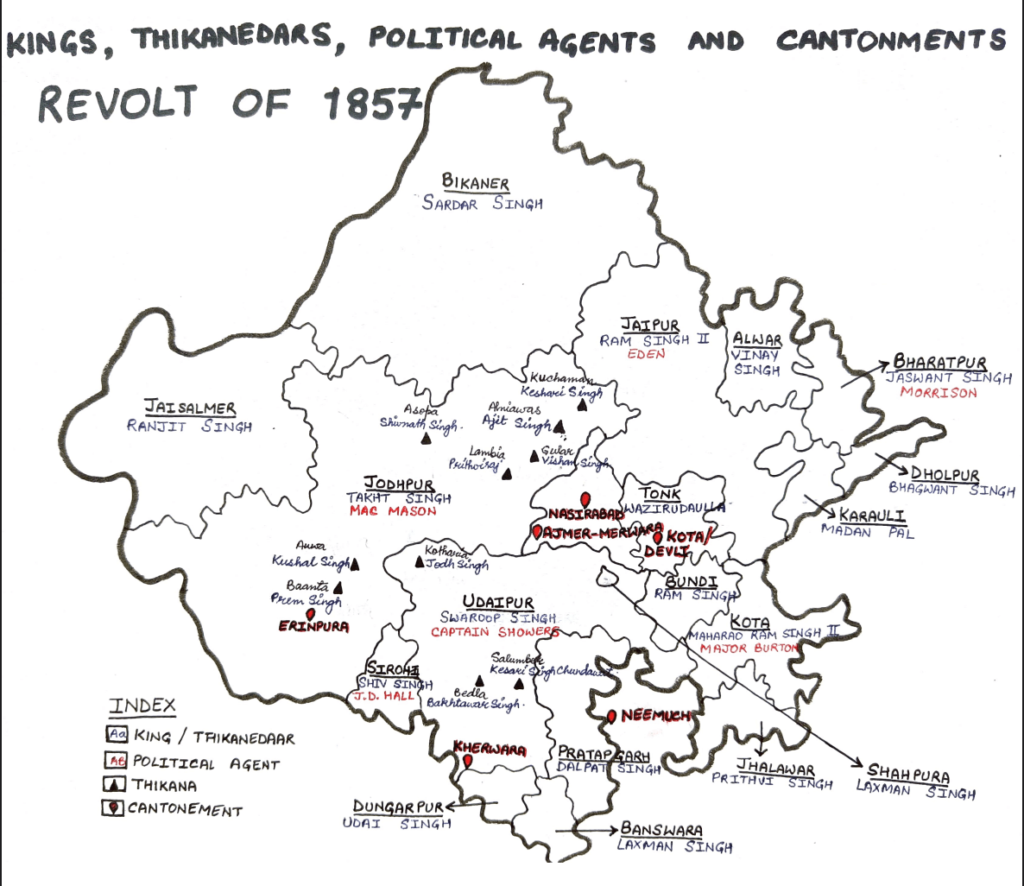
Rulers of Rajasthan States (1857 Revolution)
| State (Princely State) | Ruler |
| Dholpur | Maharaja Bhagwant Singh |
| Bharatpur | Maharaja Jaswant Singh |
| Jodhpur | Maharaja Takht Singh |
| Udaipur (Mewar) | Maharana Swarup Singh |
| Bikaner | Maharaja Sardar Singh |
| Karauli | Maharaja Madan Pal |
| Tonk | Nawab Wazir Ud-daulah |
| Bundi | Maharao Ram Singh |
| Jaipur | Maharaja Sawai Ram Singh II |
| Alwar | Maharaja Vinay Singh |
| Pratapgarh | Maharawal Dalpat Singh |
| Banswara | Maharawal Laxman Singh |
| Dungarpur | Maharawal Udai Singh |
| Jhalawar | Rajrana Prithvi Singh |
| Jaisalmer | Maharawal Ranjit Singh |
| Kota | Maharao Ram Singh II |
| Sirohi | Maharawal Shiv Singh |
Symbols and Facts of the 1857 Revolution –
- Lotus flower and Chapati (Roti) – Symbols.
- Scheduled Date – 31 May 1857.
- Actual Start – 10 May 1857.
- Leader – Bahadur Shah Zafar.
- Governor General – Canning.
6 Military Cantonments of Rajasthan (During 1857)
- Nasirabad (Ajmer) – 15th Bengal Native Infantry
- Neemuch (M.P.) – First Bengal Cavalry
- Deoli (Tonk) – Kota Contingent
- Beawar – Mer Regiment
- Erinpura (Pali) – Jodhpur Legion
- Kherwara (Udaipur) – Mewar Bhil Corps
- Total Soldiers – Approximately 5000
- Most Powerful – Nasirabad Cantonment
Actual Commencement of Revolution – (Meerut → Nasirabad)
- 10 May 1857 – Revolution begins from Meerut.
- 28 May 1857 – Revolt in Nasirabad (Ajmer).
- 15th Bengal Native Infantry revolted.
- Murder of Major Spottiswoode and Newbery.
- Cantonment was looted.
- 18 June 1857 – Rebel soldiers reached Delhi.
Neemuch Revolt (3 June 1857) –
- Mohammad Ali Beg refused to take the oath of loyalty to the British.
- Leadership – Heera Singh.
- The armory was set on fire.
- Murder of a British officer’s wife and children.
- Route: Neemuch → Chittorgarh → Hamirgarh → Banera → Shahpura.
- 5 June – Capture of Deoli cantonment.
- Departure: Tonk → Agra → Delhi.
Erinpura Revolt (21 August 1857, Pali) –
- The Jodhpur Legion revolted.
- Attack on Britishers in Abu.
- Marched towards Delhi taking the remaining soldiers.
- Met Thakur Kushal Singh of Auwa in Kharwa.
- Battle of Bithoda (08 September 1857) –
- Battle of Chelavas (18 September 1857 – Whites vs. Blacks) –
- Army Leadership – George Lawrence.
- Lawrence was defeated.
- Jodhpur Agent Monck Mason was killed.
- The Jodhpur Legion advanced towards Delhi.
Kota Revolt (14–15 October 1857) –
- 14 October – Major Burton warned the Maharao.
- 15 October – Murder of Major Burton, his sons, and a doctor.
- Leadership – Lala Jaydayal and Mehrab Khan.
- Letter signed by the Maharao –
- Responsibility for the murders.
- Declared Lala Jaydayal as the Chief Administrator.
- Dholpur (October–December 1857) –
- Maharaja Bhagwant Singh favored the British.
- Entry of soldiers from Gwalior and Indore.
- Rebels controlled the state for 2 months.
- December 1857 – Suppression of the revolt.
Battle of Auwa (20 January 1858) –
- British Army – Brigadier Holmes.
- Kushal Singh took refuge in Salumbar.
- Prithvi Singh took over the leadership.
- The fort was demolished.
- The idol of Sugali Mata was taken to Ajmer.
- 1860 – Surrender of Kushal Singh.
- Major Taylor Commission – Released due to lack of evidence.
Tatya Tope’s Visit to Rajasthan –
- First Arrival –
- Entry via Mandalgarh (Bhilwara).
- Battle of Kuada – Defeat → Move to Bundi.
- Nathdwara → Chittorgarh → Singoli → Banswara → Jhalawar.
- Defeated Prithvi Singh.
- Second Arrival – 11 September –
- Laxman Singh defeated in Banswara.
- Salumbar → Bhinder → Tonk.
- Support from Nasir Mohammad Khan.
- 21 January – Reached Sikar.
- Captured due to the betrayal of Man Singh.
- 8 April – Death sentence ordered.
- 18 April 1859 – Hanged in Shipri (Shivpuri).
- Cenotaph (Chhatri) of Tatya Tope in Sikar.
Key Revolutionaries of Rajasthan –
- Kushal Singh – Auwa
- Prithvi Singh – Auwa
- Lala Jaydayal – Kota
- Mehrab Khan – Kota
- Heera Singh – Neemuch
- Dungar Ji, Jawahar Ji – Sikar
- Amarchand Bathia – Bikaner
- Tatya Tope – Entire Rajasthan
- Female Revolutionary –
- Sudha Kanwar (Ladnun–Didwana–Kuchaman)
- Fought in male attire.
- Drove away the British.
- The only famous female warrior of Rajasthan.
- Sudha Kanwar (Ladnun–Didwana–Kuchaman)
- Role of Rajasthani Literateurs –
- Bankidas – “Aayo Angrez Mulak Re Oopar”
- Suryamall Misran – “Veer Satsai” (288 couplets)
Role of Various Princely States –
- Bharatpur –
- The public was with the revolutionaries.
- The army favored the British.
- Alwar –
- Dewan Faizulla Khan – Supporter of rebels.
- Maharaja Bannesingh – Supporter of British.
- Bikaner –
- Maharaja Sardar Singh – Supporter of British.
- Received 41 villages as a reward.
- Jaipur –
- Vilayat, Sadul, Usman – Rebels.
- Ruler Ram Singh II – Supporter of British.
- Tonk –
- Nawab was a supporter of the British.
- The public and army were rebels.
- Participation of women.
- Fall of Kota (22 March 1858) –
- General Roberts recaptured Kota.
- Lala Jaydayal and Mehrab Khan were hanged.
- Gun salute for Ram Singh-II reduced from 17 to 13.
Comments by British Officials –
- Lord Canning – The Kings and Maharajas acted as a breakwater to the storm.
- John Lawrence – Had there been leadership, we would have lost.
- Captain Prichard – Described it only as a military mutiny.
Final Outcome –
- Start of Revolution in Rajasthan – Nasirabad.
- End – Sikar (Arrest of Tatya Tope).
- The revolt transformed from a military mutiny into a mass movement.
- Public, farmers, Gujjars, Bhils, and Meos – all participated.
- This struggle became the foundation for the future national movement.



