

The Rathore dynasty of Marwar is considered a prominent and heroic dynasty in Rajasthan’s history, establishing a strong political and cultural identity in western Rajasthan. The dynasty’s rulers unified the Marwar region and developed it into a powerful state, exemplifying Rajput pride, valor, and administrative prowess.
The Rathore Dynasty of Marwar
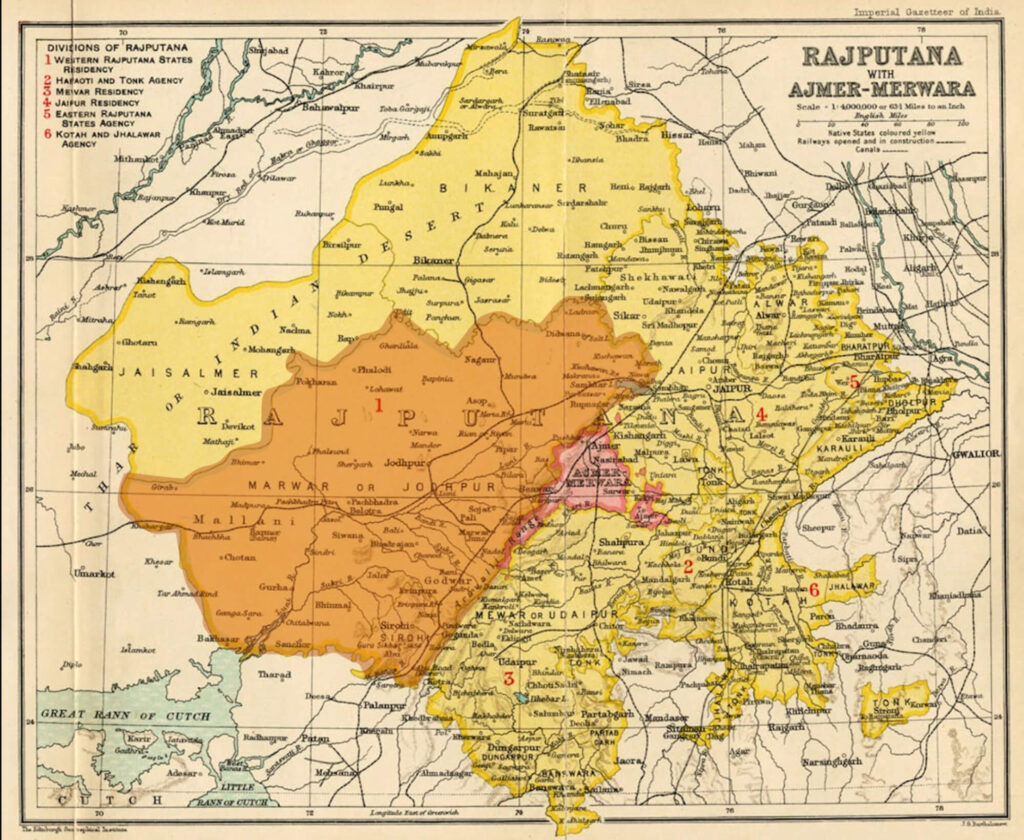
Rathore Dynasty of Marwar –
- Clan Deity and Tutelary Deity –
- Nagnechi Mata is considered the Kuldevi of the Rathores.
- Chamunda Mata is considered the Aradhya Devi of the Rathores.
- Origin of the word Rathore
- The origin of the word ‘Rathore’ is considered to be from the Sanskrit word ‘Rashtrakuta’.
Various opinions regarding the origin of Rathores –
- According to the books of the Bhats, Rathores are considered the descendants of Hiranyakashipu.
- According to Dayaldas ri Khyat, Rathores were Suryavanshi and descendants of the Brahmin-born Bhallarao and had come from Kannauj.
- This opinion is also found in Nainsi ri Khyat and Prithviraj Raso.
- According to Jodhpur ri Khyat, Rathores were born from Raja Brihadbala, the son of King Vishwutman.
- According to Colonel Tod, Rathores were the descendants of Jaichand Gahadwal of Kannauj.
- According to Vishveshvarnath Reu, Rathores were the descendants of Jaichand.
- According to Dr. G.H. Ojha, Rathores were descendants of the Rathores of Badaun and they also had a connection with the Rashtrakutas of South India.
- In Rajasthan, the rule of Rathores was in Hastikundi, Dhanop, Vagad, Jodhpur, and Bikaner; and the Jodhpur and Bikaner branches became more famous.
Jaichand, Harishchandra, and Setrai
- Jaichand attained martyrdom (Veergati) while fighting Muhammad Ghori in the Battle of Chandawar.
- Harishchandra ascended the throne of Kannauj after Jaichand.
- Following the invasion by Iltutmish in 1226 AD, Harishchandra moved to Mahui.
- Setrai was the younger son of Harishchandra.
Rao Siha — Founder of the Rathore dynasty
- Rao Siha is considered the actual founder of the Rathore dynasty.
- Rao Siha built a fort on the banks of the Kali river in Khed–Mahuli (Farrukhabad).
- Upon Muslim occupation of Farrukhabad, Rao Siha went towards Dwarika.
- On the request of Brahmins at the Pushkar camp, he saved Bhinmal from Muslim invaders.
- On the plea of Paliwal Brahmins, he saved Pali from Bhils, Meenas, and Mers and made Pali his centre.
- According to the Bithu Village (Pali) inscription of 1273 AD, Rao Siha attained martyrdom while fighting Muslim looters of Sindh in the Lakh Jhanwar / Dhaula Chautra war.
- Rao Siha was not able to establish an organized empire.
Rao Asthan (1273–1291 AD) –
- Rao Asthan made Gundoch village the centre of power instead of Pali.
- He also took control over Khed and Idar.
- In 1291 AD, Rao Asthan attained martyrdom in battle during the invasion of Jalaluddin Khalji.
Rao Dhuhad (1291–1309 AD)
- Rao Dhuhad defeated the Pratiharas and took control of Mandore.
- In 1309 AD, he attained martyrdom (Veergati) while struggling against the Pratiharas.
- He brought the idol of Nagnechi Mata (Chakreshwari) from Karnataka and installed it in Nagna Village (Balotra).
Raimal, Bhim, Raikanakpal, and Jalansi
- Raimal re-established control over Mandore but attained martyrdom (Veergati) while struggling against the Bhatis and the Turks.
- Bhim was killed in a struggle with the Bhatis.
- Raikanakpal was killed in a struggle with the Bhatis.
- Jalansi was killed in a struggle with the Bhatis.
Rao Chhada –
- Rao Chhada was a powerful ruler.
- He defeated the Sodhas of Umarkot, and the rulers of Jaisalmer, Jalore, Nagaur, Sojat, and Bhinmal.
- In 1344 AD, he attained martyrdom (Veergati) while fighting against the Songara and Deora Chauhans.
Rao Tida
- Rao Tida defeated the Songara Chauhans, Deoras, Bhatis, Balecha Chauhans, and Solankis.
- He attained martyrdom (Veergati) while defending Siwana from the Turkish army.
Mallinath
- Mallinath snatched ‘Mahewa’ from the Turks and established Rathore dominance over it.
- Mallinath assumed the title of ‘Rawal’.
- Mother – Janide, Father – Rawal Salarkha.
- Birth – 1358 AD.
- In 1378 AD, he defeated the army of the Subedar of Malwa, Nizamuddin.
- In 1389 AD, he became a disciple of Ugamshi Bhati and took initiation into Yoga Sadhana.
- In 1399 AD, he organized a grand Hari Kirtan.
- Died on Chaitra Shukla Dwitiya.
- Mallinath’s temple is located in Tilwara (Balotra).
- The name of the Western Jodhpur Pargana, ‘Malani’, was kept after him.
Rao Chunda (1394–1423 AD) –
- Rao Chunda was brought up by his uncle Mallinath.
- He received the jagir of Salaudi village.
- The Pratihar king of the Inda branch gave Mandore in dowry.
- He made Mandore his capital.
- He took control over Khatu, Didwana, Sambhar, Ajmer, and Nadol.
- In 1423 AD, he was killed through treachery by the Bhatis of Pugal.
- He built the Chundsar Lake in Nagaur.
- His wife Chand Kanwar (Chand De) built the Chand Bawri (stepwell) in Jodhpur.
- He appointed his younger son Kanha as successor instead of his elder son Ranmal.
Kanha –
Ranmal (1427–38 AD)
- Being displeased with Kanha becoming the ruler, he went to Mewar.
- He married off Hansa Bai (his sister) into Mewar.
- When his nephew Mokal became the Maharana, he had excessive influence over the Mewar administration.
- During the time of Kanha’s son Sata, Sata’s brother Randhir invited Ranmal to Marwar.
- In 1438 AD, he was killed by Kumbha (Mewari feudal lords) by having poison administered through Bharmali (his lover).
Rao Jodha (1438–89 AD)
- Son of Ranmal and Kodamde.
- Rao Jodha’s mother, Kodamde, built the Kodamdesar Stepwell (Bikaner).
- It is the oldest stepwell in Western Rajasthan.
- In 1453 AD, he took control over Mandore.
- With Rana Kumbha:
- Awal-Bawal Treaty.
- Rathore-Sissodia Treaty.
- Mewar-Marwar (Khejri) Treaty – 1453 AD.
- Marriage of Raimal (Kumbha’s son) and Shringar De (Jodha’s daughter).
- Center of the treaty – Sojat (Pali).
- In 1459 AD, he founded Jodhpur city.
- He made it his capital.
- Jodha’s wife, Jasmade, constructed the Ranisar Lake.
- He defeated the army of the Sultan of Delhi, Bahlol Lodi.
- He constructed the Mehrangarh Fort.
- Meaning of Mehrangarh Fort – Gigantic/Colossal.
- Built from red sandstone.
- Builder of this Giri Durg (Hill Fort) – Rao Jodha.
- (Karni Mata laid the foundation).
- Surnames/Other names of the fort:
- Mayurdhwaj (Peacock-flagged).
- Garh Chintamani.
- Located on Chidiyatuk Hill.
- It has 2 external gates:
- Jaipol.
- Fateh Pol.
- In 1544 AD, Sher Shah Suri took control over it.
- During Akbar’s time, it remained under the control of Husain Quli Beg.
- After the death of Jaswant Singh-I (1678 AD):
- Aurangzeb took it under his control.
- After the death of Aurangzeb:
- Ajit Singh snatched it back from Zafar Quli Khan.
- Located within this fort:
- Moti Mahal
- Phool Mahal
- Takhat Vilas
- Ajit Vilas
- Umaid Vilas
- Chokhelav Mahal
- Beechla Mahal
- Mazar of Sher Shah
- Mazar of Bhure Khan
- Shringar Chowki
- Pustak Prakash
- Temples:
- Nagnechi Mata
- Chamunda Mata
- Ananddhan Temple
- Murli Manohar
- Various Ancient Cannons:
- Kilkila
- Shambhubaan
- Gajnikhan
- Jamjama
- Kadak Bijli
- Nusrat
- Gubbar
- Bichhu Baan
- Ghudghanid
- Mirbaksh
- Rahasya Kaal
- Gajak
- Mehrangarh Tragedy Incident:
- 30 September 2008 (Ashwin Navratri)
- Inquiry Commission – Jasraj Chopra Committee
- “Believed to be built by gods, fairies, and angels” (Rudyard Kipling)
- Water Supply:
- From Ranisar and Padamsar lakes.
- Note:
- Jodha constructed the Kodamdesar Lake (in memory of his mother Kodamde).
- Rao Jodha’s son Bika:
- Establishment of Bikaner – 1488 AD (Akshaya Tritiya).
Sataldev (1489 – 1492 AD)
- Younger son of Jodha.
- Established the town of Satalmer (Jaisalmer).
- In 1492 AD, he defeated Mallu Khan of Ajmer in the Battle of Pipar (Nagaur) / Kosana.
- Phula Bhatiyani, the wife of Sataldev, constructed the Phulelav Lake in Jodhpur.
- Gudla Festival / Dance
- Started during the time of Sataldev.
- Reason: He killed Gudle Khan, the commander of Mallu Khan.
- Main dance of Marwar.
- Time: Chaitra Shukla Ashtami.
- Currently, the Rupayan Sansthan, Borunda (Jodhpur) brought international fame to the Gudla festival.
- Founders of Rupayan Sansthan: Komal Kothari and Vijaydan Detha.
- Komal Kothari –
- Resident of Kapasan (Chittorgarh).
- Brought international fame to Manganiyar and Langa folk artists.
- Recipient of the Nehru Fellowship.
- Honors: Padma Shri (1983), Padma Bhushan (2000), and honored with the first Rajasthan Ratna Award (2012).
Vijaydan Detha –
- Resident of Borunda (Jodhpur).
- Surnames: Bijji, Shakespeare of Rajasthan.
- Works: Batan ri Phulwari, Mahamilan, Anokha Ped, Sapanpriya, Alekhu Hitler, Tidorav, etc.
- On his novel “Duvidha”, Mani Kaul made a film named “Paheli” (Actor – Shah Rukh Khan), which was nominated for the Oscar Awards.
- Honored with: National Sahitya Akademi Award (1974), Padma Shri (2007), and Rajasthan Ratna Award (2012).
- Nominated for the Nobel Prize in Literature in 2011.
Rao Suja (1492–1515 AD)
- Rao Bika invaded Jodhpur during his reign.
- Viramdev established Merta as an independent state.
Rao Ganga (1515–31 AD)
- Contemporary Delhi Sultanate – Sikandar Lodi, Ibrahim Lodi.
- Contemporary Mughal Rulers – Babur and Humayun.
- Assisted Rana Sanga in the Battle of Khanwa in 1527 AD.
- Sent his son Maldeo along with the army.
- Defeated Daulat Khan of Nagaur in the Battle of Sevaki in 1529 AD.
- Ganga’s son Maldeo assassinated Ganga.
- Works –
- Built the Gogelav Lake in Jodhpur.
- Built “Ganga ki Bawri” (Ganga’s Stepwell).
- Installed the idol of Shyamji brought from Sirohi in his name, which became famous as “Gangshyam”.
Rao Maldeo (1532–62 AD)
- Patricide Ruler (Assassinated his father).
- Participated in the Battle of Khanwa on behalf of Rana Sanga.
- Assisted Rana Vikramaditya during Bahadur Shah’s invasion of Mewar in 1532 AD.
- Expansion of the Kingdom:
- Nagaur
- Bhadrajun
- Merta
- Ajmer
- Siwana
- Jalore
- In 1536 AD, married Umade, the daughter of Rao Lunkaran of Jaisalmer.
- Famous in history by the name “Roothi Rani” (The Displeased Queen).
Roothi Rani:
- Spent her life in Taragarh (Ajmer).
- During her final days, she moved from Gundoj to Kelwa (Rajsamand) with her adopted son, Ram.
- Performed Anuvaran (Sati) with Maldeo’s turban after his death.
During Sher Shah’s invasion (1544 AD):
- Maldeo sent Ishwardas to bring her back.
- However, due to the sarcasm/satire of Asha Barhat, she went away to Gundoj.
Maldeo Defeated:
- Swami Veera (Bhadrajun)
- Daulat Khan (Nagaur)
- Dungar Rathore (Siwana)
- Sikandar Khan (Jalore)
- In 1542 AD:
- Invaded Viramdev of Merta.
- Invaded Rao Jaitshi of Bikaner.
- Took control over the kingdoms of both.
Battle of Saheba (Paheba) – 1541 AD:
- Parties to the War: Rao Jaitshi (Bikaner) vs. Maldeo.
- Result: Rao Jaitshi was killed.
- Victory: Maldeo emerged victorious.
- Jaitshi’s son, Kalyanmal, went to Sher Shah.
- Maldeo appointed Kumpa as the Governor.
Battle of Mavli (1540 AD):
- Maldeo assisted the Mewar ruler Udai Singh in becoming the ruler by killing Banvir.
- Sher Shah’s Invasion of Maldeo – 1543–44 AD:
- Maldeo left the battlefield even before the war started.
- Battle of Giri-Sumel / Sumel – 5 January 1544 AD:
- Parties: Jaita & Kumpa vs. Sher Shah Suri.
- Jaita and Kumpa (Maldeo’s commanders) attained martyrdom (Veergati).
- Sher Shah Suri secured victory for Kalyanmal (Bikaner) and Viramdev (Merta).
- Source of Information: “Tarikh-i-Sher Shahi” (Abbas Khan Sarwani / Shekhani).
- Sher Shah’s Statement: “For a handful of pearl millet (Bajra), I would have lost the empire of Hindustan.”
- “I wish I had great commanders like Jaita and Kumpa; then I would have ruled Hindustan undisputed.”
- Events After the Victory in Battle:
- Sher Shah pursued Maldeo.
- Maldeo took refuge in Siwana Fort.
- Sher Shah took control of Jodhpur.
- Sher Shah appointed Khwas Khan as the Governor of Jodhpur.
- He gave Merta to Viramdev.
- He handed over Bikaner to Kalyanmal.
- After the death of Sher Shah (1545 AD):
- Maldeo re-established control over Jodhpur, Pokaran, Phalodi, Barmer, Kotra, Jalore, and Merta.
Battle of Harmada, 1557 AD –
- He defeated Rana Udai Singh.
- Maldeo died in 1562 AD.
- Persian historians – Abul Fazl, Nizamuddin, etc., called Maldeo the “Hasmat Wala Badshah” (The King with Grandeur).
- Note – The work “Roothi Rani” is authored by Kesari Singh Barhat.
Literature
- Vast literature was created during Maldeo’s time:
- Dohe of Asiya Ji
- Songs of Asha Barhat
- Sorathe of Isardas
- Jinaratri Katha
- Chhappay of Karnidan Ratnu, etc.
- Court Scholars of Maldeo –
- Ashanand
- “Umade Bhatiyani ri Kavita”
- “Baacha Bharmali ra Duha”
- “Gogaji ri Pedi”
- Participated in the Battle of Saheba in 1542 AD.
- Isardasji
- “Hala Jhala ri Kundaliyan” (Sur Satsai)
- “Deviyan”
- “Hariras”
- He is a folk deity of Western Rajasthan.
Forts Constructed by Maldeo:
- Merta
- Riyan
- Pokaran
- Sojat
- Malkot (Merta), etc.
Sons of Maldeo –
- Ram – Gundoj
- Udai Singh – Phalodi
- Chandrasen – Jodhpur
- Raimal – Siwana
- Under the influence of his wife Swarup De, Maldeo declared his third son, Chandrasen, as his successor.
Rao Chandrasen (1562–81 AD) –
- Son of Maldeo and Swarup De.
- Surnames (Titles):
- Pratap of Marwar
- Forerunner of Pratap (Precursor to Pratap)
- The Forgotten Hero / Forgotten King
- Vishveshvarnath Reu compared him to Pratap.
- Contemporary Rulers:
- Mughal: Akbar
- Mewar: Udai Singh and Pratap
- Bikaner: Kalyanmal, Rai Singh
- Amer: Bharmal, Bhagwant Das
- Chandrasen had to face the opposition of both his brothers (Ram and Udai Singh).
- 1564 AD – Ram went to seek refuge and help from Akbar.
- 1564 AD – Akbar sent Husain Quli Beg and took control of Jodhpur; Chandrasen moved to Bhadrajun and struggled against the Mughals.
Nagaur Court (Darbar) – 1570 AD:
- Objective: To make local rulers accept the suzerainty of Akbar.
- Constructed the Shukra Talab (for famine relief works).
- Participants / Those who attended:
- Harrai Bhati (Jaisalmer)
- Kalyan Singh and Rai Singh (Bikaner)
- Durjanshal Hada (Kota)
- Chandrasen (Bhadrajun)
- Udai Singh (Phalodi), etc.
- Result:
- Kalyanmal and Jaisalmer ruler Harrai Bhati accepted suzerainty and established matrimonial alliances.
- Chandrasen attended, but seeing Akbar’s inclination toward his brothers Ram and Udai Singh, he returned without accepting suzerainty.
- From 1572–74 AD, Akbar appointed Rai Singh as the Governor of Jodhpur.
- Rai Singh pursued Chandrasen;
- Chandrasen moved through Bhadrajun, Siwana (the crisis capital of Marwar), Sojat, and finally to the village of Sacciyap in the Saran Hills, where he died on 11 January 1581.
- A Chhatri (Cenotaph/Memorial) is built in Sacciyap.
Other Facts –
- 1573 AD – Akbar sent an army under the leadership of Shah Quli Khan; Jagat Singh, Keshavdas Mertiya, and Rai Singh were included; this army defeated Kalla Rathore and appointed Fatta Rathore in the Siwana Fort.
- 1575 AD – An army was sent again to Siwana under the leadership of Jalal Khan; Jalal Khan was killed at the hands of Chandrasen and Devdas.
- In later times, Shahbaz Khan (Mughal commander) took control over Siwana.
- Capture of Pokaran Fort by the Bhatis – January 1576.
- Administrator of Pokaran – Pancholi Anand (Representative of Chandrasen).
- October 1575 AD – Harrai (Jaisalmer) attacked Pokaran; Chandrasen gave the Pokaran Fort to Harrai after taking 1 lakh Phadiya (currency).
- Companions of Chandrasen – Rao Sukhraj, Suja, Devdas.
- Chandrasen defeated his brother Udai Singh in the Battle of Lohawat and his brother Ram in the Battle of Nadol.
- Chandrasen was the first Rajput ruler who, in his strategy, gave priority to mountains and forests (nature lover) instead of forts.
- Note – According to “Jodhpur Rajya ri Khyat”, Chandrasen’s feudal lord Vairsal betrayed him and put poison in his food, which caused his death.
- Description in “Jodhpur Rajya ri Khyat” – Rao Chandrasen and Maharana Pratap met in “Korda” village, and he provided indirect assistance to the Rana in the battles of Haldighati and Kumbhalgarh.
- From 1581–83 AD, Marwar was declared “Khalsa Land” (directly under central control) by Akbar
Raja Udai Singh (1583–95 AD) –
- Brother of Chandrasen.
- The first ruler of Marwar to become a ruler under Mughal suzerainty in 1583 AD.
- Udai Singh married his daughter Jodhabai / Jagat Gosain / Manibai to Akbar’s son Salim (Jahangir) in 1587 AD.
- Khurram (Shah Jahan) is the son of this same Jodhabai.
- Upon this marriage, Akbar made Udai Singh a Mansabdar of 1000.
- Udai Singh’s son, Kishan Singh, established the third center of Rathore power at Kishangarh in 1609 AD.
- Udai Singh died on July 11, 1595 AD, in Lahore.
Sawai Raja Sur Singh (1595–1619 AD) –
- The title of “Sawai Raja” was given by Akbar, along with a Mansab of 2000 Zat and 2000 Sawar.
- He accompanied Khurram in the Mughal-Mewar Treaty of 1615 AD.
- Presented Jahangir with elephants equipped with Ran-Rawat and military ornaments (Fauji Shringar).
- Constructed the Moti Mahal in Jodhpur.
Maharaja Gaj Singh (1619–38 AD) –
- Title – Dal-Thamman (One who stops the army).
- Dal-Thamman – awarded in 1621 AD by Jahangir.
- “Maharaja” – awarded in 1630 AD by Shah Jahan.
- Displayed his bravery in the Bijapur and Kandahar campaigns.
- During his lifetime, Gaj Singh appointed his younger son “Jaswant Singh I” as his successor.
- Under the influence of his lover Anara Begum, he displeased his elder son Amar Singh.
- Literary Connections:
- Hemkavi –
- Gun Bhasha Chitra
- Gun Rupak
- Keshavdas Gadan – Gajgunrupak
- Hemkavi –
Amar Singh Rathore (Nagaur)
- Being angry with Gaj Singh, he went to Shah Jahan.
- Shah Jahan granted him the Jagir of Nagaur.
- He killed Mir Bakshi Salawat Khan with his dagger (Katar) in Shah Jahan’s court.
- Matire ri Raad (The Battle of the Watermelon) – 1644 AD
- A battle between Amar Singh (Nagaur) and Karan Singh (Bikaner) in Jakhania village.
- Title – Katar ka Dhani (Master of the Dagger).
- Death – Assassinated by his brother-in-law, Arjun Singh Gaur.
- Amar Singh’s Chhatri (Cenotaph) in Nagaur – Consists of 16 pillars.
Jaswant Singh I (1638–78 AD) –
- Birth – 1626 AD, in Burhanpur.
- He was in Bundi for his marriage at the time of his father’s death.
- In 1638 AD, Shah Jahan gave Jaswant Singh the titles of “Raja” and “Teeka”.
- Celebrated the coronation festival in Jodhpur in 1640 AD.
- In 1645 AD, Shah Jahan entrusted him with the management of Agra.
- Sent on the Kandahar campaign in 1648 AD.
- Before the war of succession, Shah Jahan gave Jaswant Singh a Mansab of 7000 Zat and 7000 Sawar and the Subedari of Malwa.
- Shah Jahan appointed Thakur Rajsingh Kumpawat of Asopa as the State Minister of Jodhpur with a Mansab of 1000 Zat and 400 Sawar.
Role in Aurangzeb’s Wars of Succession –
- Battle of Dharmat (Madhya Pradesh) – 1658 AD
- Jaswant Singh participated on behalf of Dara Shikoh in the royal army against Aurangzeb.
- He was defeated due to the betrayal of Qasim Khan.
- He returned to Jodhpur, where the Udaipuri Queen (Maharani Mahamaya) closed the palace gates.
- According to writers like Bernier, Manucci, and Khafi Khan, Jaswant Singh reached Jodhpur (and was denied entry).
- Kavi Shyamaldas considers this true, while Vishveshvarnath Reu considers it false.
- In the Battle of Khajua, he plundered the royal camps and returned to Jodhpur.
Battle of Dorai – 1659 AD
- After Aurangzeb became the Emperor, an agreement was reached between Aurangzeb and Jaswant Singh through the mediation of Mirza Raja Jai Singh.
- In 1659 AD, Aurangzeb appointed him the Subedar of Gujarat without changing his Mansab.
- In 1662 AD, he was sent to the South to assist Shaista Khan against the Marathas; he did not achieve significant success.
- In 1673 AD, Jaswant Singh was sent to Kabul, and later ordered to go to Jamrud (Afghanistan).
- Jamrud – Jaswant Singh died on 28 November 1678 AD.
- Aurangzeb’s Statement – “Ah! Today the door of Kufr (opposition to religion) has collapsed.”
- Jaswant Singh was himself a scholar and a patron of scholars.
Major Works:
- Bhasha-Bhushan (A book on rhetoric and metaphors)
- Anand Vilas
- Gita Mahatmya
- Aparoksh Siddhantsar
- Siddhant Bodh
- Anubhav Prakash
- Prabodh Chandrodaya
Court Scholars –
- Muhnot Nainsi –
- Mainly wrote the history of the Rathores of Marwar, along with descriptions of other princely states—such as the 26 branches of the Gurjar-Pratiharas and 24 branches of the Gohils.
- Author of the first ‘Khyat’ of Rajasthan.
- Marwar ra Pargana ri Vigat (Khyat) –
- Surnames – The “Gazette / Gazetteer” of Rajasthan.
- The administrative text of Marwar – contains information on socio-economic conditions and census.
- Troubled by debt, he committed suicide in jail along with his brother Sundardas (at approximately 60 years of age).
- Navin Kavi
- Surat Mishra
- Narharidas
- Banarsidas
- Rupa Dhay – The wet-nurse (Dhay) of Jaswant Singh; a stepwell (Bawri) was built for her at the Merti Gate.
- Wife Atirang De – Constructed the Jansagar Lake.
- Wife Jaswant De – Constructed Rai ka Bagh / Kalyan Sagar.
- Current name – Ratanada.
- Note – Jaswant Singh established the town of “Jaswantpura” in Maharashtra.
Ajit Singh (1679–1724 AD)
- Upon receiving news of Jaswant Singh’s death, Aurangzeb declared Jodhpur as “Khalsa” (directly under imperial control) and granted the Jagir of Jodhpur and the title of “Raja” to Indra Singh (grandson of Rao Amar Singh of Nagaur) from the South.
- After Jaswant Singh’s death, two sons were born to him:
- Ajit Singh
- Dalthambhan
- The Rathore Sardars of Jodhpur brought Ajit Singh from Jamrud to Delhi.
- They stayed at the Havali of Raja Roop Singh of Kishangarh in Delhi.
- They departed from there for Jodhpur.
- On the way, Dalthambhan died.
- (According to Jodhpur ri Khyat) – Durgadas Rathore was part of the group.
Durgadas Rathore
- Surnames (Titles):
- Redeemer of Marwar (Marwar ka Uddharak)
- Anbindhiya Moti (The Unpierced Pearl)
- Ulysses of the Rathores – named by Colonel James Tod.
- Birth and Lineage:
- Resident of Salwa Village (Jodhpur)
- Father – Askaran (Minister to Maharaja Jaswant Singh).
- Jagir – Lunwa.
- Protection of Ajit Singh:
- Protected him with the help of Gora Dhay and Mukund Das Khinchi.
- Rescued Ajit Singh from Aurangzeb’s royal harem.
- Kept him with Jaidev Brahmin in Kalindri Village (Sirohi).
- Secured refuge for him from the Mewar ruler, Raj Singh I.
- Protection by Mewar:
- Granted the Jagir of Kelwa along with 12 villages.
- Formed the Rathore-Sisodia Alliance with Raj Singh.
- Struggle against Aurangzeb:
- Period – 1678–1708 AD.
- Continuous struggle for 30 years.
- Mughal Relations:
- On the advice of Ishwardas Nagar, he provided Islamic education to Akbar’s (Prince Akbar) son and daughter:
- Buland Akhtar
- Princess Safiyat-un-Nisa
- Later handed them over to Aurangzeb.
- On the advice of Ishwardas Nagar, he provided Islamic education to Akbar’s (Prince Akbar) son and daughter:
- Rewards:
- 3000 Zat
- 2000 Sawar
- Parganas – Merta, Jaitaran, Siwana.
- Discord with Ajit Singh:
- Moved to Mewar ruler Amar Singh II.
- Jagir – Vijaypur and Rampura.
- Final Days:
- Final time spent in Ujjain (Shipra River).
- Death – 22 November 1718 AD.
- Chhatri (Cenotaph) located on the banks of the Shipra River.
- Special Facts:
- Aurangzeb named a fake Ajit Singh as “Muhammadi Raj”.
- He handed this child over to his daughter, Zeb-un-Nisa.
Maharaja Ajit Singh (1708–1724 AD)
- Debari Agreement – 1708 AD.
- Declared the ruler of Marwar.
- In 1715 AD, he married his daughter Indra Kunwari to Farrukhsiyar.
- This was the last Rajput-Mughal marriage.
Scholarly Ruler – Composed texts:
- Gun Sagar
- Durgapath Bhasha
- Nirvana Duha
- Ajit Singh ra Kaha Duha
- Gaj Uddhar
Construction Works:
- Mulnayak Temple
- Fateh Mahal
- Ghanshyam Temple
- Title: Called “Kaan ka Kachha” (Easily swayed by rumors/Gullible) by Dr. G.H. Ojha.
- In 1724 AD, he was assassinated by his son, Bakht Singh.
- Gora Dhay
- The wet-nurse (Dhay Ma) of Ajit Singh.
- Known as the Panna Dhay of Marwar.
- Chhatri (Cenotaph) – Located in Jodhpur.
Abhay Singh (1724–1749 AD)
Khejarli Movement:
- Date: 28 August 1730 (Note: Historical records usually cite 1730 AD).
- Led by Amrita Devi Bishnoi.
- 363 people sacrificed their lives (including 294 men) to protect trees.
- The Amrita Devi Wildlife Protection Award was established in her honor.
- World’s only Tree Fair – Held on Bhadrapad Shukla Dashami at Khejarli.
- Gujarat Victory: Defeated Sarbuland Khan.
- Participated in the Hurda Conference.
Court Scholars:
- Karnidan: Author of Suraj Prakash and Vishadshringar.
- Veerbhan: Author of Rajrupak.
- Jagjivan Bhatt: Author of Ajitodaya and Abhayodaya.
- Surti Mishra: Author of Amarchandrika.
Ram Singh (1749–1751 AD)
- Son of Abhay Singh.
- Struggled with Bakht Singh over the Jalore Pargana.
Bakht Singh (1751–1752 AD)
- Snatched Jodhpur from Ram Singh.
- Known for the assassination of his father, Ajit Singh.
Vijay Singh (1752–1793 AD)
- Obtained permission for a mint (Taksal) from Shah Alam II.
- Issued Vijay Shahi coins.
- Formed the Rathore-Kachwaha alliance.
- Battle of Tunga: 1787 AD.
- Battle of Patan: 20 June 1790 AD.
- Kavi Shyamaldas referred to Gulab Rai as the “Noor Jahan of Marwar” and called Vijay Singh a “specimen of Jahangir.”
- Under the influence of Gulab Rai, Bheem Singh was made the ruler.
Bheem Singh (1793–1803 AD)
- Associated with the Krishna Kumari incident (The dispute over the Princess of Mewar).
Man Singh (1803–1843 AD)
- Surnames: Known as the “Sanyasi Raja” (Hermit King) of Marwar.
- Constructed the Mahamandir in Jodhpur (the main seat of the Nath Sect).
- Battle of Gingoli: 13 March 1807 (fought over the Krishna Kumari dispute).
- Subsidiary Alliances: Entered into treaties with the British in 1803 and 1818.
- Established the Man Pustakalaya (Library).
- Jodhpur Legion: Established in 1835 (Headquarters at Erinpura).
- Political Agency: Established in Jodhpur in 1839.
- Remained absent from the Ajmer Darbar of 1832.
Takhat Singh (1843–1875 AD)
- Provided military assistance to the British during the Revolt of 1857.
- Donated ₹1 lakh to Mayo College.
- Established the first printing press and school in the state.
- His Gun Salute was reduced from 17 to 15 (due to administrative reasons).
Jaswant Singh II (1873–1895 AD)
- Known as a loyal ruler to the British.
- Established the Municipality in 1884.
- Imposed a ban on Child Marriage in 1885.
- Foundation of Arya Samaj in Jodhpur in 1883.
- Dayanand Saraswati died in Ajmer on 30 October 1883 after being poisoned in Jodhpur.
- Conducted the first Census in 1881.
- Constructed the Jaswant Sagar dam in 1892.
Sardar Singh (1895–1911 AD)
- Jodhpur became the center for Polo during his reign.
- Started Telephone services in the state.
- Established the Jaswant Female Hospital.
- Participated in the Boxer Rebellion (China) in 1900.
- Created the Edward Relief Fund in 1910.
Sumer Singh (1911–1918 AD)
- Attended the Delhi Darbar in 1911.
- Participated in World War I.
- Provided ₹2 lakh financial assistance to BHU (Banaras Hindu University).
Umaid Singh (1918–1947 AD)
- Real Power: Rested with the Dewan, Donald Field.
- Constructed the Umaid Bhawan Palace (started in 1929).
- Representative to the Constituent Assembly: Jai Narayan Vyas.
- Formed the Legislative Assembly in 1945.
Hanwant Singh (1947–1949 AD)
- Initially attempted to merge with Pakistan.
- 9 August 1947: Signed the Instrument of Accession to join India.
- Finally merged into Greater Rajasthan (Vrihat Rajasthan).



