Biodiversity Conservation of Natural Resources is an essential concept in Science and Technologythat focuses on protecting the variety of life forms and the natural resources they depend on. It aims to maintain ecological balance by conserving plants, animals, and ecosystems for sustainable development. Effective biodiversity conservation ensures the long-term availability of natural resources for present and future generations.
Biodiversity conservation of natural resources and sustainable development
Biodiversity is defined as the variability among living organisms from all sources, including terrestrial, marine and other aquatic ecosystems and the ecological complexes of which they are a part; this includes diversity within species, between species and of ecosystems – United Nations Earth Summit (1992)
In our biosphere immense diversity (or heterogeneity) exists not only at the species level but at all levels of biological organisation ranging from macromolecules within cells to biomes.
Biodiversity is the term popularised by the sociobiologist Edward Wilson to describe the combined diversity at all the levels of biological organisation.
The most important of them are
Genetic diversity : the variation in genes within the same species. Because of this variation, individuals of the same species may look different, grow differently, or have different qualities.
A single species might show high diversity at the genetic level over its distributional range. The genetic variation shown by the medicinal plant Rauwolfia vomitoria growing in different Himalayan ranges might be in terms of the potency and concentration of the active chemical (reserpine) that the plant produces. India has more than 50,000 genetically different strains of rice, and 1,000 varieties of mango.
Species diversity : The diversity at the species level, for example, the Western Ghats have a greater amphibian species diversity than the Eastern Ghats.
Ecological diversity : At the ecosystem level, India, for instance, with its deserts, rain forests, mangroves, coral reefs, wetlands, estuaries, and alpine meadows has a greater ecosystem diversity than a Scandinavian country like Norway.
It has taken millions of years of evolution, to accumulate this rich diversity in nature, but we could lose all that wealth in less than two centuries if the present rates of species losses continue.
Biodiversity and its conservation are now vital environmental issues of international concern as more and more people around the world begin to realise the critical importance of biodiversity for our survival and well- being on this planet.
How Many Species are there on Earth
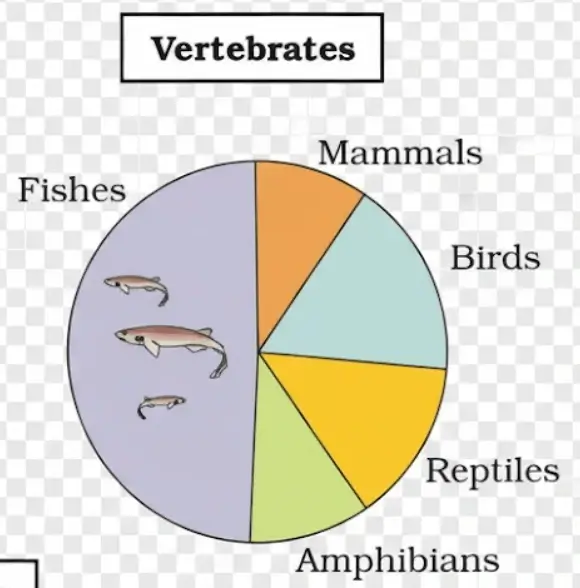
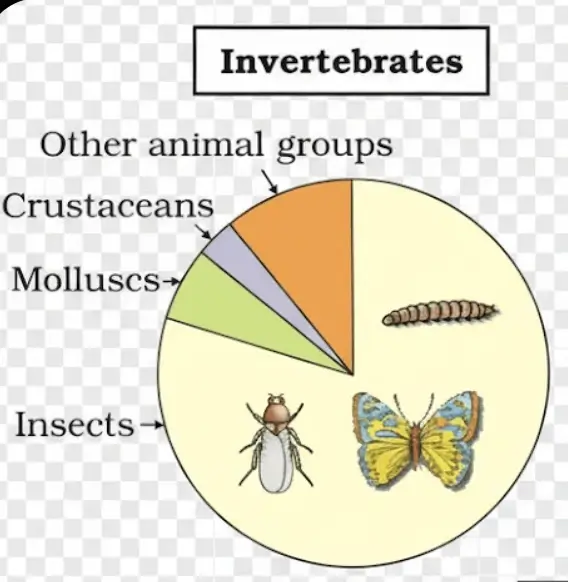
Scientists estimate there are around 8.7 million eukaryotic species on Earth, but only about 1.2 million have been formally described, meaning over 80% of life remains undiscovered.
Based on current records, animals make up over 70% of all known species on Earth.
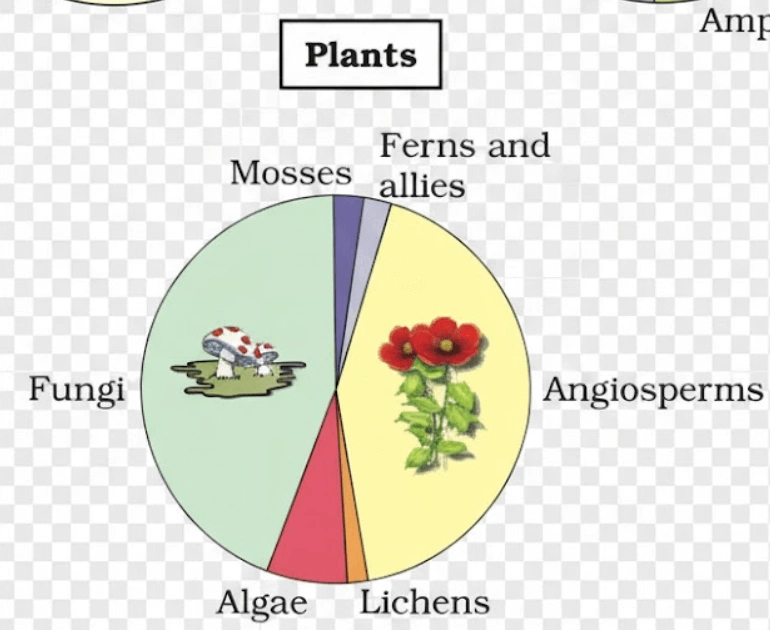
Plants (including algae, fungi, bryophytes, gymnosperms, angiosperms) form only about 22% of total species.
Among animals, insects are the most diverse group, contributing more than 70% of all animal species. This means 7 out of every 10 animals on Earth are insects.
The number of fungal species is more than the combined total of fishes, amphibians, reptiles and mammals.
Biodiversity of India
India is recognized as one of the mega-diverse countries, rich in biodiversity and associated traditional knowledge.
India has 23.39% of its geographical area under forest and tree cover.
India’s share of crops is 44% as compared to the world average of 11%.
India Represents – Two ‘Realms’, Five Biomes, and Ten Bio-geographic Zones
India has only 2.4 per cent of the world’s land area, its share of the global species diversity is an impressive 8.1 per cent. That is what makes our country one of the 17 mega diversity countries of the world.
Nearly 45,000 species of plants and twice (90,000) as many of animals have been recorded from India.
Measurement of Biodiversity
Biodiversity is measured by two major components: species richness, and species evenness.
Biodiversity Term
Explanation
Species richness
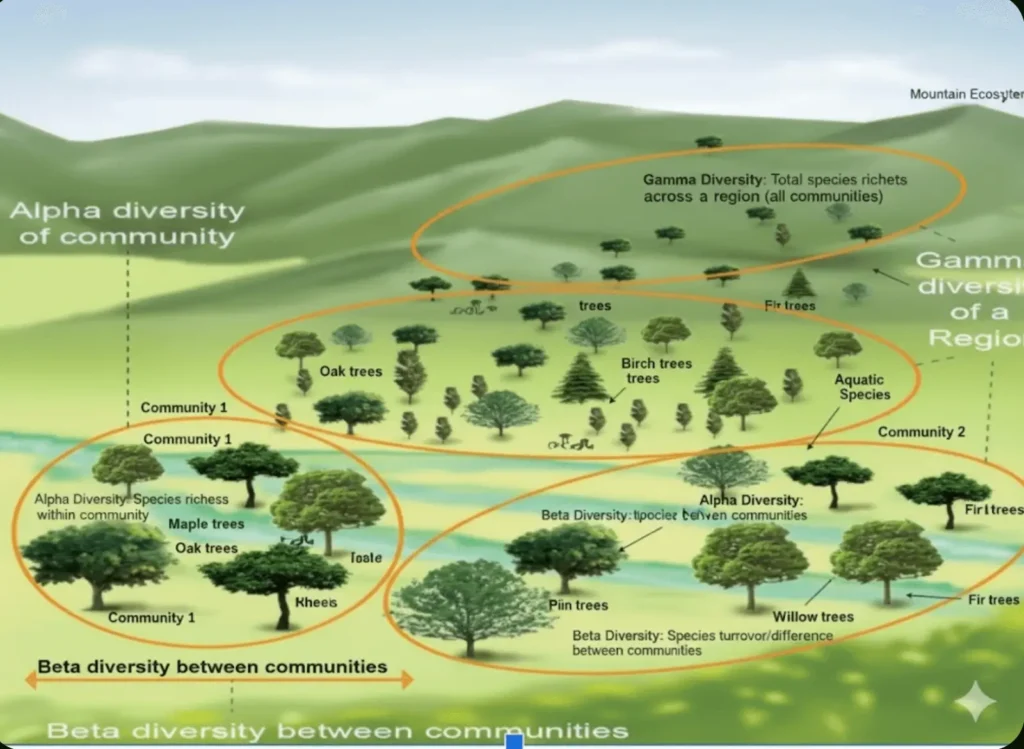
It is the measure of number of species found in a community.R. H. Whittaker introduced the ecological concepts of alpha, beta, and gamma diversity in 1972 to measure biodiversity across different spatial scales.
Alpha diversity – Refers to the diversity within a particular area ecosystem, and is usually expressed by the number of species (i.e.,species richness) in that ecosystem.
Beta Diversity – It’s a comparison of diversity between ecosystems,usually measured as the change in amount of species between the the ecosystem)
Gamma diversity – It is a measure of the overall diversity for the different ecosystems within a region.
Species evenness
It measures the proportion of species at a given site, e.g. low evenness indicates that a few species dominate the site.
Patterns of Biodiversity
Biodiversity is not evenly distributed on Earth. Some regions have more species than others.
Ecological Concept
Explanation
Latitudinal gradients
Species diversity decreases from the equator towards the poles.
Tropical regions (23.5° N to 23.5° S) have more species than temperate or polar regions.
Tropical forests (e.g. Ecuador) have 10 times more plant species than temperate forests of similar size.
The Amazon rainforest has the highest biodiversity on Earth.
Species–Area Relationship
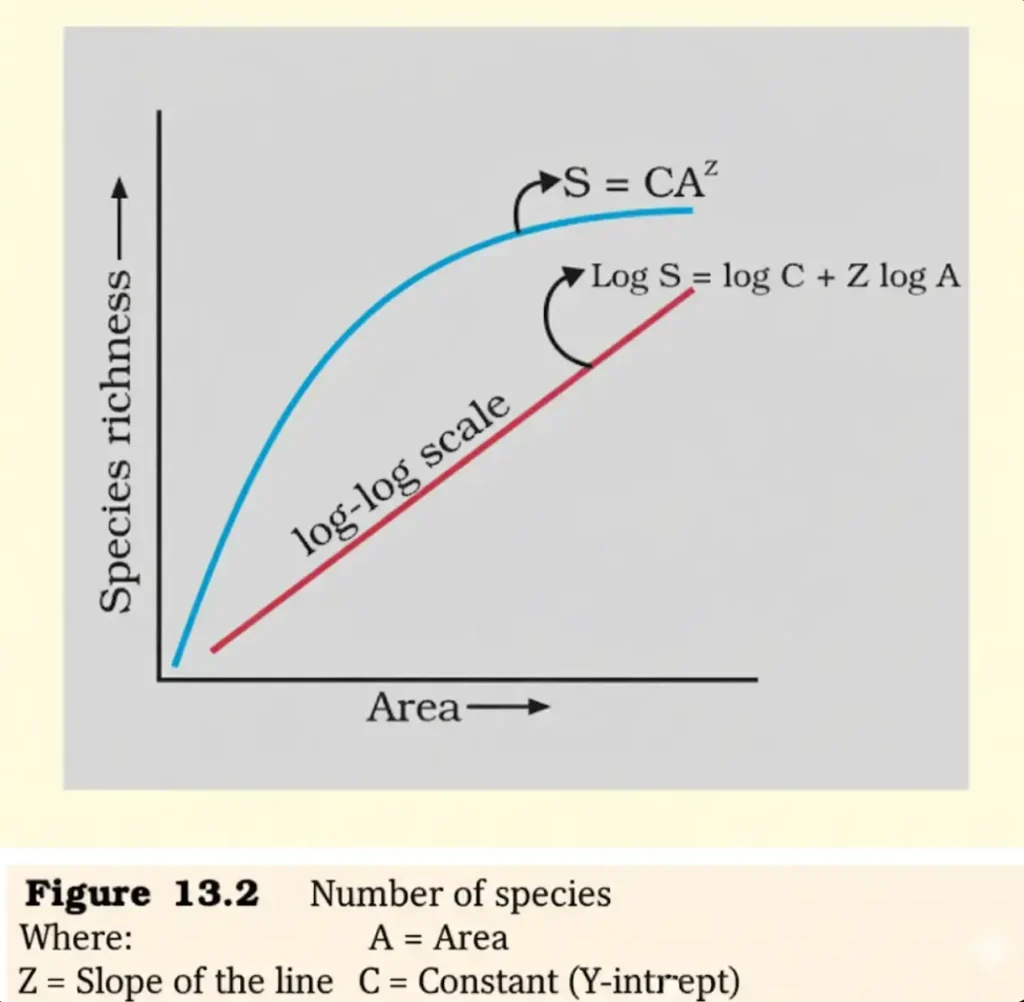
Alexander von Humboldt observed that when we explore larger areas, we generally find more species, but only up to a certain limit.
For many groups (plants, birds, bats, fishes), the species–area relationship forms a rectangular hyperbola.
When plotted on a log–log scale, it becomes a straight line:
For normal-sized areas (like forests, parks, reserves), the value of Z usually lies between 0.1 and 0.2.
This is true for many groups like plants in Britain, birds in California, and molluscs in New York.
For very large areas (like entire continents), the Z-value is higher — between 0.6 and 1.2.
Example: For fruit-eating birds and mammals in tropical forests of different continents, Z = 1.15.
A steeper Z value means:
Species number increases very rapidly with an increase in area.
Large areas support much higher biodiversity compared to small areas.
There is greater species turnover from one big region to another (species change more dramatically across continents).
Loss of Biodiversity
Causes of biodiversity losses: The accelerated rates of species extinctions that the world is facing now are largely due to human activities. There are four major causes (The Evil Quartet is the sobriquet used to describe them).
Factor
Impact on Biodiversity
Habitat loss and fragmentation
Habitat loss is the biggest reason why many plants and animals are becoming extinct.
The worst examples come from tropical rainforests. They once covered 14% of Earth’s land. Today they cover only 6%.
Rainforests are being destroyed rapidly.
The Amazon rainforest, called the “lungs of the planet”, is being cleared mainly for: Soya bean farming and grasslands for beef cattle.
When large habitats are broken into small pieces (fragmentation): Animals needing large territories (like many mammals and birds) suffer. Migratory species are badly affected. This leads to population decline and even extinction.
Over-exploitation
Humans have always used nature for food and shelter, but when need becomes greed, it leads to over-exploitation.
Many species that went extinct in the last 500 years (like Steller’s sea cow and the passenger pigeon) disappeared mainly because humans over-used them.
Today, many marine fish populations are being over-harvested, putting several commercially important fish species at risk of extinction.
Alien Species Invasions
When alien (non-native) species are brought into a new area—intentionally or accidentally—some become invasive.
Invasive species grow fast, spread quickly, and harm native species, often causing their decline or extinction.
Example: The Nile perch introduced into Lake Victoria (East Africa) caused the extinction of 200+ species of native cichlid fishes.
In India, invasive weeds like: Parthenium (carrot grass), Lantana, Eichhornia (water hyacinth) cause serious ecological damage.
The illegal introduction of African catfish (Clarias gariepinus) in aquaculture threatens the survival of native Indian catfish species.
Global Invasive Species Database
It was developed and is managed by the Invasive Species Specialist Group of the Species Survival Commission of the IUCN (International Union for Conservation of Nature).
It was developed as part of the global initiative on invasive species led by the erstwhile Global Invasive Species Programme (GISP) in 2000.
Co- extinctions
When one species becomes extinct, other species that depend on it completely also become extinct. This is called co-extinction.
Example: If a host fish species disappears, all its unique parasites also disappear.
Another example is plant–pollinator mutualism: If the plant dies out, the pollinator that depends on it also becomes extinct. And if the pollinator disappears, the plant cannot reproduce and may also go extinct.
Other causes for Biodiversity Loss
Natural Causes
Man-Made Causes
Floods
Earthquake
Landslides
Rivalry among species
Lack of pollination
Diseases
Habitat destruction
Uncontrolled commercial exploitation
Hunting & poaching
Conversion of rich biodiversity sites for human settlement and industrial development
Extension of agriculture
Pollution
Filling up of wetlands
Destruction of coastal areas
How do we conserve Biodiversity
In-situ Conservation
Ex-situ Conservation
In situ (on-site) conservation means protecting species in their natural habitats.
Conserving the animals and plants in their natural habitats.
Example: Protecting entire forests to save tigers and other species.
Ex situ (off-site) conservation means protecting endangered species outside their natural habitats.
Conserving biodiversity outside the areas where they naturally occur.
Reintroduction of an animal or plant into the habitat from where it has become extinct is another form of ex situ conservation.
Used when a species is in very high danger of extinction.
Examples
Conservation
Examples
National Parks
Wildlife Sanctuaries
Conservation Reserves
Sacred Groves
Biosphere Reserves
Marine Protected Areas
Ramsar Sites
Community Reserves
Zoological parks
Botanical gardens
Wildlife safari parks
Cryopreservation to store gametes (sperms, eggs) for long periods
In vitro fertilisation (IVF)
Tissue culture for plant propagation
Seed banks for storing seeds of important crops
Bird Houses
Aquariums
Bud Parks
Zoo
Deer Parks
In-situ Conservation
Type of Protected Area
Description
National Parks
A National Park is a protected area established by the government under the Wildlife Protection Act, 1972 to conserve wildlife, flora, and natural ecosystems. These parks aim to safeguard biodiversity and provide a secure habitat for endangered species.
They are declared by the State Government, and in some cases by the Central Government.
Human activities like hunting, poaching, and commercial use of resources are strictly prohibited within their boundaries.
National Parks also promote eco-tourism, environmental education, and scientific research to maintain ecological balance and awareness.
National Parks have higher protection than Sanctuaries.
Corbett National Park, established in 1936, is the Oldest National Parks in India.
South Button Island National Park is the Smallest National Parks in India covering an area of just 5 sq.km.
Hemis National Park (Ladakh) is the Largest National Parks in India in India by area.
The Odisha government has recently declared Similipal Tiger Reserve as the state’s second national park, following Bhitarkanika, making it the 107th national park in India.
Wildlife Sanctuaries
At present there are 573 Wildlife Sanctuaries in India.
Wildlife Sanctuaries are declared under the Wild Life (Protection) Act, 1972.
They are declared by the State Government, and in some cases by the Central Government.
Human Activities in sanctuary → Some activities allowed with regulation (e.g., grazing may be permitted).
Conservation Reserves
The Wildlife Protection Act was amended in 2003 to create a new protected area category called a Conservation Reserve.
It is created on government-owned land that is adjacent to National Parks or Wildlife Sanctuaries.
Purpose: To protect landscapes, seascapes, and habitats of plants and animals.
The State Government can declare an area as a Conservation Reserve after consulting local communities.
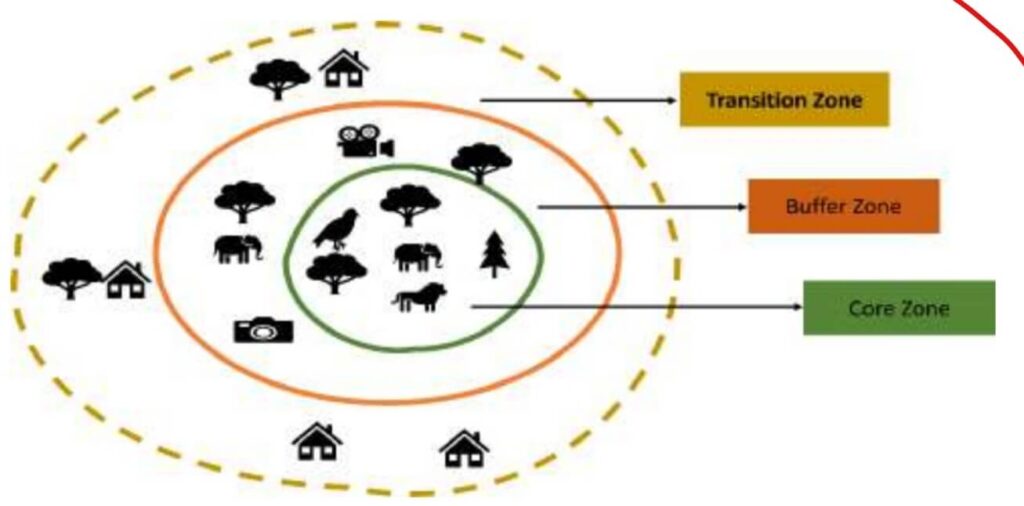
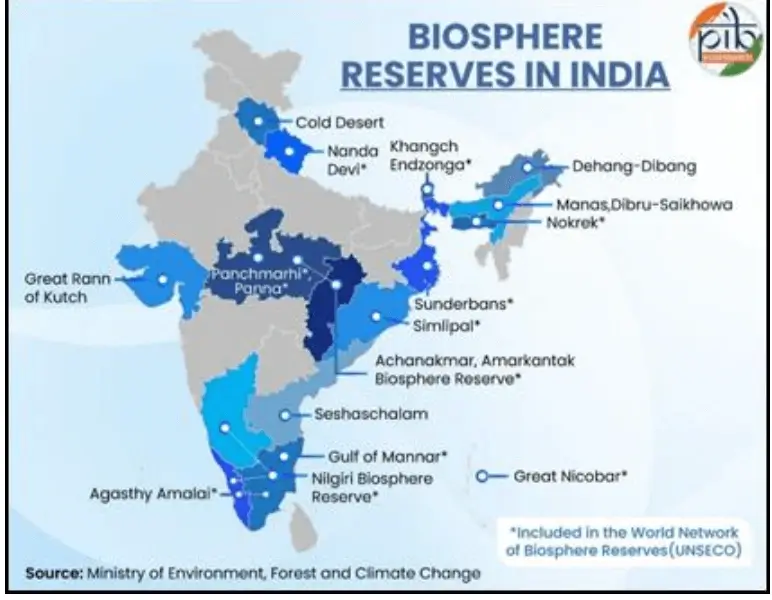
Biosphere Reserves
Biosphere reserves are nominated by national governments and remain under the sovereign jurisdiction of the states where they are located.
Biosphere reserves include terrestrial, marine and coastal ecosystems.
The country has 18 Biosphere Reserves covering 91,425 sq. km, with 13 recognized by UNESCO.
The programme operates under a Centrally Sponsored Scheme with a 60:40 funding pattern, and 90:10 for North Eastern and Himalayan states.
The inclusion of the Cold Desert Biosphere Reserve in 2025 underscores India’s growing global conservation role.
Sacred groves
Sacred groves are patches of forest or natural vegetation, ranging from a few trees to several acres.
They are dedicated to local folk deities and protected due to religious beliefs and traditions.
Local communities protect them because they believe disturbing the grove will anger the deity.
Example – Gonds (Central India) – Cutting live trees is banned, but fallen branches can be used.
Types of Sacred Groves
Traditional Sacred Groves – Home of the village deity, represented by a simple symbol.
Temple Groves – Groves protected because they surround a temple.
Burial/Cremation Groves – Forest patches conserved around burial or cremation grounds.
Marine Protected Area
It is any intertidal or subtidal area, including its water, plants, animals, and cultural features, which is legally protected to conserve the environment.
They help ensure sustainable fish production and healthy marine ecosystems.
Category I – Includes National Parks and Wildlife Sanctuaries located entirely in: Intertidal/subtidal zones, Mangroves, Coral reefs, Creeks, Seagrass beds, Algal beds, Estuaries, Lagoons
Category II – Includes islands where: Most area = marine ecosystem, Some area = terrestrial ecosystem
Category IIIA – Sandy beaches beyond the intertidal zone. Occasionally interact with seawater.
Category IIIB – Evergreen or semi-evergreen forests on islands
Ramsar Sites
Ramsar sites are Wetlands of International Importance designated under the Ramsar Convention, an intergovernmental treaty adopted in Ramsar, Iran, in 1971. This convention provides the framework for the conservation and wise use of wetlands and their resources.
India ratified the convention in 1982 and actively designates Ramsar sites for sustainable use.
As of September 2025, there are 96 Ramsar Sites in India. Tamil Nadu (20) boasts the highest number of Ramsar Sites.
Largest Ramsar Sites in India – Sundarban Wetland
Smallest Ramsar Sites in India – Renuka Lake (Himachal Pradesh)
Oldest Ramsar Sites in India – Chilka Lake – 1981, Keoladeo Ghana NP – 1981
Newly Added Ramsar Sites (2025)
Sakkarakottai Bird Sanctuary (Tamil Nadu)
Therthangal Bird Sanctuary Tamil Nadu)
Khecheopalri Wetland (Sikkim)
Udhwa Lake (Jharkhand)
90) Khichan (Phalodi) (Rajasthan)
91) Menar (Udaipur) (Rajasthan)
92) Gokul Jalashay (Bihar)
93) Udaipur Jheel (Bihar)
94) Gogabeel Lake (Bihar)
95) Siliserh Lake (Rajasthan) and
96) Kopra Jalashay (Chhattisgarh)
Montrex record
It is a register of wetland sites on the List of Wetlands of International Importance where changes in ecological character have occurred, are occurring, or are likely to occur as a result of technological developments, pollution or other human interference.
It is maintained as part of the Ramsar List.
It was established in 1990.
Currently, two wetlands of India are in Montreux record: Keoladeo National Park (Rajasthan) and Loktak Lake (Manipur).
Chilika lake (Odisha) was placed in the record but was later removed from it.
BIODIVERSITY HOT SPOTS
Biodiversity hot spot concept was put forth by Norman Myers in 1988.
To qualify as a hot spot, a region must meet two strict criteria;
Species endemism – it must contain at least 1,500 species of vascular plants (0.5 % of the world’s total) as endemics.
Degree of threat – it has to have lost at least 70% of its original habitat.
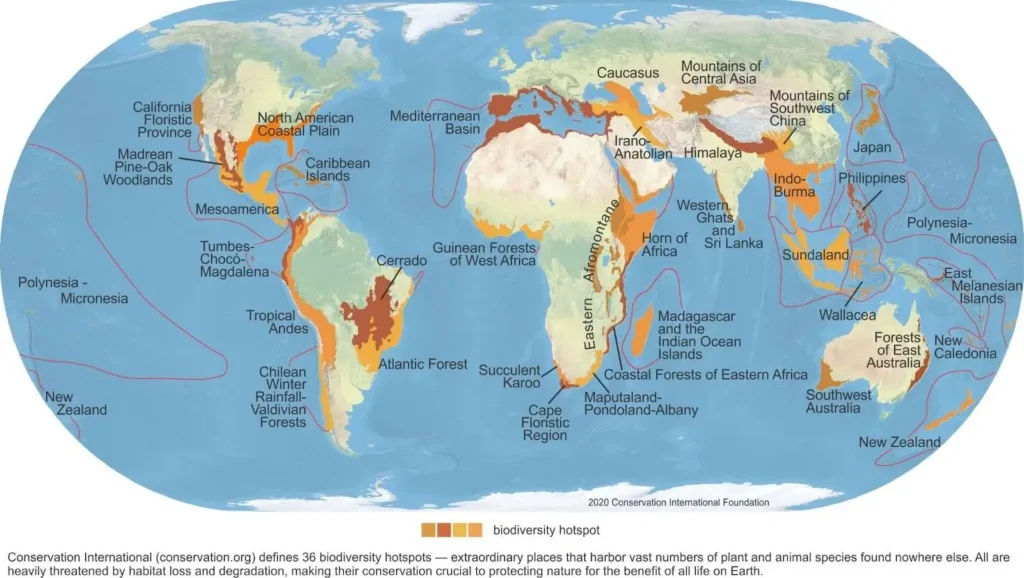
There are currently 36 recognized biodiversity hotspots. These are Earth’s most biologically rich—yet threatened — terrestrial regions.
They represent just 2.5% of Earth’s land surface. They contain around 50% of the world’s endemic plant species and 43% of all terrestrial vertebrates.
Biodiversity hotspots in India
Himalaya: Includes the entire Indian Himalayan region (and that falling in Pakistan, Tibet, Nepal, Bhutan, China and Myanmar). They are home to numerous endemic species like Himalayan blue poppy, snow leopards & red pandas.
Indo-Burma: Includes entire North-eastern India, except Assam and Andaman group of Islands (and Myanmar, Thailand, Vietnam, Laos, Cambodia and southern China). Home to unique species like orangutan, Sunda pangolin & Sumatran tiger, Orange naked patries, white eared night heron, gray crowned crotias
Western Ghats and Sri Lanka: largest hotspot in India. Includes the entire Western Ghats (and Sri Lanka). Significant endemic fauna includes Malabar civet, Asian elephant, Malabar gray hornbill ,Nilgiri tahr, lion tailed macaque.
Sundalands: Includes Nicobar group of Islands (and Indonesia, Malaysia, Singapore, Brunei, Philippines). Significant endemic fauna includes Dugong, Turtles , crocodile, Jhinga and whale.
Hottest hotspots
There are 8 special spots, collectively known as ‘hottest hotspots’, meaning, these hotspots are a notch higher in popularity than the rest.
Madagascar
Philippines
Sundaland
Brazil’s Atlantic forests
Caribbean island
Indo – Burma region
Western Ghats & Srilanka
Eastern arc & coastal forests of Tanzania/Kenya
Conservation efforts
Project Tiger
Initiated in 1973, has been India’s flagship conservation initiative, successfully completing 50 years in 2023.
As per the 5th cycle of All India Tiger Estimation 2022, India now hosts over 70% of the world’s wild tiger population, rising to 3,682, reaffirming its leadership in global tiger conservation.
As of 2025, India boasts 58 tiger reserves, which collectively cover nearly 2.3% of the country’s total land area.
Madhav Tiger Reserve is the 58th tiger reserve of India.
International Big Cat Alliance (IBCA)
Launched by PM Narendra Modi on April 9, 2023, during the 50 Years of Project Tiger event.
Union Cabinet approved its establishment in February 2024, with headquarters in India.
Founded by the National Tiger Conservation Authority (NTCA) under MoEFCC on March 12, 2024.
Focuses on the conservation of seven big cat species: Tiger, Lion, Leopard, Snow Leopard, Cheetah, Jaguar, and Puma.
The International Big Cat Alliance (IBCA) officially became a treaty-based intergovernmental organization on January 23, 2025, with Nicaragua, Eswatini, India, Somalia, and Liberia ratifying the agreement.
With 27 countries onboard, IBCA aims to drive global big cat conservation through cross-border collaboration.
Project Dolphin
Launched on 15th August 2020, Project Dolphin aims to conserve both marine and riverine dolphins. Key dolphin hotspots have been identified in Assam, Rajasthan, Madhya Pradesh, Punjab, and Lakshadweep.
On 18th December 2024, India achieved a groundbreaking milestone by successfully satellite-tagging the first-ever Ganges River Dolphin (Platanista gangetica) in Assam under Project Dolphin.
Led by the Wildlife Institute of India (WII) in collaboration with the Assam Forest Department and Aaranyak, and funded by the National CAMPA (MoEFCC), this initiative marks a global first in dolphin conservation.
Project Cheetah
Project Cheetah is a landmark wildlife conservation initiative launched on September 17, 2022 aimed at reintroducing cheetahs to India after their extinction in the late 1940s and early 1950s.
As the world’s first intercontinental large wild carnivore translocation project, it operates under the umbrella of Project Tiger and aligns with the Cheetah Action Plan to restore and conserve the species.
Transcontinental Relocation: In September 2022, eight cheetahs from Namibia were translocated to Kuno National Park, followed by twelve cheetahs from South Africa in February 2023.
Now 8 cheetahs from Botswana are introduced in India.
Project Elephant
Project Elephant was launched in February, 1992.
India, home to over 60% of the global Asian elephant population
Growing Elephant Population: India’s wild elephant population has increased from 26,786 (2018 census) to 29,964 in 2022, reinforcing the country’s successful conservation efforts.
India has 33 Elephant Reserves across 14 states, covering a vast 80,777 km², ensuring elephants have safe migratory corridors and protected habitats.
The Project Tiger and Project Elephant Scheme has been merged from FY 2023-24 and is now known as Project Tiger & Elephant.
Monitoring of illegal Killing of Elephants (MIKE) Programme – a CITES resolution program was launched in 2003.
Project Lion
Announced on August 15, 2020
Through rigorous conservation efforts, the Asiatic lion population has shown a consistent upward trend.
India’s lion population has grown to 891, up from 674 in 2020.
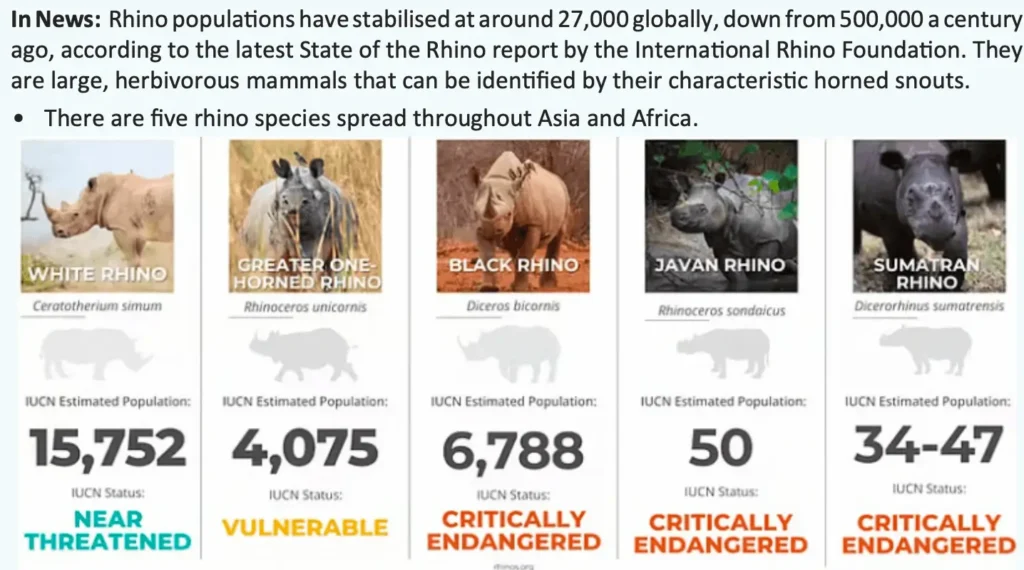
Conserving the One-Horned Rhinoceros
National Conservation Strategy for the Indian One-Horned Rhinoceros (2019): Launched by the Ministry of Environment, Forest and Climate Change in 2019, this strategy aims to repopulate rhinoceros populations in areas where they previously existed by augmenting existing conservation efforts through scientific and administrative measures.
Project Red Panda
Conservation breeding program launched in 1994 at the Padmaja Naidu Himalayan Zoological Park (PNHZP) in Darjeeling, India, to systematically breed red pandas in captivity to ensure their long-term survival.
Project Great indian bustard (Godawan – 2013
Launched on 5th of June 2013.
Probably more vulnerable to extinction than even tiger, Great Indian Bustard, although it was brought under the umbrella of Wildlife (Protection) Act, 1972
Desert National Park was designated as a Sanctuary in 1980.
Institutional efforts
UNCBD (United Nations Convention on Biological Diversity)
One of the key agreements adopted at Rio was the Convention on Biological Diversity.
Adoption of the final text of the United Nations Convention on Biological Diversity (UNCBD) on May 22, 1992, in Nairobi, Kenya.
Entered into force on 29 December 1993.
India ratified it in 1994.
Headquarters – Montreal, Canada
COP of UNCBD held biennially, recently COP 16 held in Cali Colombia.
Important agreements under UNCBD
Cartagena protocol
An international treaty governing transboundary movements of living modified organisms (LMOs) resulting from modern biotechnology, which may have adverse effects on biological diversity, taking into account risks to human health.
Adopted in 2000 as a supplementary agreement UNCBD.
It establishes an advance informed agreement (AIA) procedure for ensuring that countries are provided with the information necessary to make informed decisions before agreeing to the import of such organisms into their territory. The Protocol contains a reference to a precautionary approach.
India has ratified this protocol.
Nagoya Protocol
It is an agreement under the Convention on Biological Diversity (CBD).
Adopted in 2010 (Nagoya, Japan).
It ensures fair and equitable sharing of benefits arising from the use of genetic resources (plants, animals, microbes, etc.).
Objective – To ensure countries that provide genetic resources receive a fair share of the benefits (money, technology, research results).
Obligations
Countries must make clear rules for accessing genetic resources.
Ensure Prior Informed Consent (PIC) and Mutually Agreed Terms (MAT) before issuing permits.
Promote research and consider food security needs.
Aichi targets
5 goals and its 20 Aichi Biodiversity Targets were adopted at COP10.
COP 15MontrealCanada
Kunming-Montreal Global Biodiversity Framework” (GBF) was adopted.It includes 4 goals and 23 targets for achievement by 2030.
Goals
Goal A Protect & Restore Nature
Restore natural ecosystems and increase their total area by 2050.Stop extinction of threatened species, reduce extinction risk 10x by 2050.Increase populations of native wild species to healthy levels.
Goal BProsper withNature
Development should be sustainable and nature-friendly for present and future generations.
Goal CFair Sharing of Benefits
Benefits from genetic resources & digital genetic data shared fairly and equitably.Protect traditional knowledge of Indigenous communities.By 2050, significantly increased benefit-sharing.
Goal D Finance & Cooperation
More finance, technology support, and capacity-building for countries.Close the $700 billion per year biodiversity finance gap.
Key Targets
30×30 Goal – Restore 30% degraded ecosystems by 2030.
Conserve 30% of land + water + marine areas by 2030.
Protect Species – Stop extinction of known species by 2030. By 2050 → 10× reduction in extinction risk for all species.
Cut Pollution – Pesticides ↓ 50% by 2030. Nutrient loss ↓ 50% by 2030 All pollution reducetion to non-harmful levels.
Reduce Consumption Footprint – Lower overconsumption + waste. Food waste will be cut by 50% by 2030.
Sustainable Production – Manage agriculture, fisheries, forestry sustainably. More agroecology & biodiversity-friendly practices.
Climate Action via Nature – Promote nature-based solutions.
Control Invasive Species – 50% reduction in introduction/spread of invasive species.
Safe & Legal Wildlife Trade – Ensure sustainable and legal trade of wild species.
Urban Biodiversity – Increase green spaces in cities.
COP 16
Concluded in Cali, Colombia
Key Highlights
Cali Fund Operationalised
Fund created to ensure fair sharing of benefits from Digital Sequence Information (DSI).
50% of funding directed to Indigenous Peoples & Local Communities (especially women & youth).
DSI = genomic sequence data used in biological & environmental research.
New Permanent Body on Article 8(j)
Established to protect knowledge & practices of Indigenous Peoples.
New Programme of Work adopted → ensures their participation in conservation and benefit-sharing.
Resource Mobilisation Strategy
New strategy to mobilise USD 200 billion per year by 2030 for biodiversity.
Kunming Biodiversity Fund launched with USD 200 million from China.
Goal: Redirect USD 500 billion/year from harmful subsidies by 2030.
Synthetic Biology Action Plan
Synthetic biology = creating or modifying organisms using DNA sequencing & genome editing.
Invasive Alien Species
New measures: Better databases, stronger trade controls, coordination with e-commerce platforms to prevent spread
Ecologically or Biologically Significant Marine Areas (EBSAs) – New process approved to identify & protect key marine areas. EBSAs (started 2010) protect vulnerable ocean ecosystems.
COP 17
Yerevan, Armenia (2026)
Other
IUCN
IUCN (International Union for Conservation of Nature) was established in 1948. It was initially called the International Union for the Protection of Nature (1948–1956).
Headquarters – Gland Switzerland.
IUCN Red data book
Established in 1964, the International Union for Conservation of Nature’s Red List of Threatened Species has evolved to become the world’s most comprehensive information source on the global extinction risk status of animal, fungus and plant species.
The IUCN Red List measures the pressures acting on species, which guides and informs conservation actions to help prevent extinctions. This is why the IUCN Red List is often referred to as a Barometer of Life.
The IUCN Red List Categories and Criteria are intended to be an easily and widely understood system for classifying species at high risk of global extinction.
It divides species into nine categories:
Extinct – No known individuals remaining.
Extinct in the Wild – Known only to survive in captivity, or as a naturalized population outside its historic range.
IUCN status
Reduction in population size
Population size
Probability of extinction in the wild
Critically Endangered
> 90% over the last 10 years
less than 50 mature individuals
at least 50% within 10 years
Endangered
>70% over the last 10 years
fewer than 250 mature individuals
at least 20% within 20 years
Vulnerable
> 50% over the last 10 years).
fewer than 10,000 mature individuals
at least 10% within 100 years
Near threatened (NT) – Likely to become endangered soon.
Least concern (LC) – Lowest risk. Does not qualify for a more at-risk category.
Data deficient (DD) – Not enough data to assess its risk of extinction.
Not evaluated (NE) – Has not yet been evaluated against the criteria
WWF(World Wide Fund for Nature)
An international NGO working for environmental conservation and reducing human impact on nature.
Established: 1961
Origin: Initiated to support IUCN and global conservation efforts via fundraising and activism.
Headquarters: Gland, Switzerland
Objective of WWF:
To halt environmental degradation and promote a sustainable future where humans live in harmony with nature.
Publishes Living Planet Report and maintains the Living Planet Index.
Conducts campaigns like Earth Hour and Debt-for-Nature Swap.
CITES
Convention on International Trade in Endangered Species of Wild Fauna and Flora
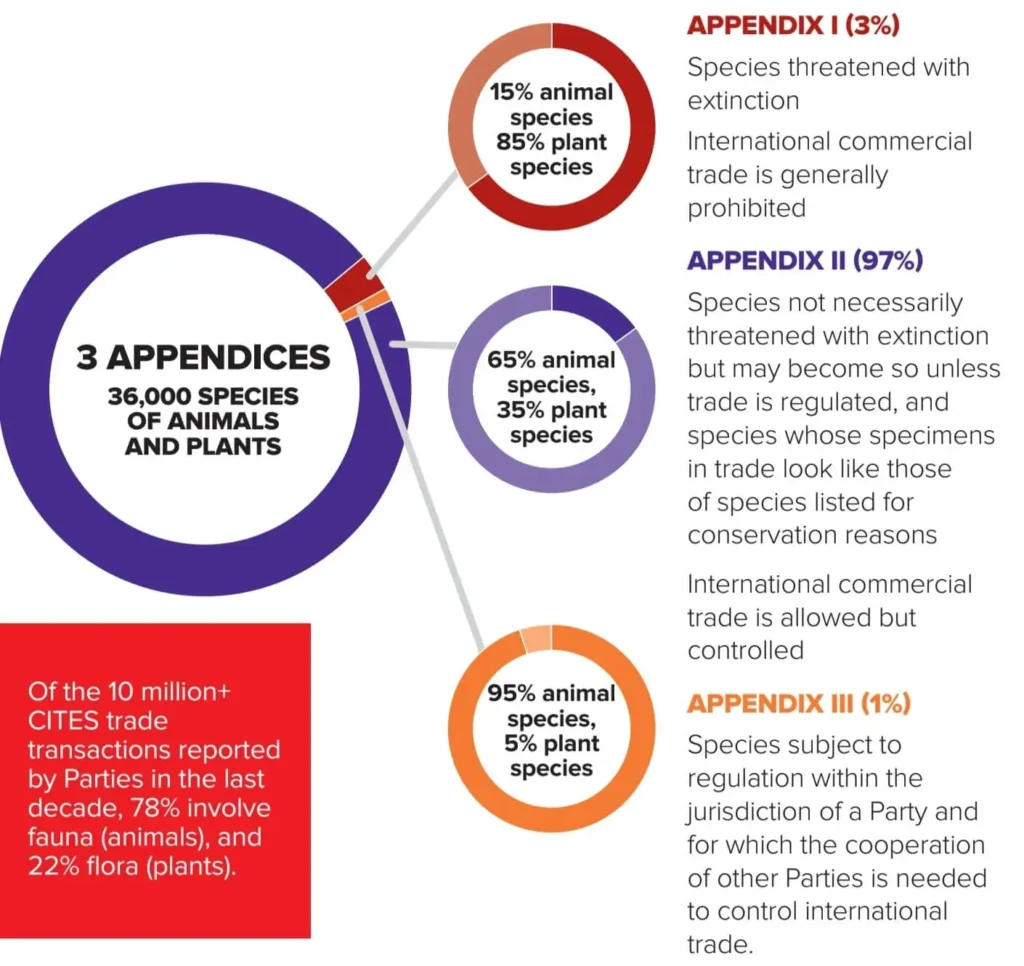
It is an international agreement between governments. Its aim is to ensure that international trade in specimens of wild animals and plants does not threaten the survival of the species.
CITES was drafted as a result of a resolution adopted in 1963 at a meeting of members of Trade record analysis of flora and fauna in commerceWildlife Trade Monitoring Network, is a leading non-governmental organisation working on wildlife trade in the context of both biodiversity conservation and sustainable development.It is a joint program of the World Wildlife Fund (WWF) and the International Union for Conservation of Nature (IUCN).It was established in 1976.Headquarters: Cambridge, United Kingdom IUCN (The World Conservation Union).
The text of the Convention was opened for signature on 3 March 1973.
On 1 July 1975 CITES entered into force.
India ratified the convention in 1976.
CITES accords varying degrees of protection to more than 36,000 species of animals and plants by applying different provisions to species included in three Appendices:
COP-20 of CITES held in Armenia.
TRAFFIC
Trade record analysis of flora and fauna in commerce
Wildlife Trade Monitoring Network, is a leading non-governmental organisation working on wildlife trade in the context of both biodiversity conservation and sustainable development.
It is a joint program of the World Wildlife Fund (WWF) and the International Union for Conservation of Nature (IUCN).
It was established in 1976.
Headquarters: Cambridge, United Kingdom
Species in news
Dugong
The dugong is a large, herbivorous marine mammal found throughout the Indo-Pacific region, including the warm coastal waters of the Indian and Pacific Oceans.
In India, dugongs inhabit the Gulf of Mannar, Palk Bay, Gulf of Kachchh, and the Andaman and Nicobar Islands
They are highly dependent on seagrass meadows, both as habitat and for food, and prefer warm, shallow bays or mangrove channels.
They are listed as Vulnerable on the IUCN Red List and in Schedule I of India’s Wildlife Protection Act, 1972.
Hangul
It is also known as Kashmir stag and is a subspecies of Central Asian red deer that is endemic to Kashmir and surrounding areas.
It was once found across the Himalaya, Chenab Valley, and parts of Himachal Pradesh, but now survives within Dachigam National Park (Kashmir).
IUCN Red List of Threatened species classified hangul as Critically Endangered species.
Koala
Australia has approved the first vaccine to protect its shrinking koala population against chlamydia.
The koala (Phascolarctos cinereus) is a tree-dwelling marsupial native to Australia.
Often mistakenly called the “koala bear,” it is not a bear but a marsupial (a mammal that carries its young in a pouch).
Great Indian Bustard
The GIB is one of the heaviest flying birds in the world.
Rajasthan’s Thar Desert, particularly the Desert National Park, is the last stronghold for the species in India, holding over 90% of the remaining wild population
Significance: It is a key indicator of the health of its native arid and semi-arid grassland ecosystems.
IUCN Status: Critically Endangered
Newly discovered species
Sparteaus karigiri →Jumping spider
Allographa effusoredica → Lichen (Western Ghats)
Portulaca bharat → Flowering plant
Sheathia rosemalayensis → Algae
Other
New Scarab Beetle Species in Northeast India
Soil-dwelling nematode, Crasso Labium Dhriti Ae in Odisha.
Piratula acuminata, a new wolf spider species in Sagar Island, Sundarbans, West Bengal
ZSI discovered two new soil micro-arthropod species in West Bengal: Salina aurantiamaculata (orange-spotted) and Salina pseudomontana (similar to S. montana), enriching India’s biodiversity.
Indian scientists discovered two new black Aspergillus species—A. dhakephalkarii and A. patriciawiltshireae—in the Western Ghats, highlighting the region’s hidden fungal diversity and ecological importance.
MAJOR FINDINGS of ISFR 2023
The Forest and Tree cover of the country is 8,27,357 sq km which is 25.17 % of the geographical area of the country,
Consisting of 7,15,343 sq km (21.76%) as forest cover and 1,12,014 sq km (3.41%) as tree cover.
As compared to assessment of 2021, there is an increase of 1445 sq km in the forest and tree cover of the country which includes 156 sq km increase in the forest cover and 1289 sq km increase in tree cover.
Top four states showing maximum increase in forest and tree cover are
Chhattisgarh (684 sq km)
Uttar Pradesh (559 sq km)
Odisha (559 sq km) and
Rajasthan (394 sq km)
Top three states showing maximum increase in forest cover are
Mizoram (242 sq km)
Gujarat (180 sq km)
Odisha (152 sq km)
Area wise top three states having largestforest and tree cover are
Madhya Pradesh (85,724 sq km)
Arunachal Pradesh (67,083 sq km)
Maharashtra (65,383 sq km)
Area wise top three states having largest forest cover are
Madhya Pradesh (77,073 sq km)
Arunachal Pradesh (65,882 sq km)
Chhattisgarh (55,812 sq km)
In terms of percentage of forest cover with respect to total geographical area,
Lakshadweep (91.33 percent)
Mizoram (85.34 percent)
Andaman & Nicobar Island (81.62 percent)
The present assessment also reveals that 19 states/UTs have above 33 percent of the geographical area under forest cover.
Out of these, eight states/UTs namely Mizoram, Lakshadweep, A & N Island, Arunachal Pradesh, Nagaland, Meghalaya, Tripura, and Manipur have forest coverabove 75 percent.
The total mangrove cover is 4,992 sq km in the country.
In the present assessment total carbon stock in the country’s forest is estimated to be 7,285.5 million tonnes. There is an increase of 81.5 million tonnes in the carbon stock of country as compared to the last assessment.
Regarding status on achievement of target under NDC related to carbon sequestration, the current assessment shows that India’s carbon stock has reached 30.43 billion tonnes of CO2 equivalent; which indicates that as compared to the base year of 2005, India has already reached 2.29 billion tonnes of additional carbon sink asagainst the target of 2.5 to 3.0 billion tonnes by 2030.
Sustainable development
Definition – ‘Development which meets the needs of the present without compromising the ability of future generations to meet their own needs’.
Sustainable development (SD) calls for concerted efforts towards building an inclusive, sustainable and resilient future for people and planet.
History
Global Initiatives on Sustainable Development
The Stockholm Conference, 1972: It was the first step towards putting environmental concerns on the global agenda.
UNEP was set up in 1972 to serve as a catalyst in developing and coordinating an environmentally focused approach in the programmes of other organisations.
World Commission on Environment and Development (WCED)
Establishment – Set up in 1983 by the United Nations, Also known as BrundtlandCommission.
The idea of “sustainable development” was popularized by this commission.
Introduced through the Brundtland Report (1987), Titled as “Our Common Future”.
Laid foundation for Earth summit(1992) and Agenda 21.
The Earth Summit, 1992
United Nations Conference on Environment and Development (UNCED) held in Rio de Janeiro, Brazil, 3 to 14 June 1992.
Agenda 21, the Rio Declaration on Environment and Development, and the Statement of Principles for the Sustainable Management of Forests were adopted by more than 178 Governments at the (UNCED).
Millennium Development Goals (MDGs) by 2015
Member States unanimously adopted the Millennium Declaration at the Millennium Summit in September 2000 at UN Headquarters in New York.
The Summit led to the elaboration of eight Millennium Development Goals (MDGs) to reduce extreme poverty by 2015.
UNCED, the World Summit on Sustainable Development
(Rio+10) was held in 2002 in Johannesburg, South Africa. In 2012, the United Nations Conference on Sustainable Development (Rio+20/Rio Earth Summit 2012) was also held in Rio, Brazil.
It reaffirmed the global community’s commitments to poverty eradication and the environment protection, and built on Agenda 21 and the Millennium Declaration by placing greater emphasis on multilateral partnerships.
Rio+20 (2012) or Earth Summit 2012
At the United Nations Conference on Sustainable Development (Rio+20) in Rio de Janeiro, Brazil, in June 2012, Member States adopted the outcome document “The Future We Want” in which they decided, inter alia, to launch a process to develop a set of SDGs to build upon the MDGs and to establish the UN High-level Political Forum on Sustainable Development.
The Rio +20 outcome also contained other measures for implementing sustainable development, including mandates for future programmes of work in development financing, small island developing states and more.
The SDGs replace the Millennium Development Goals (MDGs), which started a global effort in 2000 to tackle the indignity of poverty.
UN Agenda 2030 – Sustainable Development Goals
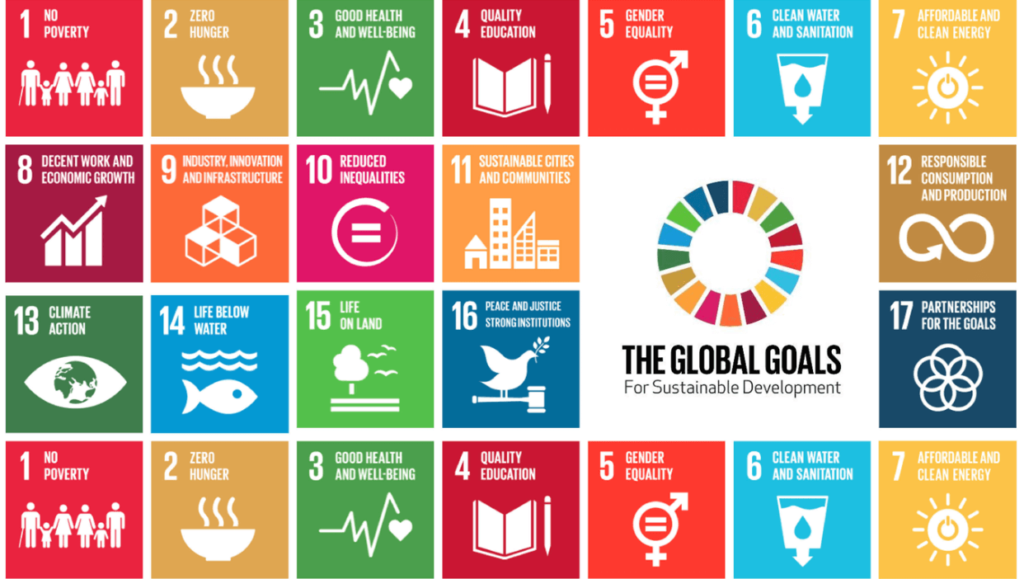
SDGs are a collection of 17 global goals, and their 169 targets, set by the United Nations General Assembly (UNGA) in 2015 for the year 2030 (UNGA resolution “2030 Agenda”). They aim at eradicating poverty in all forms and “seek to realise the human rights of all and achieve gender equality”.
This Summit was convened as a high-level plenary meeting of the 70th UN General Assembly (UNGA).
The SDGs coincided with another historic agreement reached in 2015 at the COP21 Paris Climate Conference.
Previous to this event, the Outcome Document, “Transforming our world: the 2030 Agenda for Sustainable Development”, was agreed upon by consensus on 2 August 2015.
Goals
Subject
Goal 1
No poverty
Goal 2
Zero hunger
Goal 3
Good Health and Well-Being
Goal 4
Quality Education
Goal 5
Gender equality
Goal 6
Clean Water and Sanitation
Goal 7
Affordable and clean energy
Goal 8
Decent work and economic growth
Goal 9
Industry Innovation and Infrastructure
Goal 10
Reduced inequalities
Goal 11
Sustainable Cities and Communities
Goal 12
Responsible consumption and production
Goal 13
Climate Action
Goal 14
Life below Water
Goal 15
Life on land
Goal 16
Peace justice and strong institutions
Goal 17
Partnerships for goals
Rajasthan SDG portal 2.0 launched on 29 june 2025 at RIC Jaipur.