

Governor in India: Related Constitutional Provisions is an important topic under Rajasthan Polity that explains the constitutional framework governing the office of the Governor. It covers key Articles, powers, functions, and the role of the Governor in the state administration. Understanding this topic helps in analyzing the relationship between the Centre and the State, and the functioning of the executive system.
Governor: Constitutional Provisions
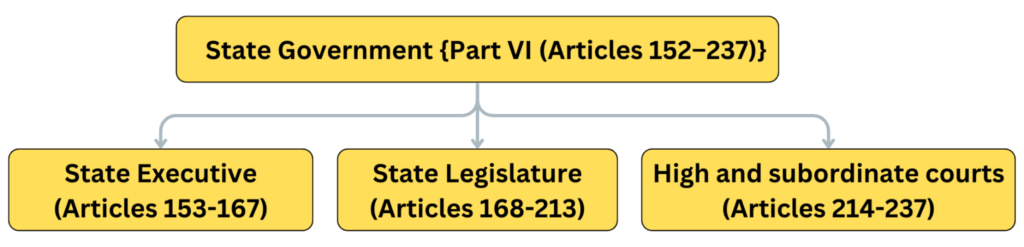
Note: Article 152 clarifies the definition of the State.
- According to the definition of Article 152, the State of Jammu and Kashmir is not included in the constitution of States.
- Articles 153 to 167 of Part VI of the Constitution deal with the State Executive.
- The state executive consists of-
- Governor
- Chief Minister and Council of Ministers
- Advocate General of the State.
- The Governor is an integral part of the Legislature.
- The first citizen of the state.
- de jure head of the state administration
Articles related to the Governor
Article 153 – Governors of States
- There will be a Governor for each state.
- 7th Constitutional Amendment Act (1956) – According to Section 6 of the Constitution of India, the same person can be appointed as the Governor of two or more states.
Article 154 – Executive power of the State
- The executive power of the State shall be vested in the Governor and shall be exercised by him either directly or through officers subordinate to him in accordance with this Constitution.
- Note :
- Subordinate officers refer to the Chief Minister and the Council of Ministers, who carry out the administrative work of the state.
- The constitutional head of the state is the Governor, who is an independent and constitutional post.
- The political head of the state is the Chief Minister, who is the de facto executive head of the government.
- The highest administrative officer of the state is the Chief Secretary, who is responsible for coordinating various departments.
- In India’s parliamentary system of government, there are two types of executive – the nominal executive, which consists of the Governor, and the real executive, which consists of the Chief Minister and his Council of Ministers.
Article 155: – Appointment of Governor
- The Governor of a State shall be appointed by the President by warrant under his hand and seal.
- The President issues a warrant in this regard. The Chief Secretary of the State reads out the warrant of appointment.
- The Governor is appointed by the President on the recommendation of the Union Council of Ministers, meaning the Governor is indirectly appointed by the President. There are two traditions regarding the appointment of the Governor.
- The President shall not appoint a person as Governor of a State of which he is a resident.
- The President consults the Chief Minister of the concerned state before appointing the Governor.
- Note- Although both conventions have been violated in some cases, for example
- In 1981, Jagmohan was appointed Governor of Jammu and Kashmir without consulting Chief Minister Farooq Abdullah. The state cabinet resigned in protest.
- In 1988, TV Rajeshwar Rao was appointed Chief Minister of West Bengal without consulting Chief Minister Jyoti Basu.
- Dr. HC Mukherjee (West Bengal), Dr. Karan Singh (Jammu & Kashmir), Sardar Ujjwal Singh (Punjab) etc. were appointed as Governors despite being residents of the respective states.
- The Sarkaria Commission had recommended that Article 155 should be amended to make consultation with the Chief Minister of the concerned State mandatory.
- The Second Administrative Reforms Commission had recommended the implementation of the collegium system in the appointment of the Governor.
- Appointment of Governor: The Constituent Assembly’s Vision The issue of direct election of the Governor was raised in the Constituent Assembly, but the provision for the appointment of the Governor by the President was adopted. The main arguments behind this were the following:
- Adverse Impact on the Parliamentary System – The direct election of the Governor could have been detrimental to the parliamentary system established in the state.
- Conflict between the Chief Minister and the Governor – Direct elections would have increased the likelihood of a clash of powers between the Chief Minister and the Governor.
- Role of the Constitutional Head – The Governor serves as the constitutional head. The process of electing this officeholder was deemed complex and impractical.
- Lack of Neutrality – An elected Governor could potentially be affiliated with a political party, thereby raising questions regarding his or her neutrality.
- Political Discord and Separatism – The direct election of the Governor could have served as a catalyst for fostering political discord and separatist tendencies.
- Difficulty in Performing a Dual Role – The Governor acts as both the head of the state and an agent of the Centre. In the event of being elected, he or she might be unable to function effectively in the capacity of the Centre’s agent.
- Analysis of the American and Canadian Models – The Constituent Assembly rejected the American model (wherein the Governor is directly elected) and adopted the Canadian model instead. Under the Canadian model, the Governor is appointed by the Centre.
Conclusion
- India’s federal system of government is centrally oriented, as a strong center is essential for the unity and integrity of the country. The center can exercise effective control over the states through an appointed governor. If the governor were elected, effective control by the center over the states would be impossible. Thus, the appointed system of governors helps strengthen India’s federal structure.
Article 156 – Term of office of Governor
- The Governor shall hold office during the pleasure of the President.
- The Governor may, by writing under his hand addressed to the President, resign his office.
- Subject to the foregoing provisions of this article, the Governor shall hold office for a term of five years from the date on which he enters upon his office:
- Provided that the Governor shall, notwithstanding the expiration of his term of office, continue to hold office until his successor enters upon his office.
- If the Governor dies suddenly, the Chief Justice of the concerned state acts as the Governor.
- The grounds for removal of governors are not mentioned in the Constitution, but in V.P. Singhal vs. Union of India (2010), it was held that no governor should be removed on political grounds.
- The President can transfer a Governor. Upon transfer, the Governor serves for the remainder of the term.
- A person can be made Governor any number of times.
- The Punchhi Commission had suggested adopting the process of impeachment for the removal of governors.
- The Constitution does not clearly define a procedure for removing a governor.
- In 1989, V.P. Singh’s National Front government sought the resignation of Congress-appointed governors, removing some and allowing others to remain in office.
- In 1991, P.V. Narasimha Rao’s Congress government removed 14 governors appointed by the V.P. Singh government.
- Because there is no clear constitutional provision for the appointment and removal of governors, the process depends on the political priorities of the central government, which can impact the federal structure.
Article 157 – Qualifications for appointment as Governor
- A person shall be eligible to be appointed as Governor only if-
- He is a citizen of India and;
- Has completed 35 years of age.
Article 158 – Conditions of office of Governor
- He should not be a member of Parliament or the State Legislature. If he is, his membership will automatically end upon assuming the office of Governor.
- The Governor shall not hold any other office of profit.
- There will be a rent-free Raj Bhavan and such other benefits, privileges and allowances as may be determined by the Parliament. (3A) – Section 7 of the 7th Constitutional Amendment Act, 1956 added – If a governor represents two or more states, the states will jointly provide emoluments and allowances according to standards set by the President. That is, if a person serves as governor of two states, they will receive the same salary as a single governor, but their salaries will be distributed among the states in a ratio determined by the President.
- The emoluments and allowances of the Governor shall not be reduced during his term of office.
- The salary and allowances of the Governor are borne by the Consolidated Fund of the State.
- Pension is paid from the Consolidated Fund of India.
- According to the second schedule, currently the Governor is paid a salary of Rs 3 lakh 50 thousand per month.
- At the time of implementation of the Constitution, the salary of the Governor was Rs 5500 per month.
Article 159 – Oath or affirmation by the Governor
- Every Governor and every person discharging the functions of the Governor shall make and subscribe an oath or affirmation.
- The Chief Justice of the High Court of the concerned State or in his absence the senior-most judge administers the oath of office to the Governor.
- The format of their oath is mentioned in Article 159. The form of the Governor’s oath is not found in Schedule 3.
- The Governor takes an oath to preserve, protect and defend the Constitution and the law and to serve and protect the welfare of the people of the state.
- If he is given additional charge of any state, he has to take oath again.
Article 160 – Discharge of functions of Governor in certain contingencies
- The President may make such provision as he thinks fit for the discharge of the functions of the Governor of a State in any contingency not provided for in this Chapter.
- Note : In such a situation, the Chief Justice of the High Court of the concerned state can be temporarily entrusted with the charge of the Governor.
Article 161 – Power of Governor to grant pardons, etc., and to suspend, remit or commute sentences in certain cases
- The Governor of a State shall have power to pardon, reprieve, respite or remit the punishment of, or to suspend, remit or commute the sentence of, any person convicted of an offence against any law relating to any matter to which the executive power of the State extends.
Article 162 – Extent of executive power of the State
- Subject to the provisions of this Constitution, the executive power of a State shall extend to matters with respect to which the Legislature of the State has power to make laws:
- Provided that in any matter with respect to which the Legislature of a State and Parliament have power to make laws, the executive power of the State shall be subject to, and limited by, the executive power expressly conferred on the Union or its authorities by this Constitution or by any law made by Parliament.
Article 163: Council of Ministers to aid and advise the Governor –
- The Governor shall be assisted and advised by a Council of Ministers with the Chief Minister as the head of the Council of Ministers in all his functions except those specified in the Constitution.
- The Constitution does not provide for the Governor to return the advice of the Council of Ministers for reconsideration. However, the 44th Constitutional Amendment, 1978, made this provision for the President in Article 74(1).
- In matters where the Governor has been given discretionary powers, the Governor’s decision will be final.
- The Court will not examine whether the Council of Ministers had advised the Governor or not, and if so, what advice it had given.
Article 164 – Other provisions as to Ministers
- The Chief Minister will be appointed by the Governor and other ministers will be appointed by the Governor on the advice of the Chief Minister.
- Collective responsibility
- The Council of Ministers is collectively responsible to the Legislative Assembly.
- This means that any decision made by the Cabinet is considered a collective decision of the Council of Ministers. No minister can oppose this decision.
- No minister can go against this decision, all the ministers swim together and sink together.
- That is, the ministers are individually responsible to the Governor and collectively to the Legislative Assembly.
- The Council of Ministers is collectively responsible to the Legislative Assembly.
Article 165 – Advocate General of the State
- The Governor of every State shall appoint a person qualified to be appointed as a Judge of a High Court to be the Advocate General of the State.
- It shall be the duty of the Advocate General to give advice to the Government of the State on such legal matters and to perform such other duties of a legal character as may, from time to time, be directed or assigned to him by the Governor and to discharge such functions as are conferred on him by or under this Constitution or any other law for the time being in force.
- The Advocate General shall hold office during the pleasure of the Governor and shall receive such remuneration as the Governor may determine.
Article 166 – Conduct of business of the Government of the State
- All executive actions of the Government of a State shall be deemed to be taken in the name of the Governor.
- Orders and other instruments issued and executed in the name of the Governor shall be authenticated in such manner as may be specified in rules to be made by the Governor and the validity of any order or instrument so authenticated shall not be called in question on the ground that it is not an order or instrument issued or executed by the Governor.
- The Governor shall make rules for the more convenient transaction of the business of the Government of the State and for the allocation of the said business among the Ministers in so far as it is not a business with respect to which the Governor is by or under this Constitution required to act in his discretion.
Article 167 – Duties of Chief Minister in relation to furnishing information to the Governor, etc.
- It shall be the duty of the Chief Minister of every State—
- To communicate to the Governor all decisions of the Council of Ministers relating to the administration of the affairs of the State and legislative proposals.
- To furnish such information as the Governor may require relating to the administration of the affairs of the State and to legislative proposals; and
- Any matter on which a Minister has given a decision but which has not been considered by the Council of Ministers may, if so required by the Governor, be placed before the Council for consideration.
Article 168 – Constitution of the Legislatures of the States
- Every state will have a legislature consisting of the Governor and one or two houses.
- Where a State Legislature consists of two Houses, one shall be known as the Legislative Council and the other as the Legislative Assembly; and where it consists of only one House, it shall be known as the Legislative Assembly.
Article 175 – Right of the Governor to address and send messages to the House or Houses.
- The Governor may address either House of the State Legislature, or both Houses assembled together, and may require the attendance of members for that purpose.
Article 176 – Special address by the Governor
- At the commencement of the first session after each general election to the Legislative Assembly and at the commencement of the first session of each year, the Governor shall address the Legislative Assembly or, in the case of a State having a Legislative Council, both Houses assembled together and shall state the reasons for his summons to the Legislature.
Article 180. Power of the Deputy Speaker or other person to perform the duties of the office of, or to act as, Speaker:
- When the posts of Speaker and Deputy Speaker of the Legislative Assembly are vacant, the Governor can appoint any member of the Legislative Assembly to perform the duties of the Speaker.
- In the absence of the Speaker from any sitting of the Legislative Assembly, the Deputy Speaker, or if he is also absent, such person as may be determined by the rules of procedure of the Legislative Assembly, or if no such person is present, such other person as may be determined by the Legislative Assembly, shall act as Speaker.
Article 192 – Decision on questions relating to disqualifications of members
- If any question arises as to whether a member of either House of the Legislature of a State has become subject to any of the disqualifications mentioned in clause (1) of article 191, the question shall be referred to the Governor for his decision and his decision shall be final.
- Before deciding any such question, the Governor shall seek the opinion of the Election Commission and shall act in accordance with such opinion.
- Note :
- Article 191 mentions the grounds for termination of membership of the members of the State Legislature.
- The Governor has no role in defection matters. All decisions regarding defection are made by the Speaker of the relevant House.
- Note :
Article 202 – Annual Financial Statements
- The Governor shall, in respect of each financial year, cause to be laid before the House or Houses of the Legislature of the State a statement of the estimated receipts and expenditure for the year.
Article 203 – Procedure in relation to estimates in the Legislature
- (3) A demand for any grant shall be made only upon the recommendation of the Governor, or not.
Article 205 – Supplementary, additional or further grants
- (1B) If in any financial year money has been spent on a service for that year in excess of the amount granted for that service, the Governor shall cause to be laid before the House or Houses of the Legislature of the State, as the case may be, another statement showing the estimated amount of such excess expenditure, or cause a demand for such excess to be presented to the Legislative Assembly of the State.
Article 207 – Special provisions as to Finance Bills
- No Bill or amendment making provision for any matter specified in sub-clauses (a) to (f) of clause (1) of article 199 shall be introduced or moved except on the recommendation of the Governor and no Bill making such provision shall be introduced in the Legislative Council:
- Provided that a proposal for an amendment providing for the reduction or abolition of any tax shall not require a recommendation under this clause.
Article 213 – Promulgation of ordinances by the Governor
- When the legislature is not in session, in case of urgent need for a law, the Governor can issue an ordinance on any subject of the State List and the Concurrent List.
- An Ordinance promulgated under this article shall have the same force and effect as an Act of the State Legislature assented to by the Governor, but every such Ordinance
- Such an ordinance remains in effect for a period of six weeks from the commencement of the new session. The state legislature may repeal the ordinance even before this period.
- It can be withdrawn by the Governor at any time.
- Explanation.—Where the Houses of the Legislature of a State having a Legislative Council are summoned to reassemble on different dates, the period of six weeks for the purposes of this clause shall be reckoned from the later of those dates.
- The Governor issues ordinances on the advice of the President/State Council of Ministers, that is, it is not the discretionary power of the Governor.
- Such an ordinance would be subject to judicial review.
- An ordinance must be passed by the legislature within six weeks of its commencement, or it lapses. (If the two houses meet on different dates, the six weeks are counted from the date of the house that meets later.)
- The maximum duration of an ordinance is 6 months and 6 weeks.
- The ordinance process is antithetical to democracy. Ordinances can be issued multiple times on a single subject.
An ordinance is issued under the following circumstances:
- When both houses of the legislature are not in session (Vidhan Sabha, Vidhan Parishad)
- When one of the two houses of the legislature is not in session and circumstances arise in the state that make it necessary to make a law, in such a situation the Governor (with the advice of the Council of Ministers) issues an order with his signature which is called an ordinance.
Article 217 – Appointment and conditions of office of Judges of High Courts
- (1)The President shall, after consultation with the Chief Justice of India, the Governor of the State and, in the case of the appointment of a Judge other than the Chief Justice, the Chief Justice of the High Court, by warrant under his hand and seal, appoint every Judge of a High Court and such Judge shall, in the case of an Additional or Acting Judge, hold office as provided in article 224 and in any other case, until he attains the age of sixty-two years.
Article 233 – Appointment of District Judges by the Governor
- The appointment of persons to be appointed as District Judges in a State and the posting and promotion of District Judges shall be made by the Governor of that State in consultation with the High Court exercising jurisdiction in relation to such State.
Article 234 – Appointment to the judicial service by the Governor (except district judges)
- Appointments to the judicial service of a State, other than appointments of District Judges, shall be made by the Governor of the State in accordance with rules made by him in that behalf after consultation with the State Public Service Commission and with the High Court exercising jurisdiction in relation to such State.
Article 243 I – Constitution of a Finance Commission to review the financial position
- The Governor of the State shall, as soon as may be within one year from the commencement of the Constitution (Seventy-third Amendment) Act, 1992, and thereafter, at the end of every fifth year, constitute a Finance Commission to review the financial position of the Panchayats.
- The Governor shall cause every recommendation made by the Finance Commission under this article to be prepared with a clear note regarding the action to be taken thereon for laying on the table of the Legislative Assembly.
Article 267(2) – Contingency Fund
- The Legislature of a State may, by law, establish a contingency fund in the nature of an imprest to be known as the “Contingency Fund of the State” into which shall be credited from time to time such sums as may be determined by such law and the said fund shall be placed at the disposal of the Governor of the State to enable him to advance moneys from such fund to meet such expenditure pending the authorisation by the Legislature of the State by law under article 205 or article 206.
Article 316 – Appointment and term of office of members
- The Chairman and other members of a Public Service Commission shall be appointed, if it is a Union Commission or a Joint Commission, by the President and, if it is a State Commission, by the Governor of the State.
- Provided that, as nearly as may be, half of the members of every Public Service Commission shall be persons who, at the date of their respective appointments, have held office under the Government of India or the Government of a State for not less than ten years.
Article 317 – Removal and suspension of a member of the Public Service Commission.
- The Chairman or any other Member of the Commission in respect of whom a reference has been made to the Supreme Court under clause (1) may be suspended from his office by the President in the case of the Union Commission or a Joint Commission and by the Governor in the case of a State Commission until the President has passed an order on the report of the Supreme Court on such reference.
Article 333 – Representation of the Anglo-Indian community in the Legislative Assemblies
- If the Governor of a State is of the opinion that the Anglo-Indian community needs a representative in the Legislative Assembly of that State and that its representation therein is inadequate, he may nominate a member of that community to that Legislative Assembly.
- Note:According to Article 366(2), an Anglo-Indian is a person whose father/grandfather is of European origin and whose mother is of Indian origin.
104th Constitutional Amendment (2019)
Closure of Anglo-Indian nomination:
- Article 331: Abolition of the provision for nomination of two Anglo-Indian members to the Lok Sabha.
- Article 333: Abolition of the provision for nomination of one Anglo-Indian member to the State Legislatures.
Extension of SC/ST reservation:
- Reservation for Scheduled Castes (SC) and Scheduled Tribes (ST) in the Lok Sabha and State Legislative Assemblies was extended for 10 years.
Note:- The 104th Constitutional Amendment Act, 2019 abolished Anglo-Indian reserved seats in the Parliament of India and state legislatures in January 2020.
Article 355 – Duty of the Union to protect the State against external aggression and internal disturbance
- It shall be the duty of the Union to protect itself from external aggression and internal disturbance. To protect the rights of every State and to ensure that the Government of every State is carried on in accordance with the provisions of this Constitution.
Article 356 – Provisions for the failure of the constitutional machinery in the States
- If the President, on receipt of a report from the Governor of a State or otherwise, is satisfied that a situation has arisen in which the government of that State cannot be carried on in accordance with the provisions of this Constitution, the President may, by Proclamation –
- It may assume all or any of the functions of the Government of the State and all or any of the powers vested in or exercisable by the Governor or any body or authority of the State other than the Legislature of the State.
Article 356: President’s rule (State emergency)
- Constitutional provisions:
- Article 355: It is the duty of the Centre to ensure that the constitutional provisions are followed in every state.
- Article 356: If the constitutional machinery in a state fails, the central government can take control of the state government.
- It is called ‘President’s Rule’, ‘State Emergency’ or ‘Constitutional Emergency’.
- Grounds for declaration:
- (i) Under Article 356:
- If the President is satisfied that the State Government is unable to function in accordance with the Constitution.
- This decision can be taken on the basis of the Governor’s report or other sources.
- (ii) Under Article 365:
- If the state fails to comply with the Centre’s directions, it will be considered a failure of constitutional provisions.
- (i) Under Article 356:
- Approval and Duration:
- The declaration of President’s rule must be approved by the Parliament by a simple majority within 2 months.
- Once approved, it remains in force for 6 months and can be extended for 6 months each.
- Under normal circumstances, it remains valid for 1 year.
- In special circumstances (Article 352 is applicable or the Election Commission declares disqualification from contesting elections), it can be extended to a maximum of 3 years.
- End of declaration:
- The President can withdraw it at any time.
- Parliament’s permission is not required to withdraw this declaration.
- Effects of President’s Rule:
- The state’s council of ministers and the chief minister are dissolved.
- The Governor rules in the name of the President.
- The State Legislative Assembly is suspended or dissolved.
- The Parliament passes state bills and budget proposals.
- Special Notes:
- The powers of the High Court are not affected during President’s rule.
- Under President’s rule, the Central Government can use the Consolidated Fund of the State and issue ordinances.
- A law made by the President or Parliament will continue to be in force even after the end of President’s rule, unless it is repealed by the State Legislature.
- Facts to remember:
- If President’s rule is imposed at the time of dissolution of the Lok Sabha, it can continue for 30 days from the first meeting of the Lok Sabha, provided the Rajya Sabha approves it.
- Important judicial decisions:
- (i) S.R. Bommai Case (1994):
- The decision of President’s rule is subject to review by the court.
- Misuse of Article 356 is unconstitutional.
- (i) S.R. Bommai Case (1994):
- Related recommendations:
- (i) Rajmannar Committee (1971): Recommendation to remove Articles 356 and 357.
- (ii) Sarkaria Commission (1988):Use of Article 356 as a last resort.
- (iii) Punchi Commission (2007): Recommendation for amendment of Articles 356 and 355.
Article 361 – Immunities of the President and Governors and Chiefs of State:
- He cannot be held accountable before the court for his actions.
- But Under Article 61, a body or court appointed by either House of Parliament may inquire into the conduct of the President, but this does not affect the right of any person who wishes to take appropriate action against the Government of India or the Government of a State.
- During his tenure, no criminal case can be filed against him, nor can he be arrested.
- No court can issue an order for the arrest or imprisonment of the Governor of a State during his term of office.
- Before any civil proceedings in respect of his personal acts—whether committed before or after assuming office as the Governor of a State—in which relief is claimed against him are instituted, the following conditions must be fulfilled:
- Written notice has to be given to the Governor at least two months in advance.
- The notice requires the party to state their name, address, the nature of the action, and the relief sought. Similarly, a civil suit can be filed against the Governor personally only after two months’ prior notice.
- Note: Article 361 specifies the privileges of the President and the Governor. (The term “Lieutenant Governor” is not mentioned in Article 361.)



