

Rajasthani Language and Literary Sources form an important foundation for understanding the cultural and intellectual heritage of Rajasthan. These sources, including folk literature, heroic ballads, and classical texts, provide valuable insights into the social, political, and cultural life of the region. In the study of Rajasthan History, Rajasthani language and literary traditions serve as key tools for reconstructing historical events and traditions.
This post is designed for RAS Prelims. For a more detailed explanation helpful for RAS Mains, please click here.
Current status of Rajasthani language
Official Language Status –
- The official language of Rajasthan is Hindi (Devanagari script).
- This status was established under the Rajasthan Official Languages Act, 1956.
- There is a demand for granting Rajasthani the status of a second official language.
- The Rajasthani Yuva Samiti is actively campaigning in this direction.
Constitutional Support –
- Article 345 (Indian Constitution) empowers the State Legislative Assembly to adopt one or more languages for official purposes.
- In 2003, the Rajasthan Legislative Assembly unanimously passed a resolution to include Rajasthani in the Eighth Schedule of the Constitution.
- This resolution has not yet been implemented by the Central Government.
- Inclusion in the Eighth Schedule
- Currently, 22 languages are included in the Eighth Schedule of the Constitution.
- Languages added through amendments –
- 21st Amendment (1967) – Sindhi
- 71st Amendment (1992) – Konkani, Manipuri, Nepali
- 92nd Amendment (2003) – Bodo, Dogri, Maithili, Santhali
- The Mahapatra Committee recommended the inclusion of Rajasthani, but no concrete steps have been taken yet.
Literary institutions
- Both the Sahitya Akademi and the UGC have recognized Rajasthani as an independent literary language.
Rajasthan Sahitya Academy (Udaipur, 1958) –
- Main Magazine – ‘Madhumati’
- Main Award – Meera Award
Rajasthani Bhasha, Sahitya and Sanskriti Academy (Bikaner, 1983) –
- Main Magazine – ‘Jagti Jot’
- Main Award – Suryamall Meesan Award
Rajasthan Sindhi Bhasha Academy –
- Year of Establishment – 1979
- Location – Jaipur
- Main Magazine – ‘Rihaan’
- Work – Working for the preservation and promotion of Sindhi language, literature, and culture.
Rajasthan Braj Bhasha Academy
- Year of Establishment – 1986
- Location – Jaipur
- Main Magazine – ‘Braj Shatdal’
- Work – Established for the study and dissemination of Braj Bhasha literature, folk art, folk songs, and devotional tradition.
Rajasthan Punjabi Bhasha Academy
- Year of Establishment – 2006
- Location – Sri Ganganagar
- Main Work – Organization working for the promotion of Punjabi language and culture.
- Objective – To promote Punjabi literature, art, and cultural heritage in the state.
Rajasthani Language and Dialects
- According to Grierson and Narottam Swami, the major dialects of Rajasthani are:
- Western Rajasthani – Marwari, Mewari, Bikaneri, Shekhawati
- Northeastern Rajasthani – Ahirwati, Mewati
- Central-eastern Rajasthani – Dhundhari, Jaipuri, Hadoti
- Southern Rajasthani – Nimadi, Malvi
- Dingal and Pingal –
- Dingal – The literary style of Western Rajasthan, primarily used by Charan poets.
- Pingal – The literary style of Eastern Rajasthan, primarily used by Bhat poets.
Literary form of Rajasthani Language
| Aspect | Dingal | Pingal |
| Region | Western Rajasthan | Eastern Rajasthan |
| Associated Language | Western Rajasthani (Marwari) | Braj Bhasha & Eastern Rajasthani |
| Primary Poets | Charan poets | Bhat poets |
| Literary Nature | Vir Rasa (Heroic, court poetry) | Narrative & historical poetry |
| Linguistic Origin | Gurjari Apabhramsha | Shauraseni Apabhramsha |
| Main Themes | Valor, warfare, heroism | Genealogy, history, praise of kings |
| Major Works | Rajrupak, Dhola Maru Ra Douha, Achaldas Khinchi Ri Vachanika | Prithviraj Raso (Chandbardai), Ratan Raso (Kumbhakaran), Khuman Raso, Vansh Bhaskar |
| Cultural Association | Rajput courts of western Rajasthan | Rajput courts of eastern Rajasthan |
Khyat Literature
- Meaning – The word “Khyat” means “famous account” or “history.”
- It is a collection of biographies of famous people and events.
- Khyats describe historical events, dynasties, wars, and folk tales of Rajasthan.
- It is an authentic literary source of Rajasthan’s history and culture.
- Major Khyats (historical chronicles):
- Bankidas Ri Khyat
- Udaibhan Champawat Ri Khyat
- Jodhpur Rajya Ri Khyat
- Marwar Ri Khyat
- Dayaldas Ri Khyat (The last Khyat of Rajasthan)
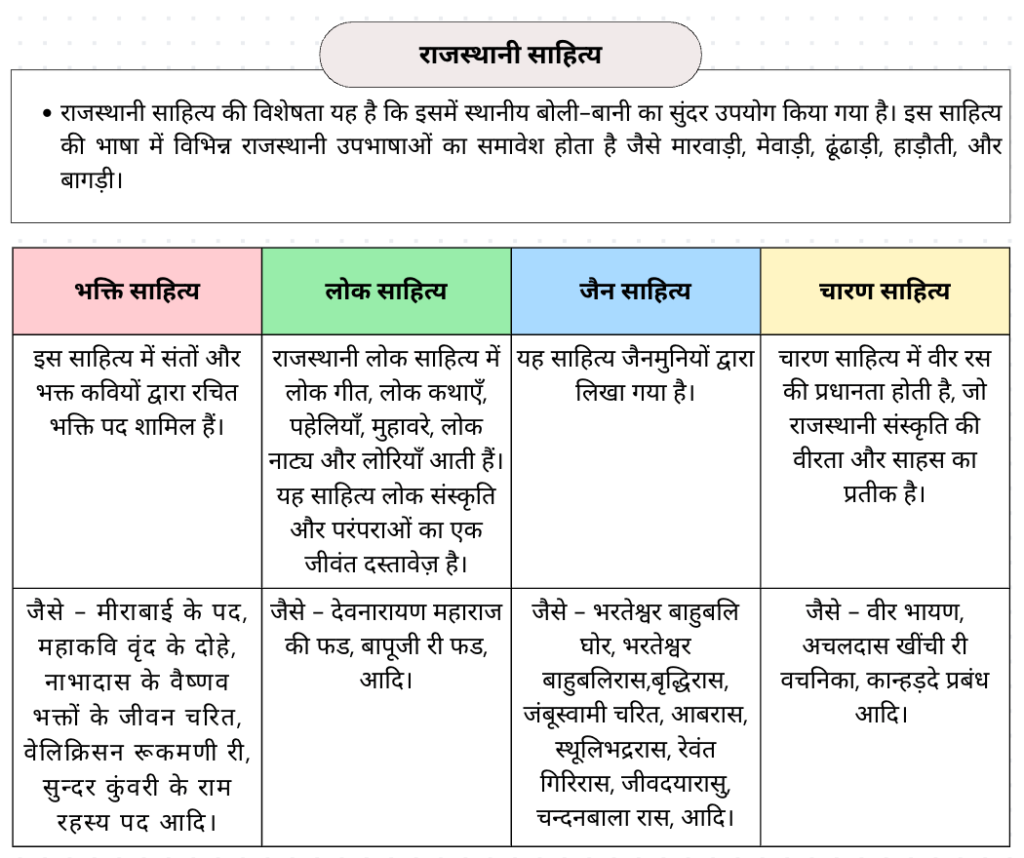
Raas Literature
- Raas literature is an ancient and distinctive form of Rajasthani literature.
- It incorporates all three art forms: dance, music, and drama.
- The religious works of Jain poets have made a significant contribution to this genre.
- The early, original form of the Rajasthani language is found in Raas literature.
- Major works –
- Ripu-Daran Raas – Composed around 905 AD in Bhinmal.
- Bharateshwar Bahubali Raas – Composed in 1150 AD by Brajsen Suri.
- Bahubali Raas – Composed in 1184 AD by Shalibhadra Suri.
- Vriddha Navkar Raas – Composed in the 13th century by Jin Vallabh Suri.
- Major works –
Other Jain literary figures and works –
- Devpal – Shrinikrajano Raas
- Dharma Samudra Gani – Ratri Bhojan Raas
- Rishivardhan Suri – Naldamyanti Raas
- Samay Sundar – Composer of numerous devotional and religious songs.
- Kushalalabh – Composer of Madhavanal Chaupai and Dhola Marwan ki Chaupai.
- Dhanpal – Sachchariyau and Mahavir Utsah.
- Udyotan Suri – Author of the famous work Kuvalaya-Mala.
Saint Literature
- The contribution of the saint tradition to enriching Rajasthani literature is significant.
- The saints presented their spiritual experiences through hymns and verses.
- Major works of Rajjab, a disciple of Dadu – Vani and Sarvangi.
- Meera Bai’s Padavali expresses feelings of love, devotion, and surrender to God.
- Humanity, equality, and devotional sentiment have been predominant in saint literature.
Charan Style Literature
- Charan poets enriched the tradition of heroic poetry.
- Their literature reflects feelings of valor, sacrifice, patriotism, and bravery.
- Major works –
- Veer Bhayan – Composed by Badar Dhadi.
- Achaldas Khinchi Ri Vachanika – Composed by Gadan Shivdas, describes the battles of Mandu and Gagron.
- Kanhadade Prabandh – Composed by Padmanabh; A description of the war between the Chauhan ruler of Jalore, Kanhadadeva, and Alauddin Khalji.
Major Works of Rajasthani Literature
| Literary Work | Writer | Description |
| Kanhadade Prabandh | Padmanabh | Description of the wars between Kanhadadev, the ruler of Jalore, and Alauddin Khilji. |
| Ding kosh | Muraridan | |
| Prithviraj Raso | Chand Bardai | It is considered as the first epic of Hindi. In this text, the origin of the Rajputs is attributed to the fire altar (Agni-kund) of Mount Abu. It provides information about the reign of Prithviraj Chauhan and the Battles of Tarain (1191-1192 AD). |
| Prithvi Raj Vijay | Jayanak | It sheds light on the history of the Chauhans and the development of Ajmer. |
| Padmaavat | Malik Mohammad Jaysi | This poetic work sheds light on Alauddin Khilji’s invasion of Chittor (1303 AD) |
| Rao Jaitsi Ro Chand | Bithu Suja | This text provides information on the reigns of the Bikaner rulers Bika, Lunkaran, and Jaitsi (1526-1541 AD). |
| Pabu Prakash | Mod Ji Ashiya | This text sheds light on the biography of Pabuji. |
| Rajprakash | Kishor Das | Mention of the origin of the Mewar dynasty, the Battle of Haldighati, and the Mewar-Mughal treaty (1615 AD). |
| Amar Kaavy | Amardan Lalas | |
| Amarsar | Pt. Jivdhar | It depicts the reign and public life of Maharana Pratap and Amar Singh. |
| Pratap Raso | Jachak Jiwan | Description of the life of Rao Raja Pratap Singh and the establishment of the Alwar state (1770 AD). |
| Ameernama | Munshi Bhusavanlal | Related to the life of Amir Khan Pindari, the Nawab of Tonk. |
| Ratan Jasprakash | Saagardan | |
| Senani | Meghraj Mukul | This poem recounts the saga of the sacrifice of Sahal Kanwar (Hadi Rani), the daughter of the Hada ruler of Bundi. In this story, when Rao Chundawat Ratan Singh asked for a memento (Senani), Hadi Rani cut off her own head and sent it as a token of remembrance. “Chundawat mangi senani, sir kaat de diyo Hadi Rani.” |
| Chanwari | Meghraj Mukul | |
| Suraj Prakash | Karnidan | This Dingal poetic work mentions the thirteen branches of the Rathores. It begins the Rathore genealogy from Kush (the younger son of Lord Rama). It also mentions the Battle of Sammel (Sumel) (1544 AD), the Battle of Dharmat (1658 AD), and the influence of the Sayyid Brothers in the Mughal court. |
| Birdad Singar | Karnidan | |
| Shakuntla | Karnidan | |
| Dhola Maru Ra Duha | Kavi Kallol | |
| Kanak Sundari | Shivchand Bhartiya | |
| Ekling Mahatamy | Kaanh Vyas | It is useful for the genealogy of the Mewar Maharanas. Some scholars consider Kumbha to be the author of this text. |
| Khumaan Raaso | Dalpati Vijay | It sheds light on the meeting between Pratap and Shakti Singh during the Battle of Haldighati, as well as the Mewar-Mughal relations during the reign of Maharana Amar Singh (1597-1620 AD). |
| Buddhi vilas | Shah Bakhtram | |
| Bisaldev Raaso | Narpati Naalh | This composition provides information about the reign of Vigraharaj IV (Bisaldev), the ruler of Ajmer (1158-1163 AD). |
| Vijay Pal Raso | Nall Singh | This Raso epic is about Raja Vijaypal, the Yadav King of Vijaygarh, Karauli. |
| Chhatrapati-Raso | Kavi Kaashi Changani | This text is a history of Bikaner. It also describes the war that took place in 1642 AD between Karan Singh, the ruler of Bikaner, and Amar Singh of Nagaur over the boundary of Jakhaniya village, which is famously known as ‘Matire ki Raad‘. |
| Darinde | Hamidullah | Information regarding the establishment of Jaipur (1727 AD) and city planning schemes. |
| Hammir Raso | Sharangdhar, Jodharaj | It describes the character and heroic deeds of Rana Hammir of Ranthambore. |
| Hammir Mahakaavy | Nayan Chandra Suri | It sheds light on Alauddin Khilji’s victory over Ranthambore. |
| Ramraso | Madho das Charan | |
| Hammir Mad Mardan | Jaisingh Suri | |
| Gun Bhasha | Hemkavi | |
| Gun Rupak | Keshavdas | |
| Raajiya Ra Sortha | Kriparam | |
| Rajrupak | Kavi Veerbhan | |
| Veer Vinod | Shyamaldas | This five-volume work is essentially the history of Mewar. In this text, the origin of the Mewar dynasty is traced back to ‘Kush’, the son of Lord Rama. |
| Buddhi Sagar | Jaan-Kavi | |
| Grinthraj | Gopinath | |
| Pagfero, Sojati Gate, Aleeja Aajyo | Mani Madhukar | |
| Ruthi Raani | Kesari singh Barhath | |
| Chetavani Ra Chungatiya | Kesari singh Barhath | A satirical work written in thirteen sorathas (couplets) to prevent Maharana Fateh Singh from attending the Delhi Durbar. |
| Veer bhayan | Badar Dhadhi | It describes the bravery of Rawal Mallinath and his sons. |
| Amarphal | Dr. Manohar Sharma | |
| Rukmani Haran | Vithaldas | |
| Ranmal Chhand | Sridhar Vyas | |
| Brijnidhi Granthavali | Pratap Singh | |
| Rangilo Marwar | Bharat Vyas | |
| Sudhi Sapno Ke Teer | Mani Madhukar | |
| Bhaktmal | Nabhadas | |
| Sagar Paakhi | Kundanmali | |
| Vairaagy Sagar | Nagaridas | |
| Ajitoday | Bhatt Jagjivan | It sheds light on the reign of Ajit Singh (1707-1724 AD), the ruler of Marwar. |
| Haan Chaand Mera hai | Hariram Meena | |
| Sudama Charitra | Mohan Raj | |
| Barkha Binani | Rewat Dan Charan | |
| Marwari Grammar (Marwari Vyakaran) | Pandit Ramkaran Asopa | |
| Badali | Chandsingh Virkaali | |
| Rajasthani Kahavtaan | Murli Vyas | |
| Sagat Raso | Girdhar Aasiya | This text is useful for the history of Mewar. It also sheds light on the Battle of Haldighati and the descendants of Shakti Singh. |
| Rajvinod | Sadashiv Bhatt | Provides details of the reign of Rao Kalyanmal of Bikaner. |
| Dhola Marwadi Chadpadi | Kavi Harrat | |
| Dhola Marwan ri Chaupai | Kushal Labh | |
| Meghdoot | Manohar Prabhakar | |
| Reengti Hain Cheentiyan | Jabarnath Purohit | |
| Hoon Gori Kin Peev Ri | Yadvendra Sharma Chandra | |
| Jog-Sanjog, Chanda Sethani | Yadvendra Sharma Chandra | |
| Jamaro, Samandar Ar Thar | Yadvendra Sharma Chandra | |
| Baatan Ri Phulwari, Hitler, Alekhu | Vijaydan Detha | |
| Duvidha, Sapan Priya, Uljhan, Antaral, Chaudharain Ki Chaturai | Vijaydan Detha | |
| Mehakti Kaya Mehakti Dharti | Annaram Sudama | |
| Dharti Dhora Ri, Minjhaur, Leeltans | Kanhaiya Lal Sethiya | |
| Paatal and Peethal | Kanhaiya Lal Sethiya | |
| Ek Beenani Do Been | Shreelal Nathmal Joshi | |
| Paranyodi Kunwari | Shreelal Nathmal Joshi | |
| Abhai Patki, Dhoran Ro Dhori | Shreelal Nathmal Joshi | |
| Hala Jhala ri Kundaliya | Isardas | |
| Achaldas Khichi ri Vachnika | Shivdas Gadan | Rajasthani Champu poetry Gagron’s ruler Achaldas and Malwa’s Sultan Hoshang Shah Ghori between happened war (1423 AD) and Jauhar’s description. |
| Rajasthani Sabadkosh | Seeta ram Lalas | |
| Tabra ri Baatan, Manjhal Raat, Moomal | Lakshmi Kumari Chundawat | |
| Dungji Jawaharji ri Baat | Lakshmi Kumari Chundawat | |
| Mahadev Parvati ri Veli | Kisno | |
| Draupadi Vinay | Ramnath Kaviya | Through this composition, an attempt has been made to awaken women’s consciousness. |
| Veli Kishan Rukmani | Prithvi Raj Rathor(Peethal) | Language and Style – An excellent Khandkavya of Dingal language in which “Veliyo Geet” meters have been used and the influence of Brajbhasha is also visible. This composition sheds light on the religious and social life of the sixteenth century. |
| Sati Raso | Suryamal Mishran | |
| Veer Satsai | Suryamal Mishran | Poetry composed to organize passive Rajput rulers against British power. |
| Vansh Bhaskar | Suryamal Mishran | Written in the Dingal language in Champu style (mixed prose and verse), this epic, along with the history of Bundi, also discusses the history of Rajasthan and India. It also mentions Maratha activities in Rajasthan and the poisoning of Krishna Kumari (1810 AD). |
| Nainsi Ki Khyat | Muhnot Nainsi | In this text of 1610-1670 AD, the history of Marwar state along with Malwa, Bundelkhand, Mewar, Amer, Bikaner, Kishangarh, etc., has been discussed. Because the style of this text is similar to Akbarnama, Munshi Devi Prasad has given Nainsi the title of ‘Abul-Fazl of Rajputana’. This Khayat is also called the “Gazetteer of Marwar”. |
| Marwar Ra Pargana Ri Vigat | Muhnot Nainsi | Description of the political, geographical, social, and economic conditions of Marwar in the seventeenth century. |
| Prabandh Chintamani | Acharya Merutung | Information about the governance and administration of Prithviraj Chauhan. |
| Shatrusal Raso | Dungarsi | |
| Kuwlaymala | Udhyotan Suri | Information about the governance and administration of Pratihara ruler Vatsaraja is found. |
| Buddhi Raso | Jall | |
| Kehar Prakash | Kavi Bakhtawar | |
| Akshar Bavani | Madho Das Barhath | |
| Raana Raso | Dayal (Dayaram) | |
| Kirtar Bavani | Dursa Aadha | |
| Veeramdev solanki Ra Duha | Dursa Aadha | |
| Radha, Bol Bharmali | Satya Prakash Joshi | |
| Judaav, Andhaarai Ra Ghaav | Paras Arora | |
| Gaon, Rang-Badrang | Gordhan Singh Shekhawat | |
| Katheyi Keen Vhegou Hai, Mhara Baap, Deethav Rai Bejan Maay | Tejsingh Jodha | |
| Bolai Sarnatou, Hooniyai Ra Soratha, Baatan Mein Bhugol | Harish Bhadani | |
| Junjhti Joon | Mohammad Sadik | |
| Chit Maro Dukh Ne | Mohan Alok | |
| Paagi, Kavad, Marag, Topnama, Rag-Viyog | Chandraprakash Deval | |
| Aa Sadi Mijli Mare | Sanwar Daiya | |
| Rindrohi | Arjandev Charan | |
| Utaryo Hai Abho | Malchand Tiwari | |
| Seer Ro Ghar | Vasu Acharya | |
| Anhad Nad and Agni Mantar | Bhagwati lal Vyas |
Prominent Litterateurs of Rajasthani Literature
| Litterateur | Major Works / Details |
| Dayaldas | Dayaldas Ri Khyat |
| Kaviraj Shyamal Das Awarded Kaiser-i-Hind by the British Indian Government and Kaviraj by the Maharana of Mewar | Veer Vinod |
| Suryamal Misran Court poet of Maharaja Ram Singh (Bundi); known as “Veer Rasavatar” Suryamal Misran Shikhar Award given annually by Rajasthan Sahitya Akademi, Bikaner | 1. Vansh Bhaskar b2. Veer Satsai 3. Dhatu Rupavali 4.Balwant Vilas 5.Ram Ranjat 6. Chhand Mayukh 7. Sati Raso |
| Bankidas | 1. Chetavani Ra Geet 2. Bankidas Ri Khyat 3. Dattar Bavani 4. Niti Manjari 5. Kukavi Battisi 6. Nath Stuti 7. Man Jaso Mandan 8. Aayo Angrez Mulk Re Upar |
| Shankar Dan Samor Called the British “Mulk Ra Meetha Thag” (Sweet Cheats of the Country) | 1. Sagati Sujas 2.Bhagirathi Mahima 3. Desh Darpan |
| Gaurishankar Hirachand Ojha Titles: Mahamahopadhyay and Rai Bahadur (by the British) | 1. Lipimala, 2.History of the Rajputs |
| Kesari Singh Barahath | 1.Chetavani Ra Chungatya 2.Pratap Charitra 3.Durgadas Charitra 4.Ruthi Rani |
| Meghraj Mukul | 1.Senani 2. Chanak 3.Dharti Ro Shringar 4.Bhoodan |
| Kanhaiya Lal Sethia | 1. Dharti Dhora Ri 2.Meenjhar 3. Leeltans 4. Deeth 5. Kun-Kun 6. Pathal and Peethal(based on the struggle of Maharana Pratap) |
| Lakshmi Kumari Chundawat | 1. Kai Re Chakwa Baat 2.Moomal 3.Amolak Baatan |
| Satyaprakash Joshi | 1.Radha (1960) 2.Bol Bharmali |
Major Literature on Folk Tales
| Author | Work |
| Laghoji | Pabu Raso |
| Kushal Labh | Dhola Maru Ra Doha-Chaupai |
| Lagharaji Mehta | Pabuji Ra Doha |
| Pahadkhan Adha | Gogade Rupak |
| Bithu Meha | Pabuji Ra Chhand |
| Mod Ji Ashiya | Pabu Prakash |
| Ramnath Kaviya | Pabuji Ra Soratha |
| Lakshmi Kumari Chundawat | Pabuji Ri Baat |
| Jasdan Bidu | Veer Meha Prakash |
| Poonamchand | Ramdev Ji Ka Byavla |
| Thakur Rudra Singh Tomar | Shri Ramdev Charitra |
| Harji Bhati | Shri Ramdev Ji Ri Veli |
| Purohit Ram Singh | Shri Ramdev Prakash |
| Chochhu Bhat | Bagdawaton Ra Shovel |
| Dr. Sonaram Bishnoi | Baba Ramdev: History and Literature |
| Mahakavi Prithviraj Rathore | Patak Muchha Paan |
| Asha Ji Barhath | Umade Bhatiani Ra Kavat |
| Hari Singh Bhati | History of Pugal |
| Poet Bhavardhan Kinniya | The Glory of Shri Mehaji Mangaliya |




good, covered from various sources.