

Mewar (Guhil-Sisodia Dynasty) has been a symbol of glorious valor, self-respect, and independence in the history of Rajasthan. The Sisodia Rajputs, descendants of the Guhil clan, ruled Mewar and waged a continuous struggle against foreign invasions. The history of Rajasthan accords a special place to the indomitable courage and sacrifice of the rulers of Mewar, especially heroes like Rana Pratap.
Mewar (Guhil-Sisodia Dynasty)
- The Guhil-Sisodia dynasty ruled Mewar for approximately 1350 years, from the 6th century CE to 1947 CE.
- In ancient times, Mewar was known as Shivi Janapada, Medapata, and Pragvata.
- The initial capital was Madhyamika (Nagari).
- According to the Puranas, this region was considered to belong to the Suryavanshi Kshatriyas.
- Initially, this region was ruled by the Malava Republic, then by the Saka rulers of Ujjain, then by the Aulikara dynasty, and later by the Maurya dynasty.
- According to Colonel Tod and Muhnot Nainsi, there were 24 branches of the Guhils.
- The last ruler of the Maurya dynasty was Manmori Maurya, whom Bappa Rawal defeated in 734 CE.
- The ancient region of Mewar extended across present-day Udaipur, Rajsamand, Chittorgarh, and Pratapgarh districts.
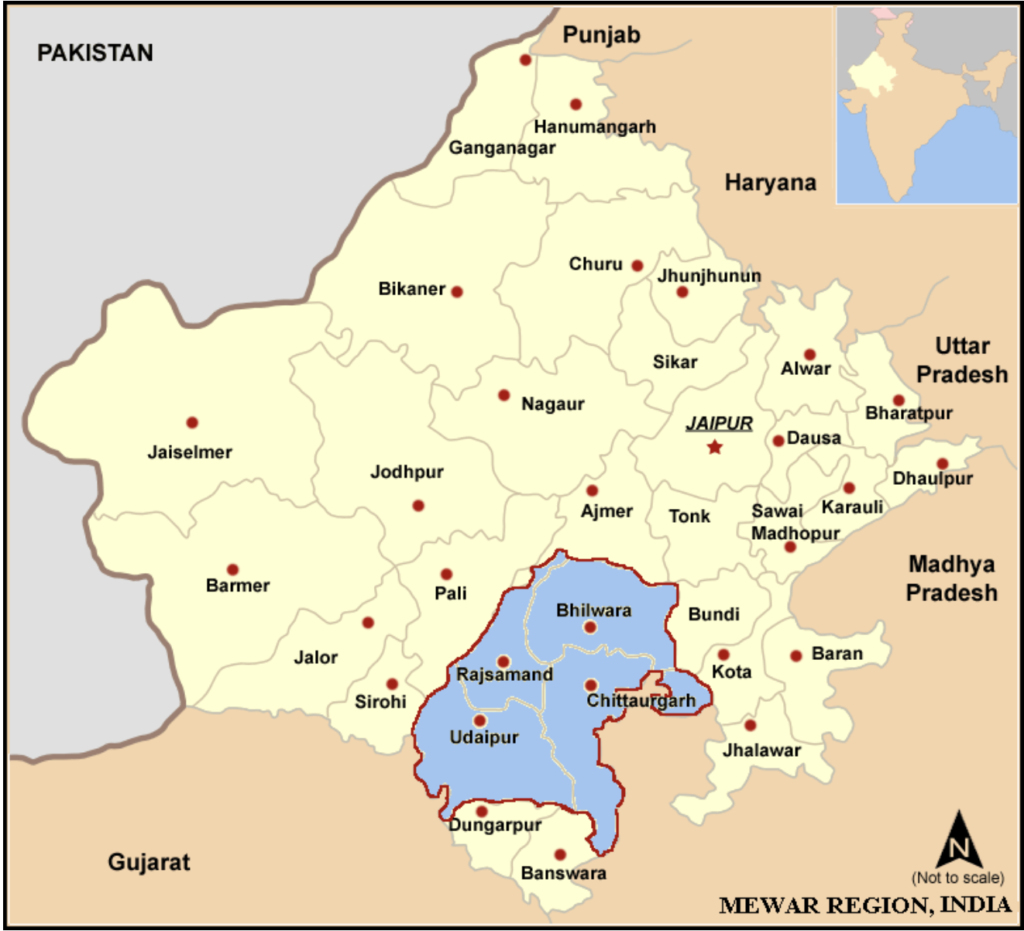
Theories Regarding The Origin Of The Guhil Dynasty
| Scholar/Source | Opinion on the Origin of Guhils |
| Abul Fazl | Guhils were descendants of Naushakhan of Iran. |
| Colonel Tod | Considered Vallabhi (Gujarat) as the place of origin for the Guhils. |
| Kavi Shyamaldas | Stated that the Guhils were of Vallabhi origin. |
| D. R. Bhandarkar | Believed the origin of the Guhils followed the Anandpur tradition (Brahmin origin). |
| Kumbhalgarh Inscription & Ekling Mahatmya | Described the Guhils as Suryavanshi (descendants of the Sun). |
| Dr. G. H. Ojha | Affirmed that the Guhils were Suryavanshi Rajputs. |
| Historical Tradition | Shiladitya (the ruler of Vallabhi) is considered the father of Guhil. |
Founder of the Guhil Dynasty : Guhil/Guhiladitya
- Guhil is considered the founder of this dynasty.
Bappa Rawal / Kalbhoj (734–753 CE) –
- Bappa Rawal is considered the real founder of the Guhil dynasty.
- According to Colonel Tod, after the murder of Nagaditya, the Guhil dynasty king of Idar, his widowed wife took her 3-year-old son, Bappa, to a woman named Kamalavati of the Badnagara caste.
- Capital – Nagda (Udaipur).
- Original name – Kalbhoj.
- Titles – Hindu Suraj, Rajguru, Chakkave (conqueror of all four directions)
- According to Dr. G. H. Ojha, Kalbhoj was the real name and Bappa was the title.
- C. V. Vaidya compared Bappa to the French general Charles Martel.
- Bappa was a disciple of Harit Rishi.
- In the Kumbhalgarh inscription (1460 AD), Bappa is referred to as a “Vipra” (Brahmin).
- He conquered Mewar by defeating Manmori Maurya in 734 AD (Shyamaldas) or 713 AD (Tod).
- A gold coin of Bappa weighing 115 grains has been found.
- He led campaigns to Central Asia to fight against Muslim invaders.
- The Eklingji temple (Kailashpuri, Udaipur) was built by Bappa.
- The rulers of Mewar still consider Eklingji as their deity and themselves as his ministers.
- The city of Rawalpindi was also named after Bappa.
- Burial place – Nagda (Bappa’s temple).
Allat:
- Other/Nickname – Aluraval.
- Second capital – Ahar (Udaipur).
- He established the first bureaucratic system in Mewar.
- He built the Varaha temple in Ahar.
- He married the Huna princess Hariya Devi, which led to intermarriage between the two dynasties.
Naravahana –
- Naravahana was the successor of Allat. Limited information is available about him.
Shaktikumar –
- Munj Parmar attacked Ahar and destroyed the city.
- Shaktikumar then took control of Chittorgarh.
- Bhoj Parmar built the Tribhuvan Narayan temple.
Ransingh (1158 AD) –
- During Ransingh’s reign, the Guhil dynasty split into two branches:
- Rawal branch – founded by Khemsingh
- Rana Branch – Founded by Rahap (from Sisoda village)
Khemsingh –
- Son – Samantsingh.
- Samantsingh married Prithvibai, the sister of Prithviraj II (Chauhan). Because of this, Kirtipal (Kitupal) expelled Samantsingh from Mewar.
- Samantsingh established the Guhil dynasty in the Vagad region and made Baroda his capital.
- Samantsingh’s brother Manthansingh defeated Kirtipal and regained Mewar.
- Manthansingh’s successor – Padmasingh.
Jaitrasingh (1213–1253 AD) –
- Contemporary Delhi rulers – Iltutmish, Ruknuddin, Razia, Bahram Shah, Alauddin Masud Shah, Nasiruddin Mahmud.
- 1227 AD – Jaitrasingh defeated Iltutmish in the Battle of Bhutala (Udaipur).
- Source – Hammiramadmardana (Jaisingh Suri).
- Colonel Tod – In 1231 AD, Jaitrasingh again defeated Iltutmish near Nagaur.
- Third capital – Chittorgarh.
- Commanders – Madan and Balak.
- Jaitrasingh’s reign – The Golden Age of Mewar.
- 1248 AD – Nasiruddin Mahmud’s invasion was unsuccessful.
- During this period, two texts, Oghaniryukti and Pakshikavritti, were composed.
Rawal Tejsingh (1253–1273 AD) –
- Title – Umapativar Labdha Praudha Pratap.
- He repelled the invasion of Delhi Sultan Balban.
- His wife Jetalde built the Shyam Parshwanath temple in Chittorgarh.
- The illustrated manuscript Shravaka Pratikramana Sutra Churni was composed by Kamalchandra.
Samarsingh (1273–1302 AD) –
- In the Chirwa inscription, Samarsingh is described as a connoisseur of Dharma (Jainism).
- Court scholars – Ratnaprabhasuri, Parshvachandra.
- Sons – Ratansingh, Kumbhakarna
- Kumbhakarna established the Rana branch in Nepal.
- Samarsingh collected reparations from Alauddin Khilji’s army that was going to Gujarat.
Rawal Ratansingh (1302–1303 AD) –
- Contemporary ruler – Alauddin Khilji.
- Rawal Ratansingh was the last ruler of the Rawal branch of the Guhil dynasty.
- After him, direct rule of the Delhi Sultanate was established over Mewar (1303–1326 AD).
- Marriage – Rawal Ratansingh was married to Queen Padmini (Padmavati).
- Queen Padmini was the daughter of King Gandharvasena of Sinhala (Sri Lanka).
- Raghav Chetan (a Brahmin banished from the kingdom) described Padmini’s beauty to Alauddin Khilji.
Alauddin Khilji’s attack on Chittorgarh:
Reasons for the attack –
- Alauddin’s imperialist policy.
- The strategic location of Chittorgarh – the gateway to Malwa and Gujarat.
- Alauddin’s desire to possess Queen Padmini.
Major events before the war –
- Alauddin entered Chittorgarh on the pretext of seeing Padmini.
- Padmini’s reflection was shown in a mirror.
- On his return, Alauddin deceitfully captured Ratansingh.
- Ratansingh was freed by Rajput warriors hidden in palanquins, according to a plan devised by Queen Padmini.
The Battle of Chittorgarh – 1303 AD –
- In this battle, Rawal Ratansingh bravely resisted.
- Gora and Badal attained martyrdom in the battle.
- Ultimately, Chittorgarh came under the control of Alauddin Khilji.
- Rawal Ratansingh died in the battle.
- After this, a great Jauhar (mass self-immolation) took place under the leadership of Queen Padmini (August 26, 1303 AD).
Situation after the war –
- The name of Chittorgarh was changed to Khizrabad.
- Khizr Khan was appointed the governor of Chittorgarh. Chittor remained under the Delhi Sultanate from 1303 to 1326 AD.
- The Rawal branch came to a complete end.
Historical Sources:
- Amir Khusrau – “Khazain-ul-Futuh” (Tarikh-i-Alai).
- Malik Muhammad Jayasi – “Padmavat” (Awadhi language).
- Hemratan Suri – “Gora-Badal Chaupai”.
- Dhaybi Pir Inscription.
- Persian tomb inscription located in Chittor – in which Alauddin is called the sun, the shadow of God, and the protector of the world.
Rana Hammir Sisodia (1326–1364 AD) –
- He truly established the Rana branch (Sisodia dynasty) in Mewar.
- He liberated Mewar after the period of subjugation under the Delhi Sultanate.
- Rana Hammir was a resident of Sisoda village.
- Seven sons of Arisingh attained martyrdom in the Battle of Chittor against Alauddin Khilji in 1303 AD.
- From 1311 to 1326 AD, Chittor remained under the Delhi Sultanate.
- In 1326 AD, the rule of Maldev Sonagara ended.
- According to G.H. Ojha, Rana Hammir re-established Mewar as an independent state.
- Colonel Tod describes him as a freedom-loving and brave ruler.
- Rana Hammir built the temple of Annapurna Mata (Barwadi Mata) in Chittorgarh.
- Titles of Rana Hammir:
- Vishmaghati Panchanan – Kumbhalgarh Prashasti.
- Brave King – Rasikpriya (Kumbha).
- Powerful Ruler – Colonel Tod.
- He was also considered a powerful ruler by Colonel Tod.
- Rana Hammir and the Delhi Sultanate:
- After 1326 AD, Rana Hammir did not accept the suzerainty of the Delhi Sultanate.
- Later, the ruler of the Delhi Sultanate, Muhammad bin Tughlaq, attempted to regain control of Mewar.
- In 1336 AD, the Battle of Singoli (Banswara) took place. In this battle, Rana Hammir defeated the army of Muhammad bin Tughlaq. This victory symbolized the complete political independence of Mewar.
Rana Kheta /Rana Kshetra Singh (1364–1382 AD):
- Rana Kshetra Singh was the son of Rana Hammir.
- The Mewar-Malwa conflict began during his reign.
- He defeated Dilawar Khan, the ruler of Malwa.
- He attained martyrdom in a battle with Bundi in 1382 AD.
Rana Lakha / Laksh Singh (1382–1421 AD):
- Rana Lakha was the son of Rana Kshetra Singh.
- To fulfill the vow of conquering Bundi, a mock fort of clay was built and a battle was fought. In this battle, Kumbha Hada attained martyrdom.
- The silver mine at Jawar was established during the time of Rana Lakha.
- Pichola Lake was constructed by a Banjara named Chhitar. The platform of Natni is located near it.
- The construction of Jag Mandir was started by Karan Singh and completed by Jagat Singh I.
- Marital Relations – Hansa Devi of Marwar (sister of Ranmal and daughter of Rao Chunda) was married to Rana Lakha.
- Mokal, the son born to Hansa Devi, became the successor to the throne of Mewar.
- Chunda and the title of Bhishma Pitamah –
- Rana Lakha’s son, Chunda, renounced the throne. Because of this renunciation, Chunda is called the “Bhishma Pitamah of Mewar.”
- Special privileges granted to Chunda: Four of the 16 first-class estates of Mewar were given to Chunda. Salumber was the largest of these estates.
- The feudal lord of Salumber would be the one who performed the coronation ceremony of the ruler of Mewar and would also be the commander-in-chief. The signatures of the feudal lord of Salumber, along with the Rana, would be mandatory on all royal decrees of Mewar.
- In the absence of the Rana, the feudal lord of Salumber would administer the capital.
- Court Scholars – Jhotting Bhatt, Dhaneshwar Bhatt.
Rana Mokal (1421–1433 AD) –
- Rana Mokal was the son of Rana Lakha and Hansa Devi.
- In 1428 AD, Firoz Khan of Nagaur attacked Mewar.
- At this time, Mokal defeated Ahmed Shah, the ruler of Gujarat.
- Assassination and Political Crisis –
- Chacha Mera and Mahampa Panwar together assassinated Mokal in Jhilwara (Rajsamand).
- This incident was a serious political conspiracy in the history of Mewar.
- Hansa Bai and Ranmal Episode –
- Hansa Bai became distrustful of Chunda.
- Chunda went to the court of Mandu.
- After this, Hansa Bai called her brother Ranmal (Marwar) to Mewar.
- Religious and Architectural Works –
- He renovated the Tribhuvan Narayan Temple built by Bhoj in Chittorgarh. This temple was later called the Mokal Temple.
- He also renovated the Samiddheshwar Temple.
- He built the Dwarkanath/Dwarkadhish Temple located in Chittorgarh.
Maharana Kumbha (1433–1468 AD) –
- The greatest ruler of Mewar.
- Father – Rana Mokal
- Mother – Saubhagyadevi (Parmar princess)
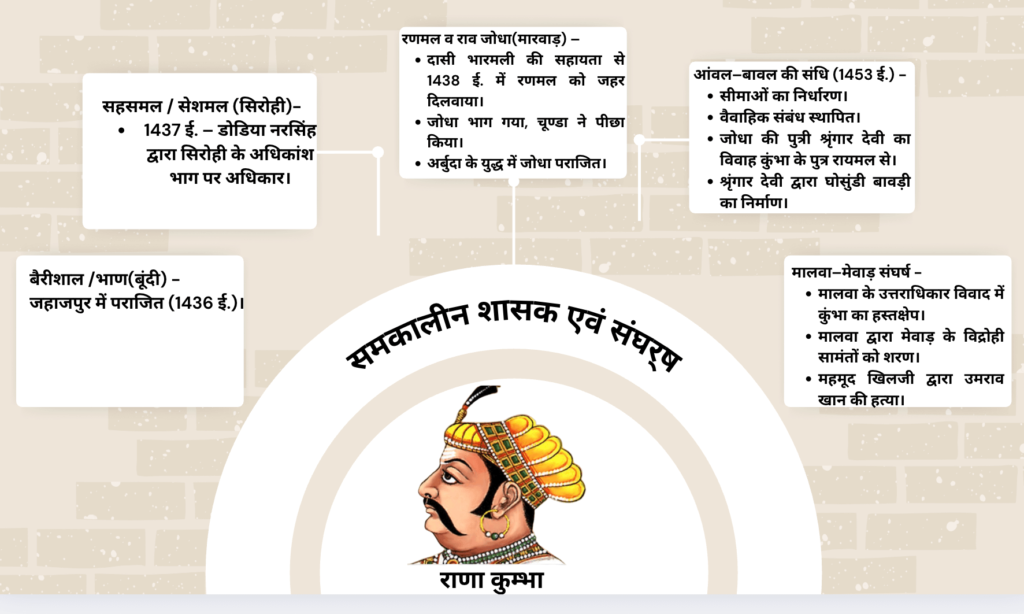
- Battle of Sarangpur (1437 AD) –
- This battle was fought between Kumbha and Mahmud Khilji-I.
- Mahmud Khilji built a 7-story minaret in Mandu to commemorate his victory.
- Kumbha constructed the Vijay Stambh (Victory Tower) in Chittorgarh Fort.
Vijay Stambh (Chittorgarh) –
- Construction period – 1440 to 1448 AD
- It is a 9-story tower.
- Dedicated to – Lord Vishnu
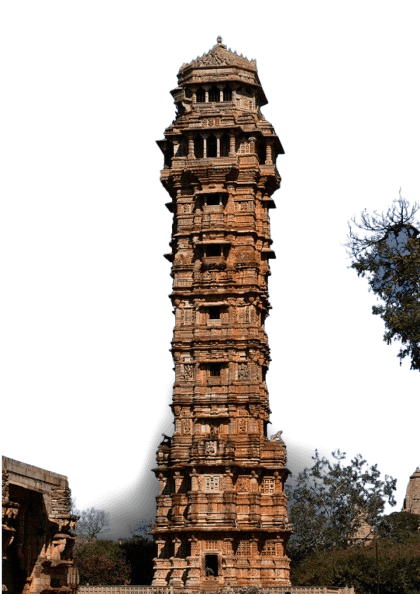
- Main nicknames – Kirti Stambh, Vishnudhwaj, Garudhwaj, Encyclopedia of Indian Sculpture, Museum of Sculptures
- Chief sculptors – Jaita, Napa, Poma, Punja, Bhumi, Chupi, Balraj
- Author of the inscription – Atri Bhatt and Mahesh Bhatt
- The word “Allah” is written 9 times in Arabic on the third floor. The ninth floor was damaged by lightning.
- Restoration – Rana Swaroop Singh
- This is the first building in Rajasthan on which a postage stamp was issued.
Jain Kirti Stambh–
- It is located in Chittorgarh Fort.
- Construction – 12th century
- Builder – Jain merchant Jijashah Bagherwal
- It is a 7-story tower.
- Dedicated to – Adinath (Rishabhdev)
- Nickname – Adinath Stambh
Malwa–Mewar War Campaign –
- In 1442–43 AD, Malwa attacked Kumbhalgarh.
- The battle was inconclusive.
- Kumbha’s commander Deep Singh was killed in this battle.
- Attack on Gagron – Khilji’s victory.
- Three attacks on Mandalgarh – 1446 and 1456 AD – all three were inconclusive.
- Attack on Ajmer – 1455 AD
- For some time, the Malwa region was under the control of Mewar.
Gujarat-Mewar Conflict –
- Main reason – Succession dispute of Nagaur
- Kumbha helped Shams Khan become the ruler of Nagaur. Shams Khan went to Gujarat.
- Treaty of Champaner – 1456 AD
- It involved Mahmud Khilji I and Sultan Qutbuddin of Gujarat.
- Plan – To divide Mewar equally between them.
- Kumbha foiled this treaty.
Battle of Badnor (Bairathgarh) – 1457 AD.
- Kumbha emerged victorious in this battle.
- Construction of Kushal Mata Temple to commemorate the victory.
- In 1468 AD, Kumbha was murdered by his son Uda (Udaykaran) at Mamadev Pond.
Contribution to Architecture –
- Kumbha is called the “Father of Rajasthani Architecture”.
- According to Shyamaldas – Kumbha built 32 of the 84 forts of Mewar.
Kumbhalgarh Fort –
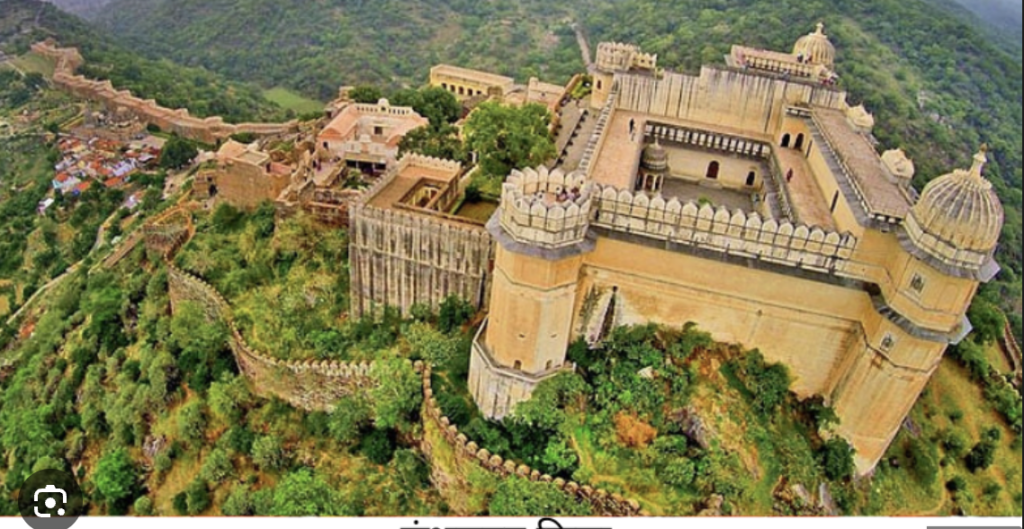
- Construction/Reconstruction – 1448–1458 AD
- Architect – Mandan
- Nickname:Emergency Capital
- Border guardian of Mewar-Marwar
- Length of the wall – 36 kilometers
- India’s first and the world’s second longest wall.
- Included in the UNESCO World Heritage List.
- Birthplace of Maharana Pratap
- Major Monuments – Kumbhshyam Temple, Badal Mahal, Jhalibav Stepwell, Mamadev Pond
- Katar Garh Fort: – Inner Fort
- Nickname – The Eye of Mewar
- Residence of Kumbha, Coronation of Udai Singh, Birth of Maharana Pratap.
- Achalgarh Fort – Sirohi
- Basantgarh Fort – Sirohi
- Machangarh Fort – Sirohi
- Bhomat Fort – Udaipur
Major Temples –
- Kumbhaswami (Vishnu) Temple – Chittorgarh, Kumbhalgarh, Achalgarh
- Shringar Chanwari Temple – Chittorgarh
- Meera Temple (Kumbh Mandap) – Kailashpuri
- Ranakpur Jain Temple – Pali
- Builder – Dharna Shah
- Sculptor – Depak
- Dedicated to – Adinath
- 1444 pillars – “Museum of Pillars”
Contribution to Literature and Music –
- Kumbha’s works – Sangeet Granth, Sangeetraj, Sangeet Mimansa, Sudaprabandha, Sudha Prabandha, Kamaraj Ratisar.
- Commentaries – Rasik Priya commentary (on Jayadeva’s Gita Govinda), Chandishataka commentary (Banabhatta), Sangeet Ratnakar commentary (Sarangadhara)
- Kumbhalgarh Prashasti – Kumbha wrote 4 plays (in Mewari language)
- 5 parts of Sangeetraj – Pathya/Path Ratnakosha, Vadya Ratnakosha, Nritya Ratnakosha, Geeta Ratnakosha, Rasa Ratnakosha/Asi Prakarana
- Kanha Vyas – Ekalinga Mahatmya
- Natha, Govind, Mehaji
- Hiranand Muni – Kumbha’s guru, Title – Kavirama
- Ramabai – Kumbha’s daughter
- Title – “Vagishwari”
- Interested in music like her father.
- Given the pargana of “Jawar”.
- Note: Kumbha’s music guru was “Sarang Vyas” and Kumbha himself was a good musician and “Veena player”.
Works and subject matter of Kumbha’s courtier Mandan:
| Work | Subject Matter |
| Rupamandan | Sculpture |
| Devamurti Prakarana | Idol making and iconography |
| Vastumandan | Architecture |
| Vastusara | Forts, buildings, and city planning |
| Kodanda Mandan | Archery |
| Shakun Mandan | Auspicious and inauspicious omens |
| Vaidhya Mandan | Diseases and diagnosis (medical science) |
| Prasad Mandan | Temple construction |
| Rajvallabh Mandan | From residences of ordinary citizens to city planning |
Maharana Kumbha’s Titles
| Title | Meaning |
| Abhinavabharatacharya | Because he was the author of musical treatises |
| Hindu Suratan | Given by Muslim rulers |
| Ranarasau | Patron of scholars |
| Shail / Halaguru | Builder of hill forts |
| Chapaguru | Expert in guerrilla warfare tactics |
| Narapati | Greatest among men |
| Paramaguru | Supreme ruler of his time |
| Danaguru | Great benefactor |
- Other titles: Maharajadhiraja, Raorai, Ranerai, Chapaguru Rai-Rayan, Ashwapati, Gajapati, etc.
- Note: The above titles of Rana Kumbha are inscribed in the Gitagovinda (commentary) and the Kumbhalgarh Prashasti.
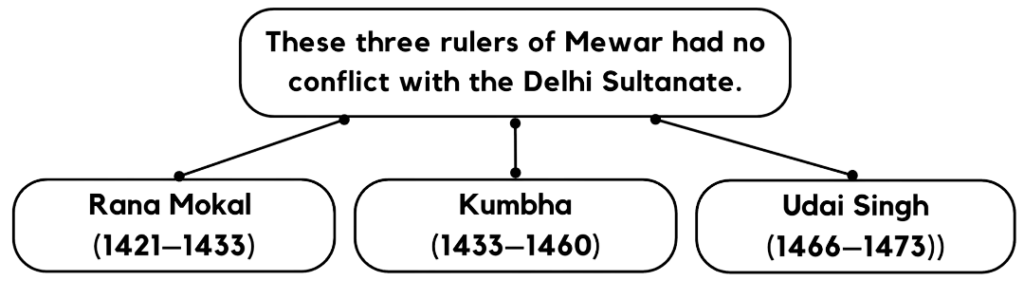
Uda / Udayakaran (1468–1473 AD) –
- He murdered his father, Maharana Kumbha, at Mamadev pond in 1468 AD.
- For this reason, Uda is called “Patricide.”
- Uda was dethroned by his own brother Raymal after the “Victory of Dadimpur.”
Raymal (1473–1509 AD) –
- Architect – Arjun
- Agricultural Development – Promoted agriculture in Mewar.
- Construction work – Ram Talab, Shankar Talab, Sankat Talab
- Wife – Shringaradevi
- Constructed the Ghosundi stepwell.
- Four sons – Jaimal, Raj Singh, Sanga (Sangram Singh), Prithviraj Sisodia.
- Children – According to the poet Shyamal – 11 sons, 2 daughters
- Prithviraj Sisodia –
- Nickname – Flying Prince
- Wife – Tarabai (Named the Ajmer fort after her.)
- Son of a concubine – Banvir
- Cenotaph in Kumbhalgarh – Cenotaph with 12 pillars
Sangram Singh–I / Rana Sanga (1509–1528 AD) –
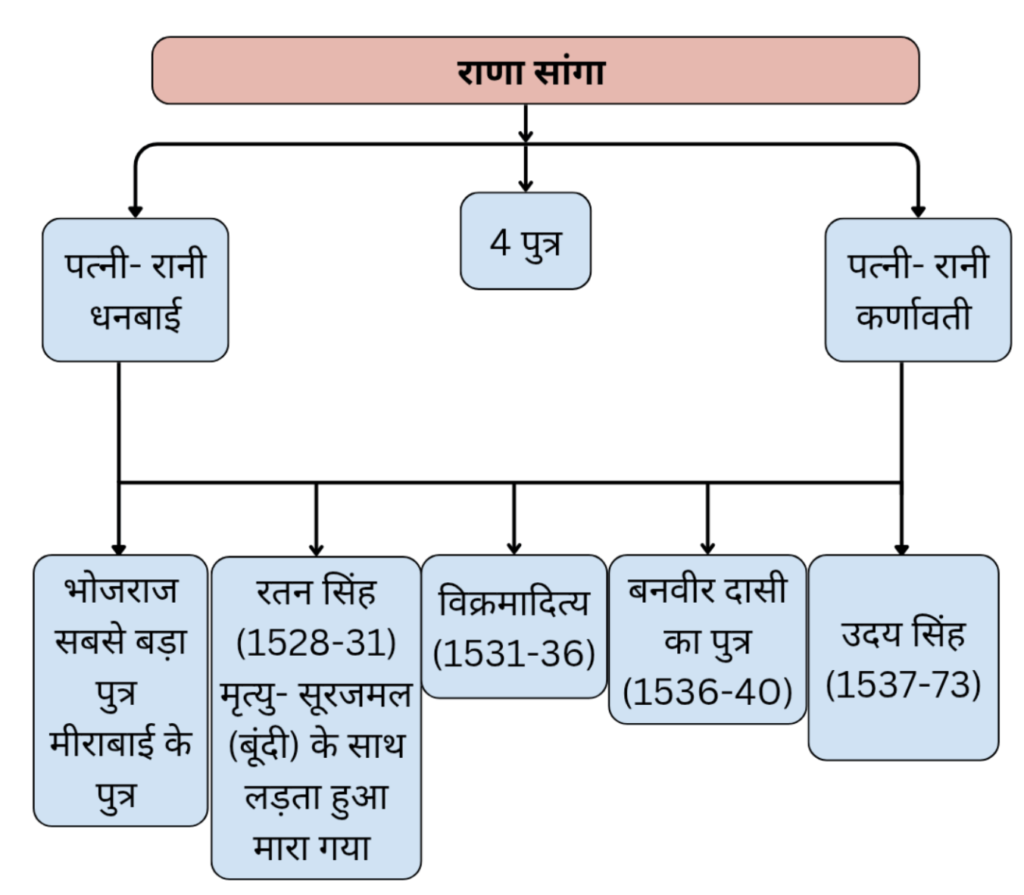
- Titles –
- By Colonel Tod – Military Ruins
- Guide of the Hindu Path
- Early Struggles –
- After a dispute with his brothers, he took refuge with Karamchand Panwar near Srinagar (Ajmer).
- Contemporary Rulers (Delhi Sultanate) –
- Sikandar Lodi
- Ibrahim Lodi
Wars between Rana Sanga and the Lodis –
- Battle of Khatoli – 1517 AD (Kota) –
- Opponents – Rana Sanga vs. Ibrahim Lodi
- Result – Victory for Rana Sanga
- Rana Sanga’s physical injuries – His left arm was severed. One leg was rendered useless by an arrow.
- Battle of Bari – 1518 AD (Dholpur) –
- Opponents – Rana Sanga vs. Ibrahim Lodi
- Result – Another victory for Rana Sanga
- Ibrahim Lodi himself was not present in the battle –
- Commanders – Mian Makhan, Mian Hussain
- Rewards for Karamchand Panwar –
- Jagir (land grant) – Ajmer, Parbatsar, Mandal, Phulia, Banera, etc.
- Title – “Rawat”
Malwa and Rana Sanga –
- 1511 AD – Death of the Malwa ruler Nasiruddin Mahmud
- His son Mahmud Khilji-II became the ruler.
- Sahil Khan dethroned him.
- Medini Rai reinstated Mahmud Khilji-II as ruler. Medini Rai became the Prime Minister.
- The Gujarat ruler Muzaffar Shah attacked Malwa.
- The blame was placed on Medini Rai → A conspiracy was hatched. Then Medini Rai sought help from Rana Sanga.
- Rana Sanga granted Medini Rai the jagirs of Gagron and Chanderi.
Battle of Gagron – 1519 AD (Jhalawar) –
- Opponents –
- On one side – Rana Sanga + Medini Rai
- On the other side – Mahmud Khilji II
- Result – Rana Sanga was victorious.
- Mahmud Khilji II was kept in captivity for 6 months. Later, he was generously released.
- Nizamuddin Ahmed (Tabaqat-i-Akbari) praised Rana Sanga’s magnanimous behavior.
Idar, Gujarat and Rana Sanga –
- The sequence of Idar –
- From ruler Bhan
- Then his son Suryamal
- Then his son Raymal
- Raymal’s uncle Bharmal – with the help of the Gujarat ruler Muzaffar Shah, removed Raymal and became the ruler himself.
- Raymal sought help from Rana Sanga. In 1520 AD, Rana Sanga defeated Bharmal and Muzaffar Shah.
- Raymal was reinstated as the ruler of Idar.
Battle of Bayana – February 16, 1527 AD –
- A battle took place between Sanga’s army and Babur’s army.
- In this battle, Rana Sanga’s army emerged victorious.
- The commander of Babur’s army was Mehdi Khwaja (brother-in-law).
Battle of Khanwa – March 17, 1527 AD –
- The Battle of Khanwa took place on March 17, 1527 AD.
- According to the Veer Vinod text, this battle took place on March 16, 1527 AD.
- The wounded Rana Sanga was brought out of the battlefield under the care of Akheraj of Sirohi.
- A platform (chabutra) of Rana Sanga is built at Baswa (Dausa).
- The wounded Rana’s crown of Mewar was worn by Jhala Ajja.
- Jhala Ajja attained martyrdom while wearing the crown.
- Rana Sanga granted the jagir of Sadri to Simha, son of Jhala Ajja.
Battle of Khanwa
| A/c to Colonel Tod Sanga’s army consisted of 7 high-ranking kings, 9 Raos, and 104 major chieftains. Sanga wrote Paati Parvan to all the kings of Rajasthan and sought their assistance.” | Warfare method – TulughmaExemption of trade tax (Tamgha tax)Use of artilleryDeclaration of Jihad (holy war) |
| Included Princely States: Amer – Prithviraj Kachwaha Marwar – Ruler: Ganga, Leadership: Kunwar Maldeo Bikaner – Ruler: Rao Jaitshi, Leadership: Kalyanmal Sirohi – Akheraj Deora Devalia (Pratapgarh) – Bagh Singh Salumbar – Ratan Singh Kathiawar Sadri – Jhala Ajja and Jhala Sajja Wagad – Udai Singh Chanderi (MP) – Medini Rai Jagner – Ashok Parmar Pali – Akheraj Songara Mewat – Hasan Khan Mewati Afghan – Mahmud Lodi Merta – Viramdev Raisen – Silhadi Tanwar Nagaur – Khanzada | Warning of Muhammad Sharif’s prophecy. Victory – Babur assumed the title of Ghazi. Ghazi – Destroyer of Hindus / Destroyer of Infidels (Kafirs). Salhadi Tanwar (Raisen) and Khanzada (Nagaur) joined Babur at the final stage of the battle(Treachery/Betrayal). |
Death of Rana Sanga –
- Kalpi (Madhya Pradesh) – Rana Sanga died on January 30, 1528 AD. Rana Sanga’s last rites were performed.
- Rana Sanga’s cenotaph is located in Mandalgarh.
Rana Ratan Singh (1528-1531 AD) –
- Rana Ratan Singh and Surajmal Hada of Bundi got into a fight while playing the Aheria festival (hunting) and both were killed.
Vikramaditya (1531–1536 AD) –
- Regent – Rani Karmavati (Hadi Rani, Bundi)
- Invasion by Bahadur Shah, the ruler of Gujarat (1533 AD) –
- In 1533 AD, Bahadur Shah invaded Mewar.
- Under the terms of the treaty, Bahadur Shah received the Ranthambore fort. This invasion occurred twice.
- The Invasion of 1534–35 AD –
- In 1534–35 AD, Bahadur Shah attacked again.
- The one who performed the Kesariya (ritual of self-sacrifice) – Bagh Singh (Deoliya).
- The Rajput women, under the leadership of Rani Karnavati, performed Jauhar.
- This is known as the Second Saka of Chittorgarh.
- The Incident of Sending a Rakhi to Humayun-
- During Bahadur Shah’s invasion, Rani Karnavati sent a Rakhi to Humayun through a messenger named Padmashah.
- Objective – To seek help for her protection.
- Humayun could not reach in time to provide assistance.
- The Escape of Vikramaditya and Uday Singh –
- During the invasion, Vikramaditya and Uday Singh went to their maternal grandfather in Bundi.
- The Murder of Vikramaditya –
- In 1536 AD, Vikramaditya became the ruler again.
- In the same year, Banvir murdered him.
Banvir (1536–1540 AD) –
- Banvir was the son of a concubine (Paswan) of Prithviraj Sisodia.
- He murdered Vikramaditya and became the ruler of Mewar himself.
Panna Dhai –
- Caste – A woman of the Gurjar caste.
- The foster mother of Rana Uday Singh.
- Famous as the protector of Mewar.
- The Incident of Saving Uday Singh – After murdering Vikramaditya, Banvir also wanted to kill Uday Singh. Panna Dhai saved Uday Singh by sacrificing her own son, Chandan. Kirat Bari assisted Panna in this act.
- The Safe Transfer of Uday Singh – Panna Dhai first took Uday Singh to Deoliya (Rai Singh). After that, she took Uday Singh to Kumbhalgarh and placed him under the protection of Asha Devpura.
Maharana Uday Singh (1537–1572 AD) –
- Father – Rana Sanga
- Mother – Rani Karnavati / Karnawati
- Coronation – He was coronated in Kumbhalgarh in 1537 AD. This opinion is given by G.H. Ojha.
- Battle of Mavli – 1540 AD –
- Opponents – Udai Singh vs. Banvir
- Ally – Rao Maldev (Marwar)
- Udai Singh, with the help of Rao Maldev, defeated Banvir.
- Udai Singh recaptured Chittorgarh.
Sher Shah Suri and Chittorgarh – 1543 AD
- In 1543 AD, Udai Singh handed over the keys of Chittorgarh fort to Sher Shah Suri without a battle.
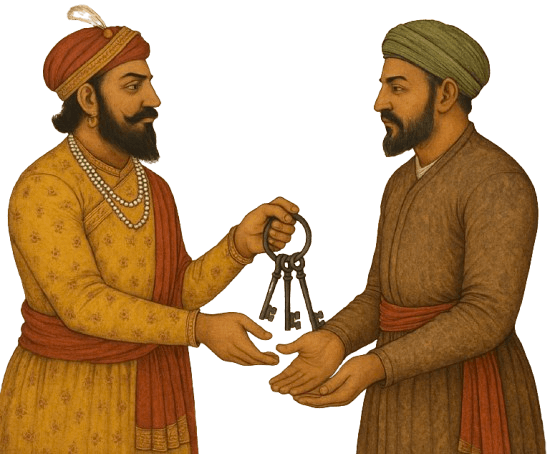
- Sher Shah Suri appointed Khawas Khan in Chittorgarh.
- Khawas Khan was appointed solely to maintain political influence.
- Battle of Harmada – 1557 AD –
- On one side – Udai Singh
- On the other side – Hakim Haji Khan (Ajmer) and Rao Maldev
- Hakim Haji Khan defeated Udai Singh.
- Establishment of Udaipur – 1559 AD –
- In 1559 AD, Maharana Udai Singh founded the city of Udaipur.
- Udaipur was made the capital of Mewar.
- He constructed the palaces of Moti Magri in Udaipur.
- He also constructed the Udaisagar Lake.
Akbar’s Invasion – 1567–1568 AD –
- Akbar invaded Chittorgarh in 1567–68 AD.
- On the advice of his chieftains, Udai Singh entrusted the responsibility of Chittorgarh to Jaimal (Merta) and Fatta / Fateh Singh Sisodia (feudal lord of Amet).
- Udai Singh himself retreated to the Girwa hills of Udaipur.
- According to Colonel Tod – “If Udai Singh had not been between Rana Sanga and Maharana Pratap, the history of Mewar would have been even more glorious.”
- This is known as the Third Saka of Chittorgarh.
- A fierce battle took place between Jaimal Rathore and Akbar.
- Ultimately, Akbar was victorious. Akbar ordered the massacre of approximately 30,000 innocent people, which is considered a stain on history. Jaimal Rathore was wounded by a gunshot and attained martyrdom. Fatta (Fateh Singh) also attained martyrdom.
- Isardas Chauhan attacked Akbar’s elephant, Madhukar, with a dagger on its trunk while entering the Chittorgarh fort.
- The Jauhar was led by Phool Kanwar (Fatta’s wife and Jaimal’s sister). A large number of Rajput women sacrificed themselves in this Jauhar.
- Akbar’s administration of Chittorgarh:
- Akbar entrusted the administration of Chittorgarh to Abdul Majid Asaf Khan. After this, Akbar himself returned.
- Akbar had stone statues of Jaimal and Fatta, mounted on elephants, erected outside the Agra Fort.
- This is mentioned by François Bernier.
- Similar statues were also erected in Rajputana by Rai Singh, the ruler of Bikaner, in the Junagarh Fort.
Kallaji Rathore:
- Kallaji Rathore was the son of Aas Singh.
- Kallaji Rathore was Jaimal’s nephew.
- He was a devout follower of Naganechi Mata.
- Sanwaliya (Dungarpur) – Where saffron and opium are offered to his idol.
- Nicknames –
- The four-armed folk deity
- Incarnation of Sheshnag
- Master of weapons, warfare, and medicine
- Contribution to the Chittorgarh war –
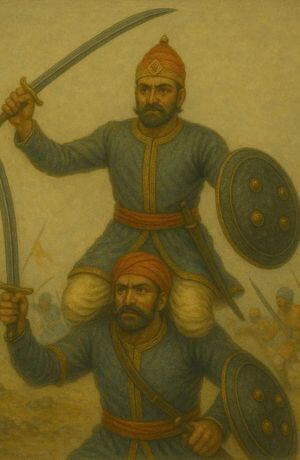
- He fought the war carrying his uncle Jaimal on his shoulders.
- He attained martyrdom in the battle.
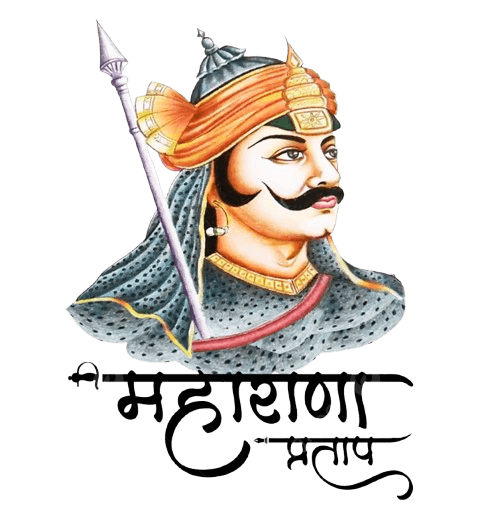
Maharana Pratap (1572–1597 AD):
- Father – Maharana Udai Singh
- Mother – Jayavanta Bai (daughter of Akheraj Sonagara, Pali)
- Queen – Ajab De Panwar
- Born – May 9, 1540 AD, Kumbhalgarh (Badal Mahal)
- Childhood name – Kika (given by the Bhils)
- Death – January 19, 1597 AD, Chavand (while stringing a bow)
- Cremation site – Badoli (8-pillared cenotaph)
- Chetak’s memorial – Balicha
- Main elephant – Ramprasad (renamed ‘Peer Prasad’ by Akbar)
- Mayra Cave – Rana Pratap’s arsenal
- Succession dispute –
- Udai Singh declared Jagmal as his successor.
- Jagmal, son of Bhatiyani Queen Dheerbai, became the ruler.
- Those who opposed:
- Akheraj Sonagara (Pali)
- Ramsingh Tanwar (Gwalior)
- Coronation – February 28, 1572 AD, Gogunda (formally at Kumbhalgarh)
- Coronation performed by – Rawat Krishnadas Chundawat (Salumber)
- He wore the royal sword on his waist.
- Chandrasen of Marwar was also present.
- Jagmal, angry, went into Akbar’s service.
- Akbar gave Jagmal the pargana of ‘Jahazpur’. In 1583 AD, he gave him half of the Sirohi state. In 1583 AD, Jagmal was killed in the Battle of Dattani fighting against Rao Surtaan (Sirohi).
Capital change and military reforms –
- To escape the Mughals, the capital was shifted from Gogunda to Kumbhalgarh.
- Last capital: Chavand was Maharana Pratap’s last capital, where he died in 1597.
- In 1585 AD, he removed Luna Chavandia, captured Chavand, and made it his capital.
- This remained the capital from 1585-1615 AD (during the reigns of Pratap and Amar Singh-I).
- The main reason for making Chawand the capital was its strategic location and its ability to provide a strong base for organizing resistance against the Mughal Empire.
- Pratap built the Chamunda Mata temple and palaces in Chawand.
- During the time of Pratap the ‘Chawand school of painting’ developed, with Amar Singh’s reign being considered the golden age of the Chawand style.
- The painter Nisardin/Nasiruddin illustrated the texts of Dholamaru (1592 AD) and “Ragmalā” (1605 AD, during the reign of Amar Singh-I).
- Pratap was the first to give high positions to the Bhils in the army.
- Prominent Bhil – Punja Bhil
- Akbar and the Envoys:
- After the conquest of Gujarat (1572), four envoys were sent:
- Jalal Khan/Jalaluddin Korchi – August/November 1572
- Man Singh – June 1573
- Bhagwant Das – October 1573
- Todar Mal – December 1573
- All the missions were unsuccessful.
- This was followed by the Battle of Haldighati.
Battle of Haldighati (June 18/21, 1576 AD) –
- Other names –
- Battle of Khamnor – Abul Fazl
- Battle of Gogunda – Abdul Qadir Badauni
- Thermopylae of Mewar – Colonel Tod
- Battle of the Elephants
- Battle of Banas
- Battle of Badshah Bagh according to Ashirwadi Lal Srivastava
- Akbar’s plan – in the fort of Ajmer
- Mughal leadership – Man Singh
- Man Singh’s route – Mandalgarh → Molela → Khamnor
- The Military Camp of Rana Pratap– Lohsinghpura Khamnor (Plan – Kumbhalgarh)
- Those who informed Maharana Pratap – Dursa Purabiya and Neta Sisodia
- Battle formation –
- Harawal (Front line – Mewar) – Hakim Khan Sur (leadership), Dodhia Bhim Singh, Rai Singh Rathore, Rawat Krishnadas Chundawat, Rawat Sanga, Chandawal (Rear line – Mewar), Punja Bhil (Panarwa), Padiyar Kalyan, Mehta Ratanchandra, Purohit Gopinath, Mahasani Jagannath, Purohit Jagannath, Charan Jesa, Charan Keshav, Mehta Jaimal
- Mughal side – Harawal Right wing and Chandawal – Syed Hashim Khan, Jagannath Kachhwaha, Asaf Khan, Ghazi Khan Badakhshi, Syed Ahmed Khan, Man Singh, Chandawal – Mihter Khan
- Battle results –
- Mihter Khan spread false news of Akbar’s arrival.
- According to most historians, the battle was inconclusive (Gopinath Sharma)
- Pratap attacked Man Singh with a spear – Amarkavya Vanshavali
- Jhala Bida fought wearing the Rana’s royal umbrella and attained martyrdom.
- Shakti Singh, Pratap’s brother (on the Mughal side), gave Pratap a horse.
- After the Battle of Haldighati –
- Pratap’s treatment – Kolyari (Udaipur)
- Akbar entrusted the administration of Udaipur to Jagannath Kachhwaha and Fakhruddin.
- Shahbaz Khan was sent for battle three times – October 1577, December 1578, November 1579 (twice unsuccessful)
- Battle of Kumbhalgarh (April 3, 1578) – Battle between Shahbaz Khan and Pratap’s army. Shahbaz was victorious. He captured Kumbhalgarh fort.
- Other Mughal campaigns –
- 1580–81 – Abdur Rahim Khan-i-Khana was made the governor of Ajmer.
- Amar Singh abducted Rahim’s family from Shergarh.
- Pratap returned the family with respect.
Battle of Dewair (October 1582) –
- The battle was fought between Amar Singh on Pratap’s side and Sultan Khan on Akbar’s side.
- Pratap killed Sultan Khan and his horse with a spear.
- Pratap was victorious.
- Colonel Tod – “The Marathon of Mewar”
- Pratap captured 36 Mughal outposts.
- December 1584 – Jagannath Kachhwaha’s last Mughal campaign.
- Jagannath Kachhwaha died in Mandalgarh. A 32-pillared cenotaph was erected in his memory.
- Court Scholars –
- Hemratna Suri – “Gaura Badal ki Chaupai”
- Chakrapani Mishra – Rajyabhishek Paddhati, Muhurtamala, Vishwavallabh, Vyavahar Adarsh
- Publisher – Shri Krishna Jugnu
- Sadulnath Trivedi – Mandar Jagir was granted.
- Proof – Udaipur inscription of 1588.
- Bhamashah / Tarachand –
- Met Pratap in Chulia village.
- Provided financial assistance.
- Appointed Prime Minister.
- Savior of Mewar / Great philanthropist.
Maharana Amar Singh–I (1597–1620 AD): –
- Maharana Amar Singh–I assumed the rule of Mewar in 1597 AD as the successor of Maharana Pratap.
- The contemporary Mughal emperors of Maharana Amar Singh–I were Akbar and Jahangir.
- Towards the end of Akbar’s reign, in 1597 AD, a Mughal campaign was sent against Amar Singh under the leadership of Salim (the future Jahangir).
- Military campaigns against Mewar by Jahangir –
- 1605 AD – Parvez, Asif Khan, Zafar Beg
- 1608 AD – Mahabat Khan
- 1609 AD – Abdullah Khan
- 1612 AD – Raja Basu
- 1613 AD – Aziz Koka–II
- All these campaigns were unsuccessful.
- After this, a campaign was sent under the leadership of Prince Khurram (the future Shah Jahan).
- As a result of Khurram’s campaign, Mewar was forced to sign a treaty.
- Mughal-Mewar Treaty (February 15, 1615 AD) –
- On behalf of the Mughals – Shirazi, Sundardas, Prince Khurram
- On behalf of the Rana – Haridas Jhala, Shubhkaran
- Main terms of the treaty:
- Amar Singh–I was not required to be personally present at the Mughal court.
- Prince Karan Singh would remain at the Mughal court.
- The Rana would be ready to serve the Mughals with 1000 cavalrymen.
- Chittorgarh fort would be returned to the Rana.
- No repairs or fortifications would be carried out at Chittorgarh. Events after the treaty –
- Dissatisfied with the treaty, Rana Amar Singh I went to Nau Chauki Pal (Rajsamand).
- His last rites were performed in Ahar.
- The first cenotaph of Amar Singh I was built in the Mahasatis (royal crematorium) of the Ranas of Mewar in Ahar.
- The first ruler of Mewar to accept Mughal suzerainty — Amar Singh I
- Three prominent Prime Ministers of the Bhamashah lineage –
- Bhamashah (during the reigns of Pratap and Amar Singh)
- Jivashah (during the reign of Amar Singh) — builder of Amarsar
- Akshraj (during the reign of Karan Singh)
- The reign of Amar Singh I is considered a period of resurgence for the Rajputs.
Karan Singh (1620–1628 AD) –
- Karan Singh was the first ruler of Mewar who served in the Mughal service before becoming a ruler.
- He was the first ruler of Mewar to whom the title of “Rana” and a robe of honor were sent by the Mughal court (Jahangir) on the occasion of his coronation.
- Karan Singh divided his kingdom into “parganas” (districts).
- Major buildings constructed by Karan Singh: – Karan Mahal, Dilkhush Mahal, Bada Dariba Khana, and the construction of “Jag Mandir” located in Pichola Lake was started by Karan Singh.
- Relationship with Prince Khurram (1622 AD) –
- In 1622 AD, Prince Khurram revolted against Jahangir.
- During this rebellion, Karan Singh welcomed Khurram.
- Karan Singh sent Khurram to the South via Mandu.
- Karan Singh and Khurram had cordial relations.
Jagat Singh I (1628–1652 AD) –
- The reign of Jagat Singh I is called the “Golden Age of Mewar Painting”.
- Jagat Singh I completed the construction of the “Jag Mandir” located in Pichola Lake.
- He established a painting school called “Chitero Ri Ovri / Tasveeranro Karkhano”.
- Jagdish/Jagannath Temple, Udaipur
- Nickname: Temple of Dreams
- Builder: Jagat Singh I
- Year of construction: – 1650 AD
- Architects: – Bhana, Mukund
- Under the supervision of Arjun
- Style: – Nagara/Panchayatana style
- The Jagannath Prashasti is inscribed on this temple.
- Author of Jagannath Prashasti: Krishnabhatt
- Krishnabhatt described Maharana Pratap as victorious in the Battle of Haldighati.
- Jagat Singh I also built a temple for his ‘wet nurse’ Neju Bai in Udaipur.
- Important Note – In 1631 AD, Shah Jahan separated Pratapgarh from Mewar and granted it the status of an independent principality.
Maharana Raj Singh I (1652–1680 AD) –
- Title – Vijayakatakatu (Conqueror of armies)
- Raj Singh is called a hydraulic ruler.
- Contemporary rulers – Shah Jahan and Aurangzeb
- Raj Singh supported Aurangzeb in the war of succession.
- Military and Administrative Works –
- Raj Singh rebuilt the boundary wall of Chittorgarh Fort.
- Shah Jahan sent Sadullah Khan to demolish it.
- Raj Singh organized the Tika-daur ceremony and annexed the Thikanas (feudal estates) into his territory.
- He also acquired the parganas of Gayaspura, Dungarpur, and Banswara.
- Aurangzeb granted Raj Singh a mansab of 6000 zat and sawar.
Dispute in Aurangzeb-Raj Singh relations –
- The Charumati episode (1659 AD) –
- Charumati – Princess of Kishangarh, daughter of Roop Singh.
- Her brother Man Singh arranged Charumati’s marriage to Aurangzeb.
- At Charumati’s insistence, Raj Singh married her.
- This became the main reason for the conflict between Aurangzeb and Raj Singh.
Hadi Rani –
- Real name – Sanhal Kanwar
- Father – Sangram Singh Hada (Bundi)
- Marriage – Rawat Ratan Singh Chundawat of Salumber
- Proverb – “Chundawat maange senani, sir kaat de diyo chhatrani” “Senani” composition – Meghraj Mukul
- A women’s police battalion in Rajasthan is named after Hadi Rani.
Religious Policy –
- In 1669 AD, Aurangzeb ordered the demolition of Hindu temples.
- In contrast, Raj Singh built Hindu temples.
- Shri Nathji Temple –
- Location – Sihada (Rajsamand)
- Builder – Raj Singh-I
- Idol brought by – Dauji / Damodar Maharaj (from Mathura)
- This is the main seat of the Vallabha sect.
- Founder – Vallabhacharya
- Worship – The child form of Krishna
- Music – Haveli Sangeet
- Pichhwai paintings – Depiction of Krishna’s childhood pastimes on black cloth.
- Ashtachhap (Vallabha sect) –
- Establishment–Vitthalnath/Vitthalachary formed a group of 8 disciples.
- Ashtachhap poets – Surdas, Kumbhandas, Parmananddas, Krishnadas, Govindswami, Chhitswami, Chaturbhujdas, Nanddas
- Principle of Pushtimarg – Salvation is attained only through God’s grace. Founder of Pushtimarg – Vallabhacharya
- “The Ship of Pushtimarg” – Surdas
- Note: –
- Ashtapradhan – Shivaji’s 8 central officials
- Ashtadiggajas – Krishnadevaraya’s 8 court scholars
- Dwarkadhish Temple –
- Location – Kankroli (Rajsamand)
- Idol brought by – Dauji / Dauji
- Builder – Raj Singh I
- Ambika Mata Temple –
- Location – Jagat (Udaipur)
- Nickname – Khajuraho of Mewar
- Note: –
- Khajuraho of Rajasthan – Kiradu (Barmer)
- Mini Khajuraho of Rajasthan / Khajuraho of Hadoti – Bhanddevra (Baran)
Marwar Succession Struggle –
- In 1678 AD, Maharaja Jaswant Singh (Marwar) died.
- Marwar was declared Khalsa (directly under the Mughal emperor) as Ajit Singh was not recognized as the successor.
- Raj Singh considered this a violation of Rajput policy.
- He formed a Rathore-Sisodia alliance against Aurangzeb with Durga Das Rathore.
- Raj Singh gave protection to Ajit Singh and granted him the jagir of Kelwa along with 12 villages.
- To break this alliance, Aurangzeb sent his son Akbar, but Akbar revolted against Aurangzeb.
- The alliance broke up with the death of Raj Singh in 1680 AD.
- Durga Das Rathore continued the struggle against Aurangzeb for 30 years.
- Jaziya Tax –
- In 1679 AD, Aurangzeb imposed the Jaziya tax.
- Jaziya – Generally a semi-religious and military tax
- According to Satish Chandra, Jaziya was imposed on economic and political grounds.
Cultural Contribution –
- Rajsamand Lake –
- Construction period – January 1, 1662 to January 14, 1676 AD
- Constructed by damming the Gomti River.
- This is the only lake built for famine relief.
- The Rajsamand district is named after this lake.
- Rajprashasti Inscription – On the lake shore
- Author – Ranchhod Bhatt
- Trimukhi Baori / Jaya Baori –
- Builder – Raj Singh’s wife, “Ramras De”
- Raj Singh’s death – occurred in Odha village.
- Court Scholars –
- Kishoredas – “Rajprakash”
- Sadashiv Bhatt – “Rajratnakar”
- Ranchhod Bhatt Tailang – “Rajprashasti”, “Vanshavali”
Jai Singh (1680–1698 AD) –
- Jai Singh–Aurangzeb Treaty (June 24, 1681 AD) –
- In this treaty, Rana Jai Singh agreed to pay the “Jaziya tax”.
- The Mewar-Mughal treaty was signed twice.
- Jagirs given in exchange for Jaziya
- The jagirs of Pur, Mandal, and Badnor were given to the Mughal side.
- Construction of Jaisamand Lake –
- Jai Singh constructed Jaisamand Lake (1687–1691 AD) on the Gomti River.
Maharana Amar Singh–II (1698–1710 AD) –
- Contemporary Mughal rulers – Aurangzeb and Bahadur Shah–I
- Role in the War of Succession –
- In the war of succession that followed Aurangzeb’s death, he supported Muazzam (Bahadur Shah–I).
Debari Agreement / Covenant (1708 AD, Udaipur)
- This agreement was against the Emperor.
- Parties to the agreement: –
- Amer – Sawai Jai Singh
- Mewar – Amar Singh–II
- Marwar – Ajit Singh
- Main conditions: –
- Sawai Jai Singh would be restored to his kingdom.
- Sawai Jai Singh would marry Chandrakunwari, daughter of Amar Singh II.
- The son born from this marriage would be the ruler/heir of Amer.
- Reacquisition of Jagirs in 1709 AD
- 1 lakh rupees (as Jaziya tax) were given to the Mughal Emperor.
- In return, the jagirs of Pur, Mandal, and Badnor were reacquired.
- Strict action against feudal lords
- The Rawat chieftains of Dungarpur, Banswara, and Deoliya were punished.
- Classification of Jagirdars/Feudal Lords –
- 16th Umrao – First Class
- 32nd Umrao – Second Class
- Administrative Tradition –
- Amar Singh II started the tradition of the “Amarshahi turban”.
- Relationship with Durgadas Rathore –
- Gave refuge to Durgadas Rathore.
- Granted him the jagir of Vijaypur.
- Appointed Durgadas Rathore as the Hakim of Rampura.
Maharana Sangram Singh II (1710–1737 AD) –
- Constructed the Saheliyon ki Bari in Udaipur.
- Constructed the Vaidyanath Shiva temple in Sisarma (Udaipur).
- Vaidyanath Temple Inscription (1719 AD) –
- Author – Rupabhatta
- This inscription provides information about the Battle of Banswara.
- In this battle, Sangram Singh II defeated the Mughal commander Ranbaz Khan.
- During his reign, the “Kalila-Dimna” paintings were created.
- During the Rana’s reign, Mewar regained the jagir of Rampura, which had been under Mughal control since the time of Akbar.
- The Marathas collected Chauth from Mewar for the first time (first time in Rajasthan).
- The Hurda Conference was proposed during the time of Sangram Singh II, but due to his sudden death, it could not be held during his lifetime.
Maharana Jagat Singh II (1734–1751 AD) –
- Hurda Conference (July 17, 1734, Bhilwara) –
- Objective – To resolve the Maratha problem.
- Original Plan – Sangram Singh II
- Organizer – Sawai Jai Singh (Jaipur)
- Presided over by – Maharana Jagat Singh II (Mewar)
- Participating Princely States:
- Abhay Singh – Marwar
- Bakht Singh – Nagaur
- Jorawar Singh – Bikaner
- Dalel Singh – Bundi
- Durjanshal – Kota
- Raj Singh – Kishangarh
- Gopal Pal – Karauli
- Maratha Policy –
- Peshwa Bajirao I visited Mewar during the reign of Jagat Singh II.
- An agreement was made regarding the collection of Chauth (a tax).
- Bajirao I’s mother, Radhabai, also accompanied him on his journey.
- Contemporary Events –
- During the reign of Jagat Singh II, Nadir Shah invaded Delhi.
- After the death of Sawai Jai Singh, he participated in the wars of Rajmahal and Bagru on the side of Madho Singh in the succession war between Ishwari Singh and Madho Singh.
- Architectural Works –
- He constructed the Jag Niwas Palace (Pichola Lake).
- Court Scholars – Nekram – “Jagatvilas” (book)
- Pratap Singh II (1751–1754 AD) –
- Raj Singh II (1754–1761 AD) –
- Ari Singh II (1761–1773 AD) –
- Established relations with the Peshwa and Madhavrao Scindia.
Hammir II (1773–1778 AD) –
Maharana Bhim Singh (1778–1828 AD) –
- Treaty with the British (January 13, 1818 AD) –
- A treaty was signed with the British due to fear of the Marathas.
- Signatory from Mewar – Thakur Ajit Singh (Asind, Bhilwara)
- Signatory from the British – Charles Metcalfe
- This treaty was under Lord Hastings’ subsidiary alliance system.
- Krishna Kumari Controversy and the Battle of Gingoli (1807 AD) –
- Daughter – Krishna Kumari
- Marriage Dispute –
- Jodhpur – Maharaja Man Singh
- Jaipur – Maharaja Jai Singh II
- Battle of Gingoli – March 1807 AD (Parbatsar, Nagaur)
- Victory – Jai Singh II
- Krishna Kumari was poisoned on the advice of Amir Khan Pindari and Ajit Singh Chundawat.
- British Agent – In February 1818 AD, Colonel James Tod came to Udaipur as an agent.
- Construction Works –
- Construction of Bhimpadmeshwar Shiva Temple on the banks of Pichola Lake by Rani Padmeshwari.
- Bhomgarh Fort and Todgarh Fort were also constructed during this period.
- Literature –
- Charan poet Kisna Adha – composed the ‘Bhim Vilas’ text.
Maharana Jawan Singh (1828–1838 AD) –
- Met with Governor-General William Bentinck in Ajmer.
Maharana Sardar Singh (1838–1842 AD) –
- To control the Bhils, the Mewar Bhil Corps was formed in Kherwara in 1841 AD.
Maharana Swaroop Singh (1842–1861 AD) –
- Currency and Economic Reforms –
- Introduced new ‘Swaroopshahi’ coins.
- The coins were inscribed with ‘Dosti London’ (Friendship London).
- Objective – To prevent the losses to trade caused by counterfeit coins.
- Social Reforms –
- 1844 AD – Prohibition of female infanticide.
- 1853 AD – Abolition of the Dakan (witchcraft) practice.
- August 15, 1861 AD – Order to ban Sati practice in Mewar.
- After the Maharana’s death, his consort Aijabai committed Sati – this is the last example of a consort committing Sati with the Maharana in Mewar.
- 1857 Revolution –
- Supported the British.
- Provided refuge to British refugees from Neemuch in Jagniwas Palace (Pichola Lake).
Maharana Shambhu Singh (1861–1874 AD) –
- Establishment of new courts in Mewar.
- 1864 AD Strike in Udaipur – led by Nagar Seth Champalal.
- Final abolition of the Sati practice.
- 1870 AD – Met with Lord Mayo at the Ajmer Durbar.
Maharana Sajjan Singh (1874–1884 AD) –
- Social and Religious Institutions –
- 1883 AD – Establishment of Paropkarini Hitkarini Sabha –
- Founder – Dayanand Saraswati
- President – Maharana Sajjan Singh
- On Dayanand Saraswati’s arrival in Udaipur:
- Welcome in Chittorgarh – by poet Shyamaldas
- The second edition of ‘Satyarth Prakash’ was written in Navalakha Palace (Gulab Bagh, Udaipur).
- Political and Royal Engagements –
- 1875 AD – Went to Bombay to welcome the Prince of Wales.
- 1877 AD – Participated in the Delhi Durbar during the time of Lord Lytton.
- Administrative Institutions –
- Ijlas-e-Khas (Council) – 15 unpaid members
- Established – 1877 AD (on the advice of poet Shyamaldas)
- Mahendra Raj Sabha – August 20, 1880 AD
- Ijlas-e-Khas (Council) – 15 unpaid members
- Salt Agreement –
- February 14, 1878 AD – Salt agreement between the Maharana and the British government
- Consequences –
- People lost their jobs.
- Salt became expensive.
- The general public faced difficulties.
- Census and Honors –
- 1881 AD – Census in Mewar
- 1881 AD – Maharana awarded the title of ‘GCSI’ by G.G. Lord Ripon
- G.G. Lord Northbrook – The first Governor General to visit Udaipur
- Construction Works (Udaipur) –
- Sajjangarh Palace – Bansdara Hill
- Sajjan Yantralaya / Printing Press
- Weekly newspaper – ‘Sajjan Kirti Sudharak’
- Sajjan Hospital
- Walter Zenana Hospital
- Sajjan Vani Vilas Library
Maharana Fateh Singh (1884–1921 AD) –
- 1889 AD – Establishment of Walter Rajput Hitkarini Sabha –
- Objectives –
- To stop polygamy among Rajputs
- To stop child marriage
- To control extravagance
Maharana Bhupal Singh (1930–1955 AD) –
- Maharana Bhupal Singh was the last Sisodia ruler of Mewar (Udaipur).
- Reign in Mewar: 1930–1948 AD
- On April 18, 1948, he became the first Rajpramukh of the United Rajasthan. Later, his title was changed from Rajpramukh to Maharajpramukh.
- Played a decisive role in the integration of Rajasthan.
- Among the initial rulers to sign the Instrument of Accession.
- Implemented complete prohibition in the Udaipur princely state in 1931.
- Made significant improvements in education, health, and the justice system.
- He passed away in 1955 while holding the position of Maharajpramukh.
- Maharana Bhupal College and Maharana Bhupal Hospital (MB Hospital), Udaipur, are named after him.
Guhil Dynasty of Vagad/Dungarpur
Samantsingh (1178 AD) –
- Samantsingh was married to the sister of Prithviraj-II.
- Samantsingh’s main enemy was Kitu Chauhan.
- Samantsingh’s capital was Baroda (Vatapadraka).
- The establishment of the Guhil dynasty in Vagad is considered to be in 1178 AD.
- Chalukya ruler Bhimdev-II (Gujarat) expelled Samantsingh from Vagad.
- Samantsingh attained martyrdom fighting on the side of Prithviraj-III in the Battle of Tarain.
Jayat (1221 AD) –
- Jayat recaptured the Vagad kingdom.
Sihardev (1221–1234 AD) –
Vijay Singh Dev (1234–1250 AD) –
Devpal (1250–1286 AD) –
- Devpal defeated the Bhils and Parmars and expanded his kingdom.
- Veer Singh (1286–1303 AD) –
- Between 1303–1388 AD
- Bhajund became the ruler.
- Dungarsingh became the ruler.
- Dungarsingh made Dungarpur his capital instead of Baroda.
- Karam Singh became the ruler.
- Karam Singh’s queen Manak built the stepwell of Desa (Dungarpur). came to be known as “Ahariya”.
Kanharadev (1388–1398 AD) –
- Kanharadev built the gates of Dungarpur.
Pratap Singh (1398–1424 AD) –
- Pratap Singh’s nickname was “Pata Rawal”.
Gopinath (1424–1447 AD) –
- The ruler of Gujarat, Ahmad Shah, attacked Gopinath and forced him into submission.
- Maharana Kumbha freed Gopinath from the influence of Gujarat. (Evidence from Kumbhalgarh inscription)
- Gopinath rebuilt the Somnath temple.
- He constructed “Gepsagar” in Dungarpur.
Somdas (1447–1480 AD)
Gangadas (1480–1497 AD)
Udai Singh (1497–1527 AD)
- In the Battle of Khanwa (1527 AD), Udai Singh attained martyrdom as an ally of Rana Sanga.
- Udai Singh married his daughter to Maldev (Marwar).
- After Udai Singh’s death, the kingdom was divided into two parts –
- Eastern part – Jagmal (founder of the Guhil branch in Banswara)
- Western part – Prithviraj (Dungarpur)
Askaran (1549–1580 AD) –
- Askaran built the Beneshwar Shiva temple.
- Askaran accepted Mughal suzerainty in 1577 AD.
- Askaran’s queen, Premal Devi, constructed the Naulakha stepwell in Dungarpur in 1586 AD.
Maharawal Sahasmal
Punjraj (Punja) (1609–1657 AD)
- Mughal Emperor Shah Jahan bestowed the title of “Mahi Maratib” upon Punjraj.
Girdhardas
Jaswant Singh (1661–1691 AD)
Ram Singh
- In 1728 AD, Ram Singh made a treaty with Bajirao-I and accepted the collection of Chauth (tax).
Shiv Singh (1730–1785 AD)
- Shiv Singh started the tradition of the “Shivshahi turban”.
Bairishal
Maharawal Fateh Singh (1790–1808 AD)
- In 1805 AD, Maharawal Fateh Singh saved Dungarpur from the Maratha siege by paying 2 lakh rupees to Sadashiv, the commander of Daulat Rao Scindia.
Jaswant Singh-II (1808–1845 AD)
- In 1818 AD, Jaswant Singh-II signed a treaty with John Malcolm and accepted a treaty with the East India Company.
- Jaswant Singh-II’s Rathore queen Guman Kanwari constructed the “Kela Baori” in Dungarpur.
Udai Singh-II (1845–1898 AD)
- Udai Singh-II was the ruler during the 1857 revolt.
- In 1883 AD, Udai Singh-II constructed the “Udai Vilas Palace” . on the banks of Gapsagar for the residence of the royal family.
- He also constructed the temples of Eklingji and Radhabihari in the same complex.
- Kavi Kishan composed the “Uday Prakash” text during his reign.
Vijay Singh (1898–1918 AD) –
- Dungarpur was modernized during Vijay Singh’s time.
- Established Ramlakshman Bank for the common people.
- Started Devendra Kanya Pathshala and Udayshahi Ser.
- Donated ₹10,000 to Banaras Hindu University (BHU).
Maharawal Lakshman Singh (1918–1948 AD) –
- He was the last ruler of the Guhil branch of Dungarpur.
- He was a member of the Standing Committee of the “Narendra Mandal” (Chamber of Princes) for 20 years.
- Dungarpur was merged into the Rajasthan Union on March 25, 1948.
- He served as the Deputy Rajpramukh of the United Rajasthan.
- He also became a member of the Constituent Assembly.
Guhil Dynasty of Banswara
Guhil Dynasty of Banswara (Eastern Branch)
Jagmal –
- Jagmal was the founder of the Guhil dynasty in Banswara.
- He was the son of Dungarpur ruler Uday Singh.
- He received the eastern part of the kingdom from Uday Singh.
- Jagmal built the Bhileshwar Mahadev Temple in Banswara.
- Jagmal constructed the Phool Mahal.
- Jagmal built the “Bai ka Talab” (Bai’s Pond).
Jai Singh –
Pratap Singh –
- Pratap Singh accepted Akbar’s suzerainty in 1576 AD.
Man Singh –
Ugrasen –
Udaybhan –
Samar Singh (1615–1660 AD) –
- Samar Singh met Jahangir in 1617 AD.
- Samar Singh made a treaty and made Banswara independent from Mewar.
- Kushal Singh (1660–1688 AD) –
- Ajab Singh (1688–1706 AD) –
- Bhim Singh (1706–1712 AD) –
- Bishan Singh (1712–1737 AD) –
- Uday Singh (1737–1746 AD) –
Prithvi Singh (1746–1786 AD) –
- Prithvi Singh’s queen, Anop Kanwari, built the Lakshminarayan Temple.
- Vijay Singh (1786–1816 AD) –
- Ummed Singh (1816–1819 AD) –
- Ummed Singh made a treaty with the East India Company through John Malcolm and accepted British protection.
- Bhawani Singh (1819–1838 AD) –
- Bahadur Singh (1838–1844 AD) –
Lakshman Singh (1844–1905 AD) –
- Boundary disputes occurred during Lakshman Singh’s reign.
- Disputes arose among the chieftains during his time.
- All these disputes were resolved by Mackenzie.
- Lakshman Singh was the ruler during the 1857 rebellion.
- Shambhu Singh (1905–1913 AD) –
Prithvi Singh (1913–1944 AD) –
- Prithvi Singh received his education from Mayo College.
- During his time as Crown Prince, an attack was launched on Mangadh Hill, and “Govind Giri” was arrested.
Maharawal Chandraveer Singh (1944–1948 AD)
- He was the last ruler of the Guhil dynasty of Banswara.
- He signed the instrument of accession to the United Rajasthan.
- While signing, he said – “I am signing my death warrant.”
Guhil Dynasty of Pratapgarh
Guhil Dynasty of Pratapgarh
- The rulers of this branch were called”Maharawal”.
Kshemsingh –
- Kshemsingh was the founder of the Guhil dynasty in Pratapgarh.
- He was the second son of Maharana Mokal of Mewar.
- Maharana Kumbha seized Sadri from him.
- Later, during the time of Rana Udda,Kshemsingh regained Sadri.
- Upon not receiving the entire territory of Sadri, his descendants, with the help of the Sultan of Malwa, acquired a part of Malwa, which came to be known as “Pratapgarh”.
Surajmal (1473–1530 AD) –
- Surajmal made “Deoliya” his capital.
- His son Bagh Singh attained martyrdom during Bahadur Shah’s siege of Chittorgarh (1534–1535 AD).
Bagh Singh (1530–1535 AD) –
- Bagh Singh attained martyrdom in the siege of Chittorgarh.
- His cenotaph is located in Chittorgarh Fort.
- Rai Singh (1535–1552 AD) –
- Vikram Singh (1552–1563 AD) –
- Tej Singh (1563–1593 AD) –
- His uncle Kandhal participated in the Battle of Haldighati.
- Bhanu Singh (1593–1597 AD) –
- Sinha (1597–1628 AD) –
- Sinha gave refuge to Mahabat Khan, who had rebelled against Jahangir.
Hari Singh (1628–1673 AD) –
- Hari Singh commissioned the writing of the “Harisaraswat” text.
- This text was written in 1765 AD.
- Gangaram composed the “Haribhushan
- In 1648 AD, Hari Singh received a robe of honor from Shah Jahan.
Pratap Singh (1673–1708 AD) –
- In 1699 AD, Pratap Singh established Pratapgarh at Doderia Kheda, replacing Deoliya as the capital.
- Prithvisingh (1708–1718 AD) –
- Sangramsingh (1718–1719 AD) –
- Ummedsingh (1719–1721 AD) –
Gopalsingh (1721–1756 AD) –
- Gopalsingh maintained the independence of Pratapgarh by establishing good relations with the Marathas, Sawai Jai Singh, and Mewar.
Salimsingh (1756–1774 AD) –
- Salimsingh constructed the Gopal Mahal.
Samantsingh (1774–1844 AD) –
- The Marathas (Holkar) extorted money from him.
- Scindia also sent Jaggubapu to collect money.
- On October 5, 1818, Samantsingh signed a treaty with the British through John Malcolm.
- Samantsingh, with the help of the East India Company, imprisoned his son Deepsingh for causing disturbances.
Dalpatsingh –
- Dalpatsingh was the ruler during the 1857 revolt.
- The British declared the ruler of Dungarpur,Jaswantsingh, incompetent and handed over the rule of Dungarpur to Dalpatsingh.
- In 1862, the British granted him the honor of a 15-gun salute.
Udaysingh (1864–1890 AD) –
- Udaysingh re-established Pratapgarh as the capital.
- The first census in Pratapgarh was conducted in 1881.
Raghunathsingh (1890–1929 AD) –
- In 1904, the use of Kaladar coins was started, replacing the Salimshahi coins.
Ramsingh (1929–1948 AD) –
- Ramsingh was the last ruler of the Guhil dynasty of Pratapgarh.
- He modernized Pratapgarh.
- On March 25, 1948, Pratapgarh was merged into the Rajasthan Union.



