

Rathore dynasty of Bikaner and kishangarh Rajasthan’s history is rich with many powerful dynasties, among which the Rathore dynasty holds a special place. The Rathores in Bikaner and Kishangarh left their mark on the political, social, and cultural spheres, making this region historically significant. The valor and administrative prowess of these kings are still remembered with pride in Rajasthan’s history.
The Rathore dynasty of Bikaner
Rao Bika (1465–1504 AD)
- Rao Bika was the founder of the Rathore dynasty of Bikaner.
- He was the son of Rao Jodha, the ruler of Marwar.
- Bikaner state was established on the day of “Akshaya Tritiya” in 1488 AD with the blessings of Karni Mata.
- Even today, the festival is celebrated with great enthusiasm in Bikaner on Akshaya Tritiya, and kites are flown.
- Rao Bika built the Bhairav Temple in Kodamdesar (Bikaner).
- He strengthened his political power by marrying the daughter of Rao Shekha of Pugal.
- Bikaner is considered the “second” center of Rathore power (after Marwar).
- He took advantage of the internal conflicts among local powers (Bhatis, Chauhans, Khinchis, Kaimkhanis) to establish control over many villages.
- He built the original temple of Karni Mata in Deshnoke.
- The current structure of the Karni Mata temple was provided by Maharaja Surat Singh.
- Note: According to one belief, Rao Bika and the Jat leader Nara jointly conquered the Jangal region, and the area was named Bikaner after them.
Rao Nara (1504–1505 AD)
- Rao Nara was the eldest son of Rao Bika.
- He passed away in 1505 AD.
Lunkaran (1505–1526 AD)
- Lunkaran was the younger son of Rao Bika.
- He was popularly known as the “Karna of the Kaliyug”.
- Bitthu Suja, in his work “Rao Jaitsi ro Chhand”, praised Lunkaran’s generosity and bravery.
- Jaysom, in the text “Karmachandravanshotkirtan Kavyam”, compared his charity to the legendary Karna of the Mahabharata.
- He defeated Muhammad Khan, the ruler of Nagaur, and Mansingh of Lodhruva.
- He married his daughter Balabai to Prithviraj Kachwaha of Amer.
- Lunkaran built the Lunkaransar Lake.
- He attained martyrdom in 1526 AD while fighting against Nawab Abimira of Narnaul (Haryana) in the “Battle of Dhosi”.
Rao Jaitsi (1526–1541 AD)
- Contemporary Rulers: Rao Ganga, Maldeo, Rana Sanga, Babur, Humayun, and Sher Shah Suri.
- Battle of Khanwa (1527 AD): He sent the Bikaner army under the leadership of his son, Kalyanmal, to assist Rana Sanga.
- In 1534 AD, he defeated Kamran (the Mughal ruler of Kabul and brother of Humayun).
- When Rao Maldeo of Marwar invaded Bikaner, Rao Jaitsi sent his minister Nagraj to seek help from Sher Shah Suri.
- Before Sher Shah’s help could arrive, he attained martyrdom in 1541 AD while fighting Maldeo in the Battle of Saheba/Paheba (Jodhpur).
- Court Scholar:Bitthu Suja was his court scholar.
- Bitthu Suja composed the famous text “Rao Jaitsi ro Chhand”.
- Following this war, his son Kalyanmal went to seek refuge with Sher Shah Suri to reclaim his kingdom.
Rao Kalyanmal (1541–1574 AD)
- Contemporary Rulers: Sher Shah Suri, Humayun, Akbar, Maldeo, Chandrasen, Udai Singh, and Pratap.
- In 1541 AD, Rao Kalyanmal accepted the suzerainty of Sher Shah Suri.
- At the Nagaur Darbar in 1570 AD, he accepted the suzerainty of Akbar, becoming the first Rathore ruler to officially do so.
- Rao Kalyanmal married his daughter to Akbar.
- He appointed both his sons, Prithviraj Rathore and Rai Singh, to the service of Akbar.
Prithviraj Rathore
- Known as “Dingal ka Heros” (The Horace of Dingal), a title bestowed by the Italian scholar L.P. Tessitori.
- His most famous composition is “Veli Krisan Rukmani ri”. The poet Dursa Arha described this work as the “Fifth Veda”. He wrote this masterpiece while stationed at the Gagron Fort.
- In Rajasthani literature, Prithviraj is referred to as “Pithal” (famously paired with “Pathal” for Maharana Pratap).
- He was a distinguished poet in the court of Akbar.
- Akbar gifted him the Gagron Fort as a reward for his literary and military services.
- Other Works:
- Marsiye of Kalla Raimalot (Elegy)
- Ganga Lahari
- Dashrath Varaut
- Dasham Bhagwat ra Duha
Maharaja Rai Singh (1574–1612 AD)
- In 1572 AD, Akbar appointed Rai Singh as the administrator of Jodhpur, a role he held until 1574 AD.
- He formally entered Akbar’s service in 1570 AD (during the Nagaur Darbar).
- In 1573 AD, he joined the royal army to suppress the rebellion of the Mirza brothers in Gujarat.
- Battle of Katholi: He defeated Ibrahim Hussain Mirza in this decisive battle.
- In 1574 AD, Akbar granted him the title of “Maharajadhiraja” and made him the ruler of Bikaner.
- He intervened as a mediator in the conflict between Devda Surtan and Bija Devda of Sirohi.
- Battle of Dattani (1583 AD): Jagmal (brother of Maharana Pratap) was killed in this battle, which occurred during his tenure.
- In 1581 AD, he was sent to Kabul to assist Mansingh Kachwaha.
- He successfully suppressed the rebellion in Baluchistan
Further Campaigns:
- 1591 AD: Sent with the Mughal army to suppress the revolt in Kandahar.
- 1593 AD: Actively participated in the Thatta (Sindh) Campaign.
- 1599 & 1603 AD: Accompanied Prince Salim (Jahangir) during the Mewar Campaigns.
- Akbar granted him the Jagir of Junagarh in 1593 AD, and in 1604 AD, he received the Jagirs of Shamshabad and Nurpur.
- Emperor Jahangir trusted Rai Singh more than Mansingh of Amer.
- Jahangir increased his Mansab from 4,000 to 5,000.
- During the rebellion of Prince Khusrau, Rai Singh was entrusted with the security of the capital, Agra, though he left for Bikaner mid-way.
- In 1577 AD, Akbar granted him 71 Parganas as a Jagir.
- Maharaja Rai Singh passed away in 1612 AD at Burhanpur (South India).
Maharaja Sur Singh (1613–1631 AD) –
- Maharaja Sur Singh was a powerful allied ruler of the Mughals.
- In 1622 AD, he suppressed the rebellion of Khurram (Shah Jahan).
- In 1628 AD, he suppressed the rebellion of Jujhar Singh Bundela.
- In 1629–30 AD, he assisted the Mughals in crushing the rebellion of Khan-i-Jahan Lodi.
Maharaja Karan Singh (1631–1669 AD) –
- Maharaja Karan Singh played a significant role in Shah Jahan’s southern campaigns.
- In 1644 AD, the “Matire ri Raad” (The Battle of the Watermelon) took place with Amar Singh Rathore (son of Gaj Singh).
- Maharaja Karan Singh received the title of “Jangal dhar Badshah”.
- This title was conferred by the Mughal Emperor Aurangzeb.
- Information related to Karan Singh is obtained from Chintamani Bhatt’s text “Shukasaptati”.
- Maharaja Karan Singh’s own composition is considered to be “Sahitya Kalpadrum”.
- His court scholars were Gaganand Maithil (Karnabhushan) and Hosik Bhatt (Karnavantas).
Maharaja Anup Singh (1669–1698 AD) –
- In 1670 AD, Aurangzeb sent Anup Singh against the Marathas.
- Impressed by his bravery, Aurangzeb conferred the titles of “Maharaja” and “Mahi Maratib” upon him.
- In 1685–86 AD, he participated in the Bijapur campaign.
- In 1687 AD, he was part of the Mughal army during the siege of Golconda.
- He installed idols brought from South India in the 33 Koti (330 Million) Gods Temple in Bikaner.
- He established the Anup Sanskrit Library in Bikaner.
- He constructed the 33 Koti Devi-Devta Temple in Bikaner.
- The reign of Anup Singh is considered the Golden Age of Bikaner painting.
- During this period, the influence of South Indian art is clearly visible.
- Anup Singh was a scholar himself; his works include Kaam Prabodh, Anupodaya (commentary on Gita Govinda), Anup Vivek, and Shraddha Prayog Chintamani.
- His prominent court scholars were Bhavbhatt, Maniram, and Anant Bhatt.
- Anand Ram performed the first translation of the Gita into the Marwari language in both prose and verse.
Rao Swarup Singh (1698–1700 AD) –
- Rao Swarup Singh had a very short reign.
Maharaja Sujan Singh (1700–1735 AD) –
- During the time of Maharaja Sujan Singh, administrative stability was maintained in the Bikaner state.
Zorawar Singh (1735–1746 AD) –
- Zorawar Singh authored works titled “Vaidyaksar” and “Puja Paddhati”.
- During his reign, the Rajmata Sisodini built the Chaturbhuj Temple in Bikaner.
Maharaja Gaj Singh (1746–1787 AD) –
- Maharaja Gaj Singh was the brother of Amar Singh of Nagaur.
- He himself never appeared in the Mughal court.
- During his time, the Nagar-Kot (city wall/fortification) of Bikaner city was constructed.
- He sent his army along with the Mughal army to suppress Safdarjung, the Nawab of Awadh.
- The Mughal Emperor granted him a Mansab of 7000.
- He was conferred the title of “Shri Rajrajeshwar Maharajadhiraja Maharaja Shiromani Shri Gaj Singh”.
Maharaja Raj Singh –
- Maharaja Raj Singh’s reign lasted for only about 21 days.
- His loyal servant, Mandalawat Sangram Singh, sacrificed his life by jumping into the funeral pyre with him.
Maharaja Pratap Singh (May 1787 – October 1787) –
- After the assassination of Maharaja Pratap Singh, Surat Singh became the ruler of Bikaner.
Maharaja Surat Singh (1781–1828 AD) –
- In 1805 AD, Maharaja Surat Singh captured the Bhatner Fort.
- Bhatner was renamed Hanumangarh because this victory occurred on a Tuesday (the day of Lord Hanuman).
- In 1814 AD, an attack was launched on the Churu Fort.
- During this war, silver cannonballs were fired by Shiv Singh when the supply of lead and iron ran out.
- The feudal lord (Samant) of Churu was Shiv Singh.
- A treaty was signed with the British on 21 March 1818 AD.
- Maharaja Surat Singh provided the present form to the Karni Mata Temple in Deshnoke.
Maharaja Ratan Singh (1828–1851 AD) –
- In 1839 AD, a ban was imposed on female infanticide in Gaya (Bihar).
- In 1844 AD, an oath was administered against female infanticide in Bikaner.
- He provided refuge to the revolutionary Jawaharji of Sikar.
- Maharaja Ratan Singh received the title of “Mahi Maratib”.
- He assisted the British in the Anglo-Afghan and Anglo-Sikh wars in 1844 AD.
- He constructed the “Ratan Bihari Temple”.
- His court scholar was Dayaldas, who authored the text “Bikaner ra Rathora ri Khyat”.
Maharaja Sardar Singh (1851–1872 AD) –
- During the Revolt of 1857, he was the only ruler who personally led his army outside his state (to Punjab and Haryana) to suppress the rebellion and assist the British.
- In 1868 AD, a British Agency was established in Sujangarh.
Maharaja Dungar Singh (1872–1887 AD) –
- The world-famous Bikaneri Bhujia was introduced during his reign.
- In 1878 AD, a contingent of 800 camels was sent for the Kabul campaign.
- Post office services were started in the state in 1884 AD.
Maharaja Ganga Singh (1887–1943 AD) –
- Maharaja Ganga Singh was the younger brother of Dungar Singh.
- In 1900 AD, he sent his famous camel corps, the “Ganga Risala”, to the Boxer Rebellion in China.
- He was awarded the China War Medal.
- In 1913 AD, he established the Praja Pratinidhi Sabha (People’s Representative Assembly).
- He assisted the British during World War I.
- In 1919 AD, he participated in the Paris Peace Conference.
- He became the first Chancellor (President) of the Chamber of Princes (Narendra Mandal).
- He was the only Indian prince to participate in all three Round Table Conferences in London.
- Between 1922–27 AD, he constructed the Gang Canal (Gangnahar).
- The Gang Canal was inaugurated by Lord Irwin.
- His nicknames are “Bhagirath of Rajasthan” and “Bhagirath of Modern India” (for bringing water to the desert).
- The chief engineer of this canal was Kanwar Sain.
- The Bikaner Conspiracy Case occurred in 1932 AD during his reign.
- He provided the highest financial assistance to B.H.U. (Banaras Hindu University).
- The Bikaner Praja Parishad was established on 22 July 1942 AD.
Maharaja Shardul Singh (1943–1949 AD) –
- Maharaja Shardul Singh was the last ruler of the Rathore dynasty of Bikaner.
- During World War II, he visited the war fronts in Burma and Iran to encourage his troops.
- He abolished the practices of ‘Nota’ (a type of tax/gift) and Takhtnashini (succession) offerings.
- He was the first Indian ruler to sign the Instrument of Accession to join the Indian Union on 7 August 1947 AD.
Rathores of Kishangarh
Rathores of Kishangarh
Kishan Singh (Established – 1609 AD)
- The third state of the Rathore dynasty in Rajasthan was Kishangarh.
- Established in 1609 AD.
- He was the son of the Jodhpur ruler Mota Raja Udai Singh.
- Kishangarh state was founded by Kishan Singh.
- The title of “Maharaja” was conferred upon him by Emperor Jahangir.
Maharaja Sawant Singh (Nagridas)
- The most famous ruler of Kishangarh.
- Immersed in devotion to Lord Krishna, he renounced his kingdom and moved to Vrindavan.
- Known as Nagridas in the world of devotion.
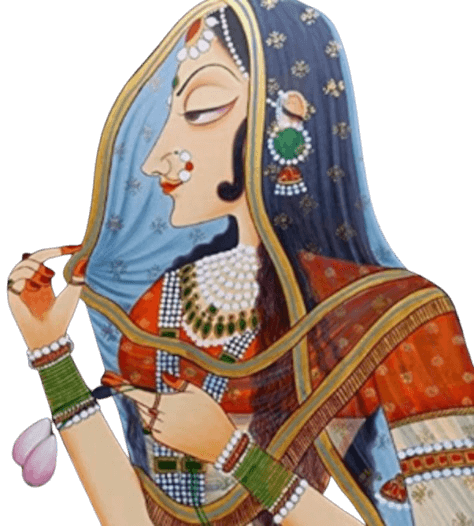
- His beloved was Bani-Thani.
- The original name of Bani-Thani was Vishnupriya.
- The world-renowned portrait of Bani-Thani was created by the artist Nihal Chand.
- Bani-Thani is referred to as the “Mona Lisa of India”.



