Major Lakes of Rajasthan are an important topic in Rajasthan Geography, highlighting the role of both natural and artificial lakes in an otherwise water-scarce region. These lakes have developed in response to varied physiographic and climatic conditions and serve as crucial sources of water, biodiversity, and cultural heritage. From saltwater lakes like Sambhar to freshwater reservoirs such as Jaisamand, they significantly influence the economy and settlement patterns of the state.
Saltwater Lakes of Rajasthan
Sambhar
The largest natural internal saltwater lake of Rajasthan, created by Vasudev Chauhan (according to Bijoliya inscription), the 3rd largest saltwater lake of India (1st Chilika – Odisha and 2nd Pulikat – Andra)
Salt production is 8% of India, 80 – 90% of Rajasthan by Sambhar Salts Ltd (Hindustan Salt Ltd.).
Kayar – Method of salt production by the transpiration method.
Ramsar site (1990) – Kurja and Flamingo
In 2019 was news due to Avian Botulism Virus and the death of 20 thousand Birds.
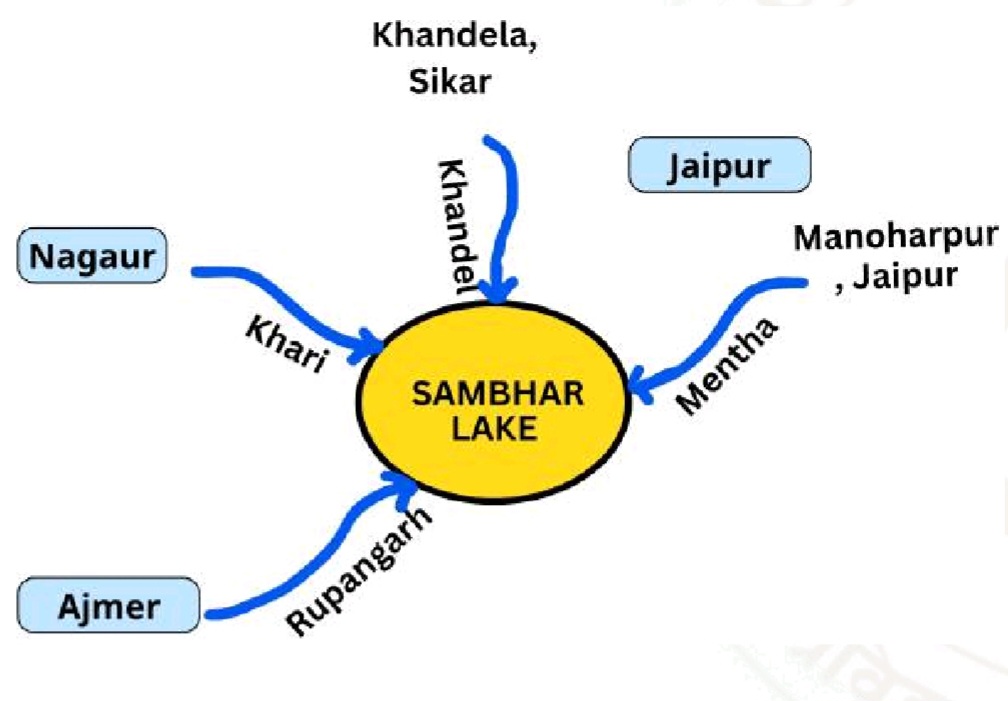
Formed by the inflow of rivers- Mentha, Rupangarh, Khandela and Khari.
Extension – Didwana, Jaipur (Phulera)
Rantmati Sambhar Lake Management Project, 2022, is running for management development and conservation of the lake.
Pachpadra Lake
Located in Balotra. The best quality of salt is produced from Pachpadra, because the sodium chloride content is 98% in this lake.
The Kharwal caste produces salt in Pachpadra with the help of the morli bush
Deedwana
Low-quality & non-edible salt is produced because the quantity of sodium sulphate (Na2SO4) is higher.
It is used in the textile, glass, paper and leather industry.
Rajasthan State Chemical Works – 1964
Other Saltwater Lake of Rajasthan
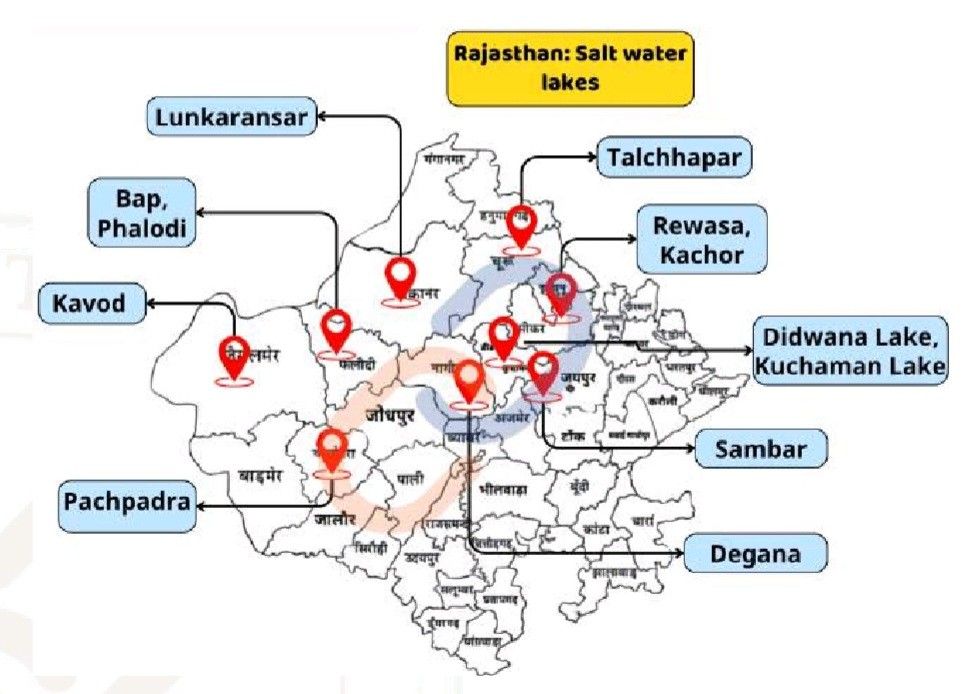
Lunkaransa – Bikaner (Very little salt is produced)
Tal Chhapar, Churu Called home for Black Buck
Lake
District
Baap lake
Phalodi
Kawod
Jaisalmer
Kachhor
Sikar
Rewasa
Sikar
Degana
Nagaur
Nawa
Didwana-Kuchaman
Pithampuri
Sikar
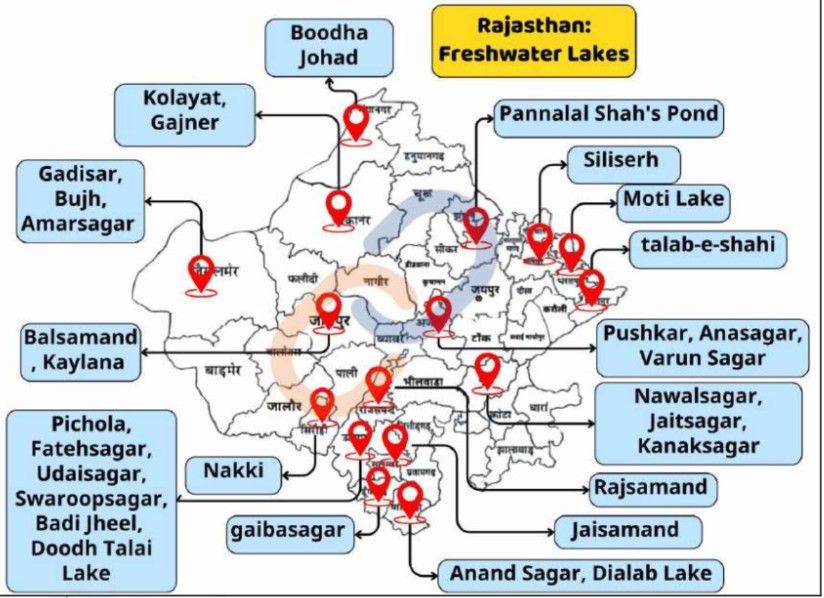
Freshwater lakes of Rajasthan
Jaisamand Lake / Dhebar Lake (Salumber)
India’s second – largest freshwater artificial lake (First – Govind Sagar, Himachal Pradesh), Rajasthan’s first artificial lake constructed between 1685 and 1691 AD by Mewar Maharana Jai Singh by blocking the Gomati, Jhaveri, and Bagar rivers.
Contains 7 islands, the largest being Baba Ka Magra/Bhangda and the smallest being Pyari.
Recognised as a habitat for the Bhil and Meena tribes.
Due to its biodiversity, it is famous as an aquatic habitat.
Nearby Attractions & Contributions
Ruthi Rani Ka Mahal, Chitrit Hawa Mahal, Elephant Rock Statue.
In 1950, two canals were bifurcated from Jaisamand Lake for irrigation – Shyampura and Bhat.
Narmadeshwar Mahadev Temple was built by Maharana Jai Singh.
Pichola Lake (Udaipur)
Constructed during the reign of Rana Lakha by Pichhu Banjara in 1525 in memory of his bull at Pichhola village.
Sisarma and Bujhra rivers bring water into the lake (from the Aravali hills).
Contains two palaces within the lake.
Jag Mandir Palace:
Located on an island, considered a precursor to the Taj Mahal. Constructionwas initiated by Maharana Karan Singh in 1620 and completed by Maharana Jagat Singh I in 1651.
During the 1857 Revolt, Maharana Swaroop Singh sheltered British officers.
Provided refuge to Prince Khurram (Shah Jahan) when he rebelled against his father, Jahangir.
Jag Niwas Palace:
Built by Maharana Jagat Singh II.
Natni Ka Chabutra was built along its banks by Rana Lakha.
Ferguson has compared these palaces with Windsor cities in London.
Doodh Talai
Located between small hills, on the road leading to Lake Pichola.
This small lake nestled among several low hills serves as a major tourist attraction.
Nearby scenic spots: Deendayal Upadhyay Park
Swaroop Sagar
Constructed in 1857 A.D. by Swaroop Singh.
It is a canal that connects Pichhola Lake to Fateh Sagar Lake.
Fateh Sagar Lake (Udaipur)
Originally constructed as “Devli Talab” by Maharana Jai Singh (1678 – 1680 AD).
Reconstructed by Maharana Fateh Singh (1888 – 1889 AD).
Features:
The dam is called Connaught Dam, named after the foundation laid by the Duke। of Connaught (British royal title).
Contains three islands: Largest – Nehru Garden
Second – Solar Observatory
Smallest – Jet Mountain
Fateh Sagar Lake is connected to Pichola Lake via the Swaroop Sagar Canal.
Nakki lake
CRATER/tectonic LAKE – located at Mount Abu (Sirohi).
It is believed that it was dug by the gods with their nails.
The highest (1200m) and deepest lake (35m) of Rajasthan.
Sacred lake for the Garasia tribe.
Toad rock, Nunrock, Nandi rock, Horn rock
Freezes in winter.
Rajsamand
The lake was the result of a dam constructed across the Gomati, Kelwa, and Tali rivers at the southwestern end by Maharana Raj Singh I, between 1662 and 1676 AD.
The reason for the dam and lake was to provide employment to the victims of a widespread drought and famine(1661) and to provide canal irrigation to local farmers.
Water supply from the Gomati River.
Nau – choki pal & Dwarkadhish temple are attraction points.
Ghevar Mata Temple (It is believed that the foundation stone of the lake was laid by Ghevar Mata) was also constructed.
Remains of a sundial were found.
Raj Singh Prasashti – 25 rock inscriptions on black marble stone; the artist was Ranchod Bhatt Telang.
Pushkar
Crater/Volcanic lake – Ajmer
Also called as – Panchva tirath, Tirthon ka mama
Crescent-shaped 52 ghats
“RANGEELA MELA”-Kartik Purnima.
Anasagar
It is a scenic artificial lake, commissioned and built by Arnoraj Chauhan, son of Ajaypal Chauhan, between 1135 and 1150 AD.
Mughal Emperor Jahangir added his touch to the lake by laying out the Daulat Bagh Gardens near the lake.
Emperor Shah Jahan, too, contributed to the expansion by building five pavilions, known as the Baradari, between the garden and the lake.
Water supply is provided by the Bandi River.
Foy Sagar Lake / Varun Sagar (Ajmer)
Built in 1892 AD by British engineer Mr Foy.
Constructed as a famine relief project to provide employment and support to people during a drought.
Kolayat Lake (Bikaner)
Kapil Muni Fair is held here on Kartik Purnima.
Deep Dan (lamp offering) tradition similar to Pushkar.
The abundance of Peepal trees creates a dry desert garden – like atmosphere.
The Charan community does not visit this lake for religious reasons.
Gajner Lake (Bikaner)
Constructed by Maharaja Gaj Singh
Mirror – like reflection – The Gajner Palace is beautifully reflected in the lake.
Gajner Wildlife Sanctuary – Famous for Batbad birds (Demoiselle Cranes)- Name of the Kurja bird.
Kaylana Lake (Jodhpur)
Built in 1872 AD by Maharaja Sir Pratap Singh as a famine relief project.
A section of the lake is known as Takht Sagar.
The Machiya Biological Park, India’s first desert botanical garden, is located on its shore.
Silisedh
Situated in Alwar
Construction by Vinay Singh
Located on golden triangle
Called “Nanden Kanan”
Now Ramsar site.
Mansagar Lake
Located in Jaipur, constructed by Mansingh in 1610 A.D.
Gap /Gaib sagar
Located in Dungarpur, constructed by Maharaval Gopinath ji
Ramgarh Lake
Located in Baran, it is a crater lake.
Udai Sagar
On the Ayad/ Bedach river, by blocking the flow of the river. Built by Maharana Udai Singh between 1559 and 1564 A.D.
Badi Lake
Located in Udaipur
Surrounded by three chhatris, the Badi Lake is one of the finest freshwater lakes in the country.
It is an artificial lake that was built by Maharana Raj Singh to help the city counterbalance the devastating effects of drought. He named the lake Jiyan Sagar after his mother, Jana Devi.
During the drought of 1973, the lake proved to be a blessing for the people of Udaipur.
Anand sagar Lake
This artificial lake, also known as Bai Talab, was constructed by Lanchi Bai, the Rani of Maharaval Jagmal Singh.
Located in the eastern part of Banswara, it is surrounded by holy trees known as ‘Kalpa Vriksha’, famous for fulfilling the wishes of visitors.
Dialab Lake (Banswara)
Located on the Jaipur road near Banswara city, this lake is known for its natural beauty.
The Hanuman Temple on its banks makes it a centre of religious faith, attracting devotees throughout the year.
Balsamand Lake
Built in 1159 AD, it was planned as a water reservoir to cater to Mandore. The Balsamand Lake Palace was built on its shore, later as a summer palace.
National Lake Conservation Scheme (NLCP) in Rajasthan.
The Ministry of Environment and Forests has been implementing the National Lake Conservation Plan (NLCP) since 2001 for the conservation and management of polluted and degraded lakes in urban and semi-urban areas.
Objectives of NLCP:
To encourage and support state governments in the sustainable management and conservation of lakes.
From April 1, 2016, the cost-sharing ratio between the central and state governments changed to 60:40 (earlier 70:30). Implementing Agency: Local Self Government (LSG) Department.
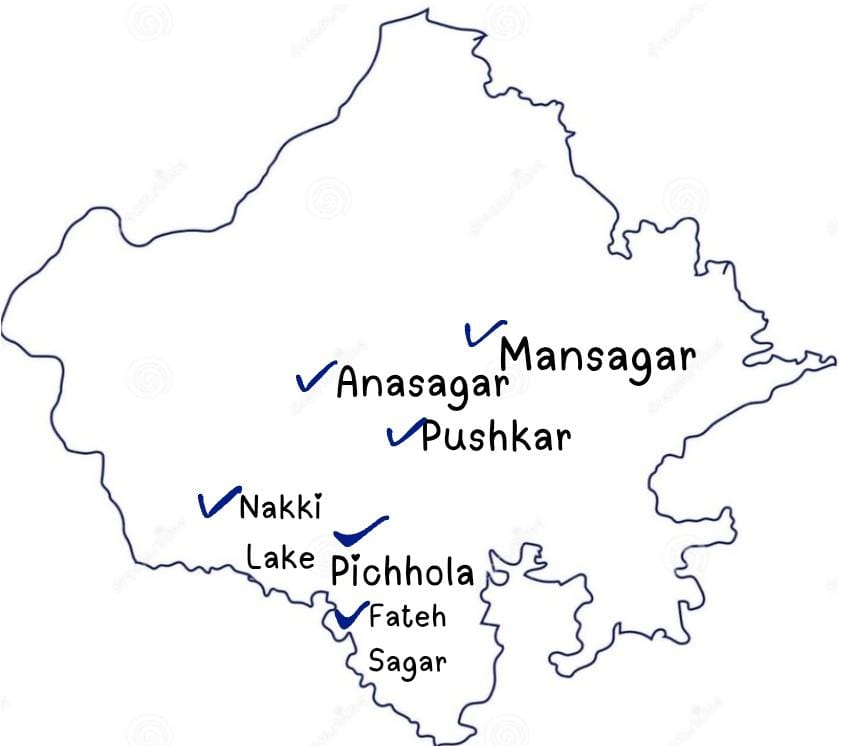
Lakes covered under the NLCP in Rajasthan
Fateh Sagar Lake, Udaipur
Pichola Lake, Udaipur
Ana Sagar Lake, Ajmer
Pushkar Lake, Ajmer
Nakki Lake, Mount Abu, Sirohi
Man Sagar Lake, Jaipur
National Plan for Conservation of Aquatic Ecosystems (NPCA)
The NPCA integrates the National Lake Conservation Plan (NLCP) and the National Wetlands Conservation Programme (NWCP) to enhance coordination and ensure holistic conservation, avoiding overlaps.
Main Objectives:
Sustainable conservation of lakes and wetlands
Biodiversity enhancement and ecosystem restoration.
Improvement in water quality and pollution control.
Strengthening the services provided by these water bodies.
Key Features:
Integrated Approach: A common regulatory framework with uniform policies and guidelines for lake and wetland conservation and management.
Financial Provisions:
Implemented during the 12th Five-Year Plan (February 7, 2013).
Estimated cost: ₹900 crore.
Cost – sharing ratio : 70: 30 (for most states), 90:10 (for Northeast states).
Program Components :
Listing and Information System for Lakes and Wetlands.
National-level guidelines and directives.
Revised Wetland Rules (2010).
Capacity building and assessment at the state and local levels.
Aajeevika Model Pariyojana- at 4 places Jaisamand, Kadana, Mahi Bajaj Sagar