Climatic Characteristics form an important component of Rajasthan Geography, as they explain the nature and variability of weather conditions across the state. Rajasthan experiences an extreme and predominantly arid to semi-arid climate, marked by high temperatures, low and erratic rainfall, and seasonal variations. These climatic features significantly influence natural vegetation, water availability, and human activities in the region.
Climate is the long term phenomenon taking place in the atmosphere surrounding earth. It is decided on the basis of the average 30-year weather conditions.
The climate of Rajasthan is a Sub tropical Arid type of climate because of its location and low rainfall.
Factors affecting the climate of Rajasthan
Latitudinal location – 23°3′ northern latitude (tropic of cancer) passes through Dungarpur and Banswara districts of Rajasthan, which is why the southern part of Rajasthan comes in the Tropical Climatic Zone, while the rest of Rajasthan comes into the Temperate Climate Zone (Subtropical climate)
Distance from sea-
Distance from the Arabian Sea – 400km
Distance from the Gulf of Kutch – 225km
Distance from the Gulf of Khambhat – 275km
Distance from Bay of Bengal – 2900km
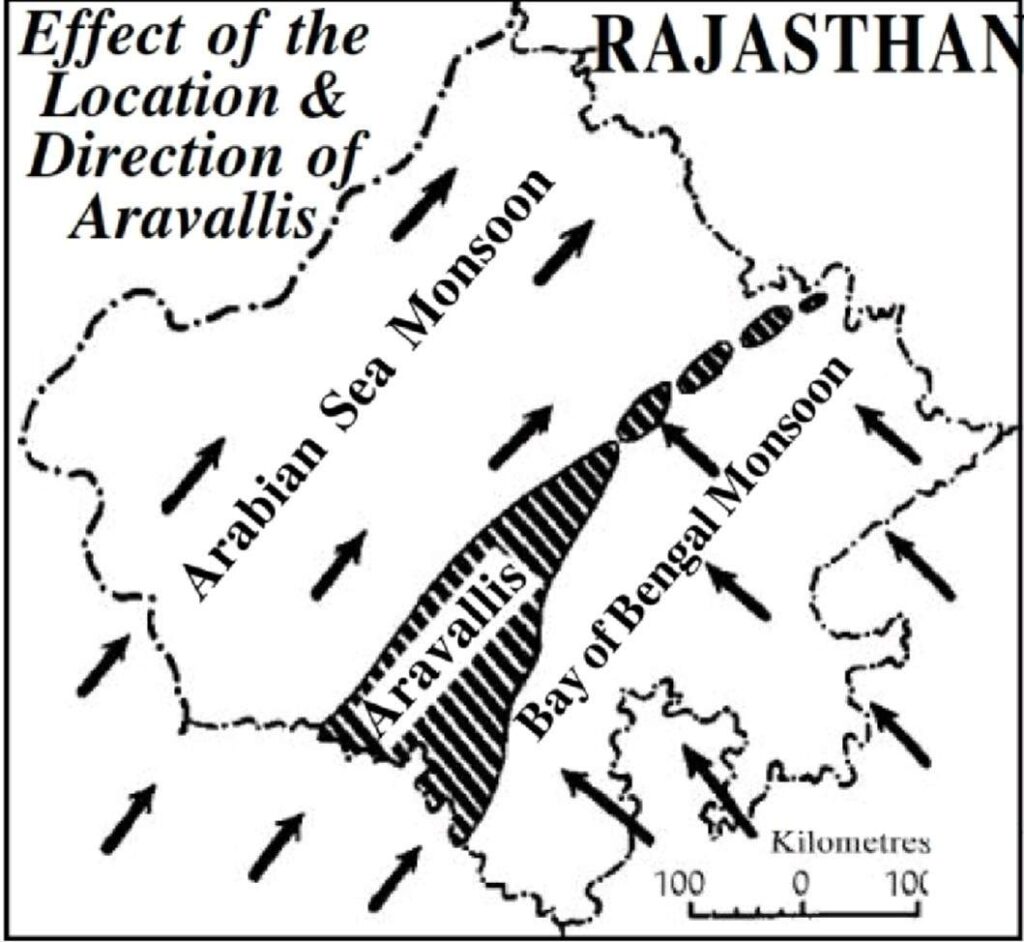
Location of Aravalli range (southwest to northeast) parallel to southwest monsoon winds from the Arabian Sea (No obstruction, therefore pass without rainfall)
Nature of terrain (Tropography )
The average surface height of the Aravali and south eastern region is more than 370 meter from sea level, due to which it comparatively remains cooler and more humid than other regions.
Soil composition –
In the western region of Rajasthan, sandy and coarse-grained soil, which heats up very fast during the day and cools in the night, due to which daily temperature and aridity are measured in the area.
Height from the seafloor and reliefs
At a height of 165 meter degree temperature decreases.
Monsoon and cyclonic wind
TheArabian Sea monsoon branch causes rainfall only in the south and south-eastern region, while the Bay of Bengal branch causes most of the rainfall in the eastern region of rajasthan creating a rain shadow region in western Rajasthan.
Characteristics of the Rajasthan climate
Region-wise diversity in climate is seen.
Subtropical Climate condition is found in Rajasthan
The average climate is arid and semi-arid
Rainfall – Avg 58 cm annually
About 90% rainfall is received in the summer months (June – July) during the southwest monsoon.
Very less 10 % from the western disturbance
Irregular and uncertain (100cm over southeastern parts to 14 cm over extreme western parts).
Scarce – drought famines are common
Temperature – extreme temperatures during summer (30 – 40°C) and winter (10 – 12°C)
Daily temperature variations are also high (Jaisalmer) sand gets easily heated up, and cooling is also fast.
Wind direction changes with the change in seasons.
Diverse physical reliefs also put great impact on the climate and local humidity.
Winds from the western plateau of Baluchistan also affect the climate, making it dry, less humid and consequently resulting in less rainfall.
Blocks the Bay of Bengal branch; therefore, rainfall in the eastern and southeastern parts
Western parts, being a rain shadow region, don’t receive adequate rainfall.
Natural vegetation
Affects the climate and is affected in return
Affects temperature, humidity
Most areas of Rajasthan have less and scattered vegetation; therefore, rainfall is less.
Seasonal Classification of Climate
There are four types of Seasons found in Rajasthan
Winter Season (December – February)
Summer Season (March – June)
Rainy Season (June – September)
Autumn Season (October – November)
Winter season
Mavath – Winter rainfall during December to March, brought by western disturbances from the Mediterranean Sea (western jet stream flowing at low latitudes), is called the Mavath (Golden drops) blessing for rabi crops.
Contributes 10% of Rajasthan’s annual rainfall, also called the temperate monsoon/winter monsoon/ Mediterranean monsoon/north west monsoon.
Cold waves – The cold temperature winds from Himalyan region due to snowfall in that region.
The cold waves enters in Rajasthan from the north-east to the south-west direction.
The maximum affected region is the Shekhawati region.
Summer Season
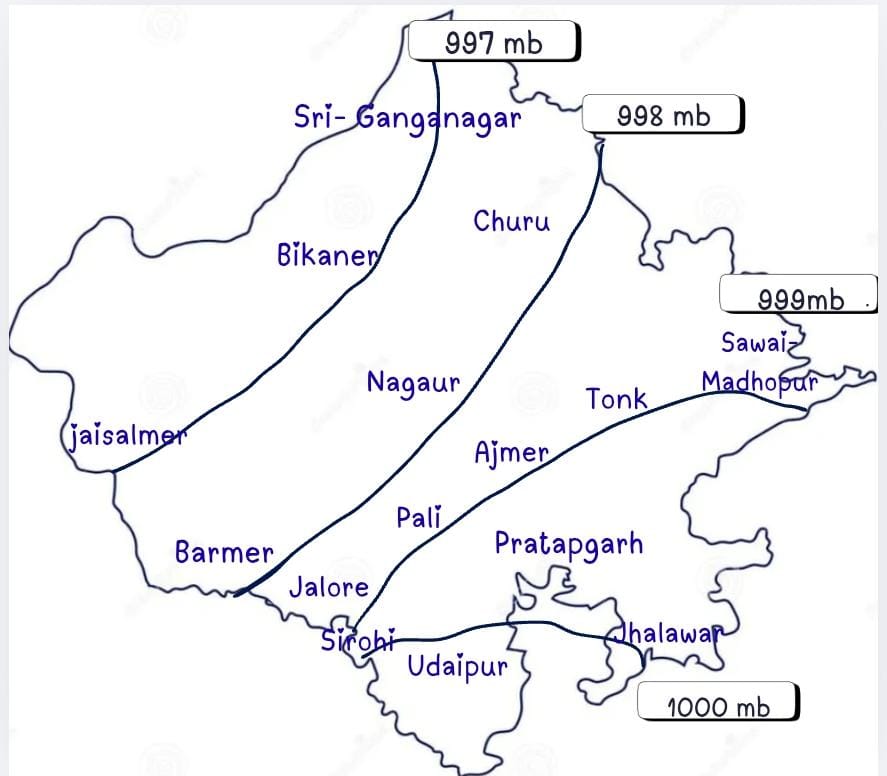
With the start of the summer solstice, more vertical sun rays fall over the state, resulting in high temperature therefore low air pressure
Average temperature 38°C (western districts 45°- 48°C)
Local hot wind called LOO (due to advection flow of wind-horizontal) mainly affects – Barmer, Balotara
Sandstorms also occur very commonly (due to convectional flow of wind – vertical), Max – Sri-Ganganagar and Min – Jhalawar
Bhabhulya – Small cyclone forms mainly in western Rajasthan, due to spiral or cyclonic winds, with maximum in Bikaner
The least humidity is found during this season.
Maximum Temperature Places
Maximum Temperature
Place – Phalodi
District – Churu
Minimum Temperature
Place – Mount Abu
District – Sirohi
Maximum temperature difference
Daily – Jaisalmer
Annually – Churu
Minimum Temperature difference
Daily – Mount Abu
Annually – Dungarpur
Rainy Season/Monsoon
Arrival 25th June (@Banswara, Dungarpur) and retreat 30th September
Average annual rainfall 57.5 cms (India – 125cms)
Monsoon rains contribute 90% of Rajasthan’s annual rainfall
The Southwest monsoon is divided into two branches
The Arabian Sea branch
The Arabian Sea branch again divides into 3 branches
The Western Ghat branch
Chota Nagpur branch
The Himachal branch (causes the first rain in Rajasthan, which is very low).
The Bay of Bengal branch
The Bay of Bengal branch divides into two branches
North – Eastern Himalaya branch
Western Great Northern – plain branch (which brings maximum rainfall in Rajasthan )
Maximum rainfall
Place – Mount Abu (Sirohi)
District -Jhalawar
Minimum rainfall
Place – Sam (Jaisalmer)
District -Jaisalmer
Autumn season
Retreat of Monsoon (withdrawal of monsoon)
Kartik heat (increase in temperature when the Monsoon is retreating), October and November, and the minimum daily temperature difference
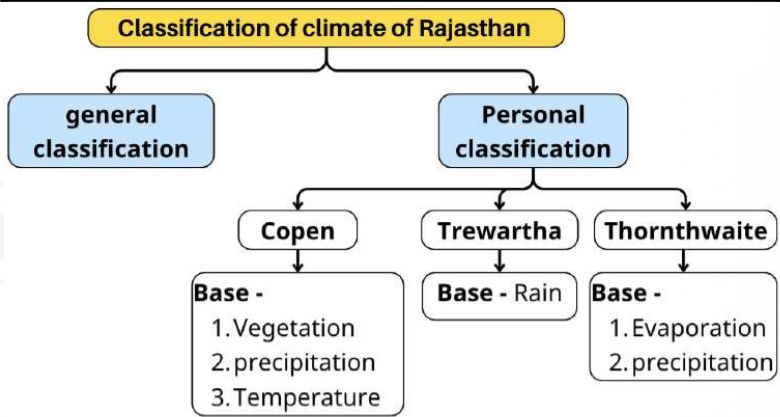
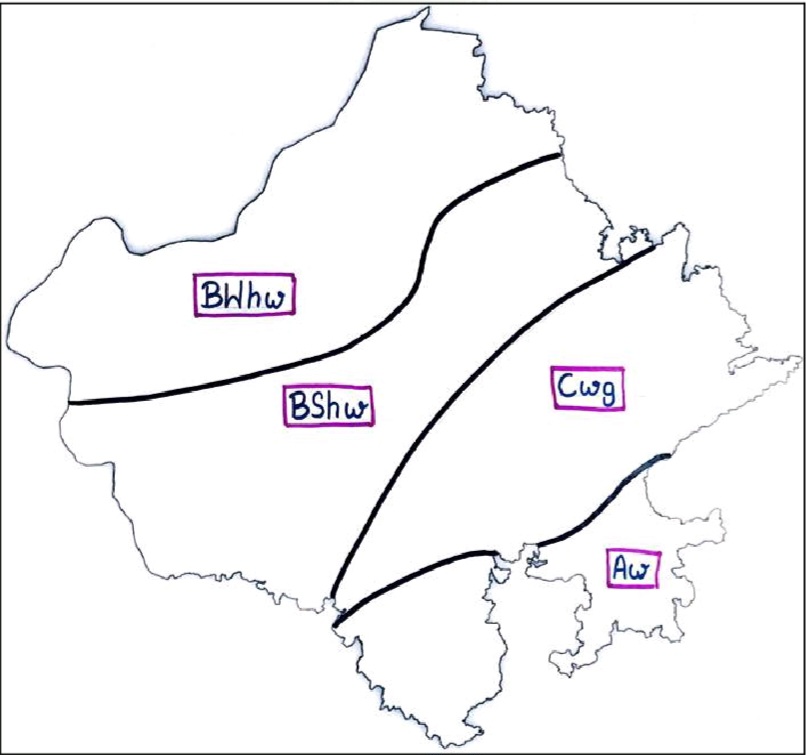
Classification of the Climate of Rajasthan
General classification of climate
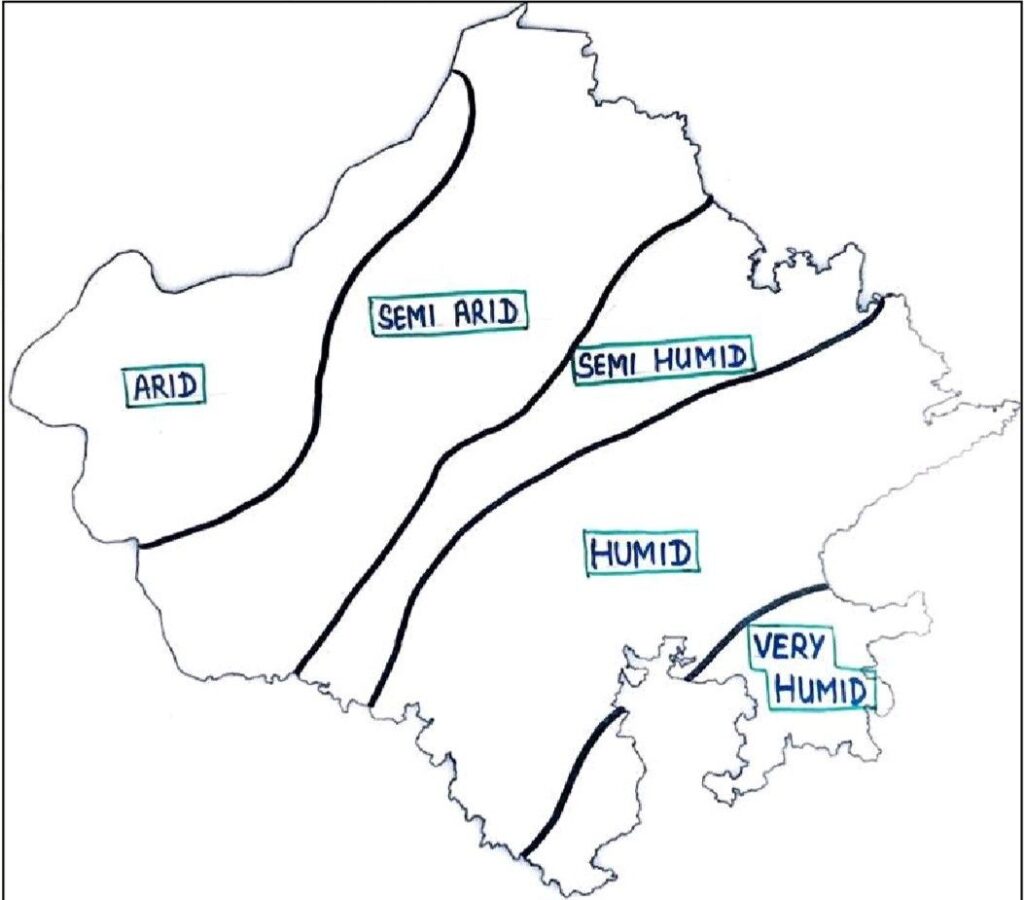
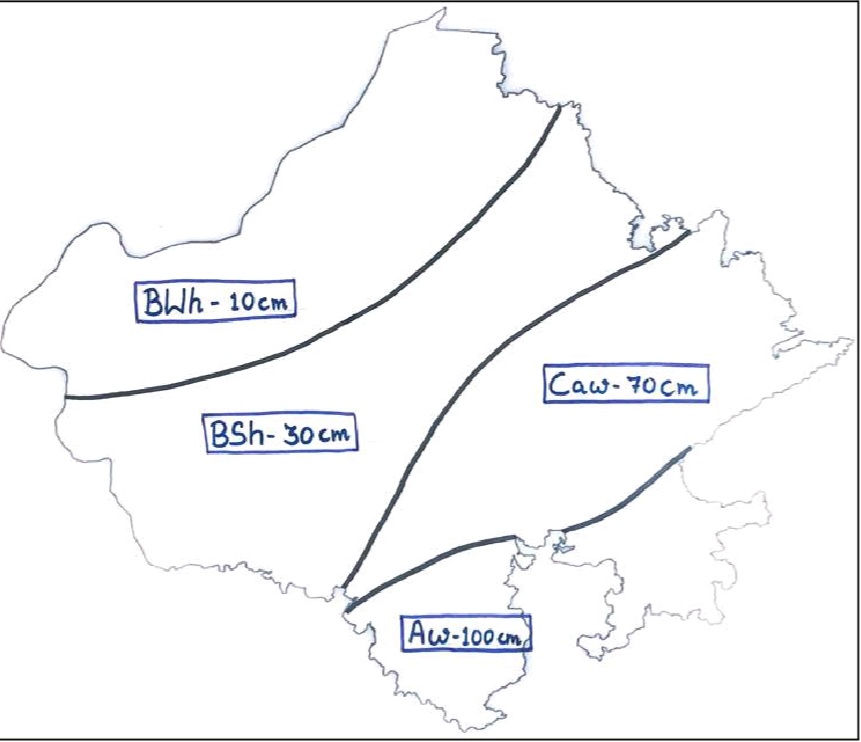
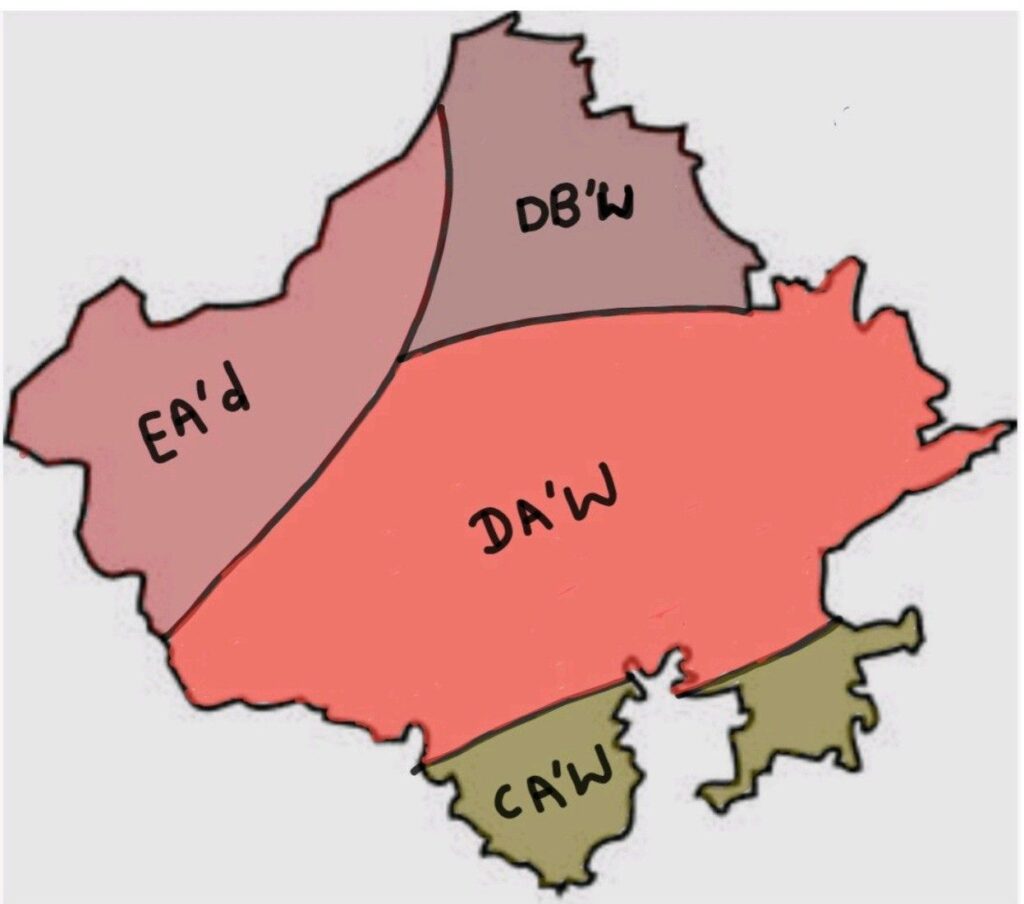
Rajasthan can be divided into five major climatic regions on the basis of temperature and rainfall.
Arid Region
Temperature – (In summer – 35 – 40 °C) (In winter – 12 – 16°C)
Rainfall– 0-20 cms
Vegetation – Xerophytes and thorny bushes
Covered Areas – Jaisalmer, Barmer, Bikaner, Phalodi, North – west Jodhpur, Western Nagaur, Churu, Southern Sri-Ganganagar
Semi Arid Region
Temperature – (In summer – 32 – 36°C) (In winter -10 – 17°C)