National Commission for Women is a statutory body established in 1992 under the National Commission for Women Act, 1990, to safeguard and promote the rights of women in India within the framework of Indian Polity. It reviews constitutional and legal safeguards, addresses grievances, and advises the government on policy matters related to women’s welfare. The commission plays a crucial role in ensuring gender justice and empowerment in society.
National Commission for Women
Installation
The National Commission for Women was established on 31 January 1992.
It is a statutory body.
legal basis
The Commission was constituted under the National Commission for Women Act, 1990 [Government of India Act No. 20 of 1990]
The Act has a total of 5 chapters and 17 sections.
Main Objective
To review the constitutional and legal safeguards available to women, recommend corrective legislative measures in their interest, assist in the redressal of grievances relating to women and advise the Government on all policy matters affecting women.
Background:-
In 1971, the Committee on the Status of Women in India (CSWI) was formed to review the constitutional, legal and administrative provisions affecting the social status of women.
CSWI recommended the establishment of a permanent National Commission for Women for redressal of grievances and socio-economic development of women.
Various committees, commissions and schemes, including the National Plan for Women’s Future (1988–2000), suggested the formation of an apex national body for women.
The need for a National Commission for Women became evident after the World Conference on Women held in the 1990s, where India expressed its commitment to establish such a Commission.
In the year 1990, the Central Government consulted NGOs, social workers and experts regarding the structure, functions and powers of the Commission.
In May 1990, a bill relating to the National Commission for Women was introduced in the Lok Sabha.
A national conference on this subject was organised by the Ministry of Human Resource Development in July 1990.
In August 1990, the Bill was amended to give the Commission the powers of a civil court.
The bill received the President’s assent on 30 August 1990.
Finally, the first National Commission for Women was constituted on 31 January 1992.
National Commission for Women Act, 1990(5 Chapters, 17 Sections)
Chapter
Name
Stream
Subject / What is the provision
Chapter-1
Initial
1
Short title, extent and commencement
2
Definitions
Chapter 2
National Commission for Women
3
Constitution of National Commission for Women
4
Term of office and service conditions of the Chairman and Members
5
Officers and employees of the Commission
6
Payment of salaries and allowances
7
Vacancies do not invalidate the work of the Commission.
8
Committees of the Commission
9
Commission procedure
Chapter-3
Functions of the Commission
10
Functions and powers of the Commission
Chapter 4
Finance, Accounts and Audit
11
Grants from the Central Government
12
Audit and Accounts (CAG)
13
annual report
14
Presentation of the report in Parliament
Chapter 5
scattered
15
Public servant status
16
Consultation with the Commission
17
Power to make rules
National Commission for Women: Composition(section 3)
Post
Number
Appointing Authority
Qualifications/Special Provisions
Chairman
1
nominated by the Central Government
A person committed to the interests of women
Member
5
Nominated by the Central Government
Experience in law/legislation, trade unionism, management of industrial capacity of women, women’s voluntary organisation (including women activists), administration, economic development, health, education or social welfare
Mandatory provisions –At least one member from Scheduled Caste (SC) and1 member from Scheduled Tribe (ST)
Member-Secretary
1
Nominated by the Central Government
(i) an expert in management, organisational structure or sociological movement or(ii) a member of a Civil Service/All India Service of the Union or a civil post under the Union with appropriate experience
The National Commission for Women (NCW) is constituted by the Central Government under Section 3 of the National Commission for Women Act, 1990. It consists of a Chairperson, 5 Members and a Member-Secretary to be nominated by the Central Government.
Functions and powers of the National Commission for Women(Section-10)
The Commission will perform the following functions—
To investigate and examine all matters relating to the safeguards provided to women under the Constitution and other laws.
To submit to the Central Government annually and at such other times as may be necessary reports on the implementation of safeguards.
The reports shall make recommendations for effective implementation by the Union or the State to improve the status of women.
To review the existing provisions of the Constitution and laws affecting women and suggest corrective legislative measures for amendment.
To raise cases of violation of the Constitution and laws relating to women before the appropriate authorities.
To consider and take suo motu cognizance of complaints, in particular—
Deprivation of women’s rights,
Non-implementation of laws for the protection, equality and development of women.
Non-compliance of policy decisions, guidelines or orders made for the welfare and relief of women.
To identify obstacles and suggest strategies by conducting special studies or investigations on specific problems arising from discrimination and atrocities against women.
To conduct promotional and educational research to ensure adequate representation of women in all fields and to identify factors hindering their advancement.
Participate and advise in the planning process for the socio-economic development of women.
To evaluate the progress of women’s development in the Union and the States.
Inspecting jails, remand homes, women’s institutions or other places of detention and taking up the matter with the authorities for remedial action, if necessary.
Providing funding for litigation related to issues affecting large groups of women.
To report to the government from time to time on matters and difficulties related to women.
Any other matter which may be referred to it by the Central Government.
The Central Government shall cause the reports of the Commission to be laid before both Houses of Parliament and shall state the action taken or proposed to be taken on the recommendations or the reasons for its rejection.
If the report relates to a state, a copy of it will be sent to the state government, which will be placed before the state legislature.
The Commission shall have all the powers of a civil court during the inquiry, including—
summoning and examining on oath any person,
discovery and production of documents,
evidence on affidavits,
obtaining public records,
Issuing commissions for the examination of witnesses and documents.
Any other matter which may be prescribed.
List of books published by the National Commission for Women
S.No.
Name of the book
1
Jagriti – Chronical of Women’s Realities, Rights, and Rise (Apr 2025 – Vol. 1)
Navjeevan – Rights, Laws and Hope for Acid Attack Survivors in India
9
Your Dreams
10
POWER OF POSH
11
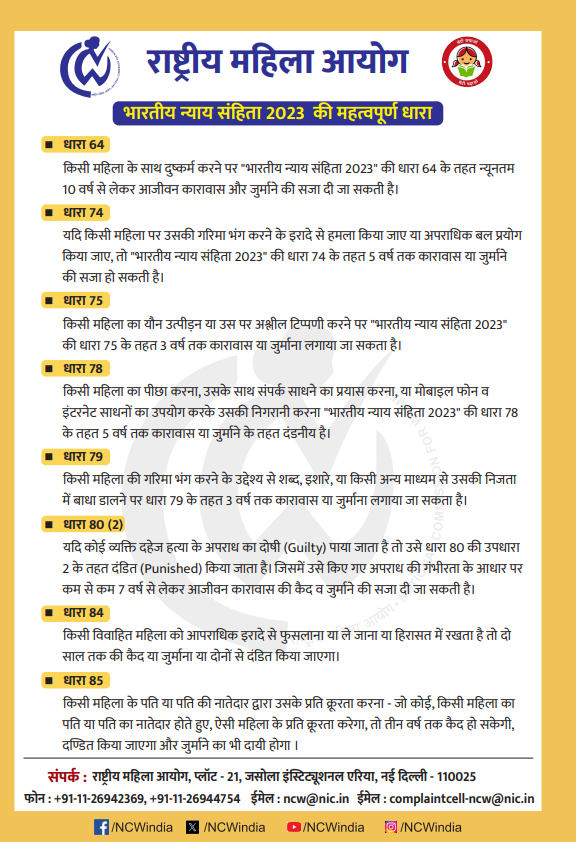
Important Sections of the Indian Penal Code 2023
12
Tere Mere Sapne – Pre-Marital Literacy Kit for Facilitators
13
Tere Mere Sapne – Pre-wedding Dialogue Hub
14
365 Days of Commitment
15
SHE Servers – Step by Step
16
Safarnama – Stories of Service and Experience
17
Collection of resolutions
18
JAGRITI – Awakening of Women’s Power
Chairperson of the National Commission for Women
S.No.
Name
Tenure (From)
Tenure (To)
1.
Ms. Jayanti Patnaik
03.02.1992
30.01.1995
2.
Dr. V. Mohini Giri
21.07.1995
20.07.1998
3.
Ms. Vibha Parthasarathy
18.01.1999
17.01.2002
4.
Dr. Purnima Advani
25.01.2002
24.01.2005
5.
Dr. Girija Vyas
16.02.2005
15.02.2008
6.
Ms. Mamta Sharma
09.04.2008
02.08.2011
7.
Ms. Lalitha Kumaramangalam
01.08.2014
29.09.2017
8.
Ms. Rekha Sharma (Acting President)
29.09.2017
28.09.2018
9.
Ms. Rekha Sharma
07.08.2018
06.08.2021
10.
Mrs. Vijaya K. Rahatkar
22.10.2024
currently employed
Important facts:-
Ms. Jayanti Patnaik – First Chairperson
Dr. Girija Vyas – Former Union Minister and senior Congress leader
Ms. Rekha Sharma – Currently also a Rajya Sabha MP.
Mrs. Vijaya K. Rahatkar –
9th Chairperson of National Commission for Women
Vijaya Kishor Rahatkar has previously served as the Chairperson of the Maharashtra State Women’s Commission (2016–2021).
Additionally, she has also served as the Mayor of Aurangabad Municipal Corporation (2007–2010).
As Chairperson, she worked on several important initiatives related to women’s empowerment and protection, including:
“Sakshama”: For the rehabilitation and empowerment of acid attack survivors
“Prajwala”: To connect self-help groups with government schemes
“Suhita” : 24×7 helpline service for women is the flagship.
currently
Chairman
Mrs. Vijaya K. Rahatkar
from 22.10.2024
Member
Ms. Delina Khongdup
From 01.03.2023
Smt. Mamta Kumari
From 10.03.2023
Member-Secretary
Mr. Sudeep Jain
from 09.09.2025
Term of office and conditions of service – (Section 4)
Tenure: 3 years (or till the age of 65 years, whichever is earlier)
Resignation: Written to the Central Government
Grounds for removal:
bankruptcy
crime involving moral turpitude
unsound mind
refusal of duty
Absence from 3 consecutive meetings
abuse of position
Note :compulsory opportunity to be heard
Re-appointment:-
Both the Chairperson and Members are eligible for reappointment. Persons who have completed two terms in any office (except the Member-Secretary) are ineligible for renomination. The Act is silent on the number of terms a Member or Chairperson may serve.
Vacancy in the post of Chairman:
In the event of the death or resignation of the Chairperson, the Central Government shall nominate a member to act as Chairperson until the vacancy is filled by a fresh nomination.
Status of Public Servant:
The Chairperson, Members, officers and employees of the National Commission for Women are deemed to be public servants.
Annual Report – (Section 13)
The Commission has to prepare a detailed report of the work done during each financial year, which is submitted to the Central Government.
Presentation to Parliament – (Section 14)
The Central Government, after receiving this report (and the audit report), places it before both the Houses of Parliament (Lok Sabha and Rajya Sabha).