

Sound and Electro-Magnetic Waves are important topics in Physics that explain how energy is transferred in the form of waves. Sound waves require a medium to travel and are mechanical in nature, while electromagnetic waves can travel through vacuum and include light, radio waves, and X-rays. Both play a vital role in communication, technology, and our daily life.
Previous year Questions
| Year | Question | Marks |
| 2018 | (a)What is the approximate wavelength range of a microwave ?(b) Explain the principle of a microwave oven. | 5M |
| 2018 | Distinguish between analog and digital signals. | 2M |
Sound Waves
What is Sound?
- Sound is a form of energy that is produced by vibrating objects.
- It travels in the form of mechanical waves through a medium (solid, liquid, or gas).
Definition: Sound is a mechanical wave that results from the back-and-forth vibration of particles in a medium.
- According to the conservation of energy, energy can be transformed but not created or destroyed. In the case of sound, energy changes from mechanical energy to sound energy.
Propagation of Sound
- Sound travels through a medium (solid, liquid, or gas), which carries the disturbance caused by the vibrating object. It cannot travel through vacuum.
- The particles in the medium vibrate but do not move forward. The disturbance moves through the medium as a wave.
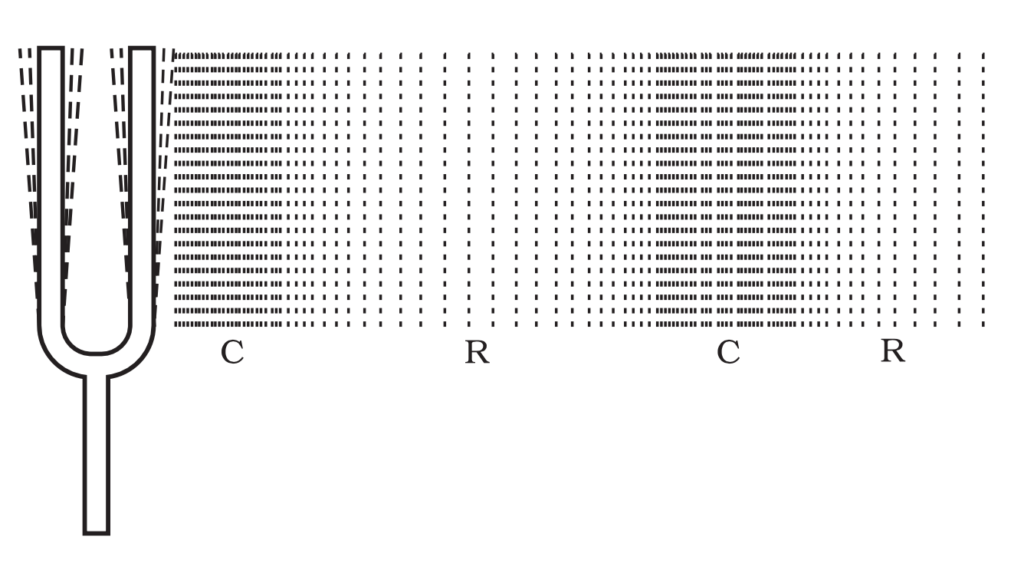
- The wave can be visualized as a sequence of compressions (regions of high pressure) and rarefactions (regions of low pressure).
- Compression: The vibrating object pushes and compresses the air, creating a high-pressure region.
- Rarefaction: As the object moves backward, it creates a low-pressure region.
- This alternating process of compressions and rarefactions carries the sound energy through the air.
- Thus, propagation of sound can be visualised as propagation of density variations or pressure variations in the medium.
Sound is a Mechanical Wave
- Mechanical wave = Needs a medium.
- It is the disturbance, not the particles, that moves forward.
Mechanical vs Electromagnetic Waves
| Property | Mechanical Waves | Electromagnetic Waves |
| Requires Medium | Yes | No |
| Examples | Sound, Water waves, Seismic waves | Light, X-rays, Radio waves |
| How it travels | Particle vibrations | Electric and magnetic field oscillations |
| Speed | Depends on the medium | Speed of light in vacuum (3×10⁸ m/s) |
Sound is a mechanical wave → it needs a medium (air, water, solid) to propagate. That’s why you can’t hear anything in space!
Experiment: Bell Jar and Vacuum Pump
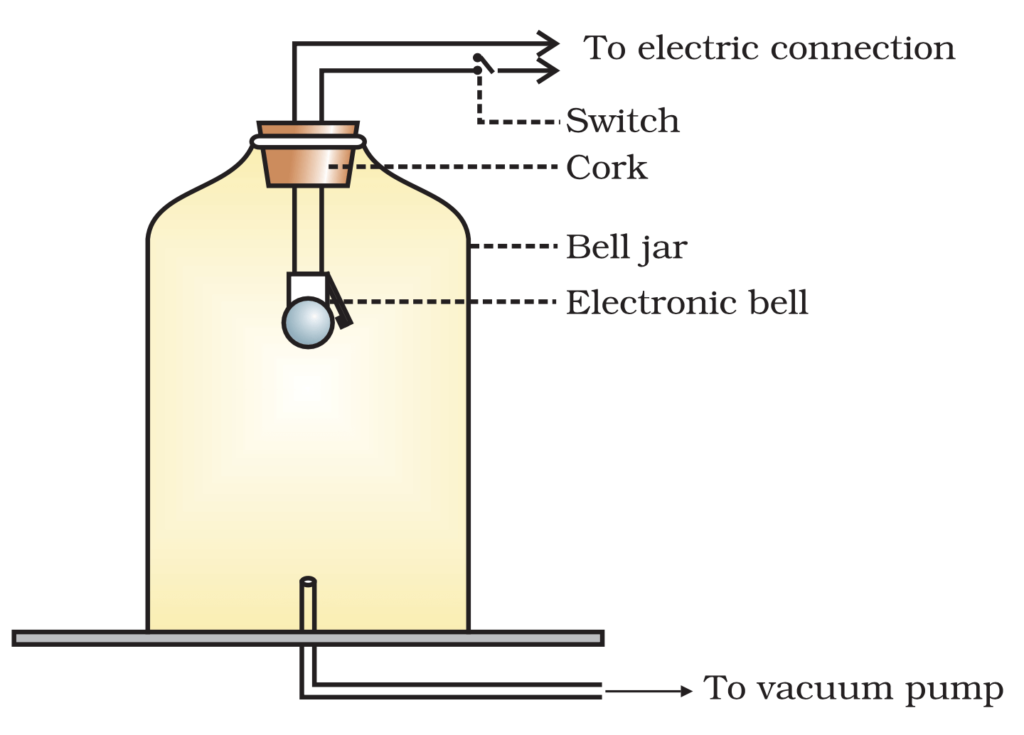
- A ringing electric bell is placed inside a glass bell jar.
- At first, with air inside, the bell’s sound is clearly heard.
- As a vacuum pump removes air from the jar:
- The sound becomes fainter.
- Eventually, when most of the air is removed, only a very feeble sound is heard.
- If all air is removed, no sound can be heard at all, even though the bell is still ringing.
👉 Conclusion: Sound needs a medium like air to travel. In a vacuum, there’s no sound.
Longitudinal Waves (Sound Waves) Vs Transverse Waves
|
Longitudinal Waves |
Transverse Waves |
Example: Sound wave in air – your vocal cords vibrate, pushing air molecules, forming compressions and rarefactions that reach someone’s ears. |
Example: Light waves, Water waves – water moves up and down while the wave travels across the surface. |
Characteristics of a Sound Wave
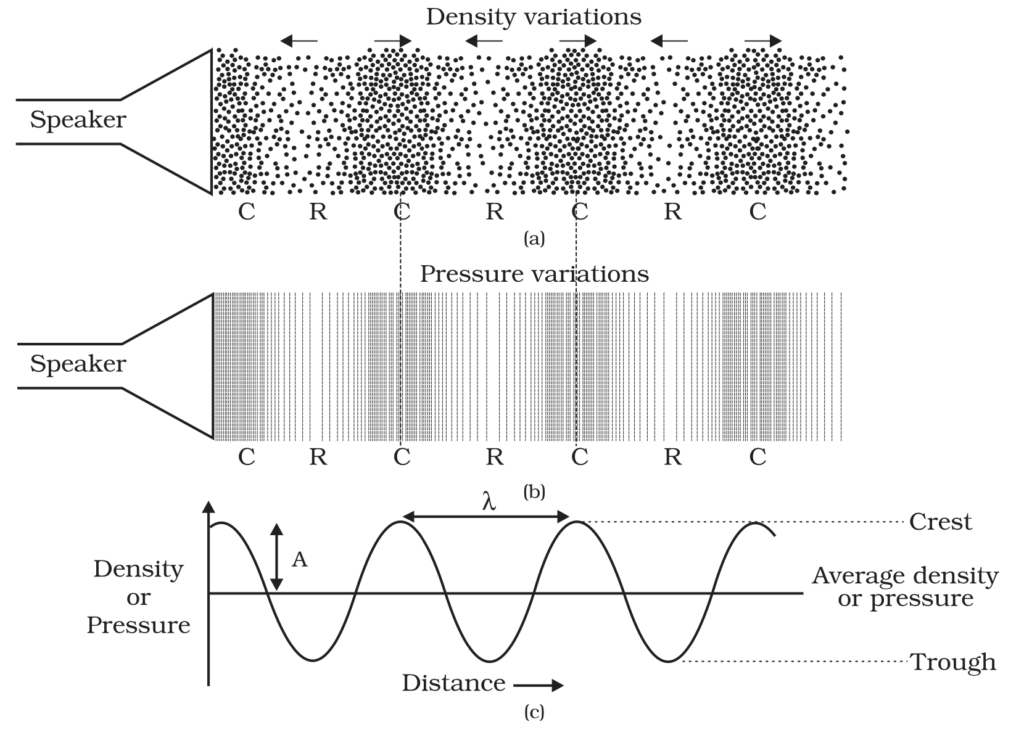
1. Wavelength (λ)
- It is the distance between two consecutive compressions or rarefactions.
- Represented by the Greek letter lambda (λ).
- SI unit: metre (m)
- Related to speed and frequency:
v = ν × λ
2. Frequency (ν)
- It is the number of oscillations (or waves) that pass a point in one second.
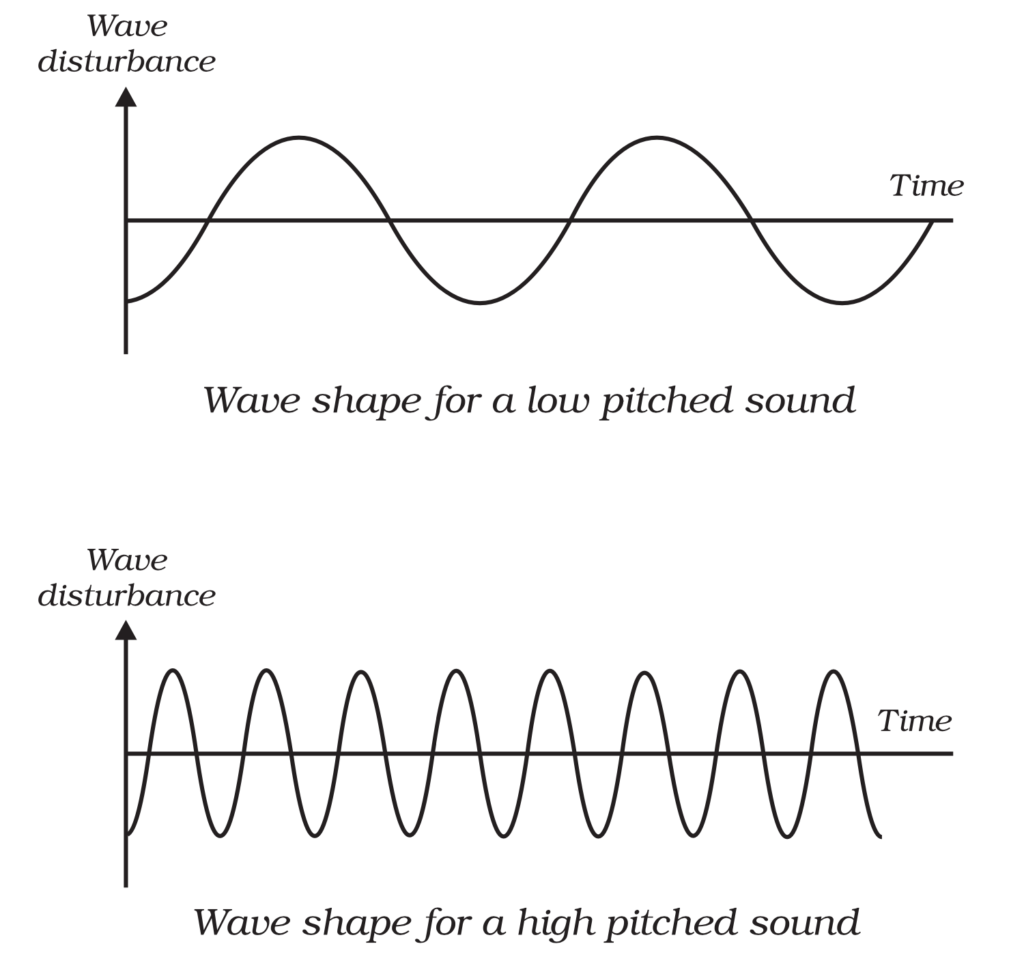
- Determines the pitch of a sound.
- Represented by the Greek letter nu (ν).
- SI unit: hertz (Hz)
- 1 Hz = 1 vibration per second
- Human hearing range: 20 Hz to 20,000 Hz
Example: If you hit a drum 5 times in a second, its frequency is 5 Hz.
Pitch:
How our brain interprets frequency.
- High frequency → High pitch (e.g., a whistle)
- Low frequency → Low pitch (e.g., a drum)
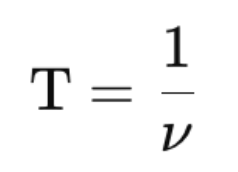
3. Time Period (T)
- Time taken to complete one oscillation.
- SI unit: second (s)
- Relation with frequency:

4. Amplitude (A)
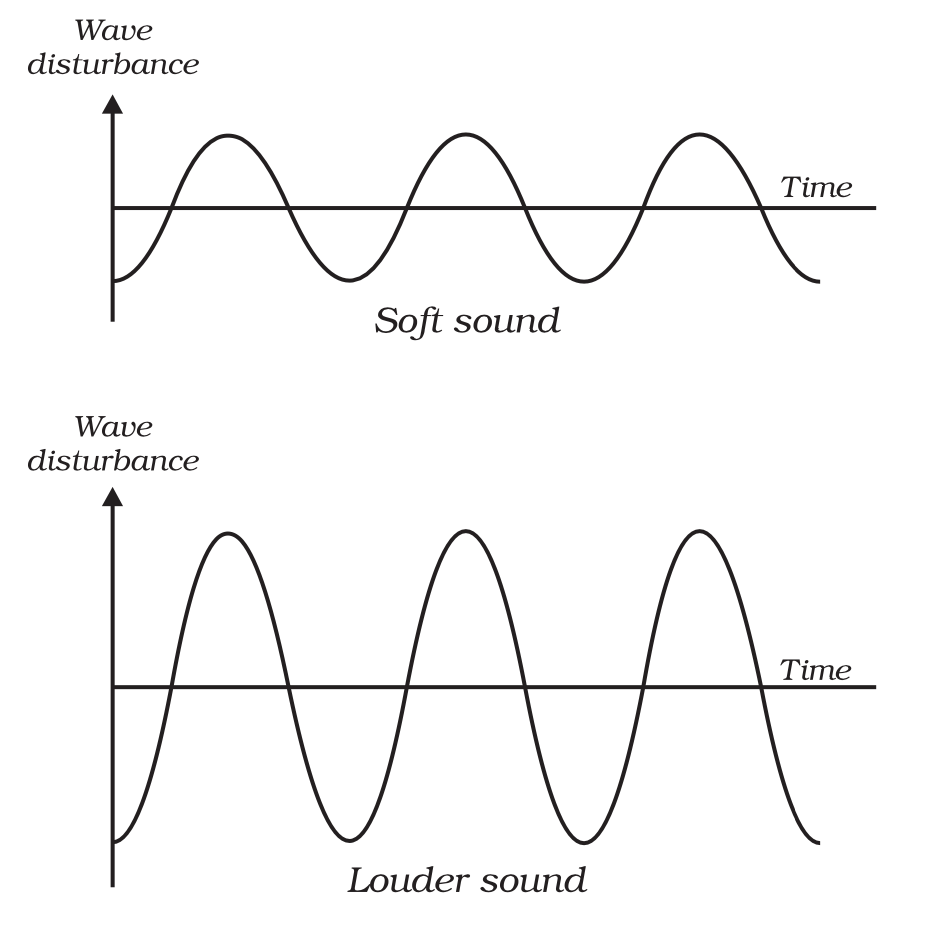
- It is the maximum disturbance of the particles from their rest position (mean value).
- Unit: meters (m)
- Represented as: height of wave from middle to crest or trough in diagrams.
- Greater the amplitude → Greater the loudness of sound.
Example:
- Tap table lightly → low amplitude → soft sound
- Hit it hard → high amplitude → loud sound
Other Characteristics of Sound
Loudness
- Depends on amplitude
- More amplitude = louder sound
- Loud sound carries more energy and can travel a longer distance.
Pitch
- Depends on frequency
- More frequency = higher pitch
- Women’s voices usually have higher pitch than men’s.
Intensity vs Loudness
- Intensity: Amount of sound energy passing through a unit area per second.
- Loudness: How our ears perceive intensity. Two sounds can have the same intensity but different loudness due to ear sensitivity.
Quality or Timbre
- It is what makes different sounds (from different sources) feel different — even if pitch and loudness are the same.
- A flute and a violin may have the same pitch and loudness, but they sound different due to their quality or timbre.
Tone, Note, and Noise
| Term | Meaning |
| Tone | Sound of a single frequency |
| Note | Sound produced by a mix of several frequencies (pleasant) |
| Noise | Unpleasant sound (irregular patterns) |
Speed of Sound
Defined as:

Speed of Sound in Different Media
| Medium | Speed of Sound (approx.) |
| Solids | Fastest |
| Liquids | Medium |
| Gases | Slowest |
- Sound travels faster in solids than in liquids or gases.
- Higher temperature = Higher speed of sound.
- Example:
- In air at 0°C → 331 m/s
- In air at 22°C → 344 m/s
- Example:
💡 Note: Sound travels much slower than light, which is why we hear thunder after we see lightning.
Sonic Boom
When an object moves faster than the speed of sound, it is said to be moving at supersonic speed (~343 m/s in air at 25°C).
- Examples: Bullets, fighter jets, some rockets.
What happens at Supersonic Speed?
- The object compresses air in front of it.
- It creates shock waves in the air — these are like powerful ripples.
- These shock waves carry a lot of energy.
Sonic Boom
- The sudden change in air pressure from the shock waves produces a sharp, loud sound known as a sonic boom.
- It sounds like an explosion or a loud thunderclap.
Effects of Sonic Boom
- That’s why supersonic flights are restricted over populated areas
- Can shatter glass windows
- May even damage buildings
Reflection of Sound
- What is it?
Just like light, sound reflects when it hits a solid or liquid surface. It follows the laws of reflection:- The angle of incidence = angle of reflection
- The incident sound, reflected sound, and the normal all lie in the same plane
- What is needed?
A large obstacle, either smooth or rough, is required to reflect sound waves effectively.
Echo
- Definition: An echo is the sound heard again after it reflects off a distant object like a tall building or mountain.
- Condition for hearing an echo:
- The time gap between the original sound and its echo must be ≥ 0.1 seconds, as the brain retains sound for that duration.
- At 22°C, the speed of sound = 344 m/s
So, minimum total distance = 344 × 0.1 = 34.4 m
Thus, minimum distance of obstacle = 17.2 m
- Interesting fact:
Thunder rolls because of multiple reflections of sound between clouds and land.
Reverberation
- Definition: Reverberation is the prolonged persistence of sound due to repeated reflection in a large room or hall.
- Problem: Too much reverberation can make sounds unclear in places like auditoriums.
- Solution: To reduce it, we use:
- Sound-absorbing materials (e.g., compressed fibreboard, rough plaster, drapes)
- Special seat materials that absorb sound
Uses of Multiple Reflection of Sound
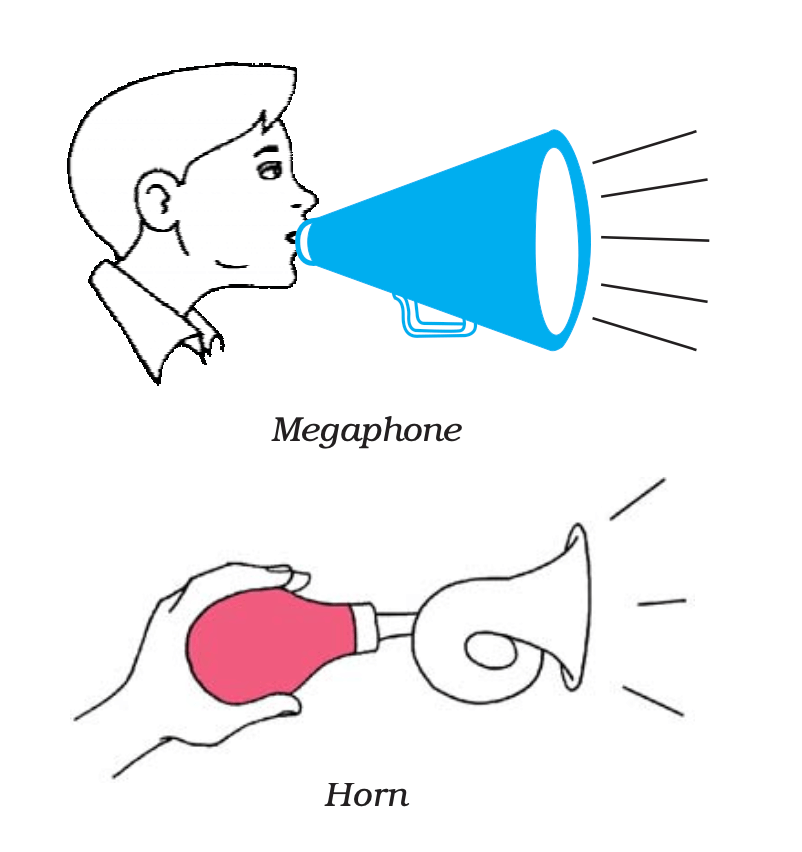
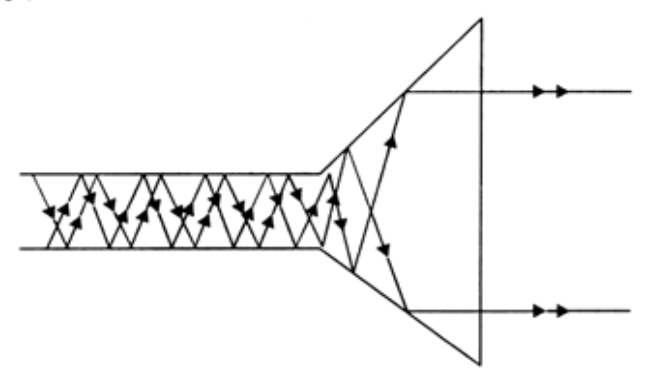
1. Megaphones, Loudhailers, Trumpets, Shehanais: These guide sound waves forward using conical shapes, ensuring the sound goes mostly in one direction.
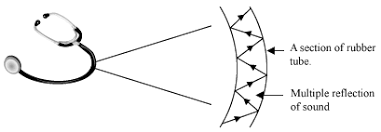
2. Stethoscopes: Use multiple reflections inside the tube to carry the patient’s internal sounds (like the heartbeat) to the doctor’s ears.
3. Conference and Cinema Halls:
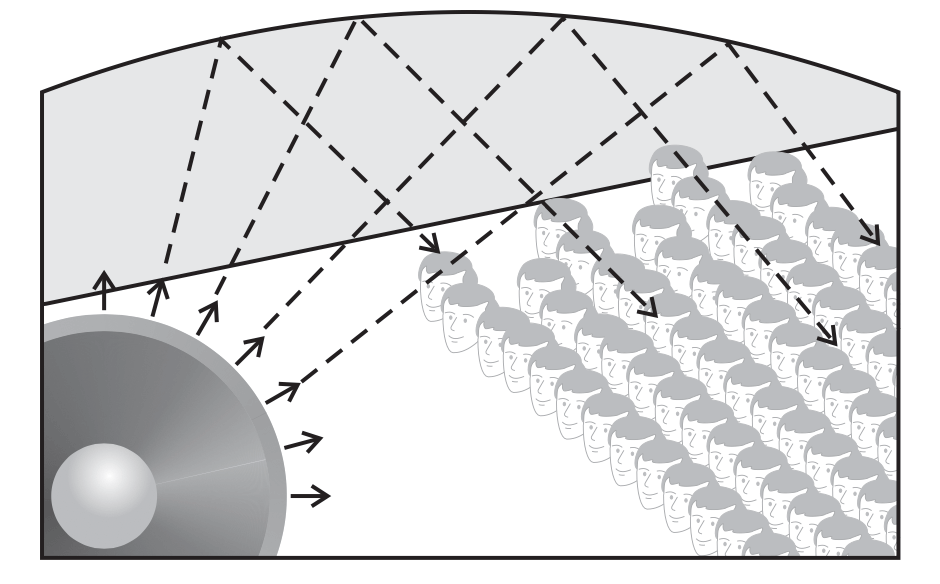
- Have curved ceilings to reflect sound to all parts of the hall.
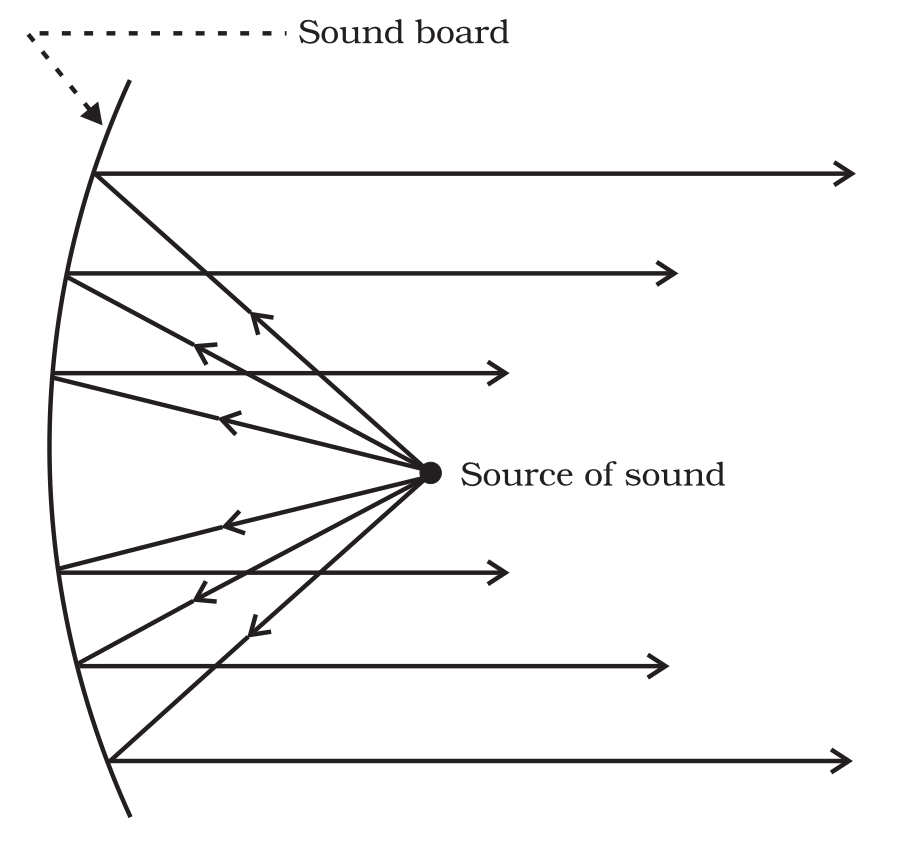
- Sometimes, a curved soundboard is placed behind the stage to spread sound evenly across the audience.
Hearing Aid
- A hearing aid helps people with hearing loss. It’s a battery-powered electronic device.
How it works:
- Microphone – picks up sound.
- Amplifier – boosts (amplifies) the sound.
- Speaker – sends louder sound into the ear.
Range of Hearing
- Human hearing range:
👂 Humans can hear sounds between 20 Hz to 20,000 Hz (also written as 20 kHz).- 1 Hz = 1 vibration per second
- 1 kHz = 1000 Hz
- Children & Some Animals:
- Children under 5 years and animals like dogs can hear up to 25,000 Hz (25 kHz).
- As we age, our ears become less sensitive to higher frequencies.
Types of Sound Frequencies
| Type | Frequency Range | Examples |
| Infrasonic | Below 20 Hz | Pendulum, earthquakes, rhinoceroses, whales, elephants |
| Audible | 20 Hz – 20 kHz | Normal human hearing range |
| Ultrasonic | Above 20 kHz | Bats, dolphins, porpoises, rats, certain moths |
- Some animals sense infrasound before earthquakes, possibly helping them escape danger.
- 🦇 Ultrasound helps bats locate objects through echolocation.
- 🐭 Rats use ultrasound to communicate and play.
Ultrasound: High-Frequency Sound Waves
- Ultrasound refers to sound waves with frequencies greater than 20,000 Hz (20 kHz).
- These waves travel in straight lines and can pass around obstacles easily.
- Ultrasound is widely used in industries and medicine.
Industrial Applications of Ultrasound
- Cleaning Delicate or Hard-to-Reach Parts
- Used for cleaning spiral tubes, electronic parts, oddly-shaped components.
- Items are placed in a cleaning solution, and ultrasonic waves are passed through.
- The high-frequency sound helps shake off dust, grease, and dirt.
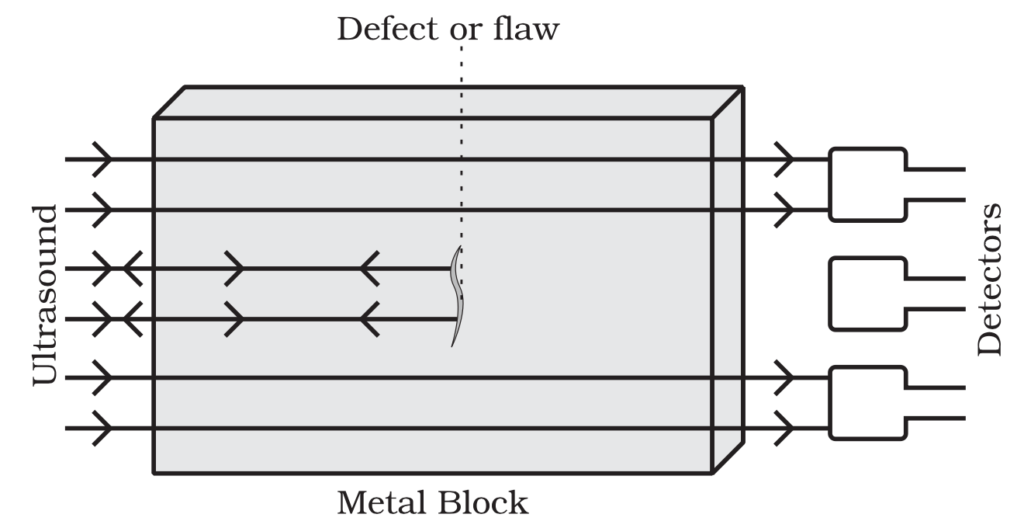
- Detecting Cracks or Flaws in Metal Blocks
- Important for bridges, buildings, machines, scientific equipment.
- Ultrasound waves are passed through metal.
- If there’s a crack or hole, the waves bounce back (reflect) and are detected.
- Ordinary sound cannot be used as it bends around defects.
- This helps ensure that hidden damage doesn’t lead to structural failure.
Medical Applications of Ultrasound
- Echocardiography
- Used to create images of the heart by reflecting ultrasound waves from different parts of the heart.
- Ultrasonography
- A safe and painless way to see inside the body.
- Used to view internal organs like liver, kidney, gall bladder, uterus, etc.
- Helps detect tumors, stones, and other abnormalities.
- Also used during pregnancy to observe the growth and development of the foetus.
- Breaking Kidney Stones
- Ultrasound can break kidney stones into tiny grains, which are then flushed out through urine.
Ultrasound in Nature: Bats & Porpoises
- Bats fly and hunt at night using ultrasound, not eyes.
- They emit high-pitched ultrasonic squeaks. (high-pitched sounds not audible to humans)
- These sounds bounce off obstacles or prey and return as echoes.
- The bat’s ears detect these echoes, which helps it:
- Know the direction, distance, and shape of the object.
- This process is called echolocation.
- Porpoises (a type of sea animal) also use ultrasound to navigate and find food in dark waters.

SONAR (Sound Navigation And Ranging)
SONAR is a technique/device that uses ultrasonic waves to detect and measure: Distance, Direction, Speed of underwater objects.
How SONAR Works
- Installed in: Boats or ships
- Main Parts:
- Transmitter – sends out ultrasonic waves
- Detector – receives the reflected waves and processes them
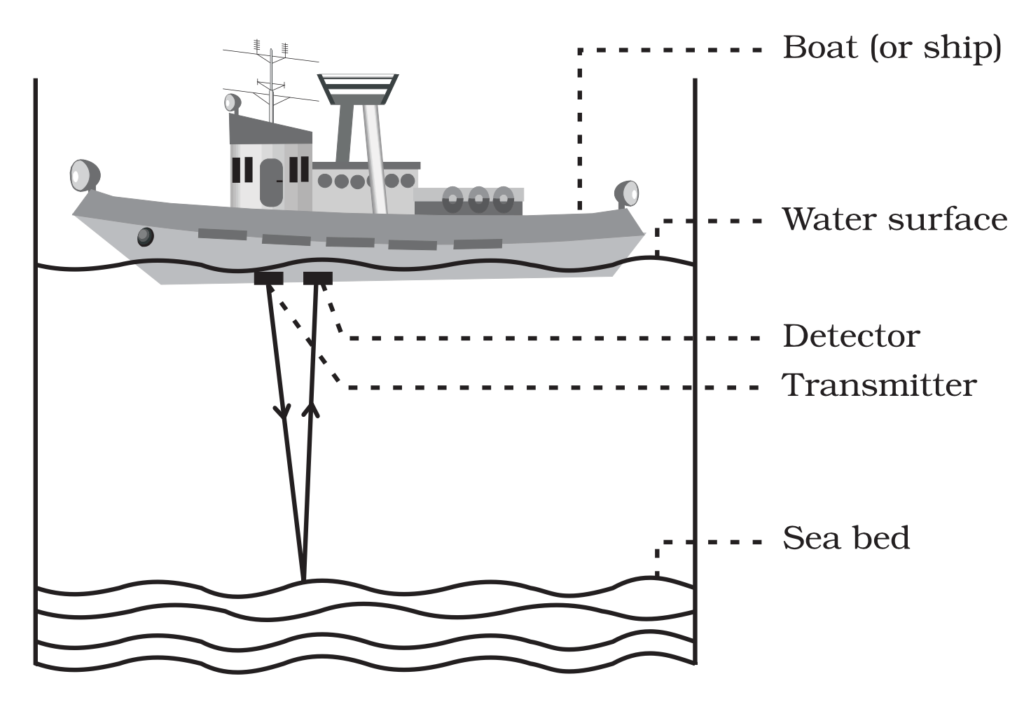
Process:
- The transmitter sends out ultrasonic waves into the water.
- The waves travel through water and hit an object (e.g. seabed, submarine).
- The waves reflect back to the ship.
- The detector receives these waves and converts them into electrical signals.
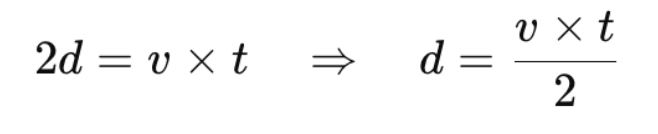
- Using the time delay between sending and receiving, and the known speed of sound in water, we calculate the distance.
Formula Used in SONAR
If:
- t = total time for ultrasound to go and return
- v = speed of sound in water
- d = distance to the object
Then:
Applications of SONAR
- Measuring depth of the sea (sea mapping)
- Detecting underwater objects:
- Submarines
- Icebergs
- Underwater hills/valleys
- Sunken ships
RADAR – Radio Detection and Ranging
- Radar is a scientific device used to detect distant objects and determine their position (direction and distance).
- It works using radio waves, which are reflected back from objects.
- Radar can “see” through fog, smog, rain, snow, smoke, or darkness – unlike the human eye.
- However, it cannot detect color or small details, only the presence and position of objects.
History & Invention
- Invented by Taylor and Leo C. Young in 1922.
- Heinrich Hertz in 1886 proved that radio waves could reflect off solid objects.
- Radar technology developed further in the 1920s and 1930s.
- Widely used from World War II onward.
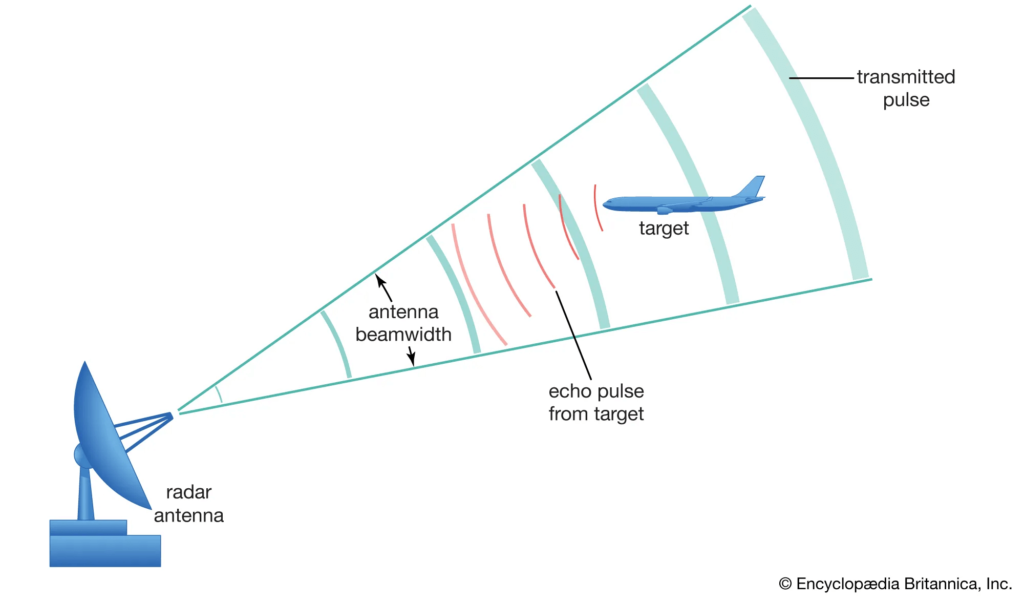
How Radar Works: Position Location
- Radar sends out radio pulses using a transmitter.
- These waves hit an object and bounce back.
- The time taken to return tells the distance.
- Speed of radio waves = 1,86,999 miles/sec
- Distance formula:

- Direction is found by rotating the radar’s highly directional antenna.
- Pip = Blip/image of the object seen on the radar screen (cathode-ray tube).
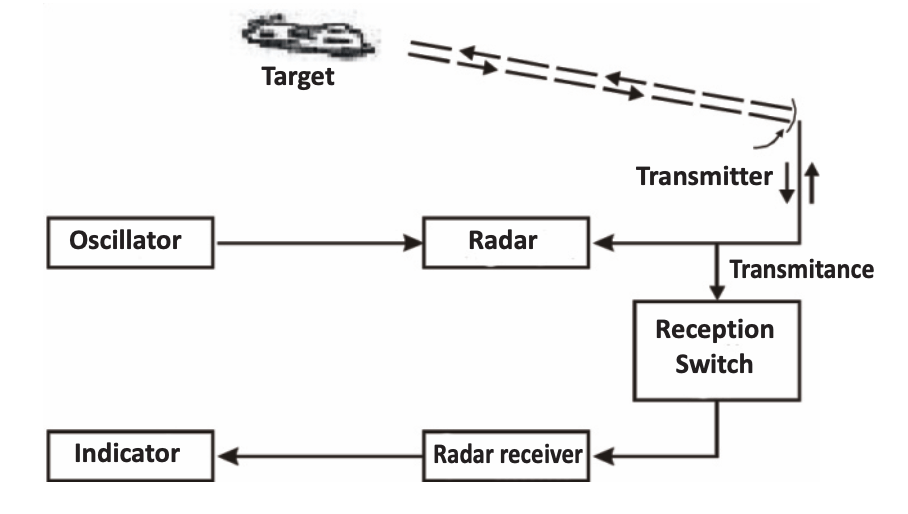
Important Radar Components
| Component | Function |
| Modulator | Provides high power pulses to the Oscillator |
| Radio Frequency Oscillator | Generates high-frequency radar signals |
| Antenna | Sends and receives radio waves |
| Receiver | Detects returning radio signals |
| Indicator | Displays object info to operator |
| Multi-cavity Magnetron | Generates high-frequency microwaves essential for radar |
Radar Accuracy
- Can detect up to 199 miles away.
- Measures distance with 15-yard accuracy.
- Measures angle with up to 1/10th of a degree precision.
- 1 microsecond time = 164 yards;
19.75 microseconds = 1 mile
Uses of Radar
During War:
- Detects enemy aircrafts, ships, missiles.
- Helps fighter planes locate targets.
- Prevents surprise attacks.
- Offers 360° monitoring up to 299 miles.
During Peace:
- Ensures safe navigation of aircrafts and ships.
- Helps planes land safely even at night or in bad weather.
- Detects mountains, icebergs, etc. from afar.
- Used in air traffic control.
- Helped USA communicate with the Moon in 1946 (distance: 4,59,999 miles; time: 2.4 seconds)
Structure of the Human Ear
Our ears help us hear by converting sound waves into electrical signals that our brain can understand.
👂 Parts of the Human Ear:
| Part | Function |
| Pinna (Outer Ear) | Collects sound from surroundings |
| Auditory Canal | Passes sound to the eardrum |
| Eardrum (Tympanic Membrane) | Vibrates when sound waves hit it |
| Middle Ear Bones(Hammer, Anvil, Stirrup) | Amplify the vibrations and pass them to inner ear |
| Cochlea (Inner Ear) | Converts vibrations into electrical signals using nerve endings |
| Auditory Nerve | Carries signals to the brain, which understands them as sound |
How It Works :
- Sound enters through the pinna and travels down the auditory canal.
- Eardrum vibrates due to the pressure of sound waves.
- Middle ear bones amplify these vibrations.
- Cochlea in the inner ear changes the vibrations into electric signals.
- Auditory nerve sends these signals to the brain.
- Brain interprets these signals as sound.
Short:
- Pinna → Canal → Eardrum → Ear Bones → Cochlea → Brain



