
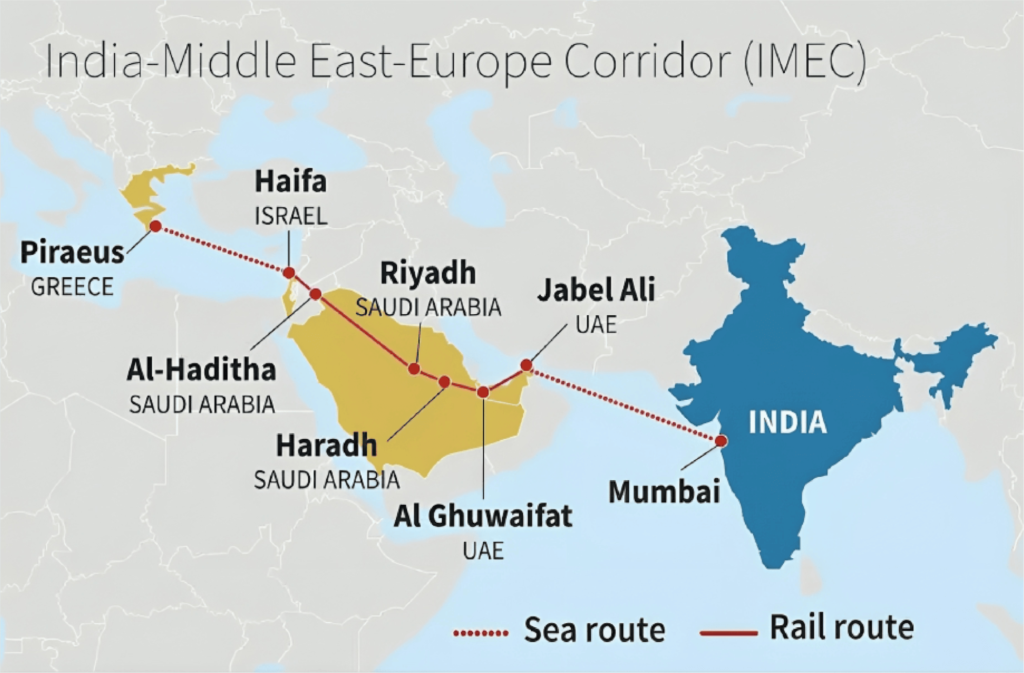
It is a proposed transit network that aims at integration of Asia, Middle East and Europe. It consists of railroad, ship-to-rail and road transport routes and networks.
Signing: Agreed upon at the G20 Summit in New Delhi. The agreement involves eight signatories: India, the US, Saudi Arabia, UAE, the EU, Italy, France, and Germany.
Significance of IMEC
- It serves as an acknowledgment, on the part of the US and EU, of the rising non-Western powers.
- Speed up trade,flow of energy and digital communications between India and Europe and help India to increase strategic engagement with the Arab world.
- It will make the global supply chain more resilient.
- offers an alternative approach to China’s Belt and Road Initiative.
- Estmated 40% reduction in journey time from India to Europe
- Transit costs may be slashed by up to 30% through an optimised route.
- Alternative route circumvents Red Sea chokepoint vulnerability
Challenges:-
- Complex geopolitics of the region (Israel-Hamas-Iran crisis).
- Lack of official diplomatic ties between Saudi Arabia and Israel.
- Potential opposition and Competition from BRI Project
- Other challenges : Lack of Financial commitments, coordination issues, Logistics, connectivity challenges.
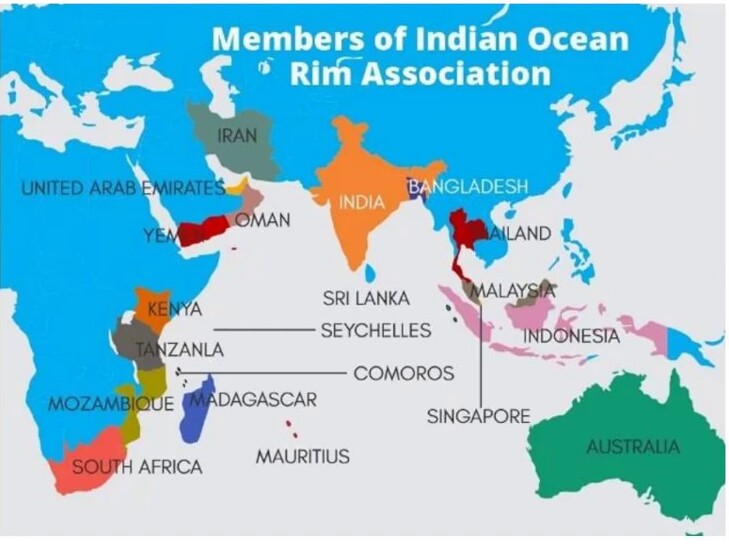
It is an intergovernmental organization established in 1997 to strengthen regional cooperation and sustainable development within the Indian Ocean region (IOR). It comprises 23 member states from within the IOR.
Economic Impact
- Trade: intra-IORA trade amounting to $800 billion.
- Funding: IORA’s Special Fund disburses $80,000 to $150,000 for member projects, fostering economic development.
- Alternative Trade Bloc: For India, IORA offers an alternative to regional institutions like SAARC and BIMSTEC, promoting economic engagement.
Security Impact
- Strategic Discussions: IORA addresses strategic issues such as sea lane security and piracy, enhancing regional security cooperation.
- No big power rivalries: IORA remains a “safe space” for India and other countries from big-power rivalries.
Geopolitical Impact
- Consensus-Oriented: Membership is based on consensus, providing a less contentious environment compared to other groupings like the SCO.
- Exclusion of Pakistan: Pakistan’s non-admission due to its failure to extend MFN status to India.
- Counter to Rival Initiatives: IORA helps counter rival initiatives like the BRI.
- Alternative to USA led organisations: like QUAD
IORA reinforces India’s commitment to a free,open and inclusive Indian Ocean region, in line with international conventions.