

Sol –
The Aspirational Districts Programme (ADP) was launched by the Government of India in January 2018.
Aim – To improve the living standards of citizens and ensure inclusive growth in 117 identified districts across 28 States/UTs
Progress made –
- Health and Nutrition – Up to 45% improvement in health indicators in 46 districts.
- Up to 69% improvement in critical maternal health indicators in 23 districts, such as antenatal care, supplementary nutrition for pregnant women, and anemia detection and treatment
- Education – Up to 34% improvement in 46 districts.
- Improvement in Pupil-Teacher Ratio, availability of functional drinking water, and girls’ toilets in schools.
- Financial Inclusion –
- Increased access to bank accounts.
- Higher coverage under government insurance schemes.
- Greater access to MUDRA loans.
- Saturation in Basic Infrastructure:
- High percentages of households with individual washrooms
- Access to all-weather roads under the Pradhan Mantri Gram Sadak Yojana (PMGSY)
- High percentages of households with electricity connections
Sol –
- To provide end-to-end holistic support to the traditional artisans and craftspeople
- To nurture the Guru-Shishya parampara, or family-based practice of traditional skills
- Launched – 17th September, 2023
- Type: Central Sector Scheme.
- Duration: FY 2023-24 to FY 2027-28.
- Nodal Ministry: Ministry of Micro, Small & Medium Enterprises
- Registration: Free of charge through Common Services Centres using a biometric-based PM Vishwakarma Portal
- A toolkit incentive of up to Rs. 15,000
- Skill upgradation – Basic Training of 5-7 days and Advanced Training of 15 days or more, with a stipend of Rs. 500 per day
- Cheap credit
- Up to 2 Lakh
- Interest subvention and collateral fees by the government
- Objectives (3D) –
- Dignity – Recognition of artisans and craftspeople as Vishwakarmas
- Digital – Digital empowerment of Vishwakarmas
- Democratization – To provide a platform for brand promotion and market linkages to small artisans
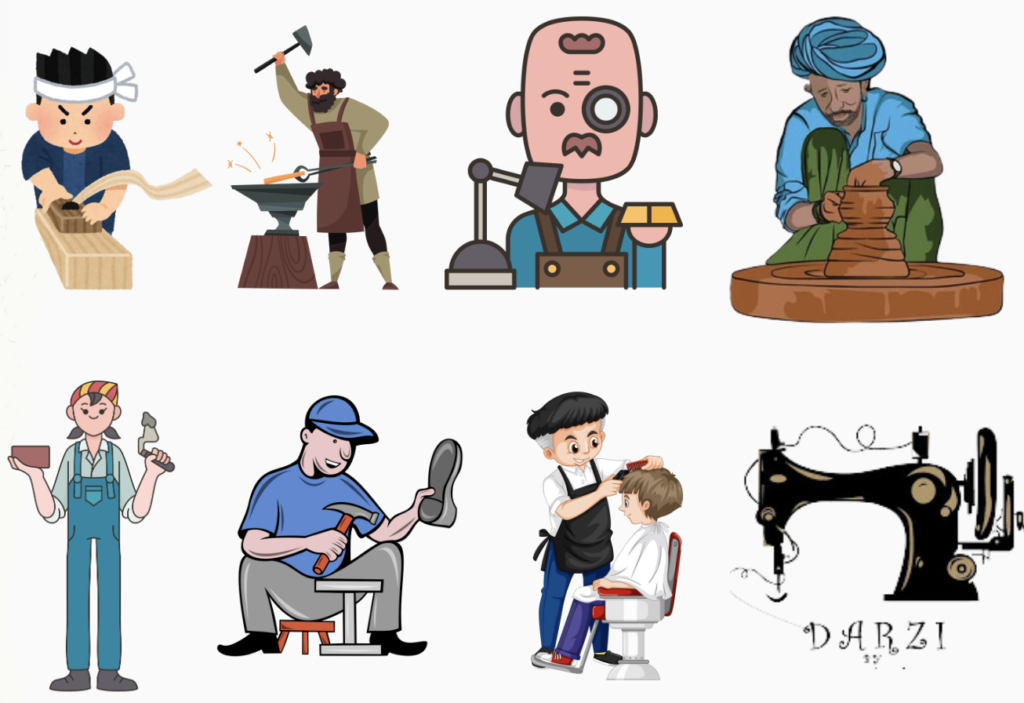
- 18 Trades covered
- Barber, Goldsmith, Blacksmith, Carpenter, Cobbler, Mason, tailor Etc
Sol –
Introduced in the Union budget 2024-25 to benefit 4.1 crore youth over five years with a central outlay of ₹2 lakh crore to promote employment and skilling
1. Scheme A –
- Objective: Financial assistance to first-time employees.
- Eligibility: First-time workforce entrants registered under EPFO.
- Benefit:
- One-month salary (up to ₹15,000) in three instalments
- Applicable to employees with a monthly salary up to ₹1 lakh
- Target: To benefit 2.1 crore youth entering the workforce.
2. Scheme B –
- Objective: To boost employment in manufacturing
- Incentive Mechanism
- Incentive to both employee and employer.
- Linked to EPFO contributions for the first four years of employment
- Focus Sector: Manufacturing
3. Scheme C –
- Objective: Financial relief to employers for hiring more workers
- Benefit –
- Government to reimburse up to ₹3,000 per month towards the EPFO contribution of employers for each additional employe
- Duration: Two years
- Applies to each additional employee hired
- Expected Impact: Benefit 30 lakh youth across all sectors
4. New Centrally Sponsored Scheme for Skilling
- Objective: Mass skilling and ITI infrastructure upgrade
- Key Features
- 20 lakh youth to be skilled over five years.
- 1,000 ITIs to be upgraded using hub and spoke model
- Expected Outcome: Boost skilled human capital and quality employment generation
5. Prime Minister’s Internship Scheme
- Objective: Provide real-world exposure and improve employability
- Scope –
- Internship in 500 top companies
- Target: 1 crore youth over five years
- Incentives –
- Internship allowance: ₹5,000/month
- One-time assistance: ₹6,000
- Duration: 12 months of internship
- Purpose: Bridge the gap between academic knowledge and industry needs
Sol –
- Tim Tim Tare initiative
- Started in 2009 in Tamil Nadu
- Currently reaches more than 10 crore students (Expanded to Central india and Gujarat) through Navodaya Vidyalayas, Kendriya Vidyalayas, Kasturba Vidyalayas, juvenile homes, YouTube, and WhatsApp groups etc
- To impart essential life skills to adolescent students across India
- Unlike vocational training, which focuses on technical skills, TTT places emphasis on soft skills
- Effective communication, emotional intelligence, and social well-being
- 16 core skills like empathy, critical thinking, etiquette, time management
- Activity-based learning, such as experience sharing, role plays, sing-along songs and interactive games
- Built on the World Health Organization’s (WHO) Life Skills Framework
- Feedback from students, teachers, principals, and parents is collected
- Officially approved by The State Council of Educational Research and Training (SCERT)
- Illam Thedi Kalvi scheme
- Designed during Covid-19 to reduce students’ reliance on internet resources for their learning,
- To bridge the education gap brought about by the Covid-19 pandemic and the digital divide
- The scheme’s volunteers work year-round to integrate out-of- school children into mainstream education, with particular attention to girls, Children with special needs (CwSN), transgender children, and those from migrant worker families
- These volunteers conducted door-to- door efforts to educate the students
- MISHTI Scheme
- Mangrove Initiative for Shoreline Habitats & Tangible Incomes
- Introduced in the Union Budget for 2023-24
- Mangroves advantages –
- High biological productivity
- High carbon sequestration capabilities
- Serve as a protective barrier for coastlines against cyclones, typhoons, and tidal waves
- MISTHI aims to promote and conserve mangroves through reforestation and afforestation measures
- The programme will cover approximately 540 square kilometres across nine coastal states and four UTs over five years (2023-2028)
- Carbon sink of 4.5 million tons of carbon
- Funding – Funding from the State Compensatory Afforestation Fund Management and Planning Authority (CAMPA), National CAMPA, Mahatma Gandhi National Rural Employment Guarantee Act (MGNREGA) and other sources
Sol –
Ministry of Micro, Small and Medium Enterprises (MSME)
- Formalisation of Enterprises
- 63% of the formalised enterprises are women-owned.
- Marketing Support
- Full subsidy for women’s participation in trade fairs.
- PM Employment Guarantee Programme (PMEGP)
- 41% of loans in FY24 sanctioned to women.
- Procurement Policy
- 3% of procurement by CPSEs is reserved for women-owned enterprises.
- Skill Development
- Over 21,600 women trained in coir manufacturing in 5 years.
- Free entrepreneurial training offered.
- ZED (Zero Defect Zero Effect) Certification
- 100% subsidy for women-owned MSMEs.
- SANKALP (Skill Acquisition and Knowledge Awareness for Livelihood Promotion)
- 32,262 women (67% of total beneficiaries) trained in entrepreneurship from 2021–2024.
Department for Promotion of Industry and Internal Trade (DPIIT):
- 10% of the “Fund of Funds for Startups” is reserved for women
- Women Entrepreneurship Platform (WEP)
- Launched in 2018 to aggregate policies and showcase women-led startups
Ministry of Food Processing Industries:
- PM Micro Food Processing Scheme
- SHG members receive ₹40,000 seed capital
- 50% grants for branding and marketing
Ministry of Tribal Affairs –
- Adivasi Mahila Sashaktikaran Yojana – Loans up to ₹2 lakh at 4% interest for Scheduled Tribe (ST) women
Ministry of Cooperation –
- Nandini Sahakar Swayam Shakti Scheme – 2% interest subvention for innovative cooperative projects run by women SHGs
- Working Capital Loan to Sahakar Yojna – Financial assistance for women Self Help Groups (SHGs)
Other schemes –
- Pradhan Mantri Mudra Yojana (PMMY) – Special focus on women-led micro-enterprises
- Deendayal Antyodaya Yojana – National Rural Livelihoods Mission (DAY-NRLM) – Promotes rural women-led enterprises
- Yashasvini Campaigns – Mass awareness and motivation programs for women entrepreneurship.
Sol –
- Lado Protsahan Yojana
- Launched on 1 August, 2024
- It aims to prevent gender discrimination, improve education and health, reduce maternal and child mortality and combat child marriage
- Financial assistance of ₹1.5 lakh is provided in seven instalments, with six payments made to the parent/guardian and the seventh directly to the girl child’s bank account
- On birth – 5,000 Rupees
- 1 year and completion of vaccination – 5,000 Rupees
- Fist class – 10,000 Rupees
- 6th class – 15,000 Rupees
- 10th Class – 20,000 Rupees
- 12th Class – 25,000 Rupees
- Graduation and 21 year old – 70,000 Rupees
- Eligibility –
- Mother is a resident of Rajasthan and
- The child must have been born in a government medical institution or a private hospital approved under the Janani Suraksha Yojana
- Mukhyamantri Ayushman Arogya Yojana (MAA)
- Facility of cashless insurance coverage of 25 lakhs for every family of Rajasthan
- Beneficiaries of the National Food Security Act and Socio Economic Census 2011 need not register. Their insurance premium will be borne by the state government
- Small and marginal farmers, contract workers and other beneficiaries can register themselves or get registered on e-Mitra. The insurance premium will be borne by the state government.
- Apart from this, other families will have to pay a premium of Rs 850 per year
- It is mandatory to have Jan Aadhar number or Jan Aadhar registration receipt to apply
- PM Surya Ghar Muft Bijli Yojana
- Launched on 13 February, 2024
- Aim – To install solar plants on 1 crore houses
- Up to 300 units of free electricity per month
- A maximum grant of ₹78,000 (for 3 KWor more) is available under the scheme
- In Rajasthan, the target is to install solar rooftop plants in 5 lakh houses
- Namo Drone Didi Yojana
- Launched – 28 November 2023
- For spraying Nano Urea and Pesticides through drone technology
- Drones to be provided to 15,000 self-help groups in four years
- Female drone pilot’s salary will be Rs 15 thousand
- Central financial assistance covers 80% of drone cost, up to Rs. 8 lakhs
- Mandatory 15-day training to be provided to one of the members of women SHGs as a drone pilot


