

Education

Sol – 

Toward achieving SDG 4 (Quality Education), India has implemented key initiatives aimed at enhancing educational outcomes across all levels.

Initiatives to Improve Educational Outcomes at Primary and Secondary Levels – 

  1. National Education Policy (NEP) 2020:
    • Objective: To address the growing developmental imperatives of India by revamping all aspects of the education structure.
    • Key Features: Inclusive, accessible, multilingual education aimed at holistic development and skill acquisition.
  2. Samagra Shiksha Scheme:
    • Launch Year: 2018
    • Scope: Covers pre-school to class XII.
    • Goals: Ensure inclusive and equitable quality education at all levels of school education.
    • Components: ICT labs, smart classrooms, teacher training, infrastructure improvements, and support for Children With Special Needs (CWSN).
  3. PM Schools for Rising India (PM SHRI):
    • Launch Date: September 7, 2022
    • Scope: Strengthening more than 14,500 schools by FY27.
    • Features: Modern infrastructure, smart classrooms, sports equipment, green initiatives, and integration of organic lifestyle in the curriculum.
  4. National Curriculum Framework (NCF) for Foundational Stage:
    • Age Group: 3 to 8 years.
    • Focus: Play-based learning and integrating early childhood care and education into the curriculum.
  5. Balvatika Project:
    • Launch Date: October 2022
    • Scope: Preparatory classes in 49 Kendriya Vidyalayas.
    • Focus: Develop cognitive, affective, psychomotor abilities, and early literacy and numeracy.
  6. Toy-based Pedagogy:
    • Objective: Integration of indigenous toys into the curriculum.
    • Benefits: Enhances conceptual understanding through age-appropriate toys.
  7. PRASHAST Mobile App:
    • Purpose: Screening tool for specific learning disabilities.
    • Scope: Covers 21 disabilities.
    • Benefits: School-wise disability screening and reporting to authorities.
  1. Vidyanjali (School Volunteer Initiative):
    • Objective: Strengthen schools through community and private sector involvement.
    • Platform: Vidyanjali portal for volunteers to contribute knowledge, skills, and resources.
  2. STARS Project:
    • States Involved: Himachal Pradesh, Madhya Pradesh, Rajasthan, Maharashtra, Odisha, Kerala.
    • Objective: Improve the quality and governance of school education.
    • Funding: Partly funded by the World Bank.

At Higher Education Level – 

  1. Expansion of Higher Education Infrastructure:
    • Increased Institutions: Growth in the number of medical colleges, IITs, IIMs, and other higher education institutions.
    • Numbers: From 387 medical colleges in 2014 to 648 in 2022, and from 723 universities in 2014 to 1,113 in 2022.
  2. Research & Development Cell (RDC):
    • Launch Date: March 2022
    • Purpose: Promote quality research and create a research ecosystem.
    • Focus: Collaboration with industry, government, and community organizations.
  3. Guidelines for Pursuing Two Academic Programmes Simultaneously:
    • Objective: Provide flexible curricular structures as per NEP 2020.
    • Options: Pursue two full-time programs, one full-time and one distance/online, or two online programs.
  4. National Credit Framework (NCrF):
    • Purpose: Seamless integration of credits across school, higher, and vocational education.
    • Impact: Enhances progression options and mainstreams vocational education.
  5. Interest Subsidy on Education Loans:
    • Scheme: Central Scheme on Interest Subsidy (CSIS)
    • Target Group: Economically weaker sections (EWS) with annual parental income below ₹4.5 lakh.
    • Benefit: Full interest subsidy during the moratorium period on education loans for professional studies.

These initiatives to enhance access, equity, quality, and infrastructure in education will help India reap the benefits of its demographic dividend

Sol – 

National Education Policy (NEP) 2020 was launched on the basis of the recommendation of K Kasturirangan Committee. 

Key features – 

  1. School education –
    • New 5+3+3+4 curricular structure corresponding to ages 3-8, 8-11, 11-14, and 14-18 years respectively.
    • Three years of Anganwadi/ pre schooling
    • 10 and 12 board examinations to be conducted twice a year (semester design)
    • Vocational Education to start from Class 6 with Internships
    • The flexibility of choosing the subjects
      • No hard separation like Science, Commerce and Arts. One can take history with chemistry 
    • National credit framework
    • Holistic education – Comprehensive sex education, Good touch bad touch
  2. Higher education – 
    • Gross Enrolment Ratio in higher education to be raised to 50% by 2035. 
    • 3.5 crore seats to be added in higher education
    • 4-year integrated B.Ed. degree
    • flexible curriculum can be of 3 or 4 years with multiple exit options
      • Certificate after 1 year 
      • Diploma after 2 year 
    • National Institute for Pali, Persian and Prakrit, Indian Institute of Translation and Interpretation to be set up.
    • Higher Education Financing agency (HEFA) – Joint venture between the Ministry of Education (MoE) and Canara Bank
    • Foreign universities to set up campuses in India

Potential Impact – 

  1. India emerge as a Knowledge superpower
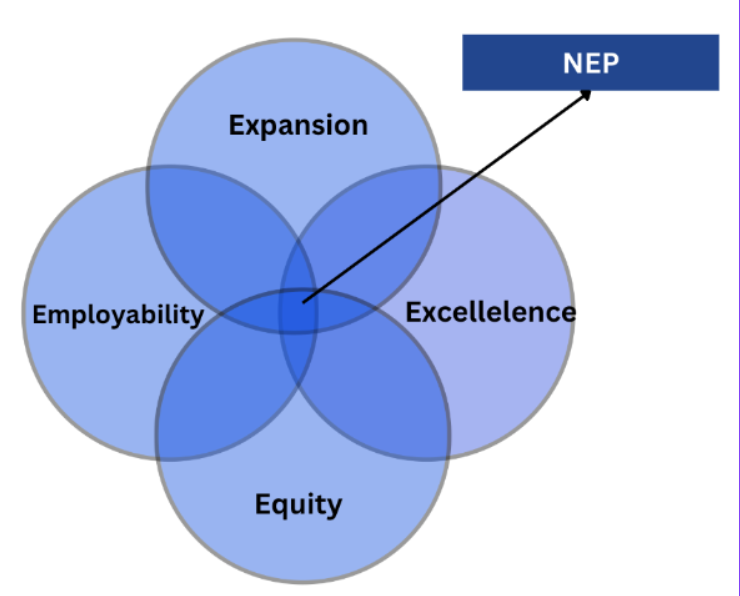
    • 4 Es – Expansion, Equity, Excellence, Employability in Indian Education system
  1. 100% Gross Enrolment Ratio (GER) in school education by 2030.
  2. Gross Enrolment Ratio in higher education to be raised to 50% by 2035
  3. 2 crore out of school children back into the mainstream through an open schooling system
  4. Better regulation –
    • National Curriculum Framework for Teacher Education
    • single umbrella body for entire higher education – HECI (Higher Education Commission of India)
  5. Internationalization of Indian education – Credit transfer and validity MoUs

Criticism – 

  1. Superficial Stakeholder Engagement – 
    • Due consultation process lacked while formulating the policy
  2. Lack of detailing – 
    • Detailed planning to achieve the goals are missing 
    • Issues like poor pupil teacher ratio, poor infra, regional imbalance etc are unaddressed 
  3. Lack of awareness among people – 
    • Many new concepts like credit system are complicated for people and need better clarity 
    • Resistance to Change
  1. Overambitious – 
    • An ambitious target of public spending at 6% of GDP 
    • Presently it’s only approx 3% 
    • To double the Gross Enrolment Ratio in higher education by 2035  we must open one new university every week, for the next 15 years
  2. Education is a state subject – 
    • Ensuring consistent and effective implementation across all states and union territories can be challenging, as different states may have varying levels of readiness, resources, and capacity


Sol – 

India has introduced several digital reforms in education to improve learning outcomes and reduce disparities, especially in remote and underprivileged areas. These reforms aim to make education more inclusive, accessible, and technology-driven.

Key Digital Reforms :- 

  • DIKSHA (Digital Infrastructure for Knowledge Sharing):
    • Provides e-content for students and teachers available in multiple languages, supports offline access
  • National Digital University (NDU):
    • To increase Gross Enrollment Ratio (GER) and reduce regional disparities in higher education, NDU provides affordable, high-quality education through a digital platform that enabls  students from remote areas to access quality education without relocating.
  • PM SHRI Schools:
    • To develop more than 14,500 model schools Equipped with smart classrooms, digital libraries, and modern infrastructure to enhance learning outcomes by implementing NEP 2020.
  • National Digital Education Architecture (NDEAR):
    • Aims to unify digital education infrastructure by personalized learning, and data-driven decision-making 
    • To make an interoperable, inclusive & scalable education ecosystem and to reduce duplication and promote innovation in digital learning.
  • PM eVidya:
    • Launched during COVID-19 to integrate all digital education efforts.
    • Ex- One Nation One Digital Platform and TV channels for each grade.
  • SWAYAM (Study Webs of Active–Learning for Young Aspiring Minds):
    • Offers free online courses from school to university level to encourages self-paced learning
  • E-Pathshala:
    • An NCERT initiative offering digital textbooks and resources.
  • AI Integration in Education –
    • Establishment of AI Centres of Excellence and incorporation of AI-driven tools in curriculam
  • Strengthening Open and Distance Learning (ODL)
  • E Jadui Pitara, Virtual Labs, PRASHAST

Effectiveness in Bridging Disparities:

  • Improved Access in Underserved Areas:
    • Number of schools with internet grown from 22.3% in 2019–20 to 53.9% in 2023–24 shows digital reach in government schools, especially in rural areas
    • In states like Jharkhand and Odisha, where internet penetration is lower, Initiatives like PM eVidya, with its Swayam Prabha TV channels and radio content helped in reducing drop out rate.
  • Multilingual and Inclusive Content:
    • Platforms like DIKSHA and E-Pathshala offer content in 33+ Indian languages, making education more accessible to various linguistic backgrounds and this reduces the learning gap among tribal and minority communities.
  • Reduced Urban-Rural Divide in Learning Resources:
    • Rise in digital public infrastructure (DPI) in education—such as NDEAR enables states to create their own digital learning platforms with local language , reducing overdependence on centralized systems. Ex –  Rajasthan’s DIKSHA platform
  • Targeted Support for Girls and Marginalized Groups:
    • Initiatives like NDU and SWAYAM aim to offer flexible, low-cost online courses, helping women and working students in Tier 2 and Tier 3 cities access higher education without relocating.
    • Ex- In Uttar Pradesh a pilot initiative using tablets under the Digital India program helped to reduce gender-based disparities in learning.

Challenges or Limitations – 

  • Around 46% of schools still lack internet (as of 2024–25), highlighting the need for further infrastructure investment.
  • Only 20–25% of rural households have access to smartphones or laptops, limiting the reach of fully online platforms.
  • Digital literacy among teachers and parents is a challenge in maximizing the use of digital tools.
  • Gender and regional disparities remain in digital access.

Conclusion:

Complete equity requires further efforts in infrastructure, training, and access to devices.                                                                    

  Continued investment and targeted policies will be key to ensuring that no student is left behind in the digital learning journey

Leave a Comment

Your email address will not be published. Required fields are marked *

error: Content is protected !!
Scroll to Top
Telegram WhatsApp Chat