
Sol –
- Dowry Prohibition Act, 1961: Criminalizes giving, taking, or abetting the giving or receiving of dowry. (Section 85 & 86 in BNS) → punishable by a minimum of five years in prison and a fine of at least Rs 15,000 or the amount of dowry given,
- Section 498A, Indian Penal Code: Makes harassment of a woman for dowry a crime.
- Section 304B, Indian Penal Code: Defines “dowry death. (Section 80 of Bhartiya Nyaya Sanhita)
- Protection of Women from Domestic Violence Act, 2005: Provides another layer of legal protection.
- Rajasthan Dowry Prohibition Rules, 2004 → Govt Servent declarations
Sol –
Dowry system is a social evil which creates serious problems for women. Such as:-
- Violence & Deaths: Unmet demands lead to abuse and dowry deaths (e.g., Vismaya case, 2021).
- Economic Burden: Families fall into debt, especially the poor.
- Gender Bias: Preference for sons, female infanticide (e.g., skewed sex ratio in Haryana).
- Delayed Marriages: Girls remain unmarried if dowry is unaffordable.
- Mental Trauma: Harassment causes depression, suicides.
- Poor Education: Dowry savings prioritized over girls’ education.
- Inequality: Reinforces the idea of women as financial burdens.
Way Forward:
- Educate & Empower Women – Promote girls’ education, skill development, and employment to ensure economic independence.
- Change Groom-Side Mindset: Encourage dowry-free marriages and build integrity and sensitivity among boys and their families. Promote the idea: “The bride herself is the dowry.”
- Community Campaigns – Highlight the moral, legal, and emotional consequences.
- Enforce Laws – Ensure ground-level implementation of :
- Dowry Prohibition Act (1961): Punishment for giving/taking/demanding dowry. Considered cognizable, non-bailable and non-compoundable offence.
- IPC 304B / BNS 80: Dowry death – 7 years to life.
- IPC 498A / BNS 85-86: Addresses cruelty by husband or relatives, including dowry harassment.
- Domestic Violence Act (2005): Protection from dowry-related violence.
- Support Inter-Caste/Love Marriages – Encourage freedom of choice.
Sol –
In 2017, a Supreme Court five-judge bench declared the practice of instant triple talaq unconstitutional, urging the government to formulate legislation against it.
Significance of the Judgment:
- Invalidation of Instant Triple Talaq
- Promotion of Gender Equality: Safeguarding the right to equality under Article 14 — previously, a Muslim man could divorce his wife by uttering “talaq” three times, whereas women lacked this ability.
- Empowerment of Muslim Women:
- This practice was not recognized as an essential practice of Islam
- The court directed that such practices negatively affecting the welfare of citizens are not protected under Article 25.
- Dignity of Women (Art 21): Emphasizing that gender equality and the dignity of women are non-negotiable principles.
- International Impact — Aligning with numerous Islamic countries, such as Pakistan and Bangladesh, that have already prohibited this practice.
Sol –
Legal Framework | Regulatory Framework |
Legal Framework:
| Regulatory Framework
|
Sol –
- Lack of Transparency: Hidden government processes enable corruption.
- Weak Institutions: Ineffective law enforcement fails to punish corruption.
- Perception of Impunity: Belief in avoiding punishment encourages corruption.
- Low Salaries: Public officials may take bribes to boost income.
- Bureaucratic Red Tape: Complicated procedures push people to bribe.
- Complex Economic Environment: Multiple permits lead to bribery in business.
- Political Interference: Politicians pressure officials into corrupt acts.
- Lack of Whistleblower Protection: Fear of retaliation silences reports.
- Social Inequality: The powerful use their influence to act corruptly.
- Cultural Acceptance: Corruption is normalized as “everyone does it.”
Cultural Deviance Theory of Corruption
- Corruption happens when society’s values accept wrong practices like bribery and favoritism as normal.
- Social acceptance → weak moral condemnation → corruption becomes habitual.
- Individuals conform to these deviant cultural norms for social acceptance and success.
- Corruption is seen as a collective cultural pattern, not just individual moral failure.
- Corruption becomes common because family, peers, and institutions don’t strongly oppose it.
- This shows that just making laws isn’t enough → needs cultural reform alongside laws.
Sol –
| Corruption as an Economic Crime | Corruption as a Social Problem |
| Misuse of Public Funds: Development funds diverted through bribes and embezzlement. | Erodes Public Trust: Corruption reduces people’s trust in the government, which can lead to social unrest and protests. |
| Reduced Investment: Investors avoid corrupt economies due to unpredictability. | Promotes Inequality: Poor suffer more. |
| Growth of Black Economy: Encourages unaccounted wealth, reduces tax collection. | Encourages Nepotism: Merit is ignored in favor of favoritism and connections. |
| Distorted Resource Allocation: Projects granted based on bribes, not public need. | Moral Degradation: Corruption becomes socially accepted; ethics are compromised. |
| Inefficient Service Delivery: Funds meant for welfare schemes don’t reach beneficiaries. | Weakens Institutions: Judiciary, elections, and police lose credibility. |
Sol –
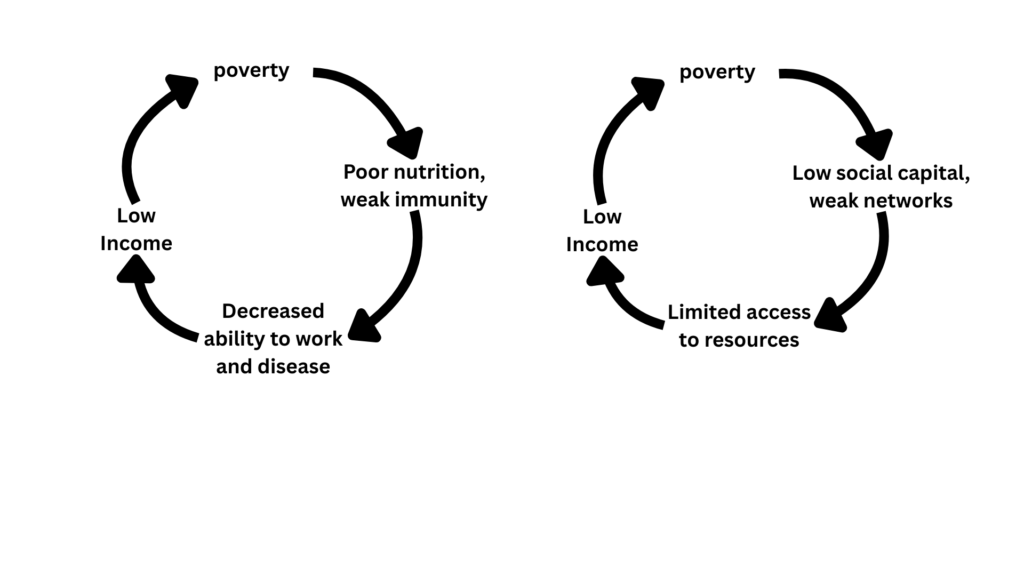
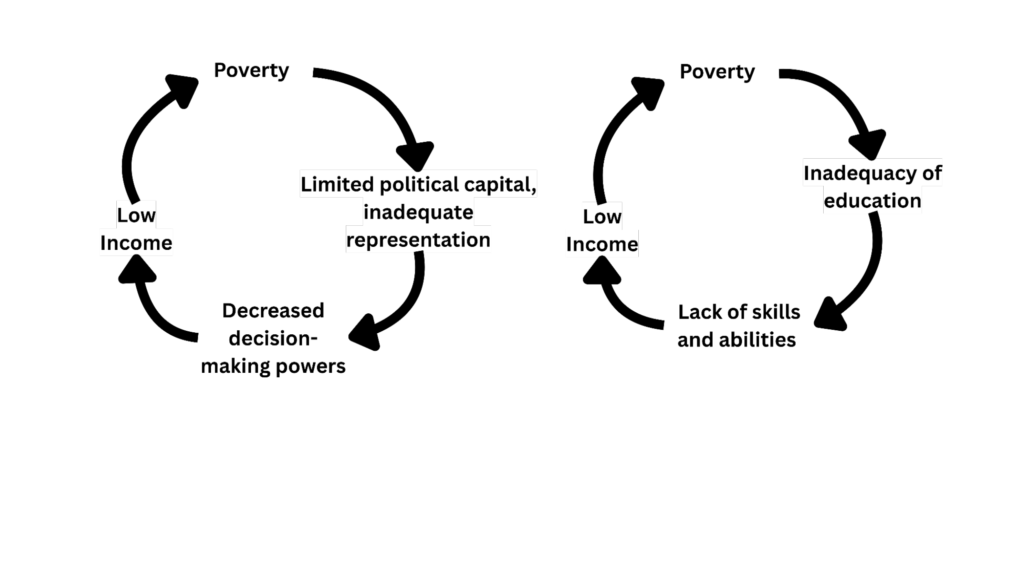
The vicious circle of poverty theory argues that various factors which cause poverty work in such a way that a poor person can never get out of it. For example – unemployment leads to poverty, poor people cannot have good education, without good education there is no employment
This vicious circle acts as a positive feedback system, where the initial state of poverty generates conditions that make it increasingly difficult to escape, thus perpetuating intergenerational poverty.
Sol –
Poverty is a complex societal issue that extends beyond mere economic deprivation. It is intricately linked to social exclusion, which manifests in various dimensions.
- Economic Deprivation→Lacking basic needs like food and shelter→35% of children under five in India are stunted(NFHS-5)
- Deprivation of Social Capital– Lower Social status leads to weaker networks, reducing opportunities.
- Deprivation of Political Capital– Lower representation in decision-making.
- Limited Education→Poverty restricts access to good education→Poor children attend underfunded schools.
- Health Disparities→Poverty leads to poorer health due to limited healthcare→Only 19.7% of the rural population and 30.1% of the urban population had health insurance (NSSO).
- Employment Discrimination→Job discrimination and lower wages→PLFS shows a higher unemployment rate among SCs and STs), indicating limited job opportunities.
- Social stigma→Poverty causes stigma and exclusion →25% of homeless individuals faced discrimination
- Legal and Political Exclusion→Limited participation in civic processes and access to legal representation
- Cultural Isolation and digital divide→Leads to cultural isolation→ No access to the internet. Only 14.9% of rural households (NSSO).
Sol –
| Aspect | Structural Unemployment | Cyclical Unemployment |
| Definition | Unemployment due to a mismatch between workers’ skills and job market demands. | Unemployment related to economic downturns and reduced demand for goods and services. |
| Cause | Long-term changes in the economy, such as technological advancements or industry shifts. | Short-term fluctuations in the economy, such as recessions or economic slowdowns. |
| Impact | Creates long-term unemployment that may not improve without significant retraining or shifts in the economy. | Causes temporary unemployment that decreases as economic conditions improve. |
| Example in India | The rise of the IT sector left many traditional workers unemployed due to a lack of relevant skills. | The COVID-19 pandemic led to job losses in sectors like retail and manufacturing due to reduced demand. |
Sol –
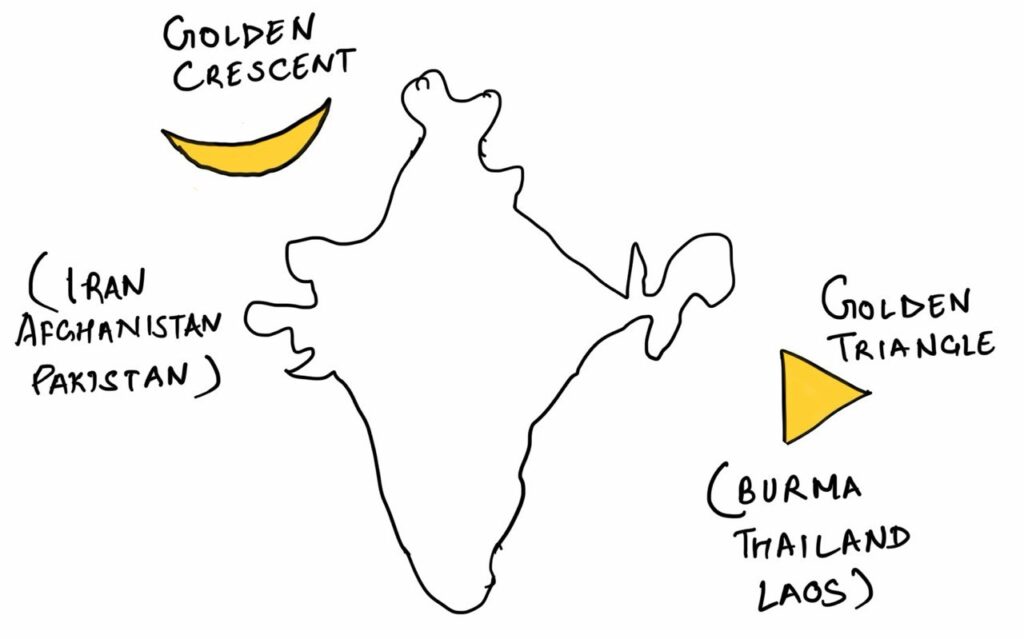
India is located between the two largest opium-producing regions: Golden Triangle (Thailand, Myanmar, Laos, Vietnam) and Golden Crescent (Pakistan, Afghanistan, Iran).
Public Health Crisis: 2.1% of Indians use opioids (2018 study).
Internal Security Threat:
- Porous borders → hard to curb drug smuggling.
- Drug trade → funds insurgency, terrorism.
- Drug trafficking → NE children used as drug carriers (false livelihood promises).
- Disrupts formal economy → promotes black market, lowers productivity