

Changes in Contemporary Indian Society and Culture: Secularisation, Urbanisation, Modernisation and Globalisation.

Sol –

Secularization, according to M.N. Srinivas and Bryan Wilson, is the gradual decline of religious influence in society. This involves a shift towards rationalisation and individual autonomy in various societal domains.

Features of Secularization –

  1. Belief of the masses increases towards worldliness.
  2. Belief in uncommon and supernatural authority lessens.
  3. ⁠Traditional thoughts are made to go through a logical yardstick. Rational thinking, freedom, and ideas are emphasised.
  4.  ⁠The path of science and technology is chosen to resolve everyday problems, instead of the path of religion. The belief in scientific principles increases.
  5. ⁠Religious principles are converted into behavioural practices and processes, as per the changing needs of society

Sol –

Basis

Indian Secularism

Western Secularism

Meaning

Secularism in India means that the state is neutral to all religious groups but not necessarily separate.

The state is separate from the functioning of all religious institutions and groups. 

Expression

In India, all expression of Religion is manifested equally with support from the state.

The Western concept of Secularism does not believe in an open display of religion except for places of worship.

Distinction

There is no clear distinction between the state and religion in India. 

The distinction between state and religion is clear and set in stone.

Origin

Although the concept of secularism was rudimentary and practised in ancient and medieval India, the term secularism was enshrined in the Constitution of India with the 42nd Amendment Act, 1976.

The concept of secularism first came about in the mid-17th Century concepts of the Enlightenment, which were enshrined first in the Constitution of France following the French Revolution (5 May 1789 – 9 November 1799).

State aid

The state gives financial aid to religious institutions and taxes them as well.

The state treats all religions with equal indifference. It does not aid any religious institutions through financial means or tax them.

Uniform code

Although the law is the same for all citizens, certain personal laws with regard to marriage and property rights are different for every community. But they are all given equal consideration under the Indian Penal Code.

A single uniform code of law is used to dispense justice regardless of religious background.

Sol –

Effects of secularization on Indian society-

  1. Social thought was re-explained 
  2. Concept of secularization changed the notion of purity and impurity.
  3. Secularization broadened the narrow mentality of individuals
  4. Focus of public mind was laid on development of self
  5. Caste discrimination enfeebled as the expectations to achieve wealth, power and authority strengthened
  6. There was a change in the belief from supernatural authority to universality.
  7.  Sentiments of devotion and faith did not disappear but now path to God was through humans
  8. Consciousness developed, people started donating to hospitals, educational institutions, social service organizations etc
  9. The traditional system of accepting the predominant cast class as Panch, in the rural society, tarnished
  10. Politicization of rural communities began. 

“Social Change in Modern India” – Book by M.N. Srinivas 

Sol – 

Aspect

Relationship between secularism and communalism

Indian context

Secularism vs. Communalism

Secularism ensures equal treatment of all religions; communalism emphasizes religious identity over national unity, leading to conflicts.

Babri Masjid demolition (1992): Clash between communal sentiments and secular ideals.

Historical Roots

British “divide and rule” policy and Partition deepened communal divisions, challenging secularism.

British Separate Electorates: Heightened communal identities influencing Indian politics.

Post-Independence Tensions

Despite a secular constitution, communal politics persist, with religion sometimes used to gain votes. 

Gujarat Riots (2002): Communal politics led to violence, challenging secularism.

Secularism as a Response

Secularism counters communalism by promoting social harmony and protecting all religions equally.

Sabarimala Case: The Supreme Court upheld secular principles by allowing women to enter the temple.

Challenges

Selective secularism and majoritarianism threaten India’s secular fabric, as governments may favour particular religions.

Shah Bano Case: The government overturned a Supreme Court ruling under religious pressure, sparking tensions.

Sol –

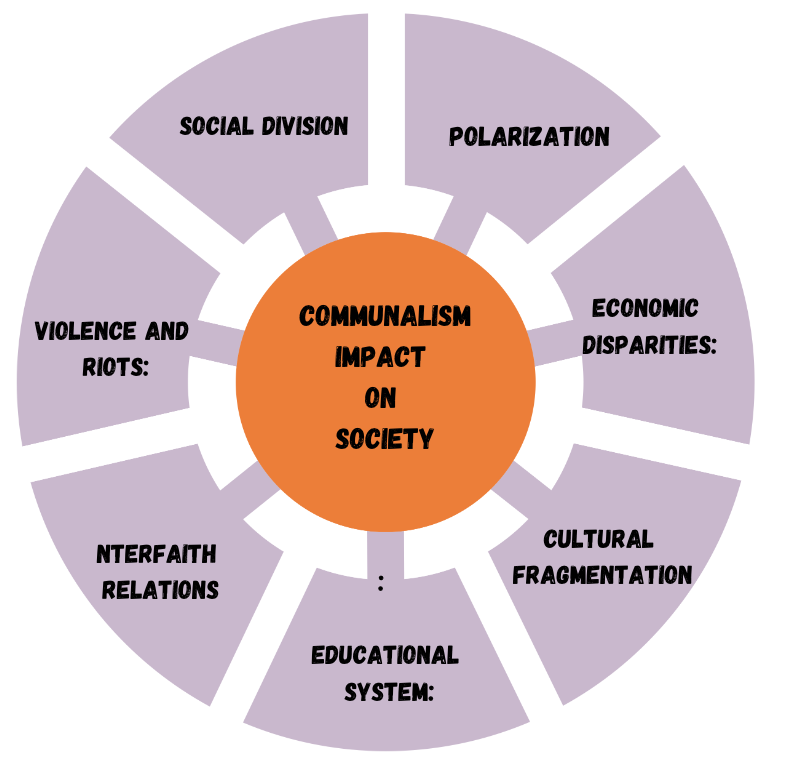
Communalism impacted the fabric of Indian society

  • Social Division: creation of divisions along religious lines, fostering mistrust and animosity.For example, during the partition of India. 
  • Violence and Riots: Communal tensions often escalate into violence and riots, causing loss of life and property. Instances like the Gujarat riots in 2002.
  • Interfaith Relations: Strains interfaith relations, making it challenging for communities to coexist harmoniously and collaborate for common goals. Ex- Instances of interfaith marriages facing societal backlash and religious conversions being politicized.
  • Educational System: Influence leads to biased narratives and fosters prejudices among students. 
  • Partisan perspectives in textbooks and curricula reinforce communal stereotypes and misconceptions.
  • Cultural Fragmentation: Fragment the cultural fabric of society, eroding the pluralistic ethos that has been a hallmark of Indian society. Attacks on religious and heritage sites.
  • Economic Disparities: minority communities may face discrimination in employment, business opportunities, and access to resources.
  • Polarization: Communalism polarizes society, creating ‘us vs. them’ mentalities and deepening religious identities. Political parties exploit these divisions for electoral gains, further polarizing communities. The Babri Masjid riots

Addressing these impacts requires concerted efforts from various stakeholders, including government bodies, civil society organizations, religious leaders, and the media, to promote secularism, tolerance, and inclusive development.
Sol –

Homogenization of Culture

Glocalization of culture

  • Refers to the process by which cultural differences blur and a uniform, standardized culture emerges. 
    It often involves the global spread of similar cultural products, values, and practices, leading to a more homogeneous global culture.
  • Examples: The spread of global brands (Apple), international fast-food chains(KFC), and Homogenisation of language (English)
  • This can lead to a reduction in cultural diversity as certain elements become dominant.
  • Glocalization ( “globalization” + “localization”) involves the adaptation of global products or ideas to local contexts, allowing for the coexistence of global and local influences. 
  • It emphasizes the importance of both global and local dynamics in shaping culture.
  • Examples: Global companies incorporating local languages in advertisements. McDonald’s goes vegetarian during the Navratri festival.
  • It allows for a fusion of global and local elements.

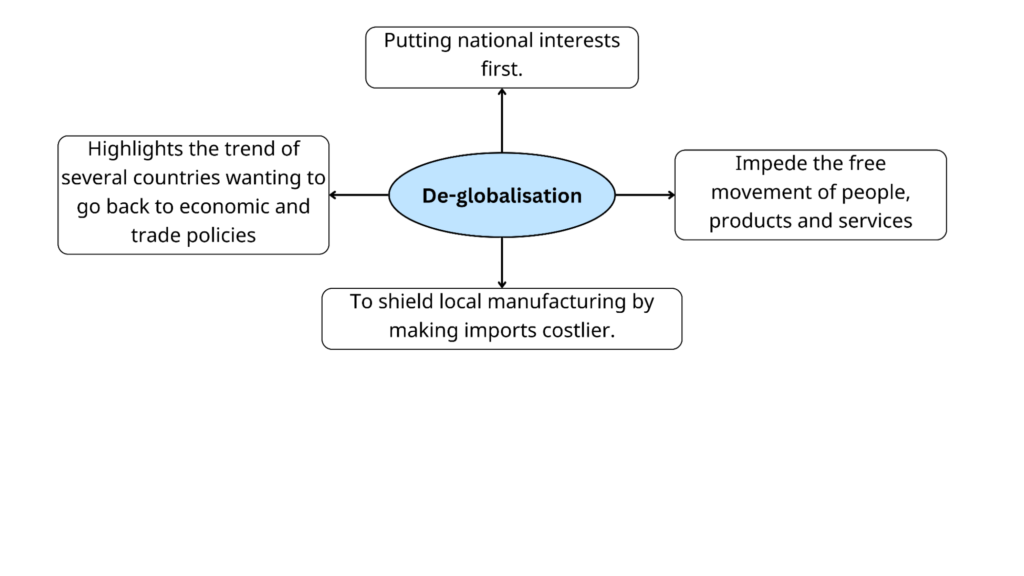
It is the process of diminishing interdependence and integration between the nations. It is characterised by the decline in economic trade and investment between countries.

{Reasons : Trade Wars , Decoupling (Reducing dependence on particular country), Protectionism (America first Policy) etc

Impact  → Supply Chain Disruption, Reduced access to export markets for emerging countries like India }
Sol –

Globalization has had a number of impacts on caste dynamics in India, including:

Positive 

Negative

  1. Breaking down rigid caste structure– led to the emergence of a working class, middle class, and elite class.
  2. Secularization of caste -By making caste more secular; led to a more relaxed caste structure, where inter-caste unions and social interactions with outcast castes are common.
  3. Expanding economic opportunities– Led to a rise in education, and liberal thoughts; weakened the caste system; led to the gradual acceptance of inter-caste marriages.
  4. Social mobility- The expansion of economic opportunities and breakdown of traditional division of labor has led to social mobility.
  5. Recognition of rights of vulnerable sections like DALIT 
  1. Reinforcement of Hierarchies: Dominant norms perpetuate discrimination.
  2. Exploitative Labor: Outsourcing exploits lower caste labor.Cultural Commodification: Stereotyping reinforces social hierarchies.
  3. Marginalization of Livelihoods: Traditional occupations face displacement + In the absence of skills, menial jobs became concentrated among lower castesRise in caste based economic inequalities 
  4. Exploitation of vulnerable caste groups- Shown resilience in terms of exploitation of the vulnerable caste groups. 

Leave a Comment

Your email address will not be published. Required fields are marked *

error: Content is protected !!
Scroll to Top
Telegram WhatsApp Chat
