

The Khajuraho temples (9th–11th centuries CE, built by the Chandela dynasty in Madhya Pradesh) are UNESCO-listed monuments and renowned examples of the Nagara style of architecture. Their key features include:
- Nagara Style:
- Characterized by a curvilinear shikhara (spire), such as the Kandariya Mahadeva Temple’s 31m spire with 84 smaller spires.
- Elevated platforms (jagati), like the Lakshmana Temple’s 3.5m platform.
- Multiple mandapas (porch and hall) as seen in the Vishvanatha Temple.
- Intricate Carvings:
- Over 30,000 sandstone sculptures; around 10% are erotic (e.g., Kandariya Mahadeva’s 870+ figures).
- The outer walls are adorned with sculptures depicting deities, celestial beings, musicians, dancers, animals, and daily life scenes.
- Erotic Sculptures:
- These carvings represent fertility, the creative power of life, and spiritual union.
- Layout and Structure:
- Use of the Panchayatana plan (e.g., Lakshmana Temple) and east-facing designs (e.g., Chitragupta Temple).
- The Western Group of temples is the largest, spread over 6 sq km.
- Structural elements include carved pillars, lotus ceilings (e.g., Adinatha Jain Temple), and star-shaped bases (e.g., Chaturbhuj Temple).
- Construction Material:
- Temples are built primarily with sandstone, allowing for fine carving and precise joints without mortar.
- Symbolism and Syncretism:
- The temples symbolize the mythical Mount Meru, considered the axis of the universe.
- They represent religious pluralism, with 80% Hindu temples (Shaiva, Vaishnava, Shakta) and 20% Jain temples, coexisting harmoniously.
- Commissioned by: Emperor Ashoka in the 3rd century BC.
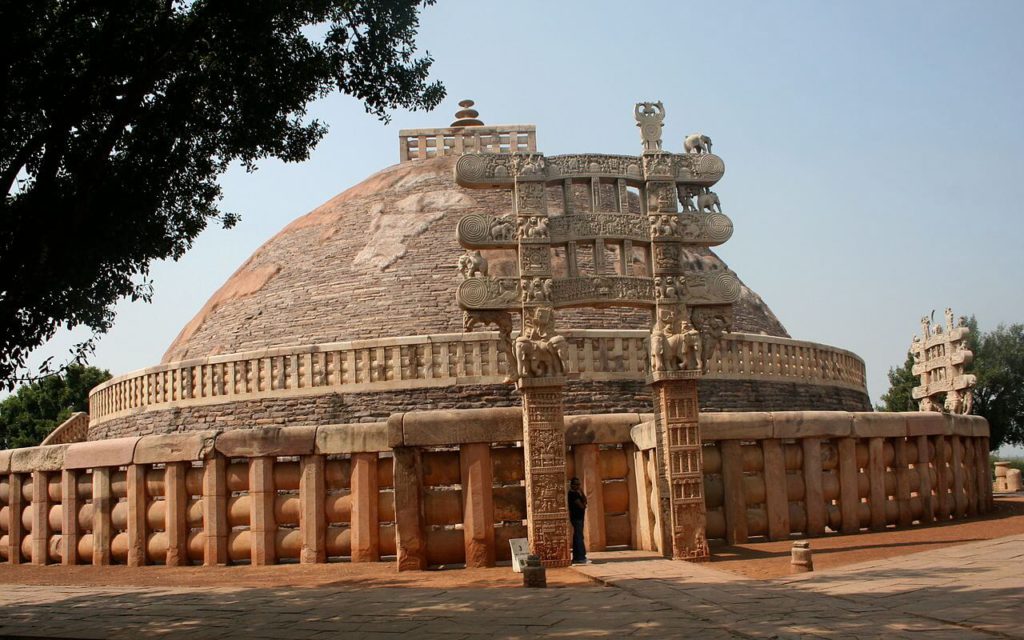
- Location: Sanchi, Madhya Pradesh
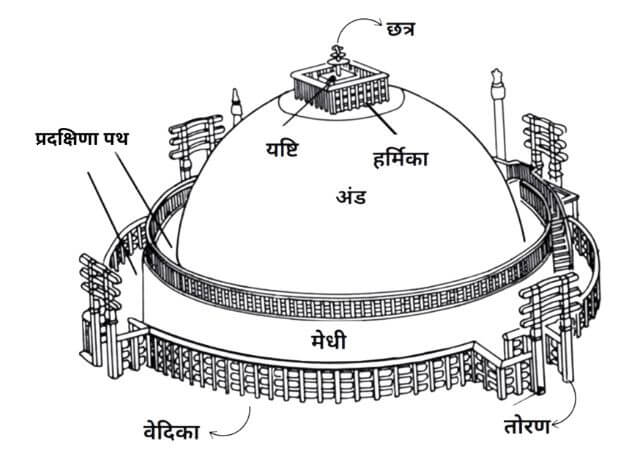
- Architecture: Large hemispherical dome (Anda) symbolizing the universe
- Central Relic Chamber: Contains sacred Buddhist relics
- Toranas (Gateways): Four intricately carved gateways depicting Jataka tales and Buddha’s life
- Harmika: Square railing on top representing the heavens
- Chhatra (Umbrella-like Structure): Symbolizes high rank and protection
- Vedika (Stone Fence): Encircles the stupa, separating the sacred from the secular.
Akbar (1556-1605 ) made significant contributions to Mughal architecture.
Principal Features of his reign:
- Blending indigenous styles with Persian, Central Asian, and Timurid influences.
- Use of redstones and marble
- Introduction of “Tudor arch” (four centred arch)
Some of Prominent works:
- Forts :He built many forts → Agra Fort was built in red sandstone (inside garden – char bagh style). His other forts are at Lahore and Allahabad, ajmer (Magazine fort)
- Fatepur Sikri : described as a “frozen moment in history” as buildings are unique blend of hindu and persian styles
- It is a palace cum-fort complex at Fatehpur Sikri (City of Victory.
- Many buildings in Gujarathi and Bengali styles are found in this complex.
- The most magnificent building in it is the Jama Masjid and the gateway to it called Buland Darwaza or the Lofty Gate. The height of the gateway is 176 feet. It was built to commemorate Akbar’s victory over Gujarat.
- Other important buildings at Fatehpur Sikri are Jodh Bai’s palace and Panch Mahal with five storeys, ibadat khana, Diwan-I-Aam, Diwan-I-Khas, tomb of salim chisti
- Humayun’s tomb was built in Delhi and it had a massive dome of marble. It may be considered the precursor of the Taj Mahal.
- Nilkanth Temple or Imarat-i-Dilkhusha (the heart-pleasing abode) is a temple built on the orders of Mughal Emperor Akbar by the governor of Mandu, Shah Badgah in 1574 AD.
- Raja Man Singh and Akbar built a temple of Govind Dev in Vrindavan.
In conclusion, Akbar’s impact on Mughal architecture is evident in the demonstration of a seamless integration of various cultural influences.
| Features | Traditional Indian Architecture | Indo-IslamicArchitecture |
| Architectural Influences | Influenced by regional styles like Nagara and Dravidian | A mixture of Persian, Turkish, and Indian styles |
| Material Usage | Mostly constructed using stone | Used materials like red sandstone and marble |
| DecorativeElements | Decorated with idols, sculptures, and motifs of gods and animals | Decorated with geometric patterns, floral designs, and Quranic verses |
| Arches and Domes | Primarily used lintels and beams in temples | Introduced arches and domes replacing lintel and beam style |
| Roof | Shikhara style (pyramidal or spire) | Large domed roofs(Taj Mahal) |
| Gardens and Courtyards | Simpler temple courtyards, no garden layouts | Charbagh garden layout |
| Examples- | Kandariya Mahadev Temple, Khajuraho,Somnath Temple,KonarkSun Temple etc. | Taj Mahal, Humayun’s Tomb, Gol Gumbaz,Qutb Minar, Jama Masjid,Fatehpur Sikri, Alai Darwaza etc. |
The history of India begins with the birth of the Indus Valley Civilization, also known as Harappan Civilization.It flourished around 2,500 BC, in the western part of South Asia, in contemporary Pakistan and Western India.
Indus Valley Civilization as an Urban Society
- Well-Planned Cities and Grid System
- Cities like Harappa, Mohenjo-daro, and Dholavira were built on a grid pattern with systematically arranged streets.
- Streets were wide, intersecting at right angles, with separate residential and public areas.
- Advanced Drainage and Sanitation Systems
- Covered drains, soak pits, and public baths (e.g., the Great Bath of Mohenjo-daro) highlight their engineering expertise.
- Houses had individual bathrooms and drainage systems, indicating concern for hygiene.
- Standardized Building Materials
- Used burnt bricks of uniform size, showing advanced construction techniques.
- Multi-room houses with courtyards suggest a well-developed domestic architecture.
- Granaries and Public Structures
- Large granaries in Harappa and Mohenjo-daro indicate organized food storage.
- Presence of dockyards at Lothal suggests an early form of maritime trade.
Indus Valley as a Cradle of Early Indian Art and Architecture
- Sculptures and Terracotta Figurines
- The “Dancing Girl” (Mohenjo-daro) made of bronze reflects early metallurgical skills and artistic expression.
- The “Priest-King” bust shows detailed craftsmanship, use of steatite, and a sophisticated sense of proportion.
- Terracotta figurines of animals and mother goddesses suggest religious and cultural symbolism.
- Seals and Early Iconography
- Thousands of seals (made of steatite) were found with animal motifs (unicorn, bull, elephant) and script-like markings.
- The famous Pashupati seal (depicting a three-headed figure surrounded by animals) indicates early roots of Hindu religious traditions.
- Pottery and Artistic Expression
- Painted black-and-red ware pottery with geometric and floral motifs suggests artistic refinement.
- The use of glazed and perforated pottery represents technical expertise.
- Architecture of Religious and Public Structures
- The Great Bath of Mohenjo-daro suggests a form of ritualistic or religious water use.
- Large-scale fire altars in Kalibangan indicate early ritualistic practices.
Thus, The Indus Valley Civilization was more than just an advanced urban society; it nurtured early artistic and architectural traditions that influenced later Indian cultures.



