

Freons are a group of synthetic compounds known as chlorofluorocarbons (CFCs) and hydrochlorofluorocarbons (HCFCs). They are fully or partly halogenated hydrocarbons containing carbon (C), hydrogen (H), chlorine (Cl), and fluorine (F).
Contribution to Ozone Depletion:
- Freons break down in the stratosphere due to UV radiation, releasing chlorine atoms. Chlorine atoms catalytically destroy ozone molecules (O₃), leading to ozone depletion.
Cl + O₃ → ClO + O₂
ClO + O → Cl + O₂
{Extra :
- Effects: Thinning of the ozone layer allows more harmful UV radiation to reach the Earth’s surface, posing risks to human health and ecosystems.
- As a result of CFCs contributing to ozone depletion in the upper atmosphere, the manufacture of such compounds has been phased out under the Montreal Protocol, and they are being replaced with other products such as hydrofluorocarbons (HFCs) .
- The most common example is dichlorodifluoromethane (R-12). R-12 is also commonly called Freon and was used as a refrigerant.}
- Freons are chlorofluorocarbons (CFCs) – compounds of carbon, chlorine, and fluorine.They are non-toxic, non-flammable, and chemically stable, making them useful industrially.
- Common Uses of Freons (CFCs)
- Refrigerants in air conditioners, refrigerators.
- Propellants in aerosol sprays (e.g., perfumes, deodorants).
- Foaming agents in plastic and foam manufacturing.
- Solvents for cleaning electronic components.
- Environmental Impact of CFCs
- Ozone Depletion:
- CFCs release chlorine radicals in the stratosphere.
- These react with ozone (O₃), breaking it down into oxygen (O₂).
- Leads to ozone layer depletion, increasing harmful UV radiation reaching Earth.
- Ozone Depletion:
- Global Warming Potential (GWP):
- CFCs are potent greenhouse gases, contributing to climate change.
- Long Atmospheric Lifespan:
- CFCs are stable and remain in the atmosphere for decades, causing long-term damage.
- Due to their harmful effects, global efforts like the Montreal Protocol (1987) aim to phase out CFCs and protect the ozone layer.
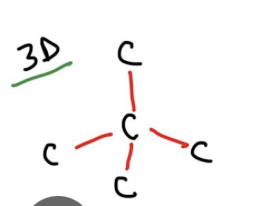
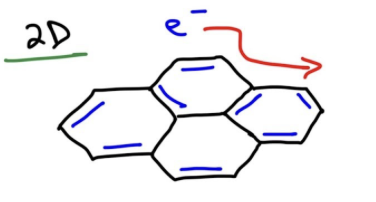
Characteristic | Diamond | Graphite |
Atomic Structure | Each carbon atom is bonded to four other carbon atoms in a tetrahedral arrangement. | Each carbon atom is bonded to three other carbon atoms in layers, forming hexagonal rings. |
Hardness | Extremely hard, ranking 10 on the Mohs scale. | Relatively soft and slippery, ranking around 1-2 on the Mohs scale due to weak interlayer forces. |
Electrical Conductivity | Insulator, does not conduct electricity. | Conductor of electricity along the planes of carbon atoms due to delocalized π electrons. |
Optical Properties | Transparent with a high refractive index. | Opaque and dull in appearance. |
Specific Density | High (3.5) | Lower compared to diamond (2.25) |
Activeness | Chemically inert | Chemically more active |
Applications | Jewelry, cutting tools, and abrasives. | Lubricants, pencils, and thermal management materials. |
 |  |
Differences between alkanes, alkenes, and alkynes-
| Feature | Alkanes | Alkenes | Alkynes |
| Type of bonding | Only single bonds (σ bonds) | One double bond (1 σ + 1 π bond) | One triple bond (1 σ + 2 π bonds) |
| Hybridisation | sp³ | sp² | sp |
| General Formula | CₙH₂ₙ₊₂ | CₙH₂ₙ | CₙH₂ₙ₋₂ |
| Saturation | Saturated (max H atoms) | Unsaturated (less H due to double bond) | Unsaturated (less H due to triple bond) |
| Reactivity | Least reactive | Moderately reactive (π bond reactive) | Most reactive (2 π bonds reactive) |
| Types of Reactions | Substitution reactions (halogenation) | Addition reactions (hydrogenation, halogen addition) | Vigorous addition reactions |
| Reason for Reactivity | Strong σ bonds only | Weak π bond breaks easily | 2 π bonds → highly reactive sites |
| Example Compounds | Methane (CH₄), Ethane (C₂H₆) | Ethene (C₂H₄), Butene | Ethyne (C₂H₂), Butyne |
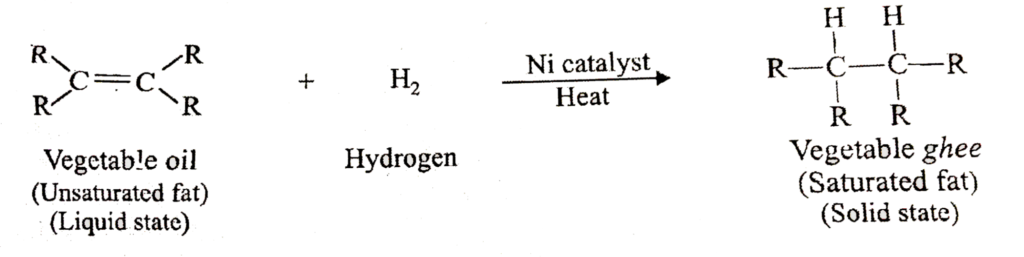
Addition of hydrogen to unsaturated hydrocarbons in presence of a catalyst such as nickel or palladium to form saturated hydrocarbons is called hydrogenation.
Industrial application of Hydrogenation:
- Food Industry: To prepare vegetable ghee from vegetable oils.
- Petrochemical Industry: Converts unsaturated hydrocarbons in crude oil or natural gas into saturated hydrocarbons to improve the quality of petroleum products.
- Hydrogenation of Nitro Compounds: Converts nitro compounds into amino compounds, important in dye, pesticide, and pharmaceutical synthesis.



