

| Aspect | Roasting | Calcination |
| Definition | Heating ore in the presence of excess oxygen. | Heating ore in the absence or limited supply of air. |
| Ore Type | Mainly for sulphide ores. | Mainly for carbonate and hydrated ores. |
| Products | Converts sulphide ores into oxide + SO₂ gas. | Converts carbonates into oxide + CO₂ gas. |
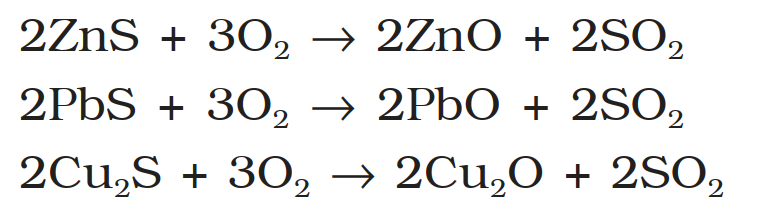
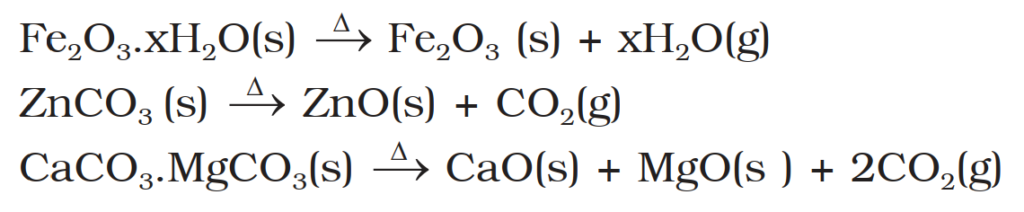
| Example | ZnS + O₂ → ZnO + SO₂ | CaCO₃ → CaO + CO₂ |
| Applications | Used for metals like Zn, Cu, Pb. | Used for Ca, Mg, Fe carbonates and hydroxides. |
The entire scientific and technological process used for isolation of the metal from its ores is known as metallurgy.
Ores are usually contaminated with earthly or undesired materials known as gangue.
The extraction and isolation of metals from ores involve the following major steps:
- Crushing and Grinding : Pulverization ⇒ Find powder is prepared to increase the surface area for chemical reactions.
- Concentration of Ores → Removal of Gauge
- Physical Methods
- Hydraulic washing: based on the differences in gravities of the ore and the gangue particles ⇒ gravity separation. Eg for Gold, Chromium and Iron
- Magnetic Separation : when either the ore or the gangue (one of these two) is capable of being attracted by a magnetic field . Ex Pyrolusite (MnO2) & Chromite (FeO.Cr2O3)
- Froth Floatation : for removing gangue from sulphide ores .{ a suspension of powdered ore is made with water, to which collectors (e.g., pine oils, fatty acids, xanthates) and froth stabilizers (e.g., cresols, aniline) are added.
- Chemical methods
- Leaching: commonly employed when the ore is soluble in suitable solvent.
- Leaching of Alumina from Bauxite: Bauxite is digested with a concentrated solution of NaOH at elevated temperatures and pressures. This leaches out Al2O3 as sodium aluminate, leaving impurities behind.
- Other Examples: silver and gold ⇒ the respective metal is leached with a dilute solution of NaCN or KCN in the presence of air.
- Leaching: commonly employed when the ore is soluble in suitable solvent.
- Physical Methods

- Conversion of ore into metal oxide:
- Heating in the presence of air (roasting) or without air (calcination) to remove volatile impurities, moisture, and sulphur. → Leaving behind metal oxide
Roasting | Calcination |
Primarily for sulphide ores | for carbonate ores |
 |  |
4. Reduction of Metal Oxide/smelting (koi si bhi ek reaction sufficient hai )
- Smelting is the process of extracting a metal from its oxide ore by heating it with a reducing agent such as coke (carbon) in a furnace.
- Extraction of copper from cuprous oxide [copper(I) oxide]: Coke as reducing agent
- Cu2O(s)+C(s)→2Cu(s)+CO(g)
- Extraction of zinc from zinc oxide
- ZnO + C → Zn + CO (coke,1673K)
- Extraction of copper from cuprous oxide [copper(I) oxide]: Coke as reducing agent
- Refining/Purification : Refining methods include distillation, fractional crystallization, liquation, electrolytic refining, zone refining, vapour phase refining, and chromatographic methods.



