

A nuclear reactor generates electricity through controlled nuclear chain reactions involving fissile materials like enriched uranium or plutonium.
- Fuel Rods: Enriched uranium or plutonium.
- Control Rods: Boron or cadmium.
- Moderator: Water, graphite, or heavy water.
- Coolant: Water, pressurized water, or liquid sodium.
- Reactor Vessel: Robust steel container.
- Steam Generator: Converts water to steam.
- Turbine: Drives generator.
- Condenser: Cools steam to water.
- Containment Building: Reinforced concrete or steel structure.
{In a nuclear reactor, controlled nuclear chain reactions occur, where the nuclei of heavy atoms, such as uranium-235 or plutonium-239, split into smaller nuclei, releasing large amounts of energy in the process. This energy heats up a coolant, typically water or gas, which then transfers the heat to a secondary system, where it is used to generate steam. The steam drives turbines connected to generators, producing electricity.}
India’s Nuclear Energy Mission 2025 aims to triple nuclear power capacity (from 8180 MW (As of January 2025) to 22,480 MW by 2031) by leveraging Small Modular Reactors (SMRs) and international collaborations. This aligns with India’s net-zero 2070 pledge and energy security goals.
Objectives of Nuclear Energy Mission 2025:
- Capacity Expansion– Triple nuclear capacity to 22,480 MW by 2031
- SMR Deployment– Install 50+ 300MW SMRs by 2035
- Energy Mix– Achieve 9% electricity share from nuclear by 2047
- Indigenization– Develop AHWR-300 thorium reactor by 2030
- Industrial Applications– Power 10+ mega desalination plants
- Transport Revolution– Electrify 100% railways using nuclear power
- Rural Access– Deploy 10MW microreactors in Ladakh/Andamans
In the 1950s, Dr. Homi Bhabha, the father of the Indian nuclear program, conceptualized India’s three-stage nuclear program.
Objective Behind India’s Nuclear Power Program
- India has one of the biggest shares of worldwide Thorium reserves as opposed to a small share of worldwide Uranium reserves. But, Thorium is not a fissile material. But, it can breed another fissile material, U-233. U-233 is the most used nuclear fuel.
- Breeding of U-233 and achieving a Thorium fuel cycle is not a one-step process, that is why India needs a three-stage program. So, the objective is to achieve the Thorium fuel cycle and be self-sufficient in meeting energy demands.
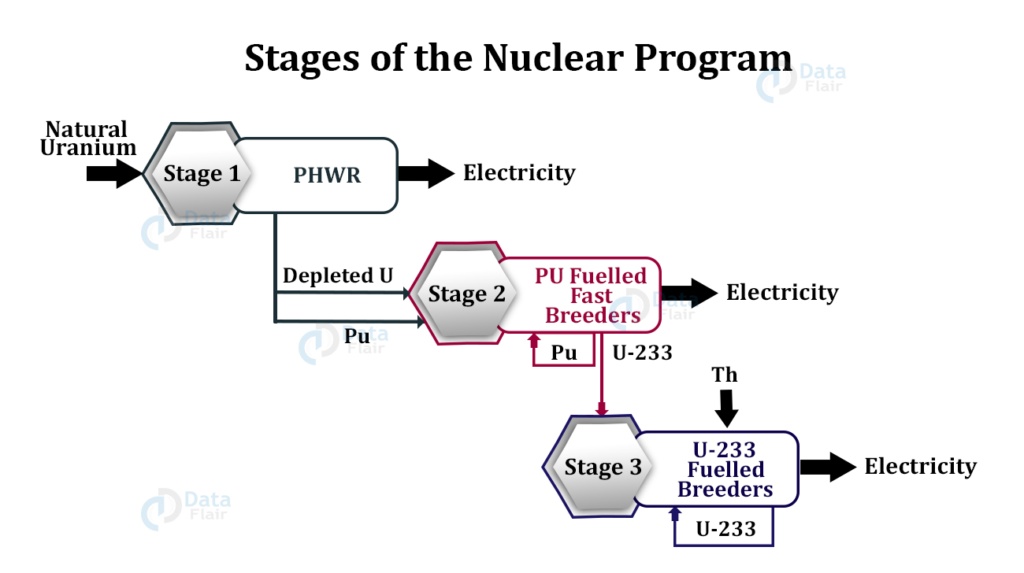
Stage I – Pressurized Heavy Water Reactor (PHWR):
- Natural uranium-fueled PHWRs produce electricity and plutonium-239.
- [U-238 → Plutonium-239 + Heat]
- No uranium enrichment needed; U-238 is directly used.
- Heavy water (D2O) serves as moderator and coolant.
- PHWRs were chosen for their efficient uranium utilization without the need for enrichment.
- NPCIL operates 22 reactors with a capacity of 6,780 MWe.
Stage II – Fast Breeder Reactor (FBR):
- In the second stage, FBRs use plutonium-239 recovered from spent fuel of the first stage and natural uranium.
- Plutonium-239 undergoes fission to produce energy, while uranium-238 transmutes into additional plutonium-239.
- Thus, the Stage II FBRs are designed to “breed” more fuel than they consume. Once the inventory of plutonium-239 is built up thorium can be introduced as a blanket material in the reactor and transmuted to uranium-233 for use in the third stage.
- Moderators are not required in FBRs.
Stage III – Thorium-Based Reactors:
- The Advanced Heavy Water Reactor (AHWR) is designed to use thorium as its primary fuel.
- The third stage involves a self-sustaining series of thorium-232-uranium-233 fueled reactors.
- The thorium transmutes to U-233 which powers the reactor. Fresh thorium can replace the depleted thorium.
Current State of India’s Three-Stage Nuclear Power Program:
- Presently, India is in the second stage of the program.
- The vital second stage of India’s three-stage nuclear programme got a boost with the commencement of ‘core loading’ at the country’s first indigenous Fast Breeder Reactor (FBR) at Kalpakkam, Tamil Nadu
- Once commissioned, India will be the second country after Russia to have a commercial operating FBR.
- The PHWR program is also underway, and the India-US civil nuclear deal allows India to buy uranium for domestic reactors, accelerating the nuclear program.
- DAE aims for 22,400 MWe by 2032, with 10 new PHWRs planned in ‘fleet mode.’
By implementing the three-stage program, India aims to develop a robust and secure nuclear energy infrastructure that supports its growing energy demands, economic development, and environmental goals.
Nuclear fusion is the process where two light atomic nuclei combine to form a heavier nucleus, releasing a large amount of energy.
Energy Release in Nuclear Fusion:
The Sun is powered by thermonuclear fusion, mainly through the Proton-Proton (pp) cycle.
Step-by-step reactions:
Step 1:

(Two protons form deuterium, releasing a positron and a neutrino)
Step 2:

(Deuterium fuses with a proton to form helium-3, releasing a gamma-ray photon)
Step 3:
(Two helium-3 nuclei combine to form helium-4, releasing two protons)
Overall Reaction:
Energy released per cycle = 26.7 MeV
Providing energy to stars by the Sun-
- Fusion of Hydrogen Nuclei:
In stars, hydrogen nuclei (protons) collide at extremely high temperatures (~15 million °C) and fuse to form helium through a series of reactions known as the proton-proton chain. - Overcoming Electrostatic Repulsion:
Protons are positively charged and repel each other. Extremely high temperatures and pressures provide the kinetic energy needed to overcome this Coulomb barrier. - Mass Defect and Energy Release:
The mass of the resulting helium nucleus is slightly less than the combined mass of the original four protons. This mass difference (mass defect) is converted into energy according to Einstein’s equation:
E=mc2
- Gamma Ray Emission:
During fusion, high-energy gamma rays are released. These gamma rays gradually lose energy as they move outward through the layers of the star and are eventually emitted as visible light and heat.
Like electrons, each proton and neutron possesses an intrinsic spin of 1/2. Therefore, nuclei also have spin angular momentum. When this nuclear magnetic moment associated with a nuclear spin is placed in an external magnetic field, the different spin states are given different magnetic potential energies. A radio frequency signal at the appropriate frequency can induce a transition between spin states (‘spin flip’).
Thus, the phenomenon of resonance, where selective absorption (or emission) of appropriate very high-frequency radio waves causes a spin flip between different energy states of atomic nuclei (with non-zero nuclear spins) in an external magnetic field, is called Nuclear Magnetic Resonance.
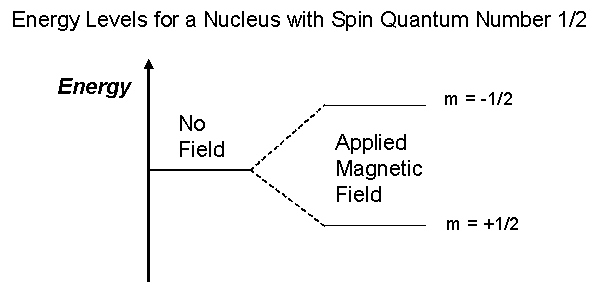
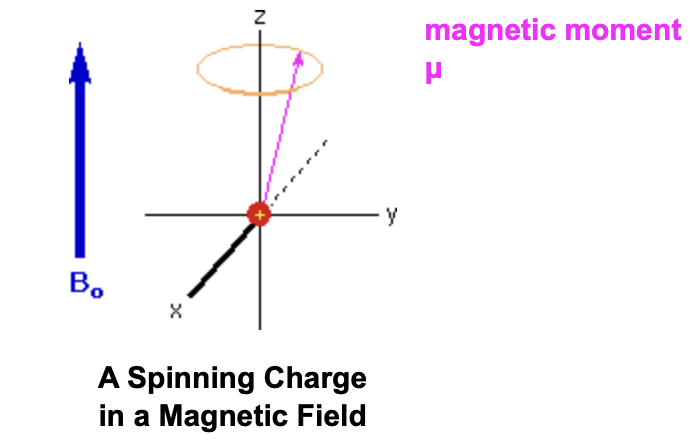
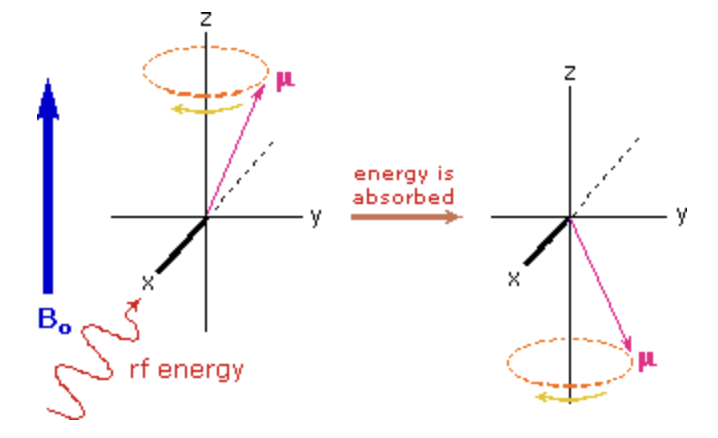
NMR spectroscopy is used to elucidate the structure of organic molecules, study crystals and non-crystals, and can be applied to medical diagnostic imaging (MRI)
Application of NMR Principle to MRI
MRI is a useful non-invasive and non-destructive diagnostic tool for imaging soft tissues such as the brain, heart and muscles, and for discovering tumors in many organs.
- MRI utilizes proton NMR to image the concentration of protons, making it ideal for imaging soft tissues like the brain and eyes. Tissues with high proton density appear brighter in the images, while those with low proton density, such as bone, appear dark.
Component and working of MRI
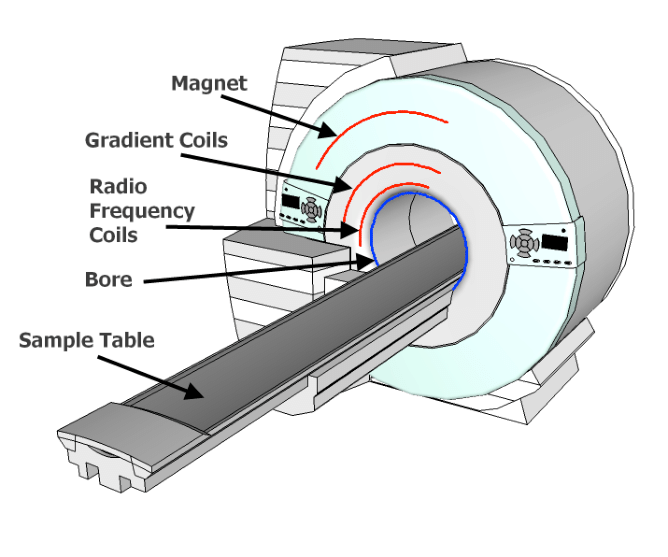
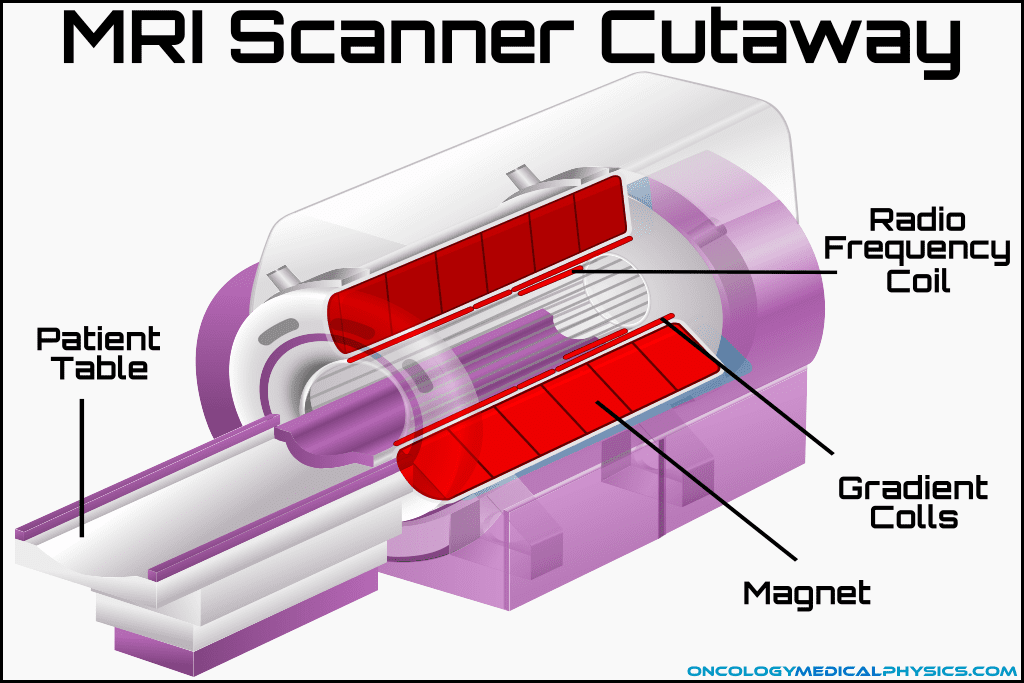
- Powerful Magnet for Proton Alignment: The MRI scanner contains a powerful magnet (ranging from 0.5 to 3 tesla (T) or higher) that generates a strong external
- magnetic field. This field aligns the nuclear spins of hydrogen atoms (protons) present in the body’s water molecules.
- Gradient Coils for Spatial Encoding: Gradient coils produce varying magnetic field strengths across different spatial dimensions. By applying gradients along the x, y, and z axes, the MRI scanner can localize signals from specific regions of the body, allowing for precise imaging.
- Radiofrequency (RF) Coils for Spin Flipping (Resonance): Transmit coils generate RF pulses that excite the protons in the body, while receive coils etect the resulting signals emitted by the excited protons during relaxation.
- Receiver and Computer for Image Reconstruction: The signals emitted by the aligned protons in response to the RF pulses are detected by receivers in the MRI scanner. These signals are then processed by a computer using fourier transformation, which reconstructs detailed images of the internal structures based on variations in signal intensity and timing.
Magnetic resonance imaging (MRI) is a medical imaging technique that uses a magnetic field and computer-generated radio waves to create detailed images of the organs and tissues in the body.
- MRI utilizes proton NMR to image the concentration of protons, making it ideal for imaging soft tissues like the brain and eyes. Tissues with high proton density appear brighter in the images, while those with low proton density, such as bone, appear dark.
Advantages of MRI
- Provides detailed images of soft tissues and organs, aiding in precise diagnosis.
- Does not use ionizing radiation like X-rays, reducing health risks and making it safer for frequent use.
- Provides excellent soft tissue contrast, allowing for better differentiation between healthy and diseased tissues.
- Diagnostic : Find unhealthy tissue in the body, Locate tumors, Bone damage, Assess condition of tissue,neurological disorders, joint injuries Surgery planning
- Research: Neuroscience, Cancer, Understand how the brain works doing tasks
Most MRI machines are large, tube-shaped magnets. When someone lie inside an MRI machine, the magnetic field inside works with radio waves and hydrogen atoms in your body to create cross-sectional images
Component and working of MRI
- Powerful Magnet(0.5-3 T) for Proton Alignment: This field aligns the nuclear spins of hydrogen atoms (protons) present in the body’s water molecules.
- Gradient Coils for Spatial Encoding: Gradient coils produce varying magnetic field strengths across different spatial dimensions → allowing for precise imaging of specific regions of the body
- Radiofrequency (RF) Coils for Spin Flipping (Resonance): Transmit coils generate RF pulses that excite the protons in the body, while receive coils detect the resulting signals emitted by the excited protons during relaxation.
- Receiver and Computer for Image Reconstruction: The signals emitted by the aligned protons in response to the RF pulses are detected by receivers in the MRI scanner. These signals are then processed by a computer for reconstruction of detailed images.



